
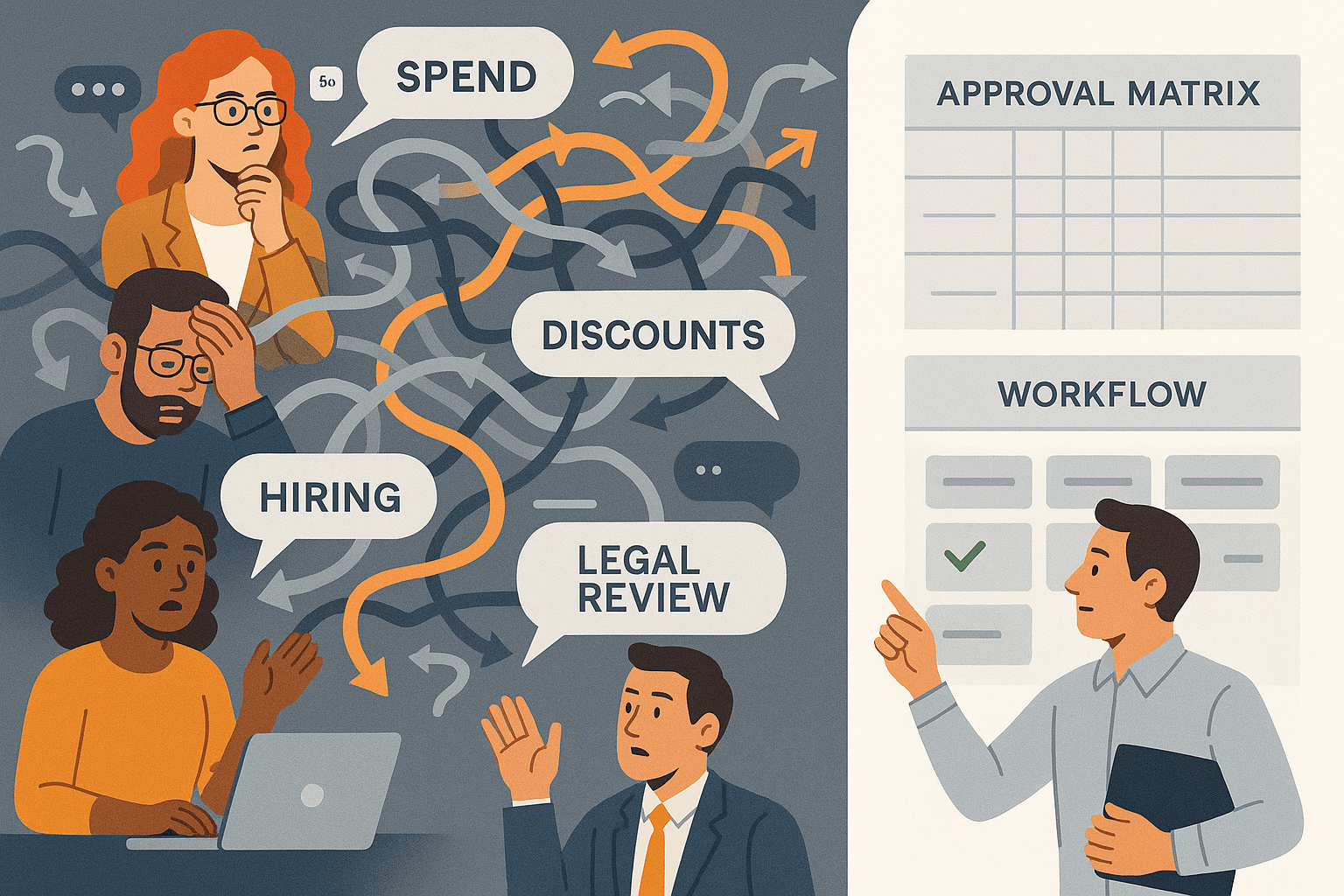
Most startup teams do not design approval systems. They inherit them.
At 8 people, approvals are basically memory. The founder knows every vendor, every candidate, every nonstandard contract, every customer discount, and every expense above a few hundred dollars. At 20 people, that memory starts leaking into Slack. Someone posts in #finance asking if a software purchase is okay. A sales rep DMs the VP to approve a one-off discount. A hiring manager asks the founder in a hallway if they can open a role. Legal redlines are approved because “we did this last time.” Procurement happens through forwarded emails and emoji reactions.
At 50 people, nobody says there is an approval system, but one exists anyway. It is just undocumented, inconsistent, person-dependent, and increasingly expensive.
That is the approval routing drift problem.
It shows up when authorization logic lives in chat, memory, and precedent instead of a shared operating model. It usually does not fail all at once. It fails quietly:
- Finance thinks anything over $5,000 needs CFO signoff, but engineering has been buying tools up to $12,000 with director approval.
- Recruiting thinks headcount is approved once the role is in the plan, but finance expects fresh signoff when compensation exceeds band.
- Sales believes discounts under 20% are manager-approved, while deal desk assumes 15% is the limit unless legal terms also change.
- Vendor renewals auto-renew because nobody knows who actually owns the decision.
- Exceptions become the norm because the shortest path is “ask in Slack and see who responds.”
This is not just annoying operational debt. It directly affects spend control, hiring speed, deal velocity, accountability, audit readiness, and managerial trust.
The painful part is that standard advice is often useless. Big-company approval frameworks are too heavy. “Move fast and trust people” stops working once money, compensation, legal exposure, and pricing complexity rise. Most startups get trapped between bureaucracy and chaos.
There is a better middle ground: a lightweight approval architecture that defines what needs approval, by whom, under what conditions, through which route, with what evidence, and inside what response time. Not enterprise workflow theater. Just enough structure so decisions are consistent, fast, and reviewable.
This article is a practical playbook for building that system.
A real failure scenario: when approvals drift faster than the org chart
Consider a startup at roughly 70 employees, Series B, growing fast. Revenue is ramping. Hiring is aggressive. Departments are buying tools independently. The founder still participates in many decisions, but no longer sees everything.
On paper, the company believes it has strong controls:
- Annual budget exists.
- Hiring plan exists.
- Standard discount guardrails exist.
- Finance reviews expenses monthly.
- Legal has a contract template.
In reality, the operating system is Slack.
Here is what happens over a six-week period.
Failure 1: procurement spend slips through inconsistent thresholds
Marketing needs a new enrichment tool. Total annual cost: $18,000. The senior manager asks in Slack whether they can proceed. Their VP says yes because a similar tool was approved last quarter. Procurement is not involved because “this is just software.” Security review is skipped because the vendor claims SOC 2 compliance on their website.
Two weeks later finance notices the contract while reviewing cards and asks why this was not routed for approval. Finance’s understanding is that anything above $10,000 annual contract value needs finance approval and security review if customer data is involved. Marketing says they got VP approval and had precedent.
Everyone is technically acting in good faith. The problem is that “approval” means different things to different functions.
Failure 2: hiring stalls because authorization logic is split across planning layers
A hiring manager moves quickly on a critical product role. The role was part of annual headcount planning, so recruiting opens the req. The candidate is strong but expensive. To close them, the team proposes compensation 15% above the original range and an accelerated start date that pulls salary expense into the current quarter.
Recruiting assumes this is within manager and VP scope because the role was approved. Finance disagrees: the headcount plan approved a role, not any compensation package. The founder gets pulled in late. Offer approval takes five extra days. The candidate accepts another offer.
Nobody intentionally blocked the hire. The issue is that “role approval,” “budget approval,” and “offer approval” were treated as one thing until they suddenly were not.
Failure 3: deal velocity slows because discounting and term exceptions are coupled informally
Sales has a large opportunity near quarter-end. The rep offers a 17% discount, custom billing terms, and a modified liability clause based on what they think was approved in a similar past deal. The regional manager approves the price in Slack. Legal sees the clause changes and escalates. Finance sees the billing terms and wants review because of cash-flow impact. The CRO thought only discounts above 20% needed escalation.
Three functions are now reviewing different slices of the same exception bundle with no unified routing logic. The customer waits. Procurement on the customer side gets nervous. The rep says internal approvals are slowing the deal. In truth, the company never defined the relationship between discount thresholds, nonstandard terms, and approval combinations.
Failure 4: renewal ownership disappears in the gaps
An infrastructure contract auto-renews at a 22% uplift because the original buyer left the company, finance only tracks invoices after receipt, and no one is clearly accountable for renewal review at that spend level.
The company had “approved” the original vendor. But it never defined whether renewals require fresh review based on price increase, usage change, security posture, or term length.
Failure 5: audit and trust problems emerge after the fact
At board prep, finance tries to explain software spend variance, compensation exceptions, and average discount trends. They cannot reconstruct a clean decision trail. There are screenshots, emojis, and disconnected threads, but no reliable record of who approved what and under which policy.
At this point, the problem is no longer operational inconvenience. It is governance ambiguity.
The pattern: approval routing drift is a systems problem, not a people problem
Founders often misdiagnose this problem as one of discipline.
They think:
- managers are bypassing process,
- finance is being difficult,
- sales wants too many exceptions,
- recruiters are moving without control,
- legal is slowing the business down.
Sometimes that is true. Usually it is not the root cause.
Approval routing drift happens because startups let authorization logic evolve through repeated exceptions without translating that logic into a system.
In the early phase, this is rational. Formal systems feel slow. People solve edge cases through conversation. Everyone is close enough to context that ambiguity is manageable.
Then four things change.
1. Volume increases faster than policy maturity
The number of decisions grows across spend, hiring, pricing, contracting, travel, reimbursements, security review, and compensation. Even if each category only adds a little complexity, the total routing burden compounds.
2. Decision rights spread across functions
A single action can now trigger multiple approval dimensions:
- a software purchase affects budget, security, legal, and data handling,
- an offer affects headcount, compensation philosophy, and quarter spend,
- a discount affects revenue quality, margin, and legal terms,
- a vendor renewal affects cost, owner accountability, and risk.
3. Precedent becomes policy by accident
People remember the last similar situation and act based on it. But they often remember only the visible outcome, not the conditions that justified it. “We did this before” becomes a routing rule with missing context.
4. Slack optimizes for speed, not state integrity
Slack is excellent for discussion. It is terrible as a source of truth for authorization logic.
Why?
- Threads fragment context.
- DMs hide decisions.
- Emoji reactions are ambiguous.
- Search does not create policy.
- There is no guaranteed linkage between request, approval criteria, approver, and final outcome.
- Informal approvals are hard to audit later.
The result is drift. Not because the team is irresponsible, but because the company is running a growing decision surface on a communication tool.
Why standard advice fails
Most advice on approvals comes in two bad forms.
Bad advice type 1: “Just centralize approvals”
This usually means routing more decisions to founders, finance, or a central operator.
That may reduce errors for a month. It also creates bottlenecks, strips manager accountability, and makes the business dependent on a few overloaded people.
In practice, centralization fails because:
- approval volume scales faster than executive attention,
- decisions get delayed during travel, fundraising, or quarter-end,
- context quality degrades when every issue escalates upward,
- teams stop learning how to make bounded decisions themselves.
You do not want a startup where every real decision requires a founder to bless it in Slack.
Bad advice type 2: “Implement an enterprise procurement / HR / CPQ workflow suite”
This goes to the opposite extreme. The company buys heavy software and attempts to force every request through a rigid process.
The issues:
- setup takes too long,
- policy assumptions do not match startup realities,
- users route around the system when it feels slower than chat,
- the tool solves one domain while approvals actually span multiple domains,
- operating overhead rises before the company has clean decision design.
A procurement tool does not solve offer approvals. An ATS does not solve compensation exceptions. A CPQ tool does not solve nonstandard legal terms by itself. A ticketing tool will not rescue a broken authority model.
Bad advice type 3: “Use budgets as the approval system”
This is one of the most common mistakes.
Founders assume that if a department has a budget, then spend inside that budget should be self-approving. Or if headcount is in plan, offers should move automatically. Or if sales has pricing guidelines, discounts can be judged ad hoc.
But budget is not routing logic.
Budget answers one question: did we broadly plan for this?
Approvals answer different questions:
- Is this specific transaction within delegated authority?
- Does it create risk outside budget magnitude?
- Does it involve exceptions to standard terms?
- Does it change future commitments?
- Does it require cross-functional review?
A budget can permit a category. It does not define who must approve a 24-month auto-renewing contract with customer data exposure and legal redlines.
Bad advice type 4: “Trust common sense”
Common sense decays with organizational distance. What feels obvious to a founder is not obvious to a new manager, a recruiter, or a regional sales leader. If important decisions rely on cultural osmosis, the company is already operating unsafely.
The better approach: build a lightweight approval architecture
The goal is not to create bureaucracy. The goal is to make high-frequency decisions:
- fast,
- consistent,
- delegated where possible,
- escalated only when necessary,
- visible enough to review later.
The way to do this is to treat approvals as a routing design problem.
That means defining five things clearly.
1. Approval classes
Group decisions into classes with distinct logic. At minimum, most startups need:
- Spend / procurement: software, agencies, contractors, equipment, travel exceptions, renewals
- Hiring: role creation, requisition opening, compensation exceptions, leveling changes, backfills, start-date changes
- Revenue / pricing: discounts, payment terms, nonstandard commercial terms, pilots, free usage, one-way commitments
- Legal / risk: contract redlines, indemnity, security reviews, privacy exposure, data processing exceptions
- Policy exceptions: anything outside standard thresholds or templates
Do not start by tool. Start by decision class.
2. Approval dimensions
Each class usually has multiple dimensions that can trigger review. Example for procurement:
- amount,
- contract term length,
- auto-renewal,
- budget status,
- vendor type,
- data sensitivity,
- legal changes,
- new vendor vs renewal,
- payment timing.
For hiring:
- planned vs unplanned headcount,
- compensation relative to band,
- level,
- employment type,
- geography,
- start-date timing,
- equity exception,
- backfill vs net new.
For deal approvals:
- discount percentage,
- ARR / ACV,
- payment terms,
- services inclusion,
- legal deviations,
- security commitments,
- termination rights,
- custom pricing structure.
The point is simple: stop pretending one threshold captures approval complexity.
3. Decision rights
For each class and threshold, assign:
- owner: who submits and owns completeness,
- approver: who has authority,
- reviewer: who provides required functional review but does not own final approval,
- escalation path: what happens when conditions exceed delegated authority,
- SLA: expected response time.
One subtle but important rule: separate “must be consulted” from “must approve.” Startups lose days because they mix review obligations with decision rights.
4. Routing logic
This is the actual engine. Example:
If software spend is under $5k annualized, within budget, no customer data, standard terms, then manager approval only.
If software spend is $5k–$20k, finance review required; if customer data involved, security review required; if legal terms changed, legal review required.
If above $20k or contract term exceeds 12 months, department VP plus finance approval required.
If above $50k or unbudgeted, CFO approval required.
That is routing logic. It is conditional, specific, and operational.
5. Evidence and record
Every approval needs a minimum package of information. Not long memos. Just enough to support the decision and make later review possible.
For example:
- business purpose,
- amount and term,
- budget source,
- alternatives considered,
- contract / order form,
- risk flags,
- requested exception,
- requester,
- final approver,
- date.
If you cannot reconstruct why a decision happened, you do not have an approval system. You have vibes.
How to map approval classes without overengineering
Most teams make one of two mistakes here: either they try to document every edge case before launching, or they write vague principles nobody can operate from.
Instead, map your approvals in three passes.
Pass 1: collect actual decisions from the last 90 days
Pull real examples from:
- vendor purchases,
- renewals,
- candidate offers,
- pricing exceptions,
- contract redlines,
- emergency spend,
- travel or reimbursement exceptions,
- contractor engagements.
For each example, note:
- what was being approved,
- who requested it,
- who approved it,
- where the decision happened,
- what created confusion,
- what delay occurred,
- whether there was a clear record.
This gives you the real approval surface, not the imaginary one.
Pass 2: cluster by decision similarity
Do not create a unique workflow for every department. Build around common patterns.
Examples:
- New vendor software with data exposure
- Vendor renewal with uplift >10%
- In-plan hire within band
- In-plan hire above band
- Out-of-plan role request
- Discount-only deal exception
- Discount + legal redline deal exception
- Payment term exception without discount change
You want maybe 15–25 meaningful approval scenarios, not 100.
Pass 3: define minimum viable thresholds
Thresholds should reflect actual decision risk, not false precision.
Good startup thresholds often include:
- dollar bands,
- percentage deviations,
- term length limits,
- standard vs nonstandard templates,
- planned vs unplanned status,
- data risk categories,
- contract value bands,
- timing impact on quarter or year.
Bad thresholds are those nobody can remember, or those requiring manual interpretation every time.
If your discount policy has seven ARR bands, six product carve-outs, region-specific clauses, and rep-specific overrides, your routing logic will collapse back into Slack.
A practical approval matrix founders can actually use
Below is a lightweight example. It is not universal, but it shows the level of clarity you need.
Procurement / spend
| Scenario | Required approval | Required review | SLA |
|---|---|---|---|
| <$5k annualized, budgeted, standard terms, no customer data | Manager | None | 1 business day |
| $5k–$20k or new vendor | Department head | Finance | 2 business days |
| Any customer data involved | Per spend tier above | Security | 2 business days |
| Nonstandard contract terms | Per spend tier above | Legal | 2 business days |
| >$20k annualized or term >12 months | VP + Finance | Security/Legal as applicable | 3 business days |
| >$50k or unbudgeted | CFO | Security/Legal/Procurement as applicable | 3 business days |
| Renewal with >10% uplift or scope change | Current owner + Finance | Security if data scope changed | 3 business days |
Hiring
| Scenario | Required approval | Required review | SLA |
|---|---|---|---|
| Backfill, in-plan, within approved band | Department VP | Recruiting + Finance check | 2 business days |
| New role in plan | Department VP | Finance | 2 business days |
| Out-of-plan role | Founder/CEO + Finance | Recruiting | 3 business days |
| Offer within band | Hiring manager chain per level | Recruiting | 1 business day |
| Offer above band up to 10% | VP + People lead | Finance | 2 business days |
| Offer above band >10% or leveling exception | CEO/founder + People + Finance | Recruiting | 2 business days |
| Geography / employment type exception | People lead | Finance + Legal if needed | 3 business days |
Revenue / pricing
| Scenario | Required approval | Required review | SLA |
|---|---|---|---|
| Discount within standard threshold, standard terms | Sales manager | None | Same day |
| Discount above standard threshold | RVP/CRO based on band | Finance if margin-sensitive | 1 business day |
| Payment terms exception | Sales approver per ACV + Finance | None | 1 business day |
| Any legal redlines | Pricing approver remains same | Legal | 2 business days |
| Discount + legal + billing exception combined | CRO or designated deal desk owner | Finance + Legal | 2 business days |
| One-way obligations, unusual SLAs, indemnity changes | Executive approver based on risk | Legal + Security if relevant | 2 business days |
Notice what makes this work:
- class-based logic,
- explicit thresholds,
- separate approval vs review,
- response times,
- combinations handled intentionally.
Where to codify the system: tools and tradeoffs
You do not need enterprise software first. But you do need somewhere authoritative.
Here are realistic options.
Option 1: Notion / Confluence + forms + Slack intake
Best for: 20–100 person startups
Setup:
- policy pages in Notion or Confluence,
- request forms in Google Forms, Typeform, Airtable, or native tool forms,
- Slack channel intake linked to form submission,
- approval log in Airtable or Google Sheet.
Pros:
- fast to launch,
- cheap,
- easy to update,
- good enough for many teams.
Cons:
- logic enforcement is weak,
- parallel reviews are manual,
- reporting can get messy,
- easy to fall back into ad hoc exceptions.
Typical cost:
- $0–$200/month incremental if you already use these tools.
Typical setup time:
- 1–2 weeks for a usable first version.
Option 2: Airtable / Monday / Asana / ClickUp workflow layer
Best for: startups needing light structure across multiple approval classes
Setup:
- structured request tables,
- status-driven workflows,
- conditional fields,
- automations for routing,
- dashboards for aging and bottlenecks.
Pros:
- more structured than docs,
- better audit trail,
- automations reduce manual chasing,
- can support multiple approval domains.
Cons:
- requires thoughtful design,
- can become a custom app you now own,
- permissions and complexity can sprawl.
Typical cost:
- roughly $50–$500/month depending on users and tooling.
Typical setup time:
- 2–4 weeks for something solid.
Option 3: Domain-specific tools with integrated approvals
Examples:
- procurement/spend: Zip, Ramp, Airbase, Brex, Coupa
- hiring: Greenhouse, Lever, Ashby plus compensation tools
- revenue/pricing: CPQ, deal desk workflows in Salesforce, HubSpot, or custom approval flows
- legal: Ironclad, Juro, DocuSign CLM
Pros:
- stronger controls within domain,
- better native data model,
- cleaner reporting,
- less manual work at scale.
Cons:
- each tool only solves part of the problem,
- cross-functional logic can still break,
- implementation overhead is real,
- expensive if adopted too early.
Typical cost:
- from a few hundred to several thousand dollars per month.
Typical setup time:
- 4–12+ weeks depending on system and admin resources.
The practical recommendation
For most startups under roughly 150 people, the best answer is:
- define the policy in a shared doc,
- use structured forms for intake,
- track requests in a simple workflow tool,
- push notifications into Slack,
- keep final records outside Slack.
Slack should be the notification layer, not the approval system.
That distinction matters.
Implementation details: how to build this without creating bureaucracy
Here is the rollout I would recommend founder-to-founder.
Step 1: assign a single owner for approval architecture
Not for every decision. For the system itself.
Usually this is:
- finance lead,
- chief of staff,
- biz ops,
- people ops leader for hiring-heavy organizations,
- or an operator working across functions.
If no one owns the design, drift returns immediately.
Step 2: define the “top 20” approval scenarios
Do not start from abstract policy. Start from the recurring decisions creating pain.
Good starter list:
- New software purchase
- Vendor renewal
- Contractor engagement
- Unbudgeted spend request
- Security/data vendor review
- Headcount opening
- Backfill opening
- Offer approval
- Compensation band exception
- Leveling exception
- Discount approval
- Payment terms exception
- Legal redline review
- MSA exception request
- Pilot / free usage approval
- Nonstandard SLA request
- Travel exception
- Reimbursement exception
- Emergency spend request
- Policy override request
Step 3: write routing rules in plain language first
Before building anything in software, express each scenario like this:
- what triggers the process,
- what information is required,
- who approves,
- who reviews,
- what causes escalation,
- what the SLA is,
- what counts as final approval.
If the rule cannot be understood in plain English, it will not survive implementation.
Step 4: establish minimum request quality
A huge source of delay is not approval itself. It is low-quality requests.
For each class, require a small number of fields.
Example: spend request
- Vendor name
- Business owner
- Annualized cost
- Contract term
- Budgeted or unbudgeted
- Department / budget line
- Purpose and expected outcome
- Data access type
- Contract attached
- Renewal or new purchase
- Requested go-live date
Example: offer approval
- Candidate name
- Role and level
- Hiring manager
- Planned or exception req
- Cash comp proposed
- Equity proposed
- Band midpoint / range
- Start date
- Location
- Justification for any exception
Example: deal exception request
- Account name
- ACV / ARR
- Standard price and proposed price
- Discount %
- Payment terms requested
- Legal terms changed
- Security commitments requested
- Requested close date
- Competitive context
- Reason standard terms fail
Good forms are one of the highest ROI improvements you can make.
Step 5: separate asynchronous review from decision meetings
Another startup anti-pattern: bringing every approval issue into standing meetings.
Instead:
- use forms for intake,
- route simple cases asynchronously,
- reserve meetings only for high-risk, high-value, or repeated edge cases.
This preserves speed.
A healthy system should let 70–90% of approvals resolve without meetings.
Step 6: define SLAs aggressively
Ambiguity around timing creates shadow systems. If the tool is slow, people route around it.
Reasonable startup SLAs:
- standard spend approvals: 1–2 business days,
- standard offer approvals: same day to 1 day,
- simple discount approvals: same day,
- legal reviews on standard redlines: 2 business days,
- emergency exceptions: same-day escalation path.
Then measure them. If legal or finance is the bottleneck, fix staffing, templates, or request quality. Do not let teams quietly move back to DMs.
Step 7: explicitly design exception handling
Exceptions are not a sign of failure. Undefined exceptions are.
For every class, decide:
- who can grant exceptions,
- what qualifies as urgent,
- whether exception approval is one-time or precedent-setting,
- how it is logged,
- whether policy should be updated after repeated exceptions.
This last point matters. If the same exception happens five times, it is no longer an exception. Your policy is outdated.
Step 8: review monthly for drift signals
You do not need a governance committee. You need a 30-minute monthly ops review.
Track:
- volume by approval class,
- median turnaround time,
- oldest pending requests,
- top escalation reasons,
- exception frequency,
- approvals happening outside system,
- repeat bottlenecks by function,
- threshold bands generating too much friction.
This is how you keep the system lightweight while improving it.
Workflow examples that actually work
Workflow 1: software procurement
- Requester submits form with vendor, cost, budget, data type, term, and contract.
- System classifies request:
- under threshold,
- new vendor,
- customer data involved,
- nonstandard terms present.
- Finance receives review if spend tier requires it.
- Security receives review if data exposure exists.
- Legal receives review if terms are nonstandard.
- Final approver gets routed only after mandatory reviews are complete.
- Decision is logged automatically.
- Renewal date is added to contract tracker with owner.
Why this works: reviewers comment on their dimension; one designated approver owns the final yes/no.
Workflow 2: offer approval
- Recruiter submits candidate package.
- System checks whether req is in plan.
- Compensation vs band triggers routing:
- within band: hiring chain only,
- above band: People + finance + exec if over threshold.
- Start-date impact on current quarter triggers finance check if needed.
- Final offer approval logged before candidate receives verbal close.
Why this works: role approval and offer approval are treated separately.
Workflow 3: sales exception bundle
- Rep submits one request covering discount, payment terms, legal changes, and requested close date.
- Logic routes:
- pricing approver based on discount band,
- finance review for billing/payment exception,
- legal review for redlines,
- security review if product/security commitments added.
- Deal desk owner or CRO acts as final decision-maker when multiple exception types are combined.
- Approval output is summarized in one record the rep can use internally and externally.
Why this works: all exception dimensions are handled in one bundle instead of separate Slack negotiations.
Cost and time analysis: what this actually saves
Founders often avoid building approval systems because they fear bureaucracy costs. Fair concern. But informal systems already cost real money.
Let’s do rough math for a 75-person startup.
Assume per month:
- 20 procurement requests,
- 12 offer approvals,
- 25 pricing/deal exceptions,
- 10 renewal or contract changes,
- 8 miscellaneous exceptions.
That is 75 approval events monthly.
If each event under an informal Slack system creates just:
- 20 minutes of chasing context,
- 15 minutes of duplicated review,
- 10 minutes of delay coordination,
- and 10% of cases trigger a serious delay or error,
you can easily burn 35–45 hours of operator, manager, finance, recruiting, legal, and sales time every month before counting business impact.
Now add actual downside:
- one lost candidate due to delayed offer,
- one quarter-end deal slowed by conflicting approval paths,
- one unnecessary auto-renew at inflated pricing,
- one unreviewed vendor introducing data risk,
- one board cycle wasted reconstructing decision history.
That cost dwarfs the effort of setting up a lightweight system.
Rough build cost for a lightweight system
If a finance or ops lead spends:
- 15–20 hours mapping current approvals,
- 10–15 hours aligning stakeholders,
- 10–20 hours building forms/workflows,
- 5–10 hours documenting policy and training,
then first implementation is often 40–65 hours total.
At startup labor rates, that is real but modest. And unlike bureaucracy theater, it pays back quickly in saved time and fewer high-cost mistakes.
Common traps when implementing approval logic
Trap 1: making thresholds too low
If too many decisions require VP or executive signoff, the queue collapses. Push authority downward wherever risk is bounded.
Trap 2: writing policy without enforcement points
A beautiful Notion page nobody uses is not a system. Tie policy to the intake path.
Trap 3: forgetting combined exceptions
Many failures happen when two acceptable exceptions become problematic together. Example: moderate discount plus custom payment terms plus legal givebacks. Combined logic matters.
Trap 4: treating renewals like originals
Renewals need their own routing rules. Owner confirmation, uplift thresholds, and scope changes should be explicit.
Trap 5: letting DMs remain valid
If private Slack messages can still count as official approval, your system will never stabilize. Allow Slack discussion, but final authorization must land in the record system.
Trap 6: no fallback for urgent cases
If the company has no emergency path, people will invent one. Define how urgent approvals work and how they are documented after the fact.
Trap 7: no postmortems on approval failures
When a candidate is lost, a vendor slips through, or a deal stalls, do not blame individuals first. Ask what routing ambiguity caused the failure.
What “good” looks like by stage
10–25 employees
- Simple written approval table
- Spend, hiring, and discount thresholds documented
- One shared place for final approvals
- Founder still involved, but logic visible
25–75 employees
- Structured forms for major approval classes
- Basic workflow tracking outside Slack
- Clear approval vs review distinction
- Renewal ownership and exception handling defined
75–150 employees
- Cross-functional routing logic with automations
- SLA reporting
- Monthly drift review
- Domain tools integrated where pain is highest
150+ employees
- More domain-specific systems justified
- Tighter audit and delegation controls
- More formal policy governance
- Stronger integration across finance, HR, legal, and CRM systems
The key is stage-appropriate control. Not premature enterprise process, and not founder-memory cosplay.
The takeaways
Approval routing drift is what happens when startup decision authority grows faster than the system used to express it.
If authorization logic lives in Slack, your company will eventually pay for it through:
- uncontrolled or inconsistent spend,
- delayed offers,
- messy compensation exceptions,
- slower deals,
- discount inconsistency,
- renewal waste,
- weak auditability,
- and declining trust between teams.
The fix is not heavy bureaucracy. It is a lightweight approval architecture built around:
- clear approval classes,
- explicit thresholds and dimensions,
- defined decision rights,
- codified routing logic,
- minimum evidence requirements,
- final records outside chat,
- regular review for drift.
If you are a founder or operator, start small:
- map the last 90 days of messy approvals,
- identify the top recurring approval scenarios,
- define routing rules in plain English,
- build structured intake,
- make Slack a notification layer only,
- track turnaround times and exceptions monthly.
The standard startup instinct is to postpone this until later. Usually later arrives right after a blown hire, a delayed enterprise deal, or a spend surprise nobody can explain.
Do not wait for the pain to make the system obvious.
A good approval system should feel almost boring. Requests go in. The right people review what they need to review. Decisions happen quickly. Records exist. Exceptions are visible. Managers know their authority. Finance trusts the controls. Sales knows how to get to yes. Recruiting can close candidates without drama.
That is not bureaucracy.
That is operational competence.