
Most startup hiring problems get mislabeled as talent problems.
Founders say things like:
- “The market is terrible.”
- “Strong candidates are impossible to close.”
- “Recruiters don’t understand early-stage hiring.”
- “We need more top-of-funnel.”
- “We just haven’t found the right person yet.”
Sometimes that’s true. Often it isn’t.
A lot of early-stage companies are losing candidates, slowing decisions, and making low-confidence hires long before recruiting itself becomes the bottleneck. The real problem sits underneath the process: broken hiring operations.
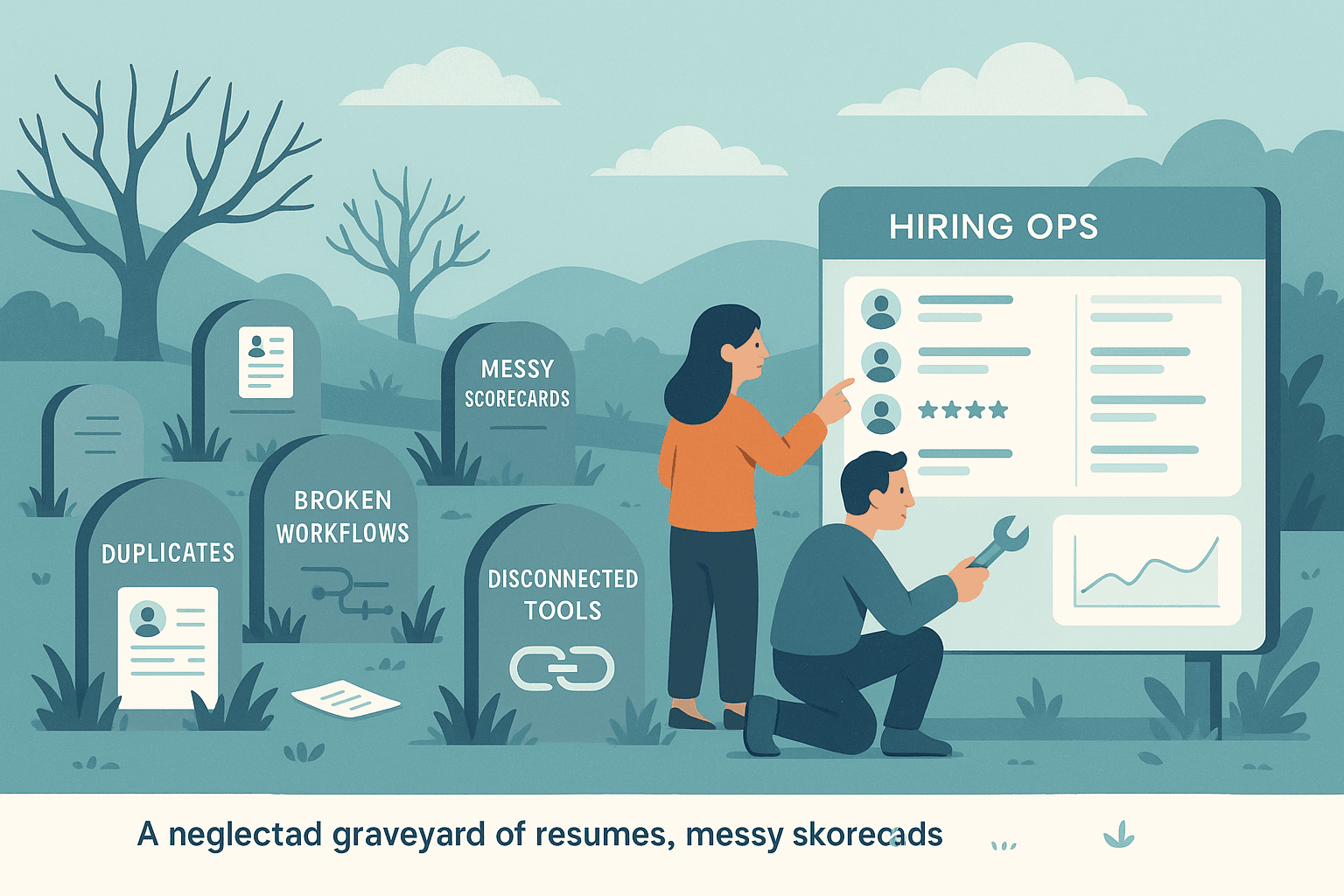
This is the ATS Graveyard problem.
It happens when a startup technically has a hiring stack, an ATS, calendar links, interview docs, maybe a sourcing tool, maybe a recruiter, but the actual system is full of invisible operational failures:
- scorecards that are vague, inconsistent, or ignored
- interviewer notes trapped in Slack, email, and private docs
- duplicate candidate records across ATS, LinkedIn, email, and agency submissions
- founder-only approval loops that delay every decision
- no clean handoff between sourcing, scheduling, interviewing, and final decision-making
- “gut feel” replacing evidence because the data is unusable
The result is predictable: candidate drop-off, slow closes, poor calibration, bad hires, and a dangerous illusion that the company is being rigorous because it bought software.
Buying an ATS does not create a hiring system. It just gives you a database where broken decisions can accumulate at scale.
This article is a tactical playbook for fixing that.
I’ll walk through:
- a real failure scenario that looks normal inside many startups
- the operating pattern underneath it
- why standard hiring advice fails early-stage teams
- a better lightweight hiring ops architecture
- implementation details for role intake, interview evidence, tooling rules, and decision workflows
- practical cost/time tradeoffs and tool comparisons
If you’re a founder, head of talent, chief of staff, or hiring manager trying to build a sane hiring machine before it collapses under growth, this is the work.
A real failure scenario: the company thinks it has a recruiting problem
Let’s say a startup has grown from 12 people to 35. Revenue is moving. Product usage is up. They need to hire:
- 2 account executives
- 1 senior product designer
- 3 engineers
- 1 head of customer success
They decide it’s time to “get serious” about recruiting.
So they buy an ATS. They connect a careers page. They assign one founder as final approver on all hires. A few interview templates get copied from Google. People start sending candidates around.
From the outside, this looks like progress.
Inside the system, here’s what actually happens.
Week 1: role definition is fuzzy from day one
The engineering manager says they need a “senior full-stack engineer.” The founder says they want someone “scrappy and startup-native.” Another interviewer says they should “raise the bar” and hire someone more staff-level.
No one writes a crisp intake doc.
There is no agreement on:
- what problems this hire owns in the first 6–12 months
- whether the role is senior IC, tech lead, or future manager
- which skills are must-have versus nice-to-have
- what compensation band is actually approved
- who makes the final decision if tradeoffs appear
The recruiter, or founder, if there is no recruiter, starts sourcing anyway.
This is the first graveyard marker: you started pipeline generation before creating a decision frame.
Week 2: candidate records begin fragmenting
A founder meets a candidate through an investor intro. An engineer refers another candidate through email. A recruiter sources five profiles on LinkedIn. One agency submits two more. Someone uploads one profile manually into the ATS. Another person forgets.
Now the same candidate may exist in:
- the ATS
- a founder inbox
- a recruiter’s sourcing spreadsheet
- Slack DMs
- LinkedIn messages
- a shared folder of resumes
No one is confident about source-of-truth ownership.
This creates:
- duplicate outreach
- embarrassing candidate experience
- broken source attribution
- missed follow-up
- confusion over who “owns” the relationship
Second graveyard marker: the ATS is not the operating system; it’s just one of several disconnected memory stores.
Week 3: interviews happen, evidence does not
The company runs interviews. Notes come in late or not at all.
One interviewer writes: “good energy, sharp.” Another writes three paragraphs on technical depth. Another leaves only a numerical score. A founder DMs the hiring manager: “I liked her. Not sure she’s enough of a killer though.”
There is no shared evidence model.
Nobody knows:
- what each interviewer was supposed to evaluate
- whether overlap exists between interviews
- whether a “yes” is based on evidence or confidence theater
- whether concerns are skill gaps, style preferences, or plain bias
By debrief time, the team argues from memory.
Third graveyard marker: interviews produced impressions, not decision-grade evidence.
Week 4: founder approval becomes a bottleneck masquerading as quality control
The team likes a candidate and wants to move to offer.
But only one founder can approve every hire.
That founder is fundraising, selling, managing product, and traveling. The debrief slips four days. The candidate gets another offer. The startup rushes comp approval. Finance was never aligned on the top end of the range. More delay.
The candidate signs elsewhere.
The postmortem says: “We lost them on compensation.”
Maybe. But really they lost them through decision latency.
Fourth graveyard marker: authority is centralized while execution is decentralized.
Week 5: the team overcorrects and makes a bad hire
After losing multiple candidates, the team gets spooked. They decide they need to move faster. A candidate with decent credentials and strong communication gets through.
Because prior interview notes were weak and calibration is poor, concerns about problem-solving depth never surface clearly. The founder likes them. The team wants to avoid another miss. They hire.
Three months later:
- ramp is weak
- manager confidence is low
- the role needs re-scoping
- half the team says they “had concerns”
- none of those concerns were documented in a decision-useful way
This is the worst version of the ATS Graveyard problem: you are both slow and low-signal.
That’s brutal, because startups can usually survive slow hiring or imperfect hiring for a while. Slow and wrong is where teams break.
The pattern: startups confuse recruiting activity with hiring system quality
The common pattern underneath these failures is simple:
The company adds hiring tools before defining hiring operations.
It’s the same mistake startups make in sales ops and customer success ops:
- they buy software before defining stage exits
- they create fields without governance
- they add process without ownership
- they collect data that doesn’t support decisions
Hiring is especially vulnerable because everyone thinks they know how to interview.
They don’t.
Or more precisely: they know how to have conversations with candidates, but not how to convert those conversations into a repeatable operating system that helps the company make better decisions over time.
The ATS Graveyard usually appears through five hidden failures.
1. Role ambiguity upstream
Most broken hiring outcomes begin before a candidate ever enters pipeline.
If the company can’t answer:
- why this role exists now
- what success looks like in 90/180/365 days
- what tradeoffs it will accept
- what level and scope are actually intended
then every downstream step becomes interpretive theater.
2. Evidence-free interviewing
Startups often run “structured enough” interviews that feel rigorous but are not.
Common symptoms:
- every interviewer asks broad, overlapping questions
- scorecards are generic and subjective
- no interviewer has a single accountable dimension
- “culture fit” becomes a bucket for unmanaged preference
- debriefs are verbal and recency-biased
3. Workflow fragmentation
Most early-stage stacks have three to seven tools involved in hiring, but no explicit handoffs between them.
Typical fragmentation points:
- sourcing tool → ATS
- ATS → scheduling
- scheduling → interview prep
- interview notes → decision record
- final decision → comp approval → offer creation
A candidate doesn’t disappear because one tool is bad. They disappear because the system has undefined transitions.
4. Centralized approval with no service-level expectations
Founders often keep final hiring authority too long. Sometimes that’s rational. But if you centralize authority without setting:
- clear approval criteria
- delegated thresholds
- response-time expectations
- fallback approvers
you create hidden queues that kill momentum.
5. No hiring ops owner
This is the killer.
In many startups, hiring ops is “owned” by everyone and therefore by no one.
Recruiters assume hiring managers own interview quality. Hiring managers assume recruiters own process. Founders assume the ATS will enforce discipline. The ATS assumes you know what you’re doing.
No one owns the system.
Why standard advice fails for early-stage startups
A lot of hiring advice is directionally correct and operationally useless.
You’ll hear:
- “Use structured interviews.”
- “Define scorecards.”
- “Move fast.”
- “Create a great candidate experience.”
- “Train interviewers.”
- “Use data.”
Fine. None of that tells a 25-person startup what to actually implement next Monday.
The problem is that standard advice usually assumes one of two realities:
- a mature company with a real recruiting function, hiring enablement, and process support
- a tiny startup still hiring through founder networks and pure improvisation
Most early-stage startups are in the uncomfortable middle.
They have enough hiring volume that improvisation fails, but not enough infrastructure to support big-company process.
So they do the worst possible thing: they import enterprise-looking artifacts without enterprise-level discipline.
That leads to fake process:
- scorecards no one reads
- interview panels with no calibration
- ATS stages that don’t map to decisions
- approval chains that exist only in Slack
- “culture” interviews that duplicate founder intuition
Why “just use a structured interview” fails
Because structure is not the same as useful evidence.
If you ask every candidate the same five broad questions but don’t define:
- what good looks like
- what weak looks like
- what counts as evidence
- how that evidence maps to the role’s real requirements
then you’ve simply standardized noise.
Why “move faster” fails
Because speed without stage discipline creates thrash.
You don’t need faster interviews if your real delay is:
- waiting three days for feedback
- waiting a week for founder approval
- restarting the process after realizing role scope is wrong
- discovering compensation misalignment at offer stage
What startups need is not generic speed. They need low-latency decision architecture.
Why “hire a recruiter” fails
A recruiter can improve sourcing and coordination. They cannot single-handedly repair:
- broken role design
- vague hiring manager requirements
- interviewer inconsistency
- founder indecision
- non-existent approval rules
A good recruiter inside a bad hiring operating system becomes a very expensive air traffic controller for a broken airport.
Why enterprise ATS implementations fail in startups
Because the company doesn’t need complexity; it needs enforcement at a few critical points.
If you’re under ~100 people and hiring under ~5–10 roles at a time, your system should be lightweight, opinionated, and difficult to misuse.
Not comprehensive. Not customizable in twenty ways. Not “robust.”
The goal is simple: make it hard to lose candidates and hard to make fuzzy decisions.
The better approach: a lightweight hiring ops architecture
Here’s the model I recommend for early-stage startups.
Think of hiring ops as four connected layers:
- Role intake: why the role exists and what success means
- Pipeline control: where candidate state lives and who owns transitions
- Interview evidence: what each conversation is supposed to produce
- Decision governance: how yes/no/offer decisions get made fast
That’s it.
You do not need a complicated talent architecture. You need minimum viable control points.
The core principle
For every open role, the system should answer five questions instantly:
- What are we hiring for, really?
- Where is each candidate, exactly?
- What evidence do we have so far?
- What decision is waiting, and on whom?
- What would cause us to stop, advance, or close now?
If your current stack can’t answer those five questions cleanly, your hiring process is operating on hope.
Layer 1: Role intake system
Most startups treat role kickoff as a meeting. That’s a mistake.
It should be a short written operating artifact.
The role intake doc
Before a role opens, require a one-page intake document with these fields:
1. Business reason for hire
- Why now?
- What business goal, bottleneck, or risk does this role address?
- What happens if we do not hire in the next 90 days?
This prevents “nice-to-have” roles from entering the system as urgent headcount.
2. Outcomes, not just requirements
Define expected outcomes for:
- first 30 days
- first 90 days
- first 180 days
- first 12 months
Example for a founding AE:
- 30 days: understand ICP, pitch, CRM hygiene, and call process
- 90 days: independently run full-cycle pipeline and close first deals
- 180 days: hit steady-state quota attainment with acceptable sales hygiene
- 12 months: contribute process feedback and mentor new reps
This is better than a list of traits like “scrappy,” “hungry,” and “great communicator.”
3. Must-have vs nice-to-have
Split requirements into three buckets:
- non-negotiables
- strong preferences
- explicit tradeoffs we will accept
Example:
- non-negotiable: has shipped production backend systems at meaningful scale
- preference: has startup experience under 100 employees
- acceptable tradeoff: strong technical depth without prior domain expertise
This reduces interview-stage drift.
4. Level and scope definition
Clarify whether the role is:
- senior IC
- lead IC
- player-coach
- future manager
- immediate manager
Many startup mis-hires are level mismatches disguised as candidate weakness.
5. Compensation and approval guardrails
Document:
- target cash range
- top-of-band exception rules
- equity guardrails
- approvers required for standard vs exceptional offers
If this is unresolved at intake, it will blow up at close.
6. Interview plan
Assign each interview to one dimension only.
For example, for a product designer:
- recruiter/founder screen: motivation, logistics, compensation alignment
- hiring manager interview: role fit, scope, collaboration, seniority calibration
- portfolio review: craft, decision-making, user understanding
- cross-functional interview: communication with PM/engineering
- work simulation: problem framing and execution quality
- founder close: company pitch and unresolved strategic concerns
No interview should exist without a distinct evaluation goal.
Who owns role intake?
At early stage:
- hiring manager drafts it
- founder or talent lead approves it
- finance signs off on comp band
This should take 30–45 minutes to produce and 15 minutes to review. Not a week.
Time/cost impact
- Setup cost: 1–2 hours per role
- Time saved later: easily 5–15 hours of interview confusion, rework, and approval delay
- Value: much higher confidence that you are interviewing for the same role across the team
This is one of the highest-ROI hiring ops interventions you can make.
Layer 2: Pipeline control and candidate state rules
Your ATS should function as the official candidate ledger.
Not because ATS products are perfect. They aren’t. But because without a designated source of truth, candidate state fragments instantly.
Non-negotiable pipeline rules
Rule 1: Every candidate enters the ATS before first interview
Not “eventually.” Before first interview.
That includes:
- founder referrals
- investor intros
- agency candidates
- inbound applicants
- sourced candidates
- boomerang candidates
If someone wants an exception because “this one is special,” that’s exactly why the rule exists.
Rule 2: One candidate, one record
Create deduplication rules and ownership logic:
- primary email is default unique identifier
- secondary matching: LinkedIn URL + phone + full name
- if duplicate exists, merge rather than recreate
- preserve source history in notes or custom fields
Without this, your source attribution and communication history become fiction.
Rule 3: Every stage requires an owner and exit condition
Example stages:
- New / To review
- Recruiter screen
- Hiring manager screen
- Interview loop
- Debrief pending
- Offer approval
- Offer out
- Closed won/lost/on hold
For each stage define:
- owner
- required artifact
- SLA
- next action if blocked
Example:
Debrief pending
- owner: hiring manager
- required artifact: all scorecards submitted, debrief scheduled
- SLA: within 24 hours of final interview
- blocked action: escalate to founder/talent lead if scorecards missing after 24 hours
Now the ATS is supporting workflow, not just storing names.
Rule 4: No Slack-only feedback
Slack can be used for coordination, not decision evidence.
If someone says “strong yes” or raises a concern in Slack, that opinion must be transferred into the ATS or interview record.
Otherwise your debrief is being run off disappearing side-channel data.
Rule 5: Candidate status changes must be visible
Use tags or fields for:
- compensation constraints
- competing offer present
- internal referral
- founder priority
- agency fee attached
- visa requirement
- fast-track candidate
This helps the team understand urgency without rewriting context every time.
Lightweight workflow example
A sourced engineer enters the ATS.
- Recruiter screen completed; compensation, location, and interest captured.
- Candidate advances to hiring manager screen only if non-negotiables are met.
- Hiring manager enters structured recommendation within same day.
- Coordinator or recruiter schedules loop; interviewers receive specific briefs.
- Scorecards due within 12 hours of each interview.
- Debrief auto-triggered only when all required scorecards exist.
- If “yes,” offer approval packet already includes comp range and exception status.
This is not complicated. It’s just explicit.
Cost/time impact
- ATS configuration: 3–6 hours initial setup
- Weekly maintenance: 30–60 minutes
- Savings: fewer missed candidates, less manual chasing, cleaner conversion metrics
Layer 3: The interview evidence model
This is where most startups fail hardest.
You do not need more interviews. You need better evidence per interview.
The principle
Each interview should answer one specific question about the candidate.
Not five. Not “overall vibes.” One question, maybe two.
Examples:
- Can this engineer independently debug and design systems at our current complexity?
- Can this AE run discovery with enough rigor to sell consultatively?
- Can this product manager make clear priority tradeoffs under ambiguity?
The evidence model
For each interview, require the following fields:
- Competency assessed
- Question set or exercise used
- Evidence observed
- Concerns / risks
- Confidence level
- Recommendation: advance / hold / no / strong yes
The key is separating evidence from conclusion.
Bad note:
Smart, thoughtful, maybe not enough urgency.
Better note:
In portfolio review, candidate clearly articulated tradeoffs, metrics, and user constraints across two shipped projects. When asked how they handled engineering pushback, examples stayed high-level and lacked direct conflict ownership. Risk: may be stronger in craft than cross-functional execution under pressure.
Now a debrief can use it.
Scorecard design: fewer dimensions, better definitions
A common mistake is having 12 scoring dimensions. Don’t.
Use 4–6 role-relevant competencies maximum.
Example for an early-stage PM:
- product judgment
- execution / operating rigor
- communication and stakeholder management
- customer reasoning
- ownership in ambiguity
For each competency define:
- what strong evidence looks like
- what acceptable evidence looks like
- what weak evidence looks like
This is interviewer calibration in miniature.
Ban undefined “culture fit”
If you care about values, translate them into observable behavior.
Don’t ask whether someone is a “fit.” Ask things like:
- How do they handle direct feedback?
- Do they create clarity in ambiguous environments?
- Can they operate with low ego and high accountability?
- How do they make decisions when data is incomplete?
Culture fit is usually where bias hides when evidence is weak.
Debrief structure
Run debriefs in this order:
- Hiring manager restates role and must-haves
- Each interviewer shares evidence, not verdict first
- Concerns are classified: fatal / mitigable / preference
- Team identifies missing evidence, if any
- Decision owner makes call
Do not start with “thumbs up/down.”
Starting with verdicts anchors the room too early, especially when a founder is present.
Interview evidence example
For a customer success leader candidate:
Competency: renewal leadership and account risk management
Evidence: candidate described building QBR motion and segmentation for 80-account portfolio; gave clear examples of churn-risk triggers and cross-functional escalation paths; quantified retention impact.
Concern: team management examples were solid, but implementation detail on tooling/reporting stack was thin.
Confidence: medium-high
Recommendation: advance; probe operating systems depth in next round.
That’s enough to be useful.
Time/cost impact
- Initial scorecard creation per role family: 2–4 hours
- Interviewer completion time per scorecard: 5–10 minutes if designed well
- Savings: much better debrief quality, fewer unnecessary extra interviews, lower false-positive rate
Layer 4: Decision governance and approvals
This is where startups lose closes.
The goal is to keep quality high without routing every decision through one overloaded founder brain.
Use a decision matrix
Define in advance who can approve what.
Example:
| Decision | Standard owner | Secondary approver | Founder needed? |
|---|---|---|---|
| Open role | Hiring manager | Founder / exec | Yes |
| Advance after screen | Recruiter + hiring manager | None | No |
| Final interview invite | Hiring manager | Talent lead | No |
| Standard offer in band | Hiring manager + finance/talent | Functional exec | No |
| Above-band comp exception | Hiring manager | Founder + finance | Yes |
| Executive hire | Functional exec | Founder | Yes |
This immediately reduces bottlenecks.
Set SLAs for approvals
Not suggestions. Real expectations.
For example:
- interview feedback due in 12 hours
- debrief scheduled in 24 hours
- offer approval decision in 24 hours
- candidate update after final round in 24 hours
If someone cannot meet the SLA, assign a backup owner.
Separate quality control from ceremonial approval
A lot of founder approvals are not adding signal. They are just ceremonial checkpoints.
Ask honestly:
- Is the founder evaluating unique evidence unavailable elsewhere?
- Or are they re-running the process because they don’t trust the team?
If it’s the second, the real fix is not more founder involvement. It’s better role intake, evidence quality, and hiring manager calibration.
Offer packet template
Before final approval, every offer should have a one-page packet:
- role and level
- compensation band and proposed offer
- exception status if any
- interview summary by competency
- key risks and mitigation plan
- close strategy: candidate motivations, competing processes, likely blockers
This turns offer approval into a fast decision instead of a scavenger hunt.
Time/cost impact
- Decision matrix setup: 1 hour
- Offer packet prep: 10–15 minutes per finalist
- Savings: days shaved from close cycle, lower candidate drop-off at final stage
Tool comparisons: what matters and what doesn’t
Founders often over-focus on which ATS to buy. The bigger issue is whether the tool supports your operating rules.
ATS: Greenhouse vs Lever vs Ashby vs “we use Notion + spreadsheets”
Greenhouse
Best for:
- companies wanting mature interview kit structure
- stronger process enforcement
- larger future scale
Tradeoffs:
- can feel heavy for very small teams
- setup/admin overhead is real
- better if someone actually owns hiring ops
Lever
Best for:
- recruiting-centric workflows
- teams that care about CRM-style candidate relationship management
- blended inbound/outbound motion
Tradeoffs:
- can still become messy if stage definitions are weak
- less important than your operating discipline
Ashby
Best for:
- startups that want flexibility plus strong analytics
- modern workflows and cleaner reporting
- lean talent teams with some ops maturity
Tradeoffs:
- flexibility can become chaos without standards
- still requires clear process design
Notion + spreadsheets + calendar links
Best for:
- very early teams hiring a handful of people through warm networks
- temporary stopgap before real volume begins
Tradeoffs:
- terrible deduplication
- weak audit trail
- poor scheduling coordination
- impossible to maintain clean evidence and conversion visibility at scale
My blunt view:
- under ~10 hires total, duct tape can be fine
- once multiple interviewers, multiple roles, and multiple candidate sources exist, get a real ATS
- but only after you define role intake, stage exits, scorecards, and approvals
Scheduling: GoodTime, Prelude, Calendly, recruiter-managed
For early-stage teams, scheduling doesn’t need to be fancy unless volume is high.
Calendly / manual scheduling
Best for:
- low volume
- straightforward screens
Tradeoffs:
- breaks down fast for panel coordination
- no enforcement of interviewer load balancing
GoodTime / Prelude / scheduling automation tools
Best for:
- multiple concurrent interview loops
- limited recruiter bandwidth
- reducing coordination lag
Tradeoffs:
- can automate chaos if interview plans are poorly defined
- worth it only once scheduling overhead becomes a real constraint
Interview notes and evidence storage
Best practice is simple:
- store official feedback in the ATS
- allow prep docs externally if needed
- never let official decision evidence live only in Google Docs or Slack
Sourcing tools
LinkedIn Recruiter, Gem, SeekOut, agency channels, all fine.
The key operational rule is not which sourcing tool you use. It’s whether every sourced candidate enters the same pipeline ledger with consistent ownership and source attribution.
A practical workflow example for a 30-person startup
Let’s make this concrete.
Assume the company is hiring:
- 1 senior backend engineer
- 1 AE
- 1 product designer
They have:
- one founder involved in final calibration
- one part-time recruiter or talent lead
- hiring managers in engineering, sales, and product
- an ATS and basic scheduling software
Weekly hiring ops workflow
Monday: role review
15-minute check on every open role:
- intake doc still accurate?
- pipeline count by stage
- blockers
- SLAs missed last week
- close-risk candidates
Daily: pipeline hygiene
Talent lead checks:
- duplicates n- stale candidates with no next step
- missing scorecards
- candidates in stage longer than SLA
Before each interview loop
Every interviewer gets:
- role intake summary
- exact competency they own
- question set or exercise brief
- definition of strong/acceptable/weak evidence
- note deadline
After each interview
Interviewer submits scorecard within 12 hours.
If not, automated reminder at 6 hours, escalation at 24 hours.
Debrief
Only scheduled when all scorecards are in.
Hiring manager leads evidence review. Talent lead watches for drift, duplicate concerns, and unsupported claims.
Offer decision
Offer packet built same day if candidate is a yes.
Founder joins only if:
- candidate is exec-level
- compensation exception is required
- unresolved strategic concern exists
Result
This workflow is lightweight enough for a small team but rigid enough to prevent most graveyard failures.
Cost and time analysis: what founders usually underestimate
Let’s compare the cost of doing this well versus badly.
Lightweight hiring ops setup cost
For a startup implementing this from scratch:
- role intake templates: 3–4 hours
- scorecard templates for 3 role families: 6–10 hours
- ATS stage cleanup and dedupe rules: 4–6 hours
- decision matrix and offer packet template: 2 hours
- interviewer training session: 60–90 minutes
Total initial setup: roughly 16–24 hours of focused work.
That sounds annoying. It is. Do it anyway.
Ongoing weekly cost
- pipeline review: 30–60 minutes
- hygiene checks: 30 minutes
- debrief discipline / reminders: 30–60 minutes
- interviewer calibration as needed: 30 minutes
Call it 2–3 hours per week of hiring ops attention.
Cost of not doing it
Now compare to one failed or delayed hire.
Lost candidate at final stage
Cost includes:
- 10–30 hours of team interview time
- 2–6 weeks of renewed pipeline generation
- delayed output in a business-critical function
- recruiter or founder rework
- opportunity cost from slowed product/sales execution
Mis-hire
Cost includes:
- salary + equity burn during failed ramp
- manager time
- onboarding time
- team disruption
- replacement search cost
- possible customer or execution damage
For a $150k–$250k fully loaded hire, a mis-hire can easily become a mid-five-figure to low-six-figure mistake, before counting strategic drag.
The hiring ops setup is cheap by comparison.
Implementation plan: fix the ATS Graveyard in 30 days
If your system is already messy, don’t try to redesign everything at once.
Use this 30-day sequence.
Week 1: stop candidate loss
Focus:
- define ATS as source of truth
- create duplicate-handling rule
- require all active candidates to exist in ATS
- clean stages to a simple set with owners and exit criteria
- flag all stale candidates
Success metric:
- 100% of active candidates tracked in one place
- zero candidate interviews happening outside official system
Week 2: fix role clarity
Focus:
- create role intake template
- require for all new openings
- rewrite current open roles with must-have/nice-to-have/tradeoff sections
- align compensation bands and approvers
Success metric:
- every open role has documented outcomes, level, interview plan, and comp guardrails
Week 3: fix interview evidence
Focus:
- reduce scorecards to 4–6 competencies
- assign one competency owner per interview
- define evidence expectations
- ban Slack-only feedback for official decisions
- enforce feedback SLAs
Success metric:
- 90%+ scorecard completion within SLA
- debriefs reference documented evidence, not recollection alone
Week 4: fix decision latency
Focus:
- create decision matrix
- define founder involvement rules
- implement offer packet template
- track approval turnaround time
Success metric:
- final-round-to-offer decision time under 48 hours for standard cases
If you only do these four things, your hiring system will improve materially.
Common failure modes even after cleanup
A few warnings.
Failure mode 1: overengineering
Teams swing from chaos to bureaucracy.
If your process adds too many interviews, too many scorecard fields, or too many approval steps, people will route around it.
Keep it minimal.
Failure mode 2: hiring managers ignore the system
This is common when the process feels like recruiter paperwork.
Fix by making the artifacts decision-useful.
If the intake doc helps close ambiguity and the scorecards help debrief faster, adoption rises.
Failure mode 3: founders still override everything informally
If founders are changing decisions through side conversations, your process is decorative.
Make overrides explicit and documented. Otherwise the team learns that evidence doesn’t matter.
Failure mode 4: tool switching instead of process fixing
A new ATS won’t save a bad operating model.
Switch tools only if your current one truly cannot support your required workflow, not because discipline is uncomfortable.
Takeaways
The ATS Graveyard problem is not really about software.
It’s what happens when a startup reaches enough hiring complexity to need systems, but still operates as if hiring is a series of informal conversations.
The hidden failures are operational:
- unclear roles
- fragmented candidate data
- unstructured interview evidence
- bottlenecked approvals
- no owner for system quality
The fix is not enterprise process for its own sake.
It’s a lightweight hiring ops architecture that makes four things reliable:
- role definition
- candidate state control
- interview evidence quality
- decision speed
If you implement only a few rules, make them these:
- no role opens without a written intake doc
- no candidate interviews outside the ATS
- no interview without a defined competency and scorecard
- no debrief without all required evidence submitted
- no founder bottleneck for standard in-band offers
That alone will prevent a lot of candidate loss, false-confidence decisions, and avoidable chaos.
Founders usually assume recruiting starts when outreach begins.
It doesn’t.
Recruiting starts when your company can reliably define a role, track a candidate, evaluate evidence, and make a timely decision.
If you haven’t built that yet, your ATS isn’t a hiring engine.
It’s a graveyard with better UI.