
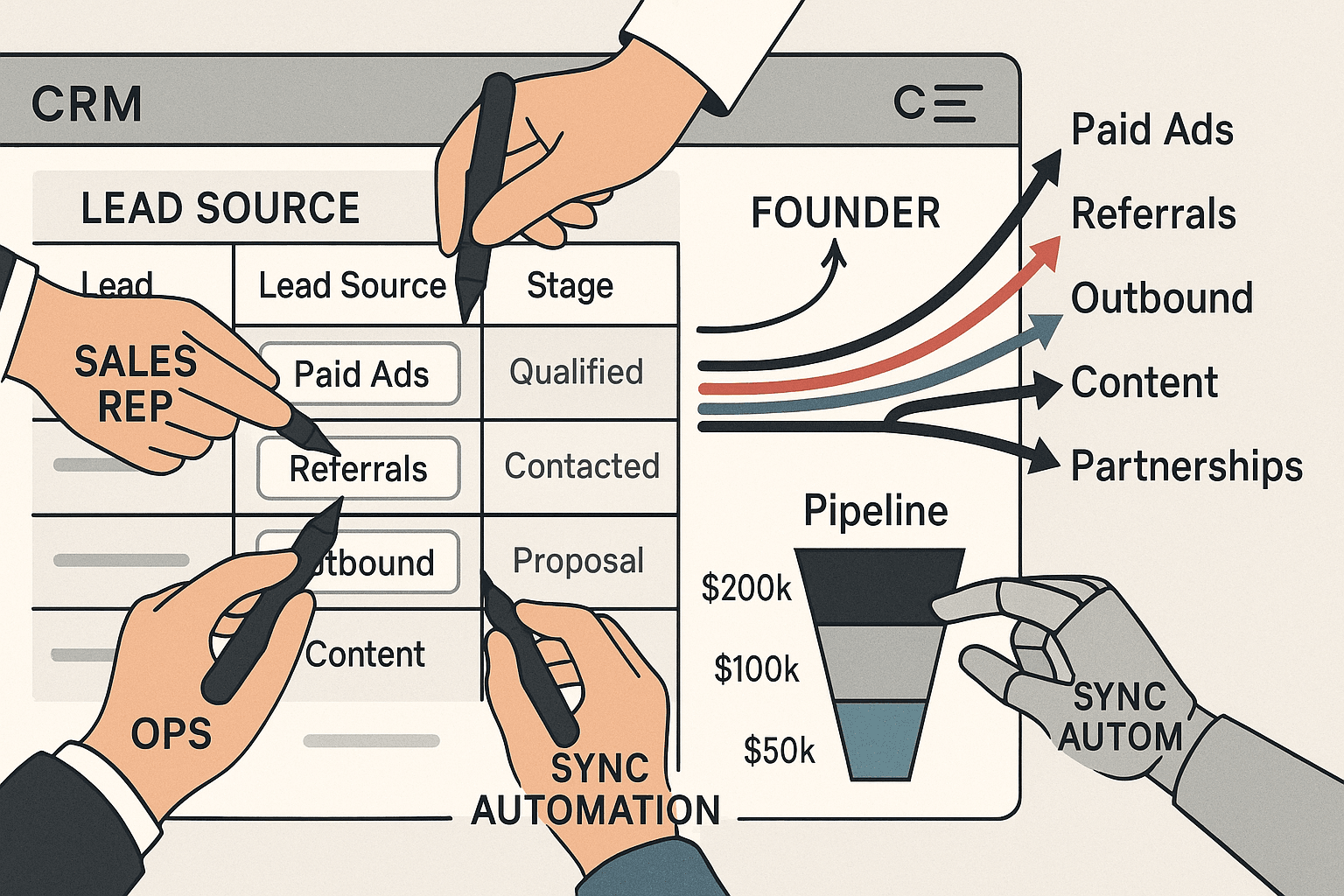
A founder notices something odd in the board deck the night before the meeting. Paid search suddenly looks efficient. Founder-led outbound appears to be underperforming. Partnerships look mediocre. And referral-sourced deals, which everyone swore were carrying the quarter, somehow shrank as a percentage of pipeline.
Nothing obvious changed in go-to-market. Same team. Same spend. Same motion. But the charts tell a different story.
So the founder asks the VP Sales. The VP Sales asks RevOps. RevOps pulls a CSV and says the issue is probably just “cleanup.” A few reps updated lead sources after discovery calls. A founder changed a handful of account records to reflect “how they really found us.” HubSpot synced over values from a form field. Salesforce workflow rules normalized some picklist entries. Someone bulk-edited old contacts before the QBR so reporting would look cleaner.
Individually, each change sounds reasonable. Collectively, they destroy the company’s ability to learn.
This is the attribution override problem: early-stage startups quietly corrupt GTM truth when humans and tools keep rewriting source data after the fact. The damage is worse than messy reporting. It changes where you invest, who you hire, what you kill, what you double down on, and how you explain results to yourself. It can make bad channels look good, good channels look flaky, and founder intuition look more “data-driven” than it really is.
If you are still small, this usually hides in plain sight. You have one CRM, a few forms, a small sales team, one ops generalist if you’re lucky, and a founder who still jumps into deals. Everyone believes they know where deals came from. That belief is exactly why the system gets corrupted. The closer the team is to the work, the more tempted people are to “fix” attribution manually.
This article is a practical playbook for fixing it. We’ll cover how overrides happen, why standard attribution advice fails in early-stage environments, how to audit source-field mutations, how to separate original acquisition from later influence, how to design locked attribution schemas, and how to create exception workflows that preserve GTM truth without slowing down execution.
The failure scenario: everyone is trying to be helpful, and that’s the problem
Here’s the common startup sequence.
You launch with basic CRM defaults:
Lead SourceOriginal SourceLatest Source- Maybe
Campaign - Maybe
Self-reported source - A rep notes field like “how did you hear about us?”
At first it works fine because volume is low. A founder personally knows most prospects. Attribution is informal but directionally useful.
Then volume rises and complexity shows up:
- Paid campaigns drive demo requests.
- Reps run outbound sequences.
- Advisors make intros.
- Prospects consume content before replying.
- A founder DMs someone on LinkedIn after they already visited the site.
- A contact fills out a form from an incognito browser, so UTMs disappear.
- A partner webinar creates traffic, but attendees convert later through direct traffic.
- A champion changes jobs and re-enters your funnel at a new account.
The CRM now has to answer several different questions at once:
- Where did this person first come from?
- What created the account?
- What touched them before conversion?
- What caused pipeline creation?
- What should get comp credit?
- What should get budget credit?
- What should explain strategic learning?
Most startups never separate those questions structurally. Instead, they overload one or two fields to serve all of them.
That’s when the rewriting starts.
A rep sees a form fill marked as Organic Search, but during the call the prospect says, “Actually my friend Sarah mentioned you.” The rep changes Lead Source to Referral.
A founder knows a deal really started from months of outbound relationship-building, so they change the source from Inbound to Founder Outbound.
RevOps finds fifty leads with blank sources and bulk-fills them based on owner or lifecycle stage.
A marketing automation sync updates Latest Source, which a dashboard mistakenly uses as Source of Opportunity.
A sales manager tells reps to update source to whatever “best reflects reality” before commission reviews.
Now reporting starts drifting:
- Referrals may be overstated because people trust self-reported anecdotes over first-touch records.
- Paid may be understated because prospects don’t remember the ad.
- Outbound may be overstated because sales wants credit for sourced pipeline.
- Founder-led channels may be selectively corrected because founders remember those stories best.
- “Direct traffic” may be a junk drawer for broken tracking, dark social, and no-cookie visits.
The worst part is that nobody thinks they are cheating. They think they are improving data quality.
The pattern: attribution corruption usually comes from schema confusion, not bad intent
When you inspect these systems, the issue is rarely one villain. It is a pattern made of four things.
1. One field is forced to represent multiple truths
Lead Source is used for:
- First-touch acquisition
- SDR sourcing credit
- Opportunity source
- Narrative explanation on forecast calls
- Budget allocation decisions
These are not the same.
When one field is expected to answer incompatible questions, humans rewrite it to suit the question of the moment.
2. Editable fields sit too close to operational workflows
If the same field powers routing, list views, rep comp debates, and strategic reporting, people will edit it under pressure.
Operational pressure always beats analytical purity. If a rep needs a field changed to move a deal, the field gets changed.
3. Tool syncs mutate records with no visible accountability
This is common in stacks like:
- HubSpot + Salesforce
- Segment + warehouse + reverse ETL
- Enrichment tools writing source properties
- Marketing automation updating lifecycle fields
- Form tools creating contacts before campaign context arrives
A workflow meant to “normalize” data can silently overwrite values that were historically accurate.
4. Teams confuse “better explanation” with “better data”
A first-touch record might show LinkedIn Paid, while a rep conversation reveals the prospect had also heard of you from a podcast six months ago and was finally nudged by a customer intro.
The human story may be richer. That does not mean the original record was wrong. It means you need multiple fields for multiple truths.
Why standard attribution advice fails early-stage startups
A lot of attribution advice comes from either enterprise RevOps teams or B2C growth environments. Early-stage B2B startups sit in the worst middle zone: too complex for simplistic tracking, too resource-constrained for elegant full-stack attribution.
Standard advice often sounds like this:
- “Use first-touch and last-touch models.”
- “Implement multi-touch attribution software.”
- “Train reps to log better notes.”
- “Standardize UTM governance.”
- “Create a single source of truth.”
All fine in theory. Usually insufficient in practice.
Why “just use first-touch and last-touch” fails
Because most startups don’t have stable entity design across person, company, and opportunity. They mix contact-level and account-level history. The first-touch of a contact is not always the origin of the account. The last-touch before form fill is not necessarily the source of the opportunity.
Why “buy attribution software” fails
Most early-stage companies do not have the event fidelity, warehouse discipline, identity resolution, or ops capacity to get value from sophisticated attribution tools. You end up with prettier wrong answers.
Why “train reps not to edit fields” fails
If your process requires reps to correct bad attribution but gives them only one mutable field, they will keep editing it. This is a system design problem, not a training problem.
Why “single source of truth” fails
There is no single source of truth if you’re asking multiple attribution questions. There should be a system of truth:
- immutable acquisition facts
- mutable operational classifications
- declared influence signals
- compensation-specific sourcing rules
Trying to compress all of that into one field is how corruption starts.
The better approach: preserve original facts, layer interpretation separately
The fix is conceptually simple:
- Preserve original acquisition data as immutable facts.
- Record human interpretation in separate fields.
- Distinguish acquisition, influence, and ownership.
- Make exceptions explicit instead of silent.
- Audit every mutation that affects GTM learning.
You are not trying to create perfect attribution. You are trying to stop your team from accidentally deleting history.
That means your schema needs to reflect three different categories.
Category 1: Original acquisition facts
These should be locked or append-only wherever possible.
Examples:
- First website session source/medium
- First known UTM campaign
- First known conversion event
- Original referring page
- Original form path
- Contact create source
- Account create source
- Original inbound timestamp
These fields answer: what do we know actually happened first in the system?
Category 2: Human-reported or discovered context
These should be editable, but never replace Category 1.
Examples:
- Self-reported “how did you hear about us?”
- Rep-discovered sourcing note
- Founder context note
- Partner claimed origin
- “Pre-existing relationship” flag
These fields answer: what additional context did we learn later?
Category 3: Business interpretation and crediting
These should be explicit classifications derived from rules.
Examples:
- Opportunity source classification
- SDR sourced flag
- Marketing influenced flag
- Partner assisted flag
- Compensation source
- Budget allocation source
These fields answer: how are we choosing to classify this for operating decisions?
That separation does two things.
First, it preserves history. Second, it lowers emotional fights because teams are no longer arguing over one field.
Marketing can keep first-touch truth. Sales can get sourced credit under defined rules. Founders can annotate nuanced context. Finance can still roll up reports consistently.
A practical schema that works at early stage
You do not need a giant attribution architecture. You need a minimum viable truth model.
Here is a practical setup for most early-stage B2B teams.
Contact-level fields
Immutable / system-set
original_contact_sourceoriginal_contact_source_detailoriginal_utm_sourceoriginal_utm_mediumoriginal_utm_campaignoriginal_conversion_eventoriginal_conversion_timestampfirst_owner_assigned_timestamp
Editable / context
self_reported_sourcerep_discovered_sourcesource_confidencesource_notes
Derived / classified
primary_acquisition_channelsales_influenced_flagmarketing_influenced_flag
Account-level fields
Immutable / system-set
original_account_creation_sourcefirst_known_inbound_contact_sourcefirst_known_outbound_activity_timestampaccount_first_touch_timestamp
Editable / context
account_origin_notesfounder_relationship_flagpartner_origin_claim
Derived / classified
account_acquisition_modelaccount_primary_source
Opportunity-level fields
Immutable / system-set or append-only
opportunity_created_timestampopportunity_creator_rolefirst_meeting_booked_source_snapshotpipeline_creation_trigger
Editable / exception-request only
opportunity_source_override_requestedoverride_reasonoverride_approved_by
Derived / classified
opportunity_source_for_reportingopportunity_source_for_compinfluenced_channels
This looks like more fields because it is more fields. That is the tradeoff. Simpler UI, worse truth. Slightly more schema, better learning.
How to audit source-field mutations before you redesign anything
Before changing process, quantify the problem. Most teams underestimate how often source data changes.
Start with a source field audit over the last 6 to 12 months.
What to look for
-
Frequency of source changes
- How many contacts had source fields changed after creation?
- How many opportunities had source-related fields changed after stage 1?
-
Time lag to change
- Were changes made within 1 day, 7 days, 30 days, 90+ days?
- Late changes are especially dangerous because reports may have already been used in decision-making.
-
Who changed it
- Sales reps
- Founders
- RevOps/admins
- Automated workflow
- Sync integration
-
Direction of change
- Paid → Organic
- Organic → Referral
- Inbound → Outbound
- Unknown → Direct
- Direct → Partner
-
Where reporting depends on mutable fields
- Board slides
- Weekly pipeline reviews
- Hiring plans
- Marketing budget allocation
- SDR performance scorecards
A simple audit workflow
If you are in Salesforce:
- Turn on field history tracking for source-related fields if not already enabled.
- Export field history for all source-related properties.
- Join to contact/account/opportunity creation dates and owners.
- Group by field, changer type, and time since create.
If you are in HubSpot:
- Use property history exports or API access to property versions.
- Pull historical values for
original source, custom source fields, and lifecycle milestones. - Check workflow logs to identify automation-based overwrites.
If you have a warehouse:
- Snapshot records daily.
- Diff source-related fields over time.
- Build a mutation table with old value, new value, actor, timestamp, and object type.
Minimum viable SQL logic
Even without sophisticated event streams, you can create a mutation log from snapshots:
- Compare each day’s value of a source field to the prior day’s value.
- If changed, log the mutation.
- Tag whether the user or integration account made the change.
- Join to pipeline and close outcomes.
This lets you answer questions like:
- Which channels get “upgraded” most often?
- Are closed-won deals more likely to be rewritten as referral or outbound founder-sourced?
- Which reps or workflows create the most drift?
That last point matters. You are looking for attribution bias, not just data hygiene issues.
The audit findings you’ll probably see
In early-stage startups, the same patterns show up again and again.
Pattern 1: good deals get rewritten into more flattering channels
Closed-won deals get relabeled as:
- referral
- founder network
- partner
- outbound
because those narratives feel causally meaningful. Meanwhile noisy channels like paid or organic retain more losses, making them look worse than reality.
Pattern 2: “direct” is hiding tracking failure
Direct often means:
- dark social
- lost UTMs
- mobile app/browser privacy loss
- forwarded links
- untagged campaigns
- founder text messages
It is not a real strategy category. It is a symptom bucket.
Pattern 3: ops bulk-fixes create retrospective fiction
When ops teams normalize old records, they often improve categorical neatness while reducing historical truth. Backfilling unknowns may be useful for operational segmentation but should not rewrite original facts.
Pattern 4: opportunity source is inherited from the wrong object
A contact’s latest source gets copied to an opportunity, even though the account was opened through outbound months earlier. Or the account source reflects first creation, while the opportunity was genuinely driven by a later partner intro.
This is where object-level confusion kills accuracy.
Designing a locked attribution schema without making the CRM unusable
You need a design that balances truth protection and team speed.
The simplest useful rule is this:
No one edits original source fields after creation except through an approved exception workflow.
That sounds strict, but the implementation can still be practical.
Lock what must be preserved
Lock these fields after initial write:
- original source fields
- original UTM fields
- first conversion fields
- first-touch timestamps
- source snapshots copied to opportunity at creation
Use field-level permissions, workflow rules, or validation rules depending on your CRM.
Keep a separate editable “context” layer
Let reps and founders add useful reality through:
- self-reported source picklist
- discovered influence multi-select
- sourcing note
- relationship context note
- confidence level
This gives people a place to put nuance without destroying historical records.
Use derived reporting fields instead of manual edits
For example:
opportunity_source_for_reportingcan follow defined precedence logic.opportunity_source_for_compcan follow comp-plan rules.marketing_influenced_flagcan be true if there was any meaningful pre-pipeline marketing interaction.
These are better places for business logic than raw source fields.
A workable attribution model for early-stage B2B
You do not need full multi-touch. You need a defensible attribution operating model.
Here’s one that works.
Layer 1: Original acquisition
Question: how did this contact or account first enter our known universe?
Examples:
- Paid Search
- Organic Search
- Direct / Unknown
- Referral
- Event
- Founder Outbound
- SDR Outbound
- Partner
- Content Syndication
Rule: immutable after initial write except audited exception.
Layer 2: Pipeline creation source
Question: what most directly created the opportunity or first qualified meeting?
Examples:
- Inbound demo request
- SDR outbound reply
- Founder intro
- Customer referral
- Partner handoff
- Expansion from existing account
Rule: derived from process milestones and activity data, not from random human edits.
Layer 3: Influence
n Question: what other channels materially influenced conversion before pipeline creation?
Examples:
- Viewed pricing page
- Attended webinar
- Opened outbound sequence
- Introduced by advisor
- Heard podcast
- Referred by customer
Rule: multiple values allowed; can include human-declared and system-observed inputs.
Layer 4: Compensation source
Question: who gets credit under the comp plan?
Rule: may differ from acquisition and pipeline source. This should be explicit, because comp logic often drives political edits.
When you separate these layers, arguments become manageable. A deal can be:
- originally acquired via paid social
- converted into pipeline through founder follow-up
- influenced by a customer reference
- credited to an SDR for comp
That is messy, but true. One field cannot capture that.
Exception workflows: the only safe way to allow overrides
There are legitimate cases where the original data is wrong.
Examples:
- Broken tracking misclassified a high-value event.
- Duplicate merge created a bad source inheritance issue.
- Offline event import arrived after contact creation.
- A partner upload created contacts without attribution metadata.
You need an override path, but it must preserve history.
Good exception workflow design
-
User requests override, not direct edit
- Form or CRM checkbox
- Required reason code
- Free-text explanation
-
Original value is never deleted
- Store prior value in audit log
- Keep current immutable field plus corrected field if needed
-
Approver is limited
- RevOps or designated admin
- Not frontline managers optimizing their own dashboard
-
Correction is tagged by reason
- Tracking failure
- Duplicate merge issue
- Offline attribution import
- System sync error
- Other
-
Reporting distinguishes raw vs corrected
- Raw acquisition source
- Corrected acquisition source
- Count of corrected records by channel and reason
This matters because too many exceptions usually indicate a broken upstream process. If your correction rate is high, don’t normalize it. Fix the system.
Tool comparisons: what’s enough versus what’s overkill
Most startups should resist buying heavy attribution platforms too early. The right stack depends on volume and complexity.
Option 1: CRM-native + spreadsheets / BI
Typical stack
- HubSpot or Salesforce
- Native property history / field history
- Basic dashboards in CRM or BI tool
- Manual audit exports monthly
Best for
- Pre-seed to Series A
- Low-to-moderate pipeline volume
- One PMM/growth lead, no dedicated RevOps team
Pros
- Cheap
- Fast to implement
- Good enough for truth preservation
Cons
- Weak cross-object logic
- Limited mutation visibility unless configured carefully
- Can get messy as complexity grows
Cost
- Software incremental: near-zero to low
- Setup: 10 to 25 hours
- Ongoing governance: 2 to 4 hours/month
Option 2: CRM + warehouse + BI + reverse ETL light governance
Typical stack
- Salesforce or HubSpot
- Warehouse like BigQuery/Snowflake/Postgres
- Fivetran/Airbyte or native connectors
- dbt for data modeling
- Looker/Metabase/Mode
- Optional reverse ETL for derived fields
Best for
- Series A to B or attribution-sensitive motions
- Multi-channel GTM with enough volume to justify discipline
- Some analytics or ops capability in-house
Pros
- Better auditability
- Daily snapshots possible
- Derived logic can live outside CRM
- Stronger historical preservation
Cons
- More moving parts
- Requires ownership and testing
- Reverse ETL can become another source of accidental overwrites if poorly controlled
Cost
- Software: moderate
- Setup: 40 to 120 hours
- Ongoing governance: 6 to 12 hours/month
Option 3: Dedicated attribution / journey analytics tooling
Typical stack
- Multi-touch attribution platform
- Marketing journey tools
- Identity resolution layers
Best for
- Later-stage companies with enough event fidelity and budget
- Teams with clear attribution definitions already in place
Pros
- Rich reporting
- Journey visibility
- Better campaign analysis
Cons
- Expensive
- Often oversold to early-stage teams
- Won’t fix broken source governance underneath
Cost
- Software: high
- Setup: 80 to 200+ hours
- Ongoing governance: significant
Bluntly: if your original CRM fields are still being manually overwritten, you are not ready for expensive attribution tooling. Fix governance first.
Workflow examples that preserve truth without slowing reps down
Here are practical workflows that actually work.
Workflow 1: Rep hears a different story on the call
Bad workflow
Rep edits Lead Source from Organic Search to Referral.
Better workflow
Rep leaves original field untouched and updates:
self_reported_source = Referralsource_notes = Mentioned Sarah from Acme recommended ussource_confidence = mediuminfluenced_channels += Referral
If your reporting logic prioritizes self-reported source for certain analyses, do that downstream. Don’t rewrite the fact table.
Workflow 2: Founder says this was really outbound
Bad workflow
Founder edits account source to Founder Outbound after joining late-stage deal review.
Better workflow
Founder logs:
founder_relationship_flag = trueaccount_origin_notes = Relationship established before inbound form fill- if needed,
override_requested = true override_reason = duplicate timeline / pre-existing relationship
RevOps reviews whether the opportunity should be classified as founder-influenced or founder-sourced under the rules. Original web acquisition remains intact.
Workflow 3: Ops bulk-fixes unknowns
Bad workflow
RevOps mass-updates blank sources from old records with guessed values.
Better workflow
RevOps creates:
source_data_quality_status = missingsource_backfill_method = inferred_from_campaign_membercorrected_source = Webinar
Then reports can either exclude inferred corrections or include them with caveats.
Workflow 4: Sync overwrites CRM values
Bad workflow
Marketing automation updates source fields whenever a new form is submitted.
Better workflow
Automation only writes to latest-touch or influence fields, never original source fields once populated. Validation rules block updates to locked properties.
Cost of getting this wrong
Founders usually tolerate attribution mess because the pain feels abstract. It isn’t.
Here’s where the real cost shows up.
1. Budget allocation errors
If paid appears weaker than reality, you cut efficient spend. If founder outbound looks better than reality, you hire into an unscalable motion.
A startup spending $25,000 to $75,000 per month on GTM can easily misallocate 20% to 40% of budget based on corrupted reporting. That’s not a data issue. That’s runway.
2. Hiring mistakes
If self-generated pipeline looks amazing because reps relabel warm inbound as outbound-sourced, you may overhire SDRs or AEs with the wrong profile. If referrals seem dominant because wins get rewritten into referral, you underinvest in channels that actually fill the funnel.
3. False confidence in repeatability
This is the biggest one. Corrupted attribution tells founders they have found repeatable GTM before they have. That leads to premature scaling.
4. Board communication risk
Once source numbers hit board decks and fundraising narratives, they harden into company mythology. Correcting them later gets politically expensive.
A 30-day implementation plan
Here is a realistic plan for an early-stage startup.
Week 1: Map current fields and breakpoints
List every field currently used for source, attribution, campaign, and sourcing credit across:
- contacts
- accounts
- opportunities
- campaign members
- forms
- marketing automation
- enrichment tools
- dashboards
Document:
- field owner
- editable by whom
- populated by what system
- which reports use it
- whether it represents original fact, context, or derived classification
You will likely discover one field being used for all three.
Week 2: Audit mutations and define source layers
Pull 6 to 12 months of source history.
Measure:
- mutation rate
- late mutation rate
- top changers
- most common channel rewrites
- difference between created-stage source and closed-won-stage source
Then define your source taxonomy:
- original acquisition
- pipeline creation
- influence
- compensation source
Keep it boring. Avoid 30-channel taxonomies you cannot govern.
Week 3: Lock fields and create context alternatives
Implement:
- field permissions or validation rules on original fields
- editable context fields for reps/founders
- source override request workflow
- separate derived reporting fields
At this stage, also fix automation so it cannot overwrite locked fields.
Week 4: Update dashboards and team behavior
This is where most projects fail. The schema gets fixed but reporting still points at the old mutable field.
Update every critical dashboard to clearly distinguish:
- original acquisition source
- opportunity source
- influenced pipeline
- corrected exceptions
Train the team with examples, not philosophy. Show reps where to log nuance. Show managers how comp credit is handled. Show founders how to annotate context without rewriting history.
The operating rules I’d put in writing
If I were implementing this for a startup, I’d write five blunt rules.
Rule 1: Original source is a fact record, not a debate field
If someone learns something new later, that goes in context or influence fields.
Rule 2: No compensation, routing, or reporting logic should depend on a free-text explanation
Humans can provide context. Systems need structured fields.
Rule 3: If a field is strategically important, it should have history tracking
No exceptions.
Rule 4: Derived classifications should be reproducible from rules
If a dashboard number changes, you should know whether it changed because reality changed, classification logic changed, or records were corrected.
Rule 5: Every override should create evidence, not erase it
The company should be able to answer: what was changed, by whom, when, and why?
Common objections and the real answer
“This is too much process for our size.”
Then do the minimum version:
- lock original source
- create one editable self-reported source field
- add one override request process
- update dashboards
That alone solves most corruption.
“Our reps won’t follow it.”
They will if the workflow is faster than arguing with ops later. Put the editable context field directly in their normal view and stop asking them to fix attribution by memory.
“Attribution is imperfect anyway.”
Correct. That is why you should preserve multiple truths instead of overwriting one imperfect truth with another.
“We can just clean it up later in the warehouse.”
Only if you preserved history. If you overwrite the source in place and don’t snapshot changes, the truth is gone.
What good looks like six months later
You know the system is working when these things are true:
- Original source mutation rate is near zero.
- Exceptions exist, but each one is auditable.
- Reps add context without editing fact fields.
- Opportunity source reporting no longer swings because someone bulk-updated contacts.
- Marketing, sales, and founders can all get the answers they need without fighting over one field.
- You can explain why paid drives first-touch demand even if referrals and founder involvement help close deals.
That last one is the whole game. Startups do not lose GTM learning only because they lack data. They lose it because they overwrite the little truth they had.
Final takeaway
The attribution override problem is not really an attribution problem. It is an organizational honesty problem embedded in CRM design.
When startups let humans and tool syncs keep rewriting source data, they are not just making reports messy. They are corrupting the feedback loop that tells them how the business grows.
The fix is not a fancy attribution model. It is a disciplined separation between:
- what happened first
- what we learned later
- how we choose to assign credit
Preserve original facts. Capture nuance separately. Make exceptions visible. Lock the fields that matter. And update reporting so strategic decisions rely on derived, governed classifications, not whichever story won the latest pipeline review.
Founder to founder: if you are still early, this is one of those boring systems problems that compounds quietly. Fix it before you scale headcount or channel spend. Otherwise you’ll spend the next year optimizing a GTM motion built on rewritten history.