
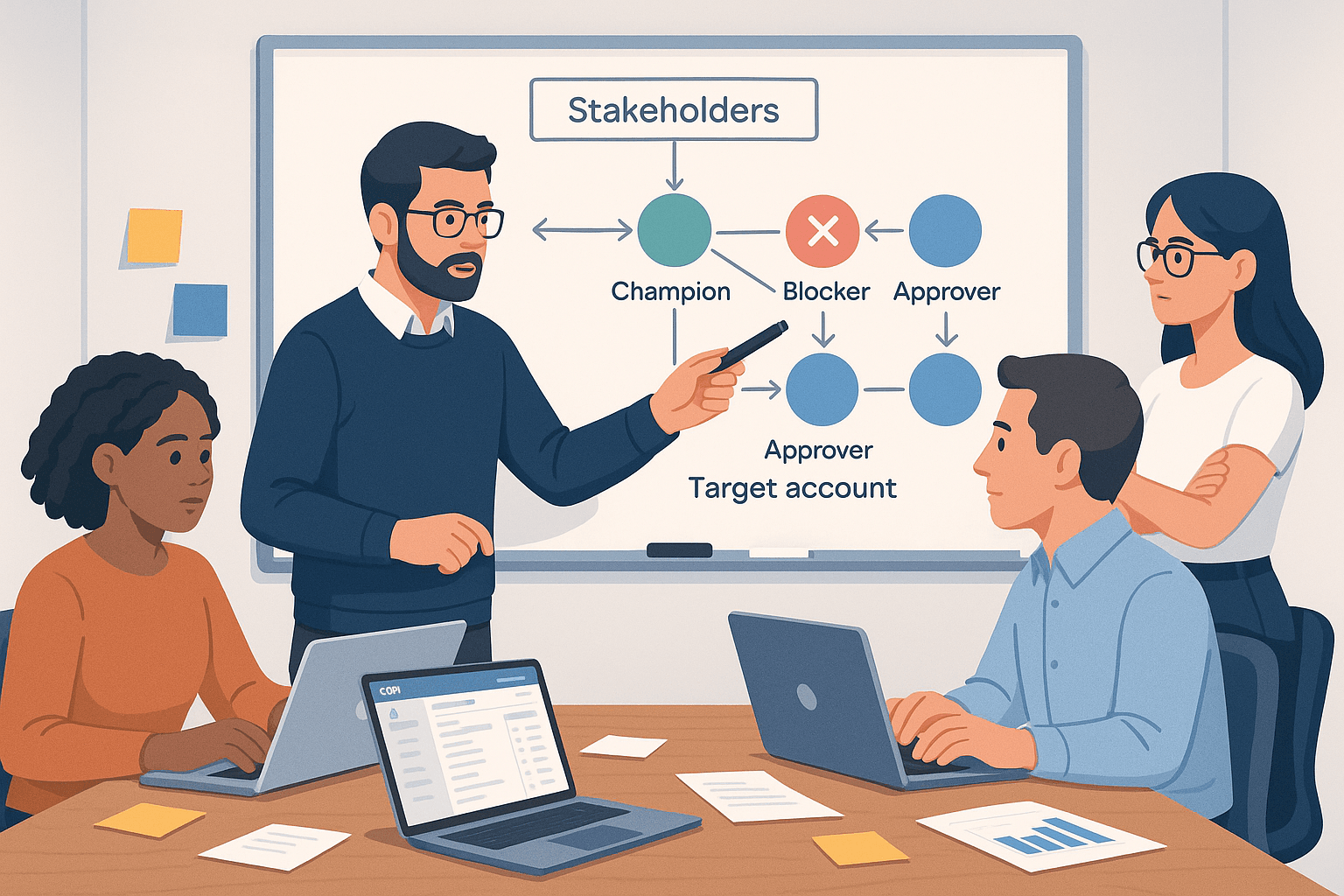
You don’t usually lose the deal on the day procurement says no.
You lose it six weeks earlier, when the only person who knew who actually mattered inside the account kept that map in their head.
The AE remembered that the enthusiastic director was not the budget owner. The founder remembered that the VP liked the product but wanted implementation risk reduced. The CSM remembered that legal had gotten involved early in a similar deal and would probably stall this one too. None of that made it into the CRM in a structured way. None of it was visible in pipeline review. None of it survived handoffs, vacation, founder context-switching, or just the passage of time between calls.
Then the deal slipped.
The rep said, “We’re still working it.” The founder said, “Do we have a champion?” The answer was technically yes, but operationally no.
That’s the champion tracking void: the gap between having some fuzzy sense of stakeholder dynamics and having a repeatable operating system for tracking who matters, how they influence each other, where approval risk sits, and what has to happen next.
For early-stage B2B startups, this is one of the highest-leverage sales operations problems hiding in plain sight. It quietly wrecks multithreading, forecast accuracy, expansion timing, onboarding quality, and founder confidence in the pipeline. It also creates a specific kind of fragility: deals become dependent on rep memory, founder intuition, and Slack archaeology instead of shared execution.
This article is a practical playbook for fixing it.
We’ll cover the failure mode, why common advice falls short, what a better operating model looks like, how to implement it without building enterprise-grade RevOps too early, what tools to use, and how to measure whether it’s actually improving close rates and forecast quality.
The failure scenario: everyone “knows” the account, but nobody can operate the account
Here’s the kind of situation that shows up constantly in early-stage B2B sales.
You’re selling a $15,000 to $60,000 annual SaaS product into mid-market teams. Sales cycles run 30 to 120 days. Founders still get involved in important deals. The AE or founder has had six calls with the account over two months.
There’s a strong user champion in operations. They love the product. They’ve pushed internally for a pilot. The rep is optimistic.
But the actual buying environment looks more like this:
- The operations lead is the evaluator and internal promoter.
- Their manager cares about implementation load and team disruption.
- IT needs to sign off on data access.
- Finance won’t care until price hits a threshold.
- Procurement gets involved only after verbal approval, but when they do, they add 2 to 3 weeks.
- A peer team leader is quietly resistant because your product threatens an existing workflow they own.
- The executive sponsor is interested, but only if the purchase supports a broader quarterly priority.
The rep knows some of this. The founder knows a different slice. Notes are spread across Gong, email, call summaries, CRM free-text fields, and DMs.
Then one of three things happens.
Failure mode 1: fake champion confidence
The team treats any enthusiastic user as “the champion.” But they never test whether that person has:
- enough influence to drive consensus,
- access to the economic buyer,
- political incentive to spend internal capital,
- credibility to handle objections from implementation, security, or finance,
- urgency tied to a real deadline.
So the pipeline review says “strong champion,” when what it really means is “friendly user with positive sentiment.” That is not the same thing.
Failure mode 2: single-threaded progression hidden inside CRM stage progress
The deal moves stages because calls happened.
- Discovery completed.
- Demo completed.
- Pilot discussed.
- Pricing sent.
But there’s no visible record of whether stakeholder coverage improved. The account may still rely on one contact. No buyer map exists. No one knows whether the rep has identified the approver, blocker, or technical gatekeeper.
The stage creates an illusion of progress while stakeholder risk remains unchanged.
Failure mode 3: context death between handoffs
Founders pull in support engineers, solutions people, CSMs, or executives as deals get serious. After close, customer success takes over. Later, the team tries to expand.
At each transition, the internal map partially dies.
The CSM knows who attended kickoff, but not who originally resisted. The AE remembers who blocked security terms, but not in a way the CSM can use later. Six months later, expansion stalls because the original champion left and nobody had documented adjacent stakeholders or succession paths.
This is where revenue gets lost quietly. Not because the team lacked hustle, but because the stakeholder system never became operational.
The pattern: early-stage teams confuse relationship intuition with process
Founders often think this problem is about rep discipline or CRM hygiene. Partly true, but incomplete.
The deeper pattern is this: in early-stage companies, valuable sales context is initially stored as human intuition because that’s the fastest way to learn.
That makes sense early on.
The founder knows that this VP is skeptical but persuadable. The first AE knows which champion types can actually mobilize internal approvals. The CSM knows which personas become renewal allies. None of that is cleanly systematized at first because the company is still discovering how buying works.
The problem starts when the company scales past pure memory.
You now have:
- multiple reps,
- more active deals,
- founder participation in only some opportunities,
- longer and more political buying cycles,
- more handoffs,
- pressure for forecast accuracy,
- a real need for account expansion planning.
At that point, “our reps know their accounts” stops being an operating model.
It becomes a bottleneck.
The warning signs are predictable:
- pipeline reviews depend on verbal storytelling rather than visible account structure,
- managers ask “who actually owns this?” every week,
- reps can describe the last call but not the internal approval chain,
- champion quality varies wildly by rep,
- a deal can be marked commit without a named business approver,
- expansion opportunities get rediscovered from scratch,
- when a rep leaves, a chunk of account intelligence leaves with them.
This is not just a sales issue. It becomes a company coordination issue.
Product loses feedback context. Success inherits customers without political history. Finance gets unreliable forecasts. Founders spend too much time reconstructing accounts during late-stage deals.
Why standard advice fails
Most advice on this topic is directionally correct but operationally weak.
You’ve heard the standard lines:
- “Multi-thread your deals.”
- “Build relationships higher in the org.”
- “Document champions in the CRM.”
- “Use MEDDICC.”
- “Map the account.”
None of that is wrong. The problem is that it usually stays at the slogan level.
Standard advice failure 1: “Just multi-thread” is too vague
Reps hear “multi-thread” and interpret it as “get more people on calls.”
But more attendees does not equal stakeholder coverage.
You can have five people attend a demo and still not know:
- who can approve budget,
- who can kill the deal quietly,
- who owns implementation risk,
- who needs proof for internal alignment,
- whether your champion can influence across teams.
A useful system needs role clarity, not just contact count.
Standard advice failure 2: CRM fields are usually too shallow
Many startups add fields like:
- Champion: Yes/No
- Economic Buyer Identified: Yes/No
- Next Step
This creates checkbox theater.
A rep can mark “champion identified” without demonstrating why that person is credible, how they benefit, what influence they have, or whether they’ve taken an internal action on your behalf.
Likewise, “economic buyer identified” may mean the rep heard a title mentioned once.
Shallow fields produce false confidence because they compress messy stakeholder reality into binary labels.
Standard advice failure 3: frameworks become compliance instead of execution
MEDDICC, SPICED, Command of the Message, and similar frameworks can help. But early-stage teams often implement them as inspection forms, not decision systems.
The rep fills out deal inspection notes before forecast call. The manager checks whether boxes are completed. Everyone performs rigor. Very little changes in the account.
If the framework doesn’t produce concrete actions like “introduce security reviewer before procurement” or “arm champion with ROI memo for VP approval,” it’s just vocabulary.
Standard advice failure 4: founders over-rely on their own deal intuition
Founders are often very good in deals because they can synthesize weak signals quickly. They remember nuance. They can identify hidden blockers in live conversation.
That strength becomes a trap.
Instead of building an observable system, the company relies on the founder joining calls, reading between the lines, and telling the team what’s really happening. That works until volume increases or the founder’s attention shifts.
Then pipeline quality drops because the insight was never codified.
Standard advice failure 5: account maps get made once, then rot
Some teams do create pretty stakeholder maps for strategic deals. They end up in slides, Notion docs, or whiteboards.
Then nobody updates them.
A buyer map that isn’t tied to the weekly deal workflow becomes a dead artifact. Since stakeholder dynamics change fast, stale maps are often worse than none because they create outdated certainty.
A better approach: treat stakeholder intelligence like live deal infrastructure
The right mental model is simple:
A buyer map is not a note. It is operating infrastructure for the deal.
That means four things.
1. Every active deal needs a live internal account map
Not for every tiny self-serve lead. But for any sales-led opportunity above a threshold, the team should maintain a visible, updateable map of:
- champion(s),
- approver(s),
- blocker(s),
- evaluator(s),
- implementation owner(s),
- procurement/legal/security participants,
- executive sponsor candidates,
- reporting lines or influence relationships,
- current level of support or risk.
This should not live in a rep’s head or only in free-text notes.
2. Stakeholder roles need evidence, not labels
You should not call someone a champion unless there is evidence.
Examples of evidence:
- they shared internal process details,
- they brought in other stakeholders,
- they advocated for the project without you present,
- they helped shape success criteria,
- they disclosed political obstacles,
- they pushed for timeline acceleration,
- they reviewed internal approval path with you.
Similarly, blockers should not only be explicit detractors. A blocker may be passive, procedural, or incentive-based.
3. Deal progression should be tied to map progression
A deal should not be considered healthier just because another demo happened.
Health should improve when:
- stakeholder coverage broadens,
- approval path clarity increases,
- champion evidence strengthens,
- blocker mitigation advances,
- implementation concerns are owned,
- next internal action is identified.
This is the operational bridge between sales activity and forecast realism.
4. The map must survive handoffs and time
The same stakeholder map should help:
- sales close the deal,
- onboarding navigate internal politics,
- customer success preserve sponsor relationships,
- account management plan expansion,
- leadership assess account fragility.
If your buyer map dies at contract signature, you’re rebuilding account intelligence from zero every cycle.
The operating model: a simple stakeholder system that early-stage teams can actually run
You do not need enterprise sales ops to fix this. You need a lightweight but enforced structure.
Here’s the model I recommend.
Part 1: define a stakeholder taxonomy
Keep this simple enough that reps will use it.
For each key contact, track:
- Role in deal: champion, user, evaluator, approver, economic buyer, technical gatekeeper, procurement, legal, blocker, executive sponsor, implementation owner
- Department/function
- Seniority level
- Support level: strong supporter, mild supporter, neutral, unknown, mild detractor, strong detractor
- Influence level: low, medium, high
- Decision impact: recommend, approve, veto, implement, budget-own, evaluate
- Relationship status: met live, emailed only, internal-only mention, introduced by champion, no direct access yet
- Last validated date
You don’t need 25 fields. But you need enough structure to distinguish “likes us” from “can move the deal.”
Part 2: require evidence-based champion scoring
Create a simple champion score from 1 to 5.
Example:
Champion 1: Friendly contact
- likes the product
- attends calls
- gives general positive feedback
- no evidence of internal advocacy
Champion 2: Active evaluator
- provides use case detail
- engages in process
- may coordinate meetings
- still unclear if they’ll spend political capital
Champion 3: Emerging advocate
- introduces additional stakeholders
- shares decision process
- reveals objections and internal dynamics
- shows urgency tied to real initiative
Champion 4: True internal driver
- advocates without vendor present
- aligns internal stakeholders
- helps navigate approval path
- requests materials for internal selling
- willing to escalate internally
Champion 5: Mobilizer with influence
- combines advocacy with organizational credibility
- can drive budget/priority conversations
- has repeatedly advanced deal motion
- helps remove blockers directly
This is more useful than a yes/no field because it creates shared language around strength and risk.
Part 3: maintain an influence map, not just a contact list
Most CRMs are good at storing contacts and bad at showing political structure unless configured thoughtfully.
For each meaningful deal, record:
- who reports to whom,
- who trusts whom,
- who influences budget,
- who owns implementation resources,
- who may feel threatened,
- where the champion is strong or weak.
A simple text or diagram field can work if consistently used.
Example:
- Ops Director Sarah is primary champion.
- Reports to VP Operations Mark, who cares about rollout risk.
- IT Manager Elena is neutral but can delay security review.
- Finance Director Ravi approves purchases above $25k.
- Team Lead Jonah likely resistant because workflow overlaps with his team’s current process.
- COO has quarterly mandate on efficiency; potential executive sponsor if ROI framed correctly.
That one summary is often more valuable than 20 scattered call notes.
Part 4: make stakeholder review part of every serious deal review
Do not review major deals only by stage, amount, and close date.
Review them by stakeholder system.
A weekly review for larger deals should cover:
- Who is the current champion?
- What evidence proves they are a champion?
- Who approves budget?
- Who can block implementation, security, legal, or procurement?
- Which relevant stakeholder roles remain unmapped?
- What is the next internal action inside the account?
- What message or asset does the champion need?
- What would make this deal slip?
- If the champion left tomorrow, what happens?
These questions force operational clarity.
Implementation details: how to build this with tools you probably already have
Let’s get tactical.
Most early-stage teams should start with a stack they already use rather than buying a full account planning platform too early.
Option A: CRM-first setup
Best for teams with a reasonably adopted CRM and at least basic RevOps discipline.
Recommended stack
- HubSpot or Salesforce as system of record
- Gong / Zoom recordings for call evidence
- Notion or Google Docs for supporting deal briefs
- Slack for deal coordination
CRM objects and fields
At minimum, add these to the opportunity level:
- Champion Name
- Champion Score (1–5)
- Economic Buyer Name
- Approval Path Known? (yes/partial/no)
- Technical Gatekeeper Identified? (yes/no/na)
- Procurement Required? (yes/no/unknown)
- Blocker Identified? (yes/no)
- Multithread Score (count of meaningful stakeholder relationships)
- Stakeholder Map Summary (long text)
- Last Stakeholder Map Update Date
- Stakeholder Risk Level (low/medium/high)
At the contact level, add:
- Deal Role
- Support Level
- Influence Level
- Decision Impact
- Last Active Deal Date
This isn’t perfect, but it creates enough structure for visibility and reporting.
Workflow example
After every material sales interaction, the rep updates:
- any new stakeholder,
- changes in support level,
- newly learned approval path details,
- blocker signals,
- one concise stakeholder map summary.
Then before weekly forecast, the rep answers in the CRM or deal brief:
- what changed in the stakeholder map this week,
- what evidence increased or decreased champion strength,
- which unmapped stakeholder role is now the top risk.
This matters because it shifts updates from “we had a good call” to “our understanding of the buying system improved.”
Pros
- works inside existing workflow
- easier reporting
- survives rep turnover better
- easier manager inspection
Cons
- CRM UX for relationship mapping is clunky
- reps may resist extra data entry
- diagrams are weak unless supplemented externally
Option B: Deal brief plus CRM hybrid
Best for founder-led sales teams or small AE teams that need flexibility.
Recommended stack
- CRM for structured fields and reporting
- Notion template or Google Doc for live account plan
- Gong or Granola or Avoma for note capture
- Slack deal channel for fast coordination
Deal brief template sections
Each serious opportunity gets a one-page live brief:
- Buying trigger
- Primary pain and success criteria
- Stakeholder table
- Influence map summary
- Known blockers and political risks
- Approval process and unknowns
- Champion strength evidence
- Next internal action at account
- Materials needed to help internal selling
- Close risks and fallback plan
This is often the sweet spot for early-stage teams because the brief can hold nuance while the CRM stores key fields.
Pros
- more usable than CRM alone
- easy for founders and cross-functional teammates to read
- better for complex context
Cons
- reporting is weaker unless key data is copied into CRM
- can drift if not enforced
- version control can get messy
Option C: Revenue intelligence / account planning tools
Examples include Clari, People.ai, Scratchpad, Accord, Trumpet, and enterprise account planning tools.
For most early-stage startups, this is usually too much too soon.
These tools can help with workflow automation, account visibility, and stakeholder management, but they only pay off when:
- you already have decent process discipline,
- enough deal volume exists,
- the complexity justifies the cost,
- leadership will actually inspect the outputs.
Practical guidance
If you’re below roughly 5 to 10 sales reps, don’t start with a heavyweight platform unless you have unusually complex enterprise deals and clear process ownership.
Start simple. Prove the operating rhythm. Then automate.
Tool comparison: what to use at different stages
Here’s the founder-to-founder version.
HubSpot
Best for: seed to Series A startups with light-to-moderate sales complexity.
Strengths:
- easy customization
- decent contact/opportunity association
- fast for small teams
- enough reporting for early champion tracking
Weaknesses:
- limited native account influence visualization
- easy to become messy without admin discipline
- long text fields can turn into note graveyards
Typical cost/time:
- software: already in stack for many teams
- setup time: 1 to 2 weeks for fields, views, playbooks, and manager cadence
Salesforce
Best for: startups with more complex GTM motion, RevOps support, or plans to scale into enterprise sales.
Strengths:
- highly customizable
- better long-term extensibility
- supports more mature process design
Weaknesses:
- admin burden
- slower to adapt without dedicated owner
- easy to over-engineer
Typical cost/time:
- higher software/admin cost
- setup time: 2 to 6 weeks depending on complexity
Notion
Best for: flexible deal briefs and founder-visible account context.
Strengths:
- fast to launch
- great for narrative stakeholder summaries
- easy cross-functional access
Weaknesses:
- weak as source of truth unless paired with CRM
- not ideal for structured reporting
- can fragment fast
Typical cost/time:
- low cost
- setup time: 1 to 3 days for templates and training
Gong / Avoma / Granola-style note tools
Best for: capturing evidence from calls without relying on memory.
Strengths:
- preserves context
- helps managers verify claims
- reduces note loss
Weaknesses:
- raw transcripts are not a stakeholder system
- requires rep or AI summary discipline to convert evidence into map updates
Typical cost/time:
- medium software cost
- setup time: low, but operational value depends on workflow integration
Dedicated account planning / revenue tools
Best for: later-stage teams with consistent process and larger contract values.
Strengths:
- better visibility
- workflow automation
- stronger inspection possibilities
Weaknesses:
- cost
- implementation drag
- often underused in early-stage companies
Typical cost/time:
- meaningful spend
- setup time: 3 to 8+ weeks including change management
The minimum viable workflow
If you want the simplest version that actually works, do this.
For every opportunity above your defined threshold, maybe $10k ACV or stage 2+:
- Create a stakeholder map summary in CRM or deal brief.
- Name the primary champion and assign a 1–5 champion score.
- Identify at least one likely approver and one likely blocker or gatekeeper.
- Track multithread count as number of meaningful stakeholder relationships, not just contacts in CRM.
- Update the map after every important call.
- Review map changes weekly in pipeline review.
- Prevent deals from entering commit forecast without minimum stakeholder coverage.
That last part is critical.
Deal exit criteria by stage: make stakeholder quality operational
Here’s an example of lightweight stage criteria.
Discovery exit
Before moving forward:
- primary use case identified
- initial stakeholder map started
- likely champion named
- approval uncertainty documented
Evaluation/demo exit
Before advancing:
- champion score at least 2 or 3
- at least 2 meaningful stakeholder relationships
- implementation owner or evaluator identified
- one major risk or blocker surfaced
Proposal/pricing exit
Before advancing:
- approver path partially or fully known
- budget owner identified or strongly inferred
- procurement/security/legal likelihood assessed
- champion evidence includes internal advocacy signal
Commit forecast eligibility
Before commit:
- champion score 4+
- approval path known
- economic buyer or final approver identified
- blocker mitigation plan exists
- internal next step scheduled or clearly owned
- no single-thread dependency without explicit risk callout
These criteria improve forecast quality immediately because they force teams to separate activity from deal reality.
Cost and time analysis: what this really takes
Founders often avoid process upgrades because they imagine a giant RevOps project. This one doesn’t need to be.
Lean implementation plan
Week 1: Define taxonomy and required fields
- 2 to 4 hours leadership design
- 1 to 3 hours CRM admin work for basic setup
- output: common definitions and fields
Week 2: Build template and manager workflow
- 2 to 5 hours to create deal brief template, views, and review questions
- 1 hour team training
- output: repeatable update process
Week 3 to 4: Pilot on 10 to 20 live deals
- reps update real opportunities
- managers inspect weekly
- refine fields that nobody uses or understands
Total direct setup time: roughly 10 to 20 hours for a small team
That is trivial compared to the cost of a few slipped deals.
Ongoing rep time
Per active serious opportunity:
- initial map setup: 10 to 20 minutes
- post-call updates: 2 to 5 minutes
- weekly review prep: 3 to 5 minutes
Call it 15 to 30 extra minutes per week on a meaningful deal.
If that feels expensive, compare it to the cost of running another custom demo, founder follow-up, security review, or discount negotiation on a deal that was politically dead already.
Economic impact example
Suppose your team handles 40 serious opportunities per quarter.
If better stakeholder tracking helps:
- save 5 doomed deals from wasting late-stage effort,
- improve close rate on 3 deals,
- reduce average slip by 10 to 15 days on a few more,
that can easily be worth tens or hundreds of thousands in revenue impact and substantial founder time.
The ROI is usually obvious once the workflow is adopted.
Common mistakes when implementing champion tracking
Mistake 1: over-building the schema
If you create 30 required fields, reps will game the system or ignore it.
Keep the minimum structured fields small. Put nuance in the map summary.
Mistake 2: inspecting completeness instead of truth
Managers should not ask, “Did you fill it out?” They should ask, “What evidence supports this?”
That changes behavior fast.
Mistake 3: calling all positive contacts champions
A true champion does internal work. Sentiment alone is not champion behavior.
Mistake 4: ignoring blockers because nobody voiced explicit opposition
Many blockers are subtle:
- implementation owner is overwhelmed,
- IT has competing priorities,
- adjacent manager fears tool sprawl,
- finance dislikes unplanned spend,
- a status quo vendor has political incumbency.
You need to infer and test for these, not wait for someone to say “I oppose this purchase.”
Mistake 5: failing to connect sales maps to post-sale ownership
The best expansion signal is often already visible during the initial sale.
If customer success inherits no stakeholder context, you delay value realization and reduce renewal/expansion leverage.
How this improves more than just close rates
Fixing the champion tracking void pays off in four adjacent areas.
1. Forecast quality
Forecasts become less about rep optimism and more about stakeholder evidence.
A deal with a strong champion, mapped approver, known gatekeepers, and active internal next step is qualitatively different from one with good demo vibes and a pending follow-up.
2. Founder leverage
Founders stop acting like human memory glue across important deals.
Instead of reconstructing account politics from scratch, they can intervene surgically where needed: executive sponsor outreach, objection handling, pricing strategy, or implementation reassurance.
3. Onboarding and retention
Post-sale teams gain political context.
They know:
- who expects value first,
- who worried about rollout risk,
- who needs executive updates,
- who may become an expansion ally,
- where change-management resistance could surface.
4. Expansion timing
Most upsell failures aren’t product timing failures. They’re stakeholder timing failures.
If you preserved the internal map, you can see when:
- original champion gained influence,
- budget cycle reopened,
- adjacent team became relevant,
- executive priority shifted in your favor.
That makes account growth more deliberate.
A simple example of the system in action
Imagine a $30k deal in stage 3.
Without a stakeholder system, the update sounds like this:
“Good demo. They liked it. Need to send pricing. Might close this month.”
With the system, the update sounds like this:
“Primary champion is Sarah, Ops Director, currently Champion 3. She introduced us to implementation manager and shared internal approval steps. We still don’t have direct access to Mark, the VP who signs off on rollout priority. Finance approval kicks in above $25k, so Ravi matters and is currently unmapped. Likely blocker is Jonah, team lead, because our workflow changes his team’s process. This week’s goal is to equip Sarah with ROI summary and secure Mark intro before sending final pricing. Stakeholder risk is medium-high until VP access is secured.”
That second update is operational. The team can act on it.
The takeaways
The champion tracking void happens when stakeholder intelligence lives in rep memory instead of a shared system.
Early-stage startups especially suffer from this because founder intuition and rep hustle can mask the problem for a while. But once deal volume, sales complexity, and handoffs increase, memory stops scaling.
The fix is not heavy process. It is a lightweight operating model that treats buyer maps as live infrastructure.
The practical version looks like this:
- define simple stakeholder roles,
- require evidence-based champion scoring,
- maintain a live influence map,
- review deals by stakeholder quality, not just stage activity,
- enforce minimum map criteria for forecast confidence,
- carry the map into post-sale ownership.
If you do this well, you’ll close more of the right deals, waste less time on politically dead ones, forecast with more honesty, and create a better base for onboarding and expansion.
Most importantly, you stop letting critical account context evaporate between calls, CRM fields, and founder intuition.
That’s the real win.
Because in early-stage B2B sales, the team that understands the customer’s internal decision system usually beats the team that just ran the better demo.