
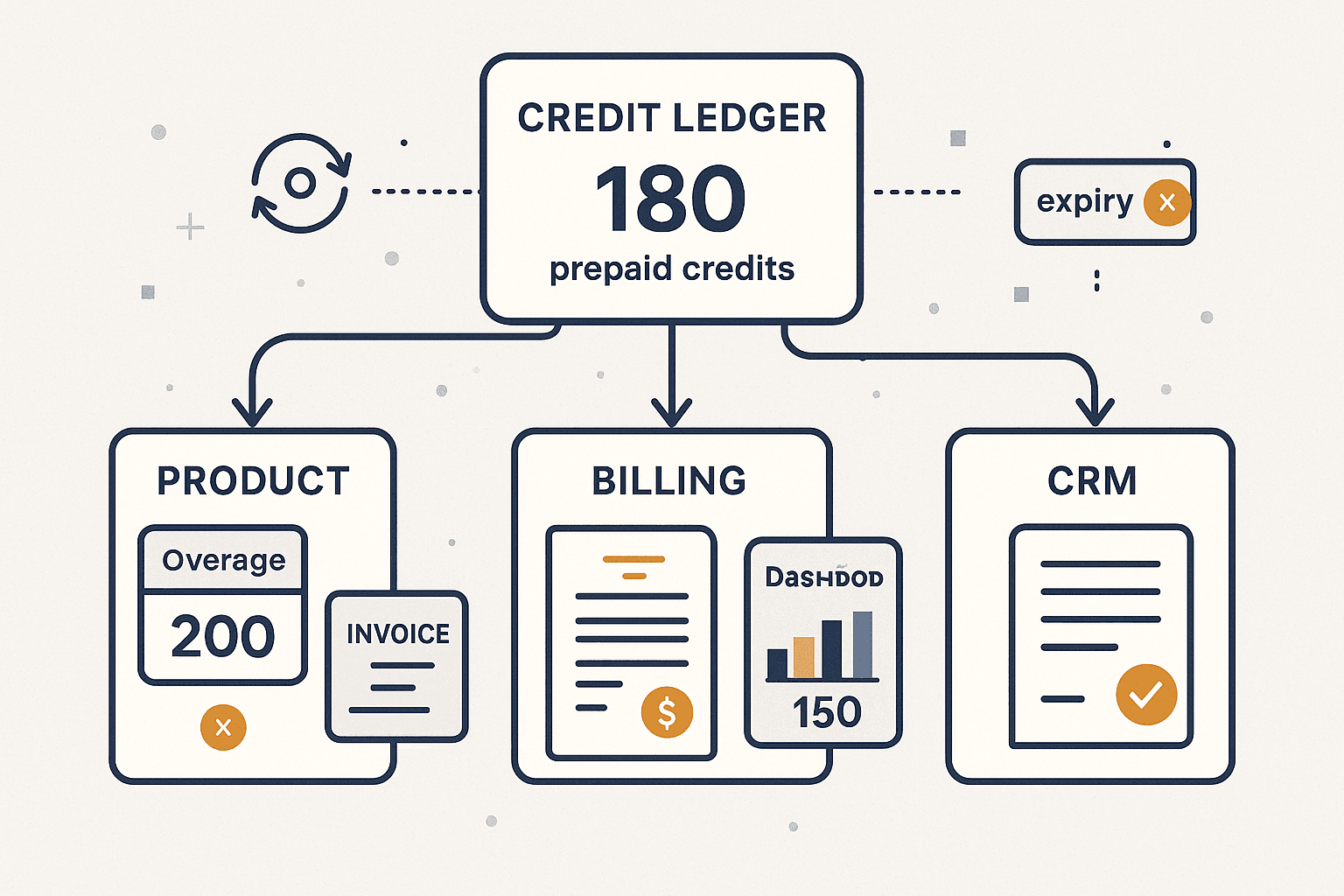
Most teams discover credit ledger drift only after it has already become expensive.
It usually starts with a perfectly reasonable product decision. You sell seats plus some usage. Or a platform fee plus prepaid credits. Or an annual contract with a monthly burn allowance. The product team wants flexibility, so they create “credits” as an abstraction layer between technical usage and commercial packaging. One API call might cost 1 credit. A data export might cost 10. Premium features might consume credits at a different rate by plan.
At first, this feels elegant. Sales can package deals. Marketing can position simple bundles. Product can change the underlying resource model without changing pricing pages every month.
Then six months later, support is handling angry tickets from customers who swear they had credits left. Finance is asking why recognized revenue doesn’t line up with invoiced balances. RevOps is trying to explain why Salesforce says an account bought 500,000 credits, Stripe shows three invoices, and the product database says they burned 620,000. The CEO wants a clean net revenue retention view and gets three different numbers depending on whether the source is billing, CRM, or app analytics.
That is credit ledger drift.
It is not one bug. It is the slow divergence between multiple systems that all think they define the same commercial reality:
- Product thinks credits are a usage control mechanism.
- Billing thinks credits are invoiceable units or prepaid liabilities.
- Finance thinks credits are deferred revenue waiting to be recognized under a policy.
- CRM thinks credits are what the rep sold and what should renew.
- Support thinks credits are whatever avoids churn in the current ticket.
When those definitions are not explicitly aligned, the company quietly builds five ledgers instead of one. You may still close deals and collect cash. But revenue recognition becomes fragile, trust gets eroded one dispute at a time, and go-to-market decisions get distorted because your “usage” numbers no longer mean the same thing across teams.
If you sell any mix of seats, prepaid usage, drawdown bundles, or consumption commitments, this is an operational problem worth fixing before scale makes it painful.
A real failure scenario
Here is what this looks like in practice.
A startup sells a $30,000 annual contract:
- 20 platform seats
- 300,000 prepaid credits
- overage available at a contracted rate
- credits expire at the end of the term
- premium workflow actions burn credits at higher rates
The systems are set up quickly:
- Salesforce stores the commercial deal terms.
- Stripe invoices annual prepayment and monthly overages.
- The product database tracks user actions and decrements a
remaining_creditsfield. - HubSpot stores renewal notes and CS activity.
- Finance uses an ERP plus spreadsheets to handle deferred revenue.
Everything works until enterprise customers start doing non-standard things:
- One customer negotiates a rollover of unused credits into Q1.
- Another gets bonus credits for signing a two-year deal.
- A third has multiple workspaces under one parent contract.
- A fourth upgrades mid-term and gets a blended package.
- Sales promises “soft overage protection” to avoid workflow interruptions.
Now the drift starts.
Failure mode 1: Product burn logic no longer matches contracted burn logic
In the app, a workflow run burns 5 credits if it uses model A and 10 if it uses model B. But sales sold an enterprise package where a whole workflow bundle was supposed to count as 1 credit per completed report, regardless of the internal steps.
Engineering never encoded that contractual exception. The product ledger burns based on infrastructure events. The customer success team manually adds credits every month to “true it up.”
Result:
- Customers see confusing balances.
- Support resolves disputes with ad hoc adjustments.
- You have no durable audit trail for why balances changed.
Failure mode 2: Billing treats credits as line items, not as a governed ledger
Stripe has invoices for prepaid credits and overage. But it does not intrinsically know whether those credits are promotional, purchased, rolled over, expired, workspace-specific, or tied to a contract version.
So when the customer asks, “Which credits did we consume first?” nobody knows for sure.
Result:
- Invoicing is technically correct but commercially ambiguous.
- Overage disputes become almost impossible to defend clearly.
- Finance cannot reliably separate purchased consumption from free promotional usage.
Failure mode 3: Finance recognizes revenue using a different usage concept than product
Finance has a policy that prepaid credits represent deferred revenue recognized as credits are consumed, unless the performance obligation is defined differently. But product is decrementing credits on internal events that may not equal billable customer value delivery.
Maybe failed jobs reverse sometimes and sometimes do not. Maybe retries burn credits temporarily. Maybe internal QA or admin actions accidentally hit production burn rules.
Result:
- Recognition schedules become manually adjusted.
- Audit support relies on spreadsheets and judgment calls.
- Gross margin analysis gets muddied because recognized revenue and infrastructure cost don’t map cleanly.
Failure mode 4: CRM overstates committed value and hides risk
Salesforce shows 300,000 prepaid credits sold. But 50,000 were bonus credits, 25,000 were emergency service recovery credits, and 40,000 were carried over from a prior exception. Meanwhile, usage dashboards only show “credits remaining” as a single balance.
At renewal, the rep says, “They only used 70% of the package; downsell risk.” The CS lead says, “No, real paid utilization is much higher once you remove bonus and carryover credits.” Both are partially right, neither has a reliable ledger.
Result:
- Renewal strategy is based on contaminated usage signals.
- Forecasting becomes political instead of analytical.
- Expansion opportunities are missed because true paid consumption is obscured.
This is the core pattern: once credits become a shared abstraction without a shared contract, every department optimizes locally and the company loses a single source of truth.
The pattern underneath the mess
Credit ledger drift usually emerges from four design mistakes.
1. You created a balance, not a ledger
A balance tells you how many credits remain right now. A ledger tells you:
- where credits came from
- under what terms they were issued
- in what order they should burn
- why they were adjusted
- whether they were purchased, free, rolled over, or courtesy
- what contract, invoice, and account they belong to
- whether they expire
- what event consumed them
Most startups begin with a balance field because it is fast:
customer.remaining_credits = 124550
That works until you need to answer basic operational questions:
- Did purchased credits burn before promo credits?
- Were expiring credits consumed first?
- Which contract funded this usage?
- Why did the balance jump by 20,000 last Thursday?
- Are overages valid or should available rollover have applied?
If you cannot answer those questions from a durable ledger, you do not have an operable credit system.
2. You let “credit” mean different things in different systems
The single word “credit” hides multiple meanings:
- a commercial packaging unit
- a product authorization unit
- a billable unit
- a rev rec trigger unit
- a customer-facing explanatory unit
Those may be related, but they are not automatically identical.
For example:
- Product may meter per API token, job, minute, or record processed.
- Packaging may sell bundles in simplified “credits.”
- Billing may invoice in dollar commitments plus drawdown schedules.
- Finance may recognize based on delivery of distinct services, not arbitrary burn events.
The mistake is assuming one abstraction can float across all of those domains without an explicit translation contract.
3. You modeled exceptions outside the system
Every startup has exceptions. That is not the problem. The problem is handling them through email, spreadsheets, one-off admin scripts, or undocumented support actions.
Common examples:
- courtesy credits after an outage
- contract amendments
- mergers of workspaces
- trial extensions
- write-offs of disputed overages
- temporary grace balances
- retroactive burn reversals
- non-expiring strategic credits
If these are not first-class ledger events, drift is inevitable.
4. You built reporting on top of operational ambiguity
Once drift exists, every dashboard becomes suspect.
- “Credit utilization” may mix free and paid usage.
- “Gross retention risk” may ignore expiry cliffs.
- “Average selling price” may be inflated by non-burnable commitments.
- “Expansion” may just be ledger cleanup or exception normalization.
This is why teams end up debating numbers rather than acting on them.
Why standard advice fails
A lot of common startup advice makes this worse because it optimizes for speed in the wrong place.
Standard advice 1: “Just keep pricing simple”
Simple pricing does not eliminate ledger complexity if delivery is variable.
Even if your pricing page says “$500/month includes 10,000 credits,” you still need rules for:
- what exactly consumes a credit
- whether failed attempts burn n- whether monthly credits accrue, reset, or roll over
- whether seats and credits interact
- what happens on mid-cycle upgrades
- which balance is consumed first if multiple grants exist
Simple packaging can sit on top of complex operational logic. If you ignore that, simplicity becomes a customer-facing veneer hiding internal inconsistency.
Standard advice 2: “Use Stripe for billing and it will handle it”
Stripe can invoice and collect money well. It is not, by itself, a comprehensive usage rights ledger, entitlement engine, or revenue policy engine.
The same is true for most billing tools. They can track subscriptions, metered events, invoices, credit grants, and balances to varying degrees. But they still depend on your company deciding:
- what a credit is
- which events are authoritative
- how exceptions are represented
- when burn occurs
- what ordering logic applies
- what customer-visible history exists
Buying a billing platform without defining these contracts is just renting a nicer place for ambiguity.
Standard advice 3: “Finance can reconcile monthly”
Monthly reconciliation is necessary, but if your operating model creates uncontrolled divergence daily, month-end becomes a cleanup ritual rather than a control.
The cost shows up as:
- delayed closes
- manual journal logic
- weak audit trails
- surprise write-offs
- late customer disputes
- GTM teams working off stale or incorrect usage data
You cannot spreadsheet your way out of an undefined ledger contract forever.
Standard advice 4: “We’ll fix it when we have scale”
This one is especially dangerous because the cleanup gets exponentially harder.
At small scale, one ops person can remember the three strategic customers with special rules. At 200 customers, those tribal-memory exceptions become revenue leakage and renewal confusion. At 2,000 customers, they become system migration pain and audit risk.
The right time to define your credit model is when you still can.
A better approach: define one commercial truth and let systems subscribe to it
The fix is not “put everything in one tool.” The fix is to establish one authoritative credit contract and one authoritative ledger model, then make product, billing, finance, and CRM consumers of that model.
That means five practical decisions.
1. Separate commercial credits from raw product usage
This is the most important conceptual move.
Your product should measure raw usage in the most accurate technical units available:
- API calls
- compute minutes
- rows processed
- storage GB-days
- reports completed
- workflow runs
- messages sent
Your commercial system can package those into credits if that helps pricing.
But do not treat the commercial abstraction as the sole source of operational truth.
A clean model looks like this:
- Meter events: immutable product events describing what happened.
- Rating logic: rules that convert meter events into commercial consumption units.
- Credit ledger: grants, burns, expiries, reversals, and adjustments against entitlements.
- Billing records: invoices and charges resulting from purchased packages or overages.
- Revenue policy mapping: rules for when ledger activity supports recognition.
This separation matters because it gives you re-rate capability. If you discover a burn bug or update pricing logic, you can recompute commercial outcomes from raw meter events instead of guessing from damaged balances.
Workflow example
For one completed workflow:
- Product emits meter events:
workflow_startedmodel_a_inference_usedreport_generated
- Rating service applies contract rules:
- enterprise contract says one completed report = 1 commercial credit
- Credit ledger posts:
- debit 1 purchased credit from grant
GRANT-2026-001
- debit 1 purchased credit from grant
- Billing engine checks whether purchased balance exists:
- yes, no overage invoice
- Finance mapping marks the debit as recognized against deferred revenue pool tied to that grant, if policy says usage-based recognition applies
That is very different from simply decrementing remaining_credits -= 1 in application code.
2. Design a real credit schema
Your schema should be able to represent the commercial truth without side channels.
At minimum, each credit grant should include:
grant_idaccount_idcontract_idcontract_versioninvoice_idor funding sourcegrant_type:- purchased
- promotional
- courtesy
- rollover
- service_recovery
- partner
quantityissued_ateffective_atexpires_atburn_priorityscope:- account
- workspace
- product line
- region
restrictions:- eligible features
- rate card version
- user class
recognition_treatmentcreated_byreason_code
Each consumption record should include:
consumption_idmeter_event_idor rated event referenceaccount_idworkspace_idcontract_idconsumed_atquantitycredit_type_consumedsource_grant_idrating_rule_versionreversal_ofif applicablecustomer_visible_description
Each adjustment should include:
adjustment_idtype:- manual grant
- reversal
- write-off
- expiry override
- migration correction
approved_byrequested_byticket_ideffective_periodreason_codenotes
If your schema cannot represent these things, the business will represent them in Slack and spreadsheets instead.
3. Define burn logic as policy, not code folklore
Burn logic needs to be explicit, versioned, and testable.
At minimum, answer these questions:
What event causes burn?
Is it:
- request submitted?
- successful completion?
- delivered output?
- downloaded asset?
- accepted result?
For customer trust, “successful delivery of the contracted unit of value” is usually safer than “attempted internal processing.” But there are tradeoffs. Infrastructure-heavy products may need partial charging rules to prevent abuse.
What burns first?
Common ordering policies:
- expiring credits first
- promotional credits first
- purchased credits first
- contract-specific bucket first
- oldest effective date first
Tradeoff:
- Burning promo first is customer-friendly but can reduce conversion pressure.
- Burning purchased first preserves promo upside but can create ugly expiry surprises.
- Burning earliest expiry first is defensible and usually easiest to explain.
Pick one. Document it. Put it in customer-facing terms.
How are failures handled?
Decide explicitly:
- failed job = no burn
- failed job = temporary hold, auto-reverse after timeout
- partially completed workflow = reduced burn
- customer-caused invalid input = burn still applies
The worst outcome is inconsistent handling by support.
How are retries handled?
Retries are a classic source of silent drift. If your system retries jobs internally, customer credits should usually not burn multiple times unless the commercial policy clearly says otherwise.
How are amendments handled?
If a customer upgrades mid-term:
- do new grants merge with old pools?
- keep separate expiry dates?
- preserve original rate card treatment?
- change burn rules prospectively only?
Versioning matters here. Never overwrite the historical contract context behind an existing grant.
4. Make expiry policy boring and defensible
Expiry creates some of the highest-trust customer moments in usage businesses.
A bad expiry policy is one that is legally valid but operationally surprising.
A better expiry policy has four traits:
- simple enough to explain in one sentence
- visible in-product well before deadline
- encoded directly in burn order and renewal workflows
- consistently applied, including exceptions
Practical expiry rules that work
Good examples:
- annual prepaid credits expire at term end; earliest-expiring credits burn first
- monthly included credits reset monthly and do not roll over
- bonus credits expire before purchased credits and are always burned first
- outage-related courtesy credits expire in 90 days and are segregated from purchased utilization reporting
Bad examples:
- “credits may expire depending on contract terms”
- silent grace periods for some customers only
- end-of-quarter manual rollover decisions
- backdated expiries done by finance after the fact
If you grant exceptions, make them new ledger entries with their own explicit dates. Do not mutate the original history.
5. Create a reconciliation contract across systems
You need a defined answer to: which system is authoritative for what?
A practical startup allocation looks like this:
Product or metering layer is authoritative for
- raw usage events
- event timestamps
- technical dimensions
- event success/failure state
Rating/entitlements layer is authoritative for
- mapping raw usage to billable/creditable consumption
- burn ordering
- grant application
- overage determination
- reversals
Billing platform is authoritative for
- invoice issuance
- payment collection
- tax-calculated charges
- customer-facing financial documents
ERP/finance system is authoritative for
- journal entries
- deferred revenue balances
- recognized revenue
- accounting period close
CRM is authoritative for
- contracted commercial intent
- renewal terms
- amendment approvals
- GTM ownership
The trick is not to make one system own all truths. The trick is to define interfaces so each truth maps cleanly.
Tooling comparison: what each category can and cannot do
No tool stack removes the need for ledger design, but some stacks are better fits depending on complexity.
Option 1: Stripe + app database + spreadsheets
Best for:
- very early-stage companies
- low exception volume
- simple monthly reset credits
Pros:
- fast to launch
- low software overhead
- strong payment UX
Cons:
- weak entitlement governance by default
- custom engineering required for durable ledger behavior
- finance reconciliation becomes manual quickly
- CRM/billing/product semantic drift happens fast
Typical cost:
- software cost low
- operator time high
- engineering cleanup cost delayed but real
Reality:
This is acceptable only if you intentionally keep credit logic simple and plan a migration point.
Option 2: Billing platform with usage support + custom metering/rating layer
Best for:
- startups with mixed subscriptions and usage
- moderate contract variation
- need for clearer invoicing and overage handling
Pros:
- better subscription and invoice controls
- more structured metered billing workflows
- easier pricing evolution than pure custom
Cons:
- still usually requires custom ledger or entitlement logic
- can create false confidence that billing equals product rights
- contract-specific exceptions still get awkward
Typical cost:
- software cost medium
- implementation time medium
- operational scalability better than spreadsheets
Reality:
For many Series A and B companies, this is the practical middle path.
Option 3: Dedicated metering/usage/entitlement stack + billing + ERP integration
Best for:
- enterprise contracts
- prepaid drawdown models
- multiple grant types and exceptions
- finance sensitivity and audit needs
Pros:
- strongest separation of metering, rating, entitlement, billing, and accounting concerns
- better auditability
- easier to support complex amendments and reconciliation
Cons:
- more systems and integration work
- higher upfront process discipline required
- can be overkill for immature pricing models
Typical cost:
- software cost medium-high to high
- implementation time high
- long-term control substantially better
Reality:
If credit products are core to monetization, this approach often becomes necessary earlier than founders expect.
What to implement in the next 30, 60, and 90 days
Most startups do not need a six-month architecture program. They need a controlled stabilization plan.
First 30 days: stop the bleeding
1. Define a credit dictionary
Get product, finance, revops, and sales in one room and decide:
- what a credit means commercially
- what events generate consumption
- what grant types exist
- what counts as paid versus free usage
- what expiry terms exist
- what overage means
Produce one shared doc with field-level definitions.
2. Inventory all exception types
Pull the last 6–12 months of:
- support credits
- contract amendments
- service recovery grants
- rollovers
- manual balance changes
- disputed invoices
If you are surprised by the list, that is the point.
3. Freeze new undocumented exception behavior
No more ad hoc admin adjustments without:
- reason code
- approver
- ticket reference
- effective date
Even before your system is fixed, your operating discipline can improve.
4. Create three reconciled reports
Every week, reconcile:
- product-rated consumption
- billed usage/credit activity
- finance-recognized usage-linked revenue
At first this may be spreadsheet-based. That is fine. The goal is visibility into drift magnitude.
5. Add customer-visible balance transparency
Even a basic ledger history view can reduce disputes:
- credits purchased
- credits consumed
- promo or courtesy grants
- expiry dates
- adjustments
A black-box balance is where trust goes to die.
Days 31–60: build the minimum viable ledger
1. Move from balance mutation to append-only events
Do not just store the current balance. Store:
- grant events
- consumption events
- reversals
- expiries
- adjustments
Balances can be computed materializations of ledger state.
2. Version your rating rules
Every consumption event should be traceable to a rating rule version. That matters when pricing logic changes or bugs need correction.
3. Encode burn priority
Implement deterministic allocation logic, for example:
- eligible grants only
- sort by earliest expiry
- then by grant type priority
- then by oldest issuance
Now two people should not get two different answers to “why did overage occur?”
4. Separate paid and non-paid pools in reporting
Your dashboards should distinguish:
- purchased credits
- promotional credits
- courtesy/service recovery credits
- rollover credits
- expired unused purchased credits
- overage beyond prepaid pools
This single change dramatically improves renewal analysis.
5. Put approval controls on manual adjustments
Not because you distrust your team, but because scale amplifies ambiguity.
Minimum control:
- requester
- approver
- amount
- type
- account impact
- rev rec impact flag
- customer communication status
Days 61–90: connect GTM, finance, and product workflows
1. Make CRM store structured contract attributes, not just notes
Do not rely on free text like “includes rollover exception.” Use fields or linked contract objects for:
- grant quantity by type
- overage rate
- expiry rule
- rollover allowed Y/N
- workspace scope
- burn special terms
- amendment effective date
2. Build renewal risk views off paid utilization, not blended balances
A strong renewal dashboard includes:
- paid credit utilization percent
- promo/courtesy share of total burn
- days to expiry
- overage frequency
- peak monthly drawdown trend
- workspace concentration
- dispute history
This is the difference between “they have 40% left” and “they are actually on track to exhaust paid capacity by month 10 but courtesy credits are masking it.”
3. Align finance policy with product event definitions
Finance should explicitly sign off on:
- what consumption event supports recognition
- how reversals affect recognized revenue
- how expiries affect deferred balances
- how free credits are excluded from paid revenue schedules
This is not something to sort out only during audit prep.
4. Add proactive customer notifications
Useful triggers:
- 75%, 90%, 100% paid pool consumed
- 30 days to expiry
- approaching soft overage threshold
- promotional credits about to expire
- unusual usage spike by workspace
These reduce disputes and also create expansion moments.
Exception handling: where good systems usually fail
You should assume exceptions are permanent, not temporary.
Here is how to handle the common ones.
Bonus credits
Treat as separate grants with:
- distinct
grant_type = promotional - separate expiry
- explicit burn priority
- exclusion from paid utilization metrics
Service recovery credits
Treat separately from promo. They represent remediation, not demand generation.
Why it matters:
If you mix these with promo, you lose the ability to measure product instability cost and contaminate expansion analysis.
Rollovers
Never silently extend original grant dates. Create a new rollover grant linked to the original grant, with:
- rollover source reference
- approved amount
- new expiry
- policy basis or exception reason
Mid-term upgrades
Create a new contract version and new grants. Do not overwrite old grant economics. If blending is needed for customer-facing simplicity, maintain separate ledger identity underneath.
Parent-child account structures
If one parent contract funds multiple workspaces or subsidiaries, define allocation rules clearly:
- shared central pool
- workspace-specific sub-limits
- region/product restrictions
- transfer permissions
This needs to be in the schema, not in CSM memory.
Soft overage protection
A lot of sales teams promise some form of “we won’t hard-stop you immediately.” Fine, but encode it.
Examples:
- allow up to 10% negative balance before enforcement
- grace pool valid for 7 days pending top-up
- auto-convert excess to invoiceable overage after threshold
If soft overage is undefined, support will create de facto credit policy case by case.
Cost and time analysis: why this matters financially
Founders often see ledger work as back-office complexity. It is actually a growth and margin issue.
Here is the hidden cost structure of drift.
Support and CS time
If even 3% of accounts generate one credit dispute per quarter, and each dispute costs:
- 30 minutes support triage
- 45 minutes CS review
- 30 minutes billing/finance check
- 15 minutes engineering/admin action
That is 2 hours per dispute before customer communication loops. At 500 accounts, you can easily burn dozens of operator hours monthly on avoidable ambiguity.
Revenue leakage
Leakage usually comes from:
- unbilled overages
- excessive courtesy grants to resolve confusion
- missed expiries due to undocumented promises
- misapplied rollovers
- inability to enforce contracted burn logic consistently
Even 1–2% leakage on a $5M ARR book is material.
Forecast distortion
When paid and unpaid usage are blended, you misread:
- expansion readiness
- renewal capacity fit
- gross retention risk
- pricing adequacy
This leads to bad GTM behavior:
- reps discounting because utilization appears low
- CS missing expansion because usage appears cushioned
- leadership overestimating product-market fit for certain segments
Finance overhead
Month-end manual reconciliations are not free. Neither is delayed close, audit prep, or policy remediation later.
A rough founder-grade calculation:
- 1 finance lead spending 8–20 extra hours monthly
- 1 revops or bizops lead spending 4–10 hours monthly
- engineering interruptions for tracebacks
- external audit friction increasing over time
This is one of those problems that looks “operational” until you quantify the fully loaded time.
A practical operating model that works
If I were setting this up in a startup that had already felt some pain but was not yet at full enterprise complexity, I would use this operating model.
System of record design
- Product emits immutable usage events.
- A rating service maps events to commercial consumption.
- An append-only ledger stores grants, burns, reversals, expiries, and adjustments.
- Billing receives invoiceable outcomes, not raw guesses.
- ERP receives summarized accounting feeds tied to ledger identities.
- CRM stores structured commercial terms and amendment metadata.
Weekly operating cadence
- RevOps reviews top 20 accounts by usage anomalies.
- Finance reviews ledger-to-billing-to-recognition reconciliation deltas.
- CS reviews accounts nearing expiry or overage thresholds.
- Product reviews failed-event burn/reversal rates.
Monthly control points
- drift report by account and contract
- manual adjustment log review
- expired credit report
- free-versus-paid consumption mix
- top dispute root causes
Ownership
Do not dump this entirely on engineering.
Recommended ownership split:
- Product/engineering: metering integrity, entitlement logic, event reliability
- Finance: rev rec policy, accounting treatment, auditability
- RevOps/BizOps: contract data hygiene, reconciliation workflows, reporting definitions
- CS/support: customer communication and exception intake
- Sales leadership: approval guardrails for non-standard credit promises
Someone senior, usually BizOps, RevOps, or a product-minded finance operator, should own the cross-functional contract.
The takeaways
Credit ledger drift is what happens when a startup sells one commercial story and runs four different operational interpretations of it.
You feel it first as support noise. Then as invoicing disputes. Then as messy rev rec. Then as forecast confusion. By the time leadership notices, the damage is usually not catastrophic, but it is expensive, distracting, and surprisingly corrosive to customer trust.
The good news is the fix is not mysterious.
- Treat balances as outputs, not the system.
- Build an append-only ledger, not mutable credit counters.
- Separate raw usage metering from commercial credit packaging.
- Version rating and burn logic.
- Make exceptions first-class events.
- Distinguish paid, promo, courtesy, and rollover pools.
- Define clear authority boundaries across product, billing, finance, and CRM.
- Base GTM decisions on paid utilization and true expiry exposure, not blended balances.
If you do this well, you get more than cleaner finance.
You get faster dispute resolution, more credible renewals, better expansion timing, fewer “special case” arguments, and a pricing system you can evolve without breaking trust every quarter.
Founder to founder: if credits are part of your monetization, this is not admin work. It is core product infrastructure for revenue. The earlier you treat it that way, the less time you will spend later explaining numbers nobody fully believes.