
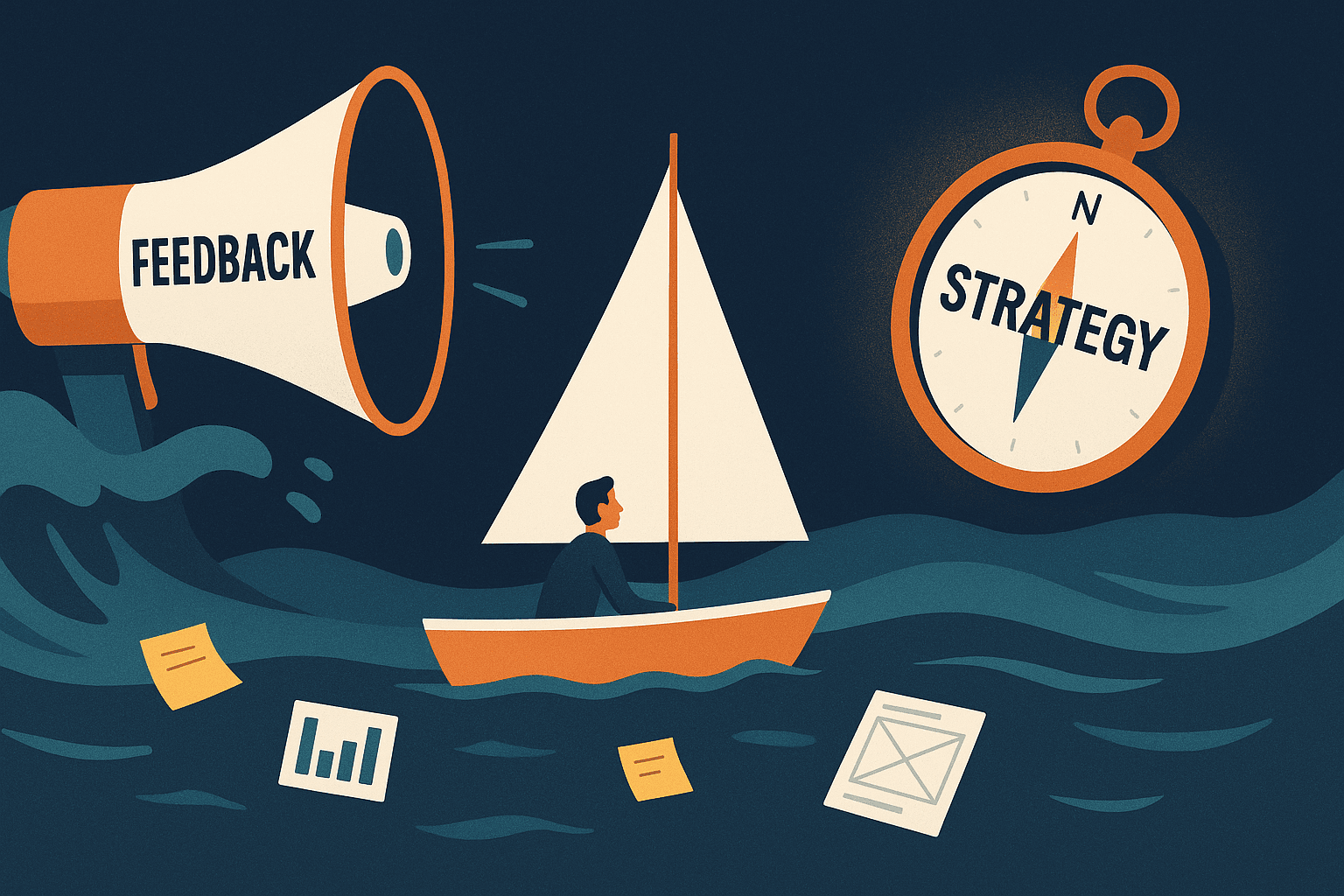
The uncomfortable truth about “customer-led”
“Be customer-led” is one of those startup commandments that sounds universally correct. It’s also the source of a lot of quietly failed companies.
Not because listening to customers is bad, far from it. The failure mode is more specific:
- Teams over-index on what customers say instead of what they do.
- They treat feedback as a roadmap rather than as evidence.
- They chase feature requests from the wrong buyers, at the wrong time, for the wrong reasons.
The result is a product that feels “responsive,” yet never becomes necessary. It accumulates complexity, edge cases, configuration screens, and one-off integrations, until differentiation collapses and shipping slows to a crawl.
This article makes an opinionated case: customer-led is a myth if you define it as “build what users ask for.” The winning version is closer to: use customer reality to validate a sharp point of view.
We’ll cover:
- When customer feedback becomes a trap (and why it’s so seductive)
- The most common biased signals and how to detect them
- A practical decision framework: ignore vs test vs build
- Early warning signs you’re drifting into “feedback theater”
Throughout, we’ll anchor the discussion in established product thinking (discovery, jobs-to-be-done, lean experimentation) and what research says about stated preferences vs revealed behavior.
Why startups die from listening (not from ignoring)
1) Customers describe solutions, not problems
Users are often right about pain and wrong about prescription.
If a customer says:
“You should add a dashboard with 12 filters and a weekly PDF export.”
They may be expressing:
- anxiety about reporting to leadership,
- a trust deficit in your system,
- a workflow mismatch (they live in email and spreadsheets),
- a compliance requirement,
- or simply that your product is not integrated with their existing BI tools.
Taking the request literally bakes in someone else’s local optimization.
This pattern aligns with long-standing product research: people are notoriously poor at predicting what they will value in the future or in unfamiliar contexts, and preferences are heavily context-dependent (see Daniel Kahneman’s work on cognitive biases and prospect theory; also the broader behavioral economics literature).
Practical takeaway: treat feature requests as symptoms. Your job is diagnosis.
2) The loudest users are rarely the best market signal
Early customers skew toward:
- early adopters with unusual tolerance for friction,
- power users with atypical workflows,
- or highly motivated “helpers” who like influencing products.
If you let the loudest voices shape the roadmap, you risk building a product that is perfect for a small, eccentric corner of the market.
This is one reason product teams emphasize triangulation: qualitative feedback is rich, but you need to corroborate it with behavioral and market evidence.
Reference concepts:
- Geoffrey Moore’s Crossing the Chasm describes the gap between early adopters and the early majority and why designing for one can fail with the other.
3) “Customer-led” can mask strategy avoidance
Roadmaps built from a queue of requests feel objective:
- “We’re not guessing; we’re listening.”
- “We’re just responding to demand.”
But strategy is the act of choosing what not to do. If you don’t choose, your customers will choose for you, each one optimizing for their environment, not for your company’s position.
In B2B especially, this becomes a slippery slope:
- one enterprise wants SSO,
- another wants on-prem,
- another wants custom roles,
- another needs a specific integration,
…and suddenly your startup becomes a bespoke software shop.
There is a time when enterprise hardening is the right move. The trap is doing it before you have a repeatable sales motion and a clear wedge.
When customer feedback becomes a trap (the “four horsemen”)
Not all feedback is equal. Here are four scenarios where “listen and build” is especially dangerous.
Horseman #1: You’re pre-product/market fit and talking to non-buyers
If you’re getting feedback primarily from:
- users who won’t pay,
- stakeholders who don’t own the budget,
- internal champions without authority,
…you’re likely optimizing for adoption theater rather than revenue reality.
In many B2B contexts, the buyer and user differ. Ignoring users is a mistake, but building solely from user delight can misalign pricing, packaging, and compliance needs.
Early indicator: high praise in demos, low conversion to paid.
Horseman #2: You’re being pulled into edge-case hell
Edge-case requests are seductive because:
- they come with urgency,
- they sound specific and solvable,
- and they often come from your largest logo.
But the cost isn’t just engineering time. It’s:
- increased surface area,
- more support burden,
- slower onboarding,
- harder QA,
- more permissions and configuration,
- and eventually a product that is harder to explain.
If your roadmap begins to look like a pile of exceptions, you’re likely losing the simplicity that makes startups win.
Rule of thumb: if you can’t explain the feature as improving the core workflow for a broad segment, it’s probably debt.
Horseman #3: Customers want you to be a “platform” before you’re a product
Requests like:
- “Make it fully customizable.”
- “Expose everything via API.”
- “Let us define our own objects.”
…can be legitimate eventually. But platform work too early creates a classic failure mode: you build infrastructure while still uncertain what should be built.
Marty Cagan and Teresa Torres have both emphasized (in different ways) that strong product discovery is about reducing risk before scaling build-out.
Early indicator: lots of engineering progress, but your ICP and value proposition remain fuzzy.
Horseman #4: Feedback is driven by politics, not workflow
In enterprises, feature requests often come from:
- internal reporting cycles,
- compliance checklists,
- procurement requirements,
- power dynamics between teams.
Some of these are real constraints. Others are bureaucracy.
A customer might demand a feature not because it improves outcomes, but because it helps them justify a purchase, win internal approval, or reduce personal risk.
That doesn’t mean you should ignore it. It means you should classify it correctly:
- Is this a value driver (improves outcomes)?
- Or a friction reducer (helps purchase happen)?
They’re different, and they deserve different treatment.
Biased signals: how customer feedback misleads you
Feedback doesn’t arrive as a clean dataset. It arrives through incentives, psychology, and sampling bias.
Bias #1: Selection bias (who you’re hearing from)
You hear from:
- churn risks,
- power users,
- friendly champions,
- prospects who like talking.
You often don’t hear from:
- silent users who tried and left,
- mid-market teams who didn’t respond,
- budget owners who declined.
Fix: systematically interview:
- churned users,
- lost deals,
- “no decision” deals,
- and users who adopted without handholding.
A balanced feedback pipeline beats a large one.
Bias #2: Courtesy bias (they want to be nice)
In early-stage startups, especially founder-led sales, prospects often avoid direct negativity:
- “This is interesting.”
- “We’ll circle back.”
- “Let’s keep in touch.”
These are not signals of value.
Fix: ask forcing questions:
- “What would you use instead if we didn’t exist?”
- “What budget line would this come from?”
- “Who would block this internally?”
- “What happens if you do nothing for six months?”
These questions surface truth without requiring confrontation.
Bias #3: Recency and availability bias (what’s top of mind)
Customers often report whatever is currently painful:
- last week’s incident,
- the newest compliance audit,
- the latest executive request.
That might be important, or it might be temporary noise.
Fix: ask for frequency and impact:
- “How often does this happen?”
- “What’s the cost when it happens?”
- “What do you do today to solve it?”
Bias #4: Solution anchoring (they hand you their design)
Humans anchor. The first proposed solution becomes the reference point.
If you build the anchored solution, you might ship something that:
- matches their mental model,
- but fails to scale,
- and doesn’t differentiate.
Fix: always reframe into jobs and outcomes:
- “What’s the job you’re trying to get done?” (Jobs-to-be-Done thinking is widely associated with Clayton Christensen and practitioners like Bob Moesta.)
- “What would success look like?”
- “How will we measure that success?”
The real goal: customer-informed, strategy-led
The best teams don’t ignore customers. They treat customer input as one input into a deliberate system.
A useful mental model:
- Customers are the best source of truth about reality.
- You are the best source of truth about direction.
Your job is to translate reality into a coherent direction, not to outsource direction to a committee.
That requires:
- A clear ICP (ideal customer profile)
- A sharp “wedge” use case
- A value metric and North Star
- A disciplined way to turn feedback into decisions
Let’s make that last part concrete.
A practical framework: Ignore vs Test vs Build
Here’s a decision system you can run in weekly product triage.
Step 1: Classify the feedback by type
Every piece of input is one of these:
-
Pain signal: “This part is slow/confusing/broken.”
-
Outcome signal: “We need to achieve X; we can’t today.”
-
Workflow signal: “Here’s how we actually do it.”
-
Constraint signal: “We can’t buy unless Y (SSO, SOC2, data residency).”
-
Solution request: “Build this feature.”
Solution requests are the least reliable category. Treat them as hypotheses.
Step 2: Score it with five questions
Use a lightweight rubric. For each item, score 1–5:
-
ICP fit: does this come from your target segment or a distraction segment?
-
Frequency: how often does the pain occur across accounts?
-
Severity: what is the economic cost (time, revenue, risk)?
-
Strategic leverage: does it strengthen your wedge and differentiation or push you toward parity?
-
Evidence quality: is this backed by behavior (usage data, conversion, retention) or just opinion?
Total score drives the action.
Step 3: Decide the track
Track A, IGNORE (or explicitly deprioritize)
Ignore when:
- low ICP fit,
- low frequency,
- mostly a “nice to have,”
- or it would balloon complexity.
Important: ignoring is not ghosting. Close the loop:
- “We understand the request. It’s not aligned with our current focus on X. If that changes, we’ll revisit.”
This preserves trust without turning your roadmap into a wishlist.
Track B, TEST (when you’re uncertain but it might matter)
Test when:
- you believe the underlying pain is real,
- but you’re uncertain about the solution,
- or you need proof of willingness to pay.
Good tests are cheap and fast:
- concierge workflow (do it manually behind the scenes),
- prototype in Figma,
- a fake-door UI test,
- limited beta for a single segment,
- pricing test via packaging (e.g., “available on Pro plan”).
This aligns with Lean Startup principles (Eric Ries): treat product changes as hypotheses to validate with experiments, not assumptions to build out fully.
Track C, BUILD (when it’s core and proven)
Build when:
- it’s a repeated pain in your ICP,
- it affects activation/retention/revenue,
- and you have evidence that solving it improves the core loop.
Even then, build the minimum coherent version that moves the metric.
How to detect “feedback theater” early
Startups drift into customer-led failure gradually. Watch these leading indicators.
Signal 1: Your roadmap is described in customer names
If roadmap items sound like:
- “Acme requested…,”
- “Globex needs…,”
…rather than:
- “Reduce time-to-first-value,”
- “Increase weekly active teams,”
- “Improve onboarding conversion,”
…you’re being pulled by accounts, not by a product thesis.
Signal 2: Sales is closing with promises engineering can’t sustainably deliver
If deals rely on:
- custom integrations,
- bespoke workflows,
- “we’ll add that next month,”
…you’re buying revenue with future complexity.
Sometimes this is rational (early survival). But it must be conscious and bounded:
- explicit “custom work budget,”
- clear graduation path to productized features,
- pricing that compensates for entropy.
Signal 3: Usage doesn’t match enthusiasm
Common pattern:
- Customers say they want a feature.
- You ship it.
- Adoption is low.
This is a classic gap between stated preference and revealed behavior.
Fix: require a pre-commitment for bigger builds:
- design partners sign LOIs,
- commit to a paid tier,
- agree to be a reference,
- or at least schedule implementation time.
Signal 4: You’re adding configuration faster than you’re adding value
Configuration is often a symptom of unclear product opinion.
Some configuration is necessary (especially in B2B). But when every request becomes:
- another toggle,
- another permission layer,
- another settings page,
…you’re deferring the hard work of choosing a default.
Signal 5: Support load rises with every release
If every new feature increases:
- tickets,
- onboarding time,
- documentation burden,
…you’re accumulating “complexity debt.”
Complexity debt is like technical debt but harder to refactor because it’s tied to customer expectations.
The nuance: when you should be customer-led
The contrarian take isn’t “ignore customers.” It’s “listen differently.”
Here are cases where strong customer pull is a good sign.
1) When customers are already hacking together a workaround
If users:
- export data to spreadsheets,
- write scripts against your API,
- build Zapier chains,
- or maintain internal SOPs to compensate,
…that’s revealed demand.
Workarounds are expensive. People only adopt them when the job is important.
2) When feedback aligns with your core loop metrics
If the request plausibly improves:
- activation (time-to-first-value),
- retention (habitual use),
- expansion (more seats/usage),
- or willingness-to-pay,
…take it seriously.
3) When constraints block purchase in your ICP
Security, compliance, and procurement requirements can be real gating factors.
If your ICP is mid-market IT or enterprise, “constraint features” like:
- SSO/SAML,
- SOC 2,
- audit logs,
- data retention policies,
…may not be differentiators, but they unlock the market.
Treat them as go-to-market enablers, not as customer whim.
A better way to run customer discovery (so you don’t get tricked)
Interview for decisions, not for opinions
Bad question:
- “Would you use this?”
Better questions:
- “Walk me through the last time this happened.”
- “What did you do next?”
- “Who else was involved?”
- “What tools were used?”
- “What broke?”
- “How did you measure success?”
This is consistent with the Mom Test style of interviewing (Rob Fitzpatrick): ask about past behavior, not hypothetical futures.
Force tradeoffs
If you ask, “Do you want feature A?” most will say yes.
Instead:
- “If we could only improve one thing this quarter, speed, accuracy, or collaboration, what would you pick?”
- “What would you give up to get this?”
Tradeoffs reveal priorities.
Separate “problem validation” from “solution validation”
- First validate the problem: frequency, severity, who owns it, what it costs.
- Then validate candidate solutions with prototypes and tests.
Don’t combine them in one conversation where your excitement biases the customer.
Quantify willingness to pay without being awkward
You don’t need to demand a price on the spot. But you do need evidence:
- “Is this a budgeted initiative?”
- “What did you pay for the current tool?”
- “What would you expect to spend to solve this?”
In B2B, budget reality is often the difference between a “cool product” and a company.
Case patterns: how this fails in real life (without naming names)
Pattern A: The integration trap
A B2B SaaS sells to ops teams. Early customers demand integrations:
- CRM, data warehouse, ticketing, messaging, custom webhooks.
The startup obliges, building a growing matrix of connectors.
Two quarters later:
- onboarding takes weeks,
- every integration has edge cases,
- support dominates engineering time,
- and new prospects say, “Looks like everyone else.”
Root mistake: integrating before establishing a differentiated workflow that justifies the integration.
Better approach: start with 1–2 integrations that reinforce the wedge, then build a scalable integration architecture after you’ve proven repeatability.
Pattern B: The enterprise feature mirage
A promising enterprise prospect says:
- “We’ll sign if you add SSO, audit logs, and custom roles.”
The startup builds it, but procurement still drags, the deal slips, and the startup is now maintaining enterprise complexity without enterprise revenue.
Root mistake: treating a single deal as proof of market readiness.
Better approach: require a concrete commitment (paid pilot, signed LOI with dates, or a meaningful deposit) before major enterprise hardening.
Pattern C: The “dashboard company”
Customers keep asking for dashboards. The team ships many dashboards. Adoption is mediocre.
The real issue was not visibility, it was that upstream data entry was unreliable, and no one trusted the numbers.
Root mistake: building reporting on top of a broken data loop.
Better approach: fix the core data capture and trust model first; reporting becomes valuable naturally.
A concise operating model for product teams
If you want something you can actually implement, use this weekly cadence.
1) Weekly: Feedback ingestion with tagging
Tag each input by:
- ICP segment
- job-to-be-done
- funnel stage (activation, retention, expansion)
- type (pain/outcome/workflow/constraint/solution)
2) Biweekly: Evidence review
Pull:
- top churn reasons,
- lost deal reasons,
- activation drop-offs,
- feature adoption.
Look for alignment (or mismatch) with the loudest feedback.
3) Monthly: Strategy checkpoint
Answer:
- Are we still building toward the same wedge?
- What are we saying “no” to?
- What complexity did we add, and what did it buy us?
4) Quarterly: Re-validate ICP and positioning
Markets move. Your early adopter base may not be your long-term base.
Reassess:
- which segment retains best,
- which segment expands,
- which segment refers others,
- and which segment costs the least to support.
This keeps “customer-led” grounded in the right customers.
What to ignore, specifically (a non-exhaustive list)
Ignoring doesn’t mean dismissing. It means choosing.
Consider ignoring or deferring:
- requests that only matter after extreme scale (premature optimization),
- features that replicate incumbents without improving your wedge,
- heavy customization demands from a single account,
- requests that conflict with your product’s core mental model,
- “platform” requests before you have a stable core object model,
- and anything that requires ongoing manual support to function.
A startup’s scarcest resource is not time, it’s focus compounded over time.
The test-before-build toolkit (fast ways to find truth)
Here are practical tests that reduce risk:
-
Fake door: add a UI entry point for a feature; measure clicks and follow-up intent.
-
Concierge MVP: deliver the outcome manually; learn what “done” means.
-
Wizard-of-Oz: simulate automation behind the scenes; validate workflow.
-
Prototype test: Figma + 5–10 target users; look for comprehension and time-to-task.
-
Pricing/packaging gate: put it behind a higher tier; see if expansion happens.
-
Design partner program: limited seats; explicit commitments; time-boxed.
These tests aren’t just for consumer products. B2B teams can use them effectively, especially with clear success criteria.
The core idea: listen for truth, not direction
The best founders and product leaders do something subtle:
- They listen intensely.
- They take customers seriously.
- And then they make decisions customers wouldn’t make.
Customers can’t see your full market map. They can’t feel your constraints. They don’t know which compromises destroy your differentiation.
But they can tell you:
- what’s painful,
- what’s broken,
- what they’re trying to accomplish,
- what they do instead,
- and what risks block purchase.
That is the raw material.
Your job is to turn that raw material into a product with a point of view.
A simple checklist to know early if you’re being “customer-led” in the bad way
If you answer “yes” to 3+ of these, you’re at risk:
- We ship features primarily because a specific customer asked.
- We can’t articulate what we’re saying “no” to and why.
- Feature adoption is consistently lower than expected.
- Support and onboarding effort increase each release.
- Sales promises are driving engineering priorities.
- Our product has many toggles/configuration paths for the same job.
- Our happiest users are not the users who expand or renew.
If that’s you, the fix is not to stop listening. It’s to rebuild your decision pipeline:
- tighten ICP,
- re-center on the core loop,
- require evidence,
- test before building,
- and treat feature requests as hypotheses, not instructions.
Closing: the “customer-led” myth you should actually believe
The myth is: customers know what you should build.
The better belief is:
Customers know their world. You must decide your product.
Be customer-informed. Be evidence-led. Be strategy-driven.
That combination is how you avoid building a Frankenstein roadmap, and how you build something customers didn’t ask for, but end up unable to live without.
References and further reading
- Eric Ries, The Lean Startup (hypothesis-driven product development)
- Rob Fitzpatrick, The Mom Test (customer interviews grounded in behavior)
- Geoffrey A. Moore, Crossing the Chasm (early adopters vs mainstream markets)
- Clayton Christensen (and Jobs-to-be-Done practitioners like Bob Moesta) on JTBD theory and outcome-driven thinking
- Marty Cagan, Inspired and Empowered (product discovery and empowered teams)
- Teresa Torres, Continuous Discovery Habits (continuous discovery practices)
- Daniel Kahneman, Thinking, Fast and Slow (cognitive biases affecting stated preferences)