
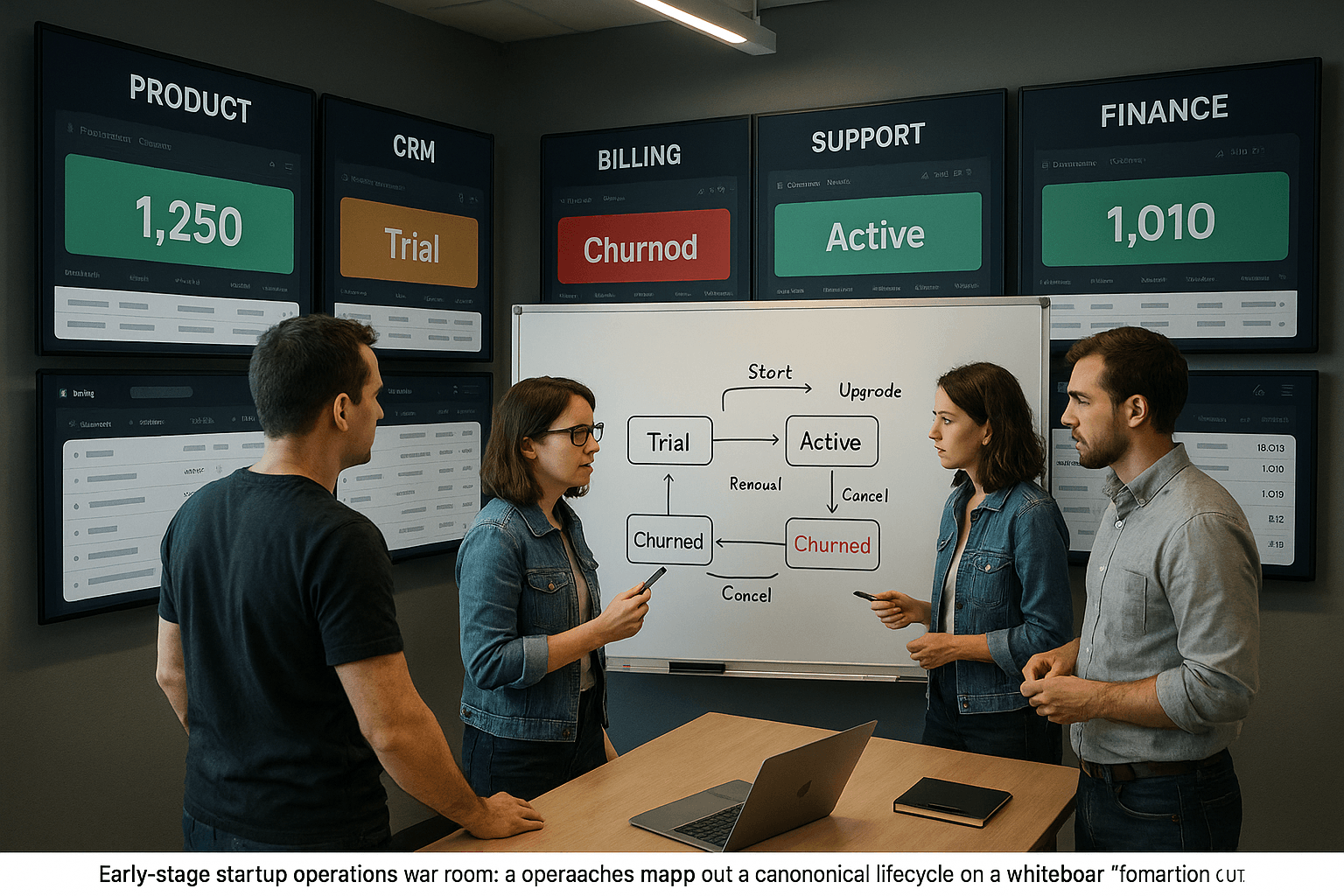
A few years ago, I watched a startup accidentally build three different companies on top of the same customer base.
The product database said 1,842 active customers.
Stripe said 1,611 paying subscriptions.
The CRM said 2,094 “customers,” because sales had converted anyone who signed an order form, even if onboarding never finished.
Support had its own logic: any account with a ticket in the last 90 days counted as active, because that was the fastest way to route priority queues.
Finance had a spreadsheet that removed paused accounts, delinquent invoices, and a handful of enterprise customers billed annually offline. Their board deck showed 1,527 active customers.
None of these numbers were random. Every team had a reason. Every system had logic that made sense locally.
And that was exactly the problem.
Customer success sent renewal risk outreach to “churned” accounts that were actually live and paying.
Sales re-opened “lost” opportunities for accounts already using the product because the product signup flow created workspaces before contract close.
Support downgraded response priority for a customer marked “inactive” in the CRM, even though they were a high-value annual contract with invoice terms and an implementation still in flight.
Marketing excluded “customers” from a win-back campaign using HubSpot lifecycle stage, but billing defined customer status differently, so a meaningful slice of former trials never got touched.
Finance spent the last week of every month reconciling MRR by hand because “active subscription,” “active workspace,” and “active account” were not the same thing.
The founder’s instinct was to ask for cleaner dashboards.
That was the wrong diagnosis.
The real issue was status logic drift: the quiet, compounding failure mode where words like customer, active, trial, churned, paused, delinquent, onboarded, and qualified mean different things in different systems.
This problem rarely explodes all at once. It leaks. A bad handoff here. A broken report there. A mistimed email. A support escalation routed wrong. A finance close that takes two extra days. A sales forecast that looks healthier than reality. A board discussion built on blended definitions.
Startups usually notice it late because each team can still function in isolation. The GTM engine still sends emails. The support team still closes tickets. The product team still counts usage. Billing still collects some money. But the company-level operating system starts lying.
This article is a tactical playbook for fixing that before it hardens into your infrastructure.
The pattern: local optimization creates global status chaos
Most startups do not intentionally design inconsistent lifecycle definitions. They inherit them.
It usually starts with sequencing.
In the earliest phase, the product is the source of truth because the founders are shipping fast. Users sign up. Workspaces get created. Someone adds a boolean field called is_active. It means “can log in” or “has used the app recently” or “account exists and is not deleted.” Nobody cares because there are 20 customers.
Then sales appears. The CRM needs stages. A lead becomes an opportunity becomes closed won. Sales starts using “customer” to mean a contract was signed. That is rational. But it is already different from the product’s meaning.
Then billing arrives. Stripe or Chargebee introduces subscription states: trialing, active, past_due, unpaid, canceled, incomplete, paused. Now “active” means something tied to payment state, which may or may not correspond to actual product access.
Then support layers on service tiers and SLAs. The support platform may define VIP, active, onboarding, legacy, or suspended to route queues.
Then finance gets involved. They need recognition rules, invoice status, collections workflows, contract dates, and a revenue definition that cannot rely on casual app semantics.
Each system adds a legitimate slice of reality. The startup mistakes these slices for a shared truth.
That is how you end up with five systems answering different questions using the same words.
A simple way to see the pattern is this:
- Product asks: can this account use the product, and are they using it?
- CRM asks: what is the commercial relationship and pipeline state?
- Billing asks: what is the payment or subscription state?
- Support asks: how should we service this account right now?
- Finance asks: what is the contract and revenue reality?
Those are different domains. If you force one field called status to serve all of them, you guarantee corruption.
The opposite mistake is just as bad: letting every tool own its own independent status universe with no canonical mapping.
You need a designed lifecycle model, not a pile of syncs.
Why standard advice fails
The usual advice sounds reasonable and still fails in practice.
“Just pick one source of truth”
This is the most common oversimplification.
There is no single source of truth for every status concept because not all statuses belong to the same domain.
Stripe should probably be authoritative for billing collection state. Your product database should probably be authoritative for product access state. Your CRM should probably be authoritative for deal stage and commercial owner. Your ERP or finance workflow may be authoritative for recognized revenue treatment.
The problem is not that you have multiple systems. The problem is that you have not defined which system is authoritative for which field and how downstream systems should interpret that field.
When founders say “Stripe is our source of truth,” what they usually mean is “we got tired of arguing.”
That works until you have annual invoicing outside Stripe, implementation periods before go-live, free but contracted pilot accounts, account freezes, or enterprise exceptions. Then Stripe stops being the whole truth.
“We’ll just sync statuses across tools”
Blind synchronization is how drift gets automated.
If HubSpot lifecycle_stage syncs into Salesforce customer_status, and Salesforce syncs into your app account_state, and Stripe webhooks update both depending on invoice events, you do not have automation. You have a fight.
Bi-directional syncs are especially dangerous when fields look semantically similar but are not actually the same. active in one system may mean “paying”; in another, “signed”; in another, “used in last 30 days.” A sync cannot solve a definition problem.
“We’ll clean it up when we’re bigger”
This is another trap.
Status mismatch is one of those issues that feels operationally annoying but strategically minor, until it touches revenue, forecasting, and customer trust.
The longer you wait, the more logic gets embedded in:
- workflow automations
- dashboard calculations
- sales compensation rules
- renewal playbooks
- entitlement checks
- support priority routing
- board metrics
- customer messaging
At 10 customers, status mismatch is a nuisance. At 100, it becomes a reporting issue. At 1,000, it becomes an execution tax across the whole company.
“The team knows what we mean”
Founders overestimate tribal knowledge.
Maybe your head of sales knows that “active customer” in the board deck really means “paying and launched.” Maybe your finance lead knows that “customer count” in the CRM includes non-billable pilots. Maybe your support lead knows which enterprise accounts are marked wrong in Zendesk.
That works only while the same five people are carrying the exceptions in their heads.
The moment you hire managers, add automation, hand reporting to RevOps, or onboard a new finance lead, hidden definitions break.
The better approach: separate lifecycle concepts, then create a canonical model
The fix is not one universal status. The fix is a canonical lifecycle model with clear domain separation.
In practice, that means you stop pretending there is one status to rule them all.
Instead, you define a small set of canonical states across a few distinct dimensions.
A strong early-stage model usually includes these five dimensions:
- Commercial status: the sales/contract relationship
- Billing status: the payment/subscription relationship
- Access status: whether the customer can use the product
- Engagement status: whether they are actually using it
- Service status: how you should support and operate the account
You may add implementation or revenue recognition status later, but these five solve most startup pain.
Example canonical lifecycle dimensions
Here is a practical version.
1. Commercial status
This is about the deal/customer relationship, usually CRM-owned.
Examples:
- prospect
- open_opportunity
- closed_won_pending_launch
- contracted
- active_customer
- renewal_in_progress
- churned
Key question answered: what is the contractual/commercial relationship?
2. Billing status
This is about payment collection and subscription state, usually billing-system-owned.
Examples:
- no_subscription
- trialing
- active_paid
- active_invoice_terms
- past_due
- paused
- canceled
- write_off
Key question answered: what is the account’s financial collection state?
3. Access status
This is about entitlement, usually product-owned.
Examples:
- invited
- provisioned
- live
- restricted
- suspended
- deprovisioned
Key question answered: can the account use the product right now?
4. Engagement status
This is about usage, usually product/warehouse-owned.
Examples:
- never_activated
- onboarding
- active_7d
- active_30d
- dormant_30d
- dormant_90d
Key question answered: are they actually using it?
5. Service status
This is about support treatment and success motion, often support/CS-owned but derived from other fields.
Examples:
- standard_support
- priority_support
- onboarding_queue
- at_risk_watch
- collections_hold
- terminated
Key question answered: how should internal teams handle this account operationally?
Notice what this does: it turns one overloaded word into several precise fields.
That is how you stop arguing whether a past-due annual customer in implementation is “active.”
They might be:
- commercial_status = contracted
- billing_status = active_invoice_terms
- access_status = live
- engagement_status = onboarding
- service_status = priority_support
Now every team can act correctly.
A realistic failure scenario, mapped properly
Let’s use a common messy example.
An enterprise customer signs a $24,000 annual contract. They are billed by invoice with net-30 terms. Their workspace is provisioned immediately so implementation can start. At day 20, they have low usage because onboarding is incomplete. At day 35, finance has not received payment yet. At day 40, support gets a critical ticket. At day 45, the CSM wants to know if this is a churn risk account.
If you only have one field called status, the company will thrash.
- Billing may mark them
past_due - Product may mark them
active - CRM may mark them
closed_won - Support may see
inactivedue to usage - CS may mark them
at_risk
Every one of those labels is partially true and operationally dangerous.
With a canonical model, the picture becomes coherent:
- commercial_status = contracted
- billing_status = past_due
- access_status = live
- engagement_status = onboarding
- service_status = priority_support
- collections_flag = true
- renewal_risk = unknown
That combination tells the company what to do:
- keep supporting them
- do not treat them as churned
- involve finance/collections
- do not trigger a win-back email
- do not count them as fully onboarded usage
- include them in contracted ARR, but handle cash collections separately
This is the real value. Not prettier data. Better decisions.
How to design your canonical lifecycle in an early-stage startup
You do not need a six-month data governance project. You need a hard, practical design session and some operational discipline.
Step 1: Inventory every status field in every critical system
Start with a simple table.
Include these systems at minimum:
- product database/app backend
- CRM
- billing platform
- support platform
- CS tool, if separate
- data warehouse / BI layer
- finance spreadsheet or ERP
- marketing automation
For each one, document:
- field name
- possible values
- business meaning
- who updates it
- whether updates are manual or automated
- what workflows depend on it
- known exceptions
Example:
| System | Field | Values | Meaning | Owner | Update method | Used for |
|---|---|---|---|---|---|---|
| Product | account_status | active, suspended, deleted | product access | Eng | app logic | login, entitlements |
| Stripe | subscription_status | trialing, active, past_due, canceled | billing state | Finance/RevOps | webhook/system | invoices, dunning |
| HubSpot | lifecycle_stage | subscriber, lead, opp, customer, evangelist | GTM lifecycle | Marketing/RevOps | workflows/manual | segmentation |
| Zendesk | account_tier | standard, priority, suspended | support routing | Support | manual/sync | SLA priority |
This exercise alone surfaces most hidden conflicts.
Step 2: Define the business questions each status dimension must answer
Do not start with tool fields. Start with decisions.
Ask:
- What determines whether a rep can sell to an account again?
- What determines whether a customer gets product access?
- What determines whether support applies premium SLA?
- What determines whether finance considers revenue collectible?
- What determines whether marketing excludes someone from prospect campaigns?
- What determines whether CS triggers adoption or churn playbooks?
Every important question should map to a specific canonical field.
If one field is being used to answer multiple fundamentally different questions, split it.
Step 3: Create a canonical lifecycle dictionary
This is the document most startups skip.
Your lifecycle dictionary should define, for each canonical field:
- exact definition
- allowable values
- value criteria
- source-of-truth system
- downstream consumers
- update trigger
- owner
- exceptions and overrides
Example:
Field: billing_status
Definition: Financial collection state of the account’s primary commercial agreement.
Allowed values: no_subscription, trialing, active_paid, active_invoice_terms, past_due, paused, canceled
Source of truth: Billing system for self-serve; finance workflow for invoiced enterprise accounts.
Owner: Finance/RevOps
Update trigger: Stripe webhook events for self-serve; invoice aging workflow for invoiced accounts.
Downstream use: collections workflows, account health context, MRR reporting, dunning, service holds.
Not for use in: product access decisions by default, prospect segmentation, usage analytics.
That last line matters. A field definition should include what it is not for.
Step 4: Assign field ownership, not just system ownership
A lot of startups say “Salesforce owns customer data” or “engineering owns the database.” Too vague.
Ownership needs to exist at the field level for critical lifecycle logic.
Example ownership model:
- commercial_status: RevOps / Sales
- billing_status: Finance / RevOps
- access_status: Engineering / Product Ops
- engagement_status: Data / Product Ops
- service_status: Support / CS Ops
Why this matters: when a definition changes, someone has to approve it. When values are wrong, someone has to fix them. When sync logic breaks, someone has to triage the issue.
Without explicit ownership, every mismatch becomes a cross-functional shrug.
Step 5: Define one-way sync rules and derived fields
This is where most implementations either get clean or become spaghetti.
The operating principle:
Canonical fields should flow outward from authoritative systems. Derived summary fields can be computed centrally. Avoid bi-directional writes for lifecycle logic unless there is a very strong reason.
Good pattern:
- Stripe owns raw subscription state
- Product owns raw access state
- CRM owns raw commercial stage
- Warehouse or middleware computes a derived
customer_operating_state - Other systems consume the derived output if needed
Bad pattern:
- CRM and billing both write to
customer_status - support tool can override it manually
- product writes back when user logs in
If multiple systems need a simplified shared field, create a separate derived field with explicit logic.
For example:
customer_operating_state:
prospecttrialcontracted_not_livelive_payinglive_nonpaying_exceptionpast_due_livepausedchurned
This field is not a replacement for underlying statuses. It is a company-facing summary generated from them.
Step 6: Design an exception framework early
This is where reality shows up.
Your clean status model will fail if it cannot handle exceptions such as:
- annual contracts billed offline
- free pilots with signed MSAs
- implementation periods before billing starts
- temporary payment grace periods
- account freezes requested by the customer
- migration states during plan changes
- bad debt accounts with continued access by executive approval
Most startups either ignore exceptions or hard-code them in ad hoc ways. Both create future breakage.
Instead, define exception classes explicitly.
A practical model:
exception_typeexception_start_dateexception_end_dateapproved_bynotesoverride_fields_impacted
Examples of exception types:
- implementation_grace
- collections_override
- pilot_nonbillable
- legacy_contract_terms
- migration_hold
- support_sla_override
This sounds bureaucratic. It is actually speed insurance. Exceptions are not the problem. Invisible exceptions are.
Tool comparisons: where to store and compute status logic
Early-stage founders often ask whether this logic should live in the CRM, billing system, product, or warehouse.
The answer depends on the type of field.
Option 1: CRM-centric approach
Best for: sales-led startups where commercial process drives most handoffs.
Pros:
- GTM teams live there
- easy for reps and CS to see
- workflow automation is accessible
- decent for territory, ownership, renewal process
Cons:
- poor fit for product usage truth
- weak for billing nuance unless tightly integrated
- manual edits create corruption risk
- tends to overload lifecycle stages with too many meanings
Use CRM for: commercial status, account owner, contract dates, renewal stage.
Do not use CRM as sole truth for: entitlement, engagement, collections status.
Option 2: Billing-centric approach
Best for: self-serve SaaS with straightforward subscription logic.
Pros:
- clean payment state
- reliable event triggers
- strong for MRR and dunning workflows
Cons:
- bad fit for enterprise invoicing edge cases
- does not represent product onboarding or usage
- often too narrow for customer lifecycle logic
Use billing for: subscription state, payment status, invoice aging signals.
Do not use billing as sole truth for: customer existence, launch state, account health.
Option 3: Product database-centric approach
Best for: product-led companies where access and behavior matter most.
Pros:
- strongest truth for access and activity
- customizable logic
- precise event-level detail
Cons:
- GTM teams cannot easily govern it
- engineering bottlenecks every change
- often poor auditability for business rule changes
Use product for: access status, provisioning state, usage facts.
Do not use product as sole truth for: deal stage, payment collection, finance treatment.
Option 4: Warehouse or middleware-centric canonical model
Best for: startups with multiple systems already in play and enough ops maturity to manage mappings.
Pros:
- centralizes transformations
- supports derived canonical fields cleanly
- good auditability and reporting consistency
- reduces direct tool-to-tool conflict
Cons:
- introduces latency depending on sync design
- needs someone technical enough to maintain logic
- not ideal for real-time entitlement decisions
Use warehouse/middleware for: canonical mappings, derived lifecycle fields, reporting-grade customer state.
Do not use warehouse alone for: real-time product access control.
My recommendation for most seed to Series A startups
Use a hybrid model:
- CRM: commercial truth
- billing platform: payment truth
- product database: access and usage truth
- warehouse or lightweight ops layer: canonical derived model
If you do not have a warehouse yet, you can implement the logic in a simple internal table or low-code ops layer, but the design principle is the same.
Implementation workflow: a 30-day cleanup plan
Here is a practical rollout that does not require stopping the company.
Week 1: Audit and definitions
Deliverables:
- system inventory of all status fields
- list of top 10 business decisions currently broken by mismatch
- draft canonical lifecycle dictionary
- identified field owners
Time cost:
- founder/ops lead: 6–10 hours
- reps from sales, support, finance, engineering: 1–2 hours each
If you cannot get alignment on definitions in a week, that is usually evidence the problem is already hurting more than people admit.
Week 2: Mapping and authority rules
Deliverables:
- system-to-canonical field mapping
- source-of-truth matrix
- sync direction rules
- exception taxonomy
Example source-of-truth matrix:
| Canonical field | Source system | Secondary references | Editable where |
|---|---|---|---|
| commercial_status | CRM | contract records | CRM only |
| billing_status | Stripe/finance workflow | ERP | billing/finance only |
| access_status | Product DB | none | product only |
| engagement_status | warehouse | product events | computed only |
| service_status | support/CS ops logic | canonical fields | support tool or ops layer |
Time cost:
- ops/revops: 8–12 hours
- engineering review: 2–4 hours
Week 3: Workflow rebuild and safeguards
Deliverables:
- updated syncs
- derived summary field logic
- disabled conflicting automations
- QA checks for impossible state combinations
Examples of impossible or suspicious combinations:
- billing_status = canceled AND access_status = live for > 30 days without exception
- commercial_status = prospect AND access_status = live
- service_status = priority_support AND no account owner
- engagement_status = active_30d AND access_status = deprovisioned
Time cost:
- engineering or ops engineer: 1–3 days
- ops QA: 4–6 hours
Week 4: Reporting cutover and operating cadence
Deliverables:
- board metric definitions updated
- GTM segmentation rebuilt on canonical fields
- support routing verified
- monthly audit cadence live
Time cost:
- revops/data: 1–2 days
- finance/support/CS validation: a few hours each
Practical safeguards that prevent drift from returning
Fixing the model once is not enough. Drift comes back through new tools, rushed automations, and well-meaning manual workarounds.
These safeguards matter more than the initial cleanup.
1. Maintain a status governance document
Keep one living doc with:
- field definitions
- source ownership
- allowed values
- sync logic
- downstream dependencies
- exception rules
- change log
If a new leader joins and cannot understand your lifecycle model from this doc, it is not complete enough.
2. Add “definition review” to tool implementation
Any time you add a new tool, CS platform, billing plugin, onboarding software, support automation, ask:
- What customer status fields does it introduce?
- Which existing canonical field does each map to?
- Is it authoritative or derived?
- Can users edit it manually?
- What workflows will depend on it?
This should be part of implementation, not a postmortem task.
3. Limit manual edits on canonical fields
Manual edits are often necessary for exceptions, but they should be constrained.
Best practices:
- only designated owners can edit critical fields
- require reason codes for manual overrides
- log old and new values
- set expiration dates for temporary overrides
A manual override without an expiry becomes a permanent lie.
4. Monitor mismatch rates
You should have a basic ops dashboard for lifecycle integrity.
Track:
- number of accounts in impossible state combinations
- percentage of accounts missing canonical fields
- number of manual overrides older than 30 days
- accounts where product access and billing state conflict
- accounts with conflicting commercial and support states
A healthy system is not one with zero exceptions. It is one where exceptions are visible and aging is controlled.
5. Tie key company metrics to canonical definitions only
Board metrics, forecast metrics, and team scorecards should use approved definitions only.
Examples:
- active customers
- paying customers
- launched customers
- churned customers
- trial conversion rate
- gross revenue retention
- support SLA coverage
If two dashboards use different definitions of active customer, that is not a reporting nuance. That is an executive problem.
Cost and time analysis: why this is worth doing earlier than feels necessary
Founders often hesitate because this sounds like operational overhead.
Fair concern. So let’s be concrete.
Cost of doing it now
For an early-stage startup with 5–50 employees:
- operator/founder design time: 10–20 hours
- cross-functional stakeholder time: 8–15 total hours
- engineering/ops implementation: 1–5 days depending on stack complexity
- reporting cleanup: 1–2 days
If fully loaded internal cost is, say, $100–$200/hour blended, you are usually looking at something like $3,000–$12,000 of time cost in a lean startup, maybe higher if your stack is already messy.
That can feel expensive when there are product fires.
Cost of not doing it
Now compare it to the silent tax:
- finance spending 1–2 extra days every month reconciling customer counts and MRR
- CS or sales sending mistimed outreach to the wrong accounts
- support misrouting priority tickets
- inaccurate board reporting creating bad strategic decisions
- missed collections because billing and access aren’t coordinated
- false churn or conversion reporting affecting pricing and GTM bets
- leadership meetings burned on arguing definitions instead of acting on data
Even conservatively, many startups are already paying this tax every single month.
A simple example:
- finance reconciliation drag: 12 hours/month
- revops/report cleanup: 8 hours/month
- sales/support/CS issue handling from bad statuses: 10 hours/month
- leadership meeting overhead and metric disputes: 4 hours/month
That is 34 hours/month. At a blended $125/hour, that is $4,250/month. Over a year, more than $50,000, before counting revenue leakage or customer damage.
And that estimate is tame.
One enterprise invoice missed, one renewal mishandled, or one board plan based on inflated “active customer” numbers can cost more than the entire cleanup.
Workflow examples: how this changes day-to-day operations
Example 1: Win-back campaigns
Old workflow:
- marketing excludes anyone with CRM lifecycle stage = customer
- many expired trials remain tagged as customer
- win-back campaign misses them
New workflow:
- audience defined as commercial_status != active_customer AND billing_status in (canceled, no_subscription) AND engagement_status = dormant_30d or dormant_90d
Result:
- fewer false exclusions
- better campaign relevance
- cleaner conversion measurement
Example 2: Support prioritization
Old workflow:
- support priority based on CRM status or plan field manually synced months ago
- invoiced enterprise accounts marked wrong
New workflow:
- support routing based on service_status derived from contract tier plus exception flags, not generic account status
Result:
- premium customers receive correct SLA
- fewer escalations caused by stale CRM fields
Example 3: Collections and access coordination
Old workflow:
- billing marks account overdue
- no coordinated visibility in product or CS
- account either keeps full access forever or gets shut off abruptly
New workflow:
- billing_status changes to past_due
- collections_hold flag turns on after policy threshold
- service_status updates to collections_hold
- CSM notified for enterprise accounts
- access restrictions only applied if policy conditions are met or exception window expires
Result:
- cleaner collections process
- fewer customer surprises
- reduced revenue leakage from unmanaged delinquency
Example 4: Board reporting
Old workflow:
- active customers on slide 6 pulled from CRM
- paying customers on slide 9 pulled from Stripe
- product dashboard shows MAU by workspace
- leadership spends meeting arguing denominators
New workflow:
- each board metric references canonical definition
- “active customer” explicitly means commercial_status = active_customer AND access_status = live
- “paying customer” explicitly means billing_status in active_paid, active_invoice_terms
Result:
- less debate, more action
- clearer trend analysis
- easier investor trust
Common mistakes when fixing this
Mistake 1: creating too many statuses
Founders sometimes overcorrect and create 40 lifecycle values.
Do not do that.
Keep canonical states limited and understandable. Complexity should live in combinations and exception flags, not endless enumerations.
Mistake 2: using a summary field as a source field
A derived field like customer_operating_state is for communication and workflow convenience. It should not become the place where teams manually update reality.
Protect the underlying authoritative fields.
Mistake 3: making engagement a manual field
Usage states should be computed from event logic where possible.
If CSMs manually mark accounts as active or inactive based on gut feel, your analytics become political.
Mistake 4: failing to define state transitions
A value dictionary is not enough. You also need transition rules.
Examples:
- who can move commercial_status to churned?
- when does billing_status move from past_due to canceled?
- what event moves access_status from provisioned to live?
- when does onboarding become active_30d?
Without transition logic, teams improvise.
Mistake 5: not accounting for account vs subscription vs workspace grain
This one bites multi-product or B2B startups hard.
Ask what entity your status refers to:
- user?
- workspace?
- account?
- subscription?
- legal billing entity?
A company can have one legal account, three workspaces, two subscriptions, and dozens of users. If you do not define grain, your statuses will conflict even with clean wording.
For most B2B startups, define lifecycle primarily at the account level, then separately model workspace or subscription details where needed.
The operating rule that keeps this clean
Here is the simple rule I would give any founder or operator:
Never ask one field to answer more than one operationally important question.
If the question is about paying, use billing. If the question is about usage, use engagement. If the question is about access, use product entitlement. If the question is about contract relationship, use commercial status. If the question is about how your team should behave, use service status.
Words overlap in conversation. They cannot overlap in systems.
Final takeaways
The “customer status mismatch” problem is not a data cleanliness issue. It is an operating model issue.
When active means one thing in the product, another in CRM, another in billing, and another in support, your company starts making bad decisions with high confidence.
The fix is not to force one universal status across everything.
The fix is to:
- separate lifecycle concepts by domain
- create canonical definitions
- assign field-level ownership
- set one-way source-of-truth rules
- build derived summary fields deliberately
- handle exceptions explicitly
- monitor drift continuously
If you are early, this is one of the highest-leverage operational design tasks you can do before scale hardens your mess.
Because once bad definitions get embedded in automations, compensation, board metrics, and customer workflows, you are not just cleaning data anymore.
You are unwinding company behavior.
Do it while it is still a design problem, not a political one.