
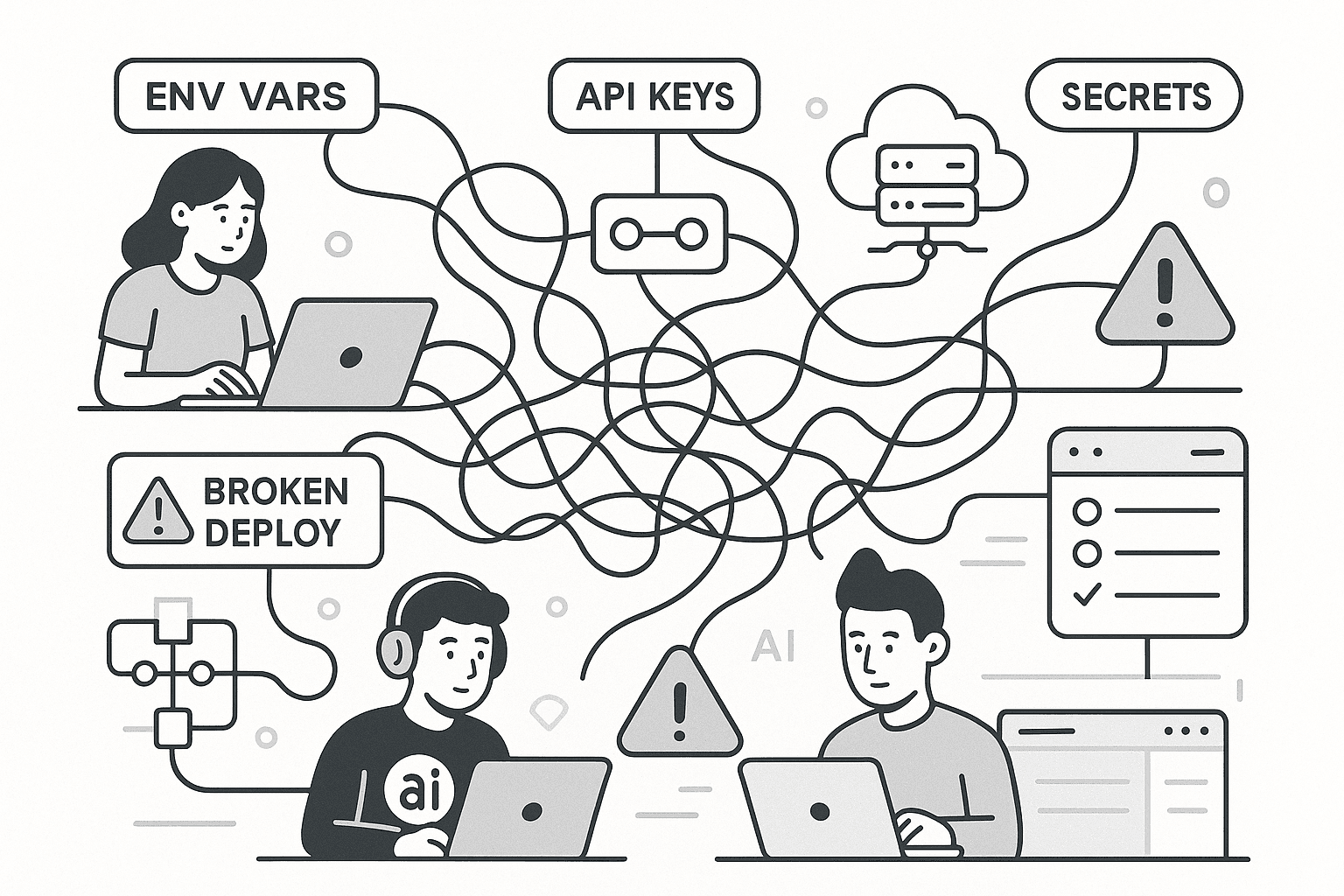
A founder usually notices environment variable debt only after it becomes an outage, a security scare, or a week-long onboarding mess.
A common version looks like this: your product worked fine when it was one repo, one backend, one frontend, and two people shipping quickly. The .env file lived in Slack at first, then in Notion, then in someone’s 1Password vault, then partly in Vercel, partly in GitHub Actions, partly in Render, partly in Zapier, and partly inside an AI agent tool that someone connected during a late-night growth experiment.
Then a deploy fails.
Not because the code is broken, but because STRIPE_WEBHOOK_SECRET exists in production hosting and nowhere else. Or your preview environment uses OPENAI_API_KEY, but the internal automation uses a different OpenAI project key with different rate limits and model access. Or onboarding stalls because a new engineer has app code, database access, and package installs working, but cannot run the app because three “temporary” secrets were never documented. Or your founder sales assistant built in no-code starts silently failing because a HubSpot token expired and nobody knew where it was configured.
This is not really a secrets problem. It is an operational design problem.
Environment variable debt accumulates the same way most startup debt does: through local optimization. Every tool makes adding one more secret easy. Very few make the whole system understandable.
If you do not actively design how configuration moves through your company, you eventually get four expensive outcomes at once:
- failed deploys caused by config drift
- slow onboarding caused by undocumented setup
- silent workflow failures in automations and AI tools
- security risk from untracked credential sprawl
The worst part is that standard startup advice does not solve it. “Just use a .env file.” “Put secrets in your hosting platform.” “Store them in a password manager.” “Use a secrets manager later.” Each suggestion is directionally correct, but incomplete. The problem is not where one secret lives. The problem is whether your team has a coherent system for secret ownership, propagation, naming, rotation, and verification across all environments and tools.
This article is a practical playbook for fixing that before it becomes a chronic tax on every deploy and every new hire.
The failure pattern: how secret sprawl actually shows up in startups
Early-stage teams rarely have one environment variable system. They have six.
A typical stack might look like this:
- local development:
.env.local,.env, Docker compose files, shell exports - CI/CD: GitHub Actions, GitLab CI, CircleCI
- hosting: Vercel, Netlify, Render, Fly.io, Railway, AWS, GCP
- backend infrastructure: Kubernetes secrets, ECS task definitions, serverless config, managed DB dashboards
- no-code/internal automation: Zapier, Make, Airtable, Retool, n8n
- AI tooling: OpenAI, Anthropic, LangSmith, Pinecone, vector DBs, agent platforms, evaluation tools, prompt management products
Now layer in the real startup reality:
- one founder created the first Stripe keys
- the first engineer added Postgres URLs in the hosting dashboard
- growth added Meta Ads credentials to Zapier
- ops added a Google service account for reporting
- somebody experimenting with AI agents added API keys to a browser-based tool under their personal account
- staging and production drifted because “we’ll sync them later”
- a preview deploy got a temporary bypass key that accidentally became permanent
No individual decision is crazy. Together they create a system nobody can reason about.
Here are the repeated symptoms.
1. Deploys break for non-code reasons
The application passes tests, the branch is clean, and the deploy still fails because one variable is missing, malformed, or present only in one environment.
Examples:
NEXTAUTH_URLset in production but not previewDATABASE_URLupdated after a migration in one environment but not in background workersS3_BUCKET_REGIONchanged in app hosting but not in the image processorOPENAI_API_KEYexists in the API service but not in the queue worker handling async inference jobs
These failures are painful because engineers investigate code first. Configuration errors often hide as application errors.
2. Onboarding becomes archaeology
A new engineer is told to “copy the env from someone.” They get a file with 84 variables. Nobody knows which 27 are required. Six are legacy. Five are for deprecated integrations. Two are prod-only but got copied locally. Three values are stale.
What should be a one-hour setup becomes a two-day Slack thread.
This is not just annoying. It slows every hire, increases support burden on senior team members, and raises the odds that secrets get shared in insecure ways because the official process is broken.
3. AI workflows fail silently
This is the newest and most underestimated version of the problem.
AI workflows often live outside your core application stack:
- prompt testing tools
- evaluation pipelines
- background workers calling model APIs
- no-code customer support automations
- meeting summarization bots
- internal agent tools accessing CRM or docs
These systems tend to be assembled quickly and often by non-infrastructure people. The secret setup is usually ad hoc.
Failure modes include:
- wrong model access because one API key is tied to a project without GPT-4.1 or Claude access
- differing rate limits between environments causing flaky behavior
- vector database keys present in one worker but not another
- eval pipelines using outdated credentials and producing misleading results
- AI agents configured with production SaaS access under an employee’s personal account
Because AI workflows are often probabilistic and asynchronous, config errors are harder to diagnose. Teams blame prompts, latency, or model instability when the real issue is environment inconsistency.
4. Security risk grows without anybody feeling responsible
Secret sprawl is a security issue, but startups usually do not experience it as a dramatic breach first. They experience it as a vague unease:
- “Where is that Google service account key stored?”
- “Who created this webhook secret?”
- “Can we rotate this without breaking something?”
- “Why does a former contractor still have access to that automation platform?”
If the answer to any of those questions is unclear, you do not have a security policy problem. You have an inventory and ownership problem.
The underlying pattern: environment variables are not config, they are supply chains
The key shift is to stop thinking about environment variables as static values and start thinking about them as assets moving through a distribution system.
Every secret or environment variable has five dimensions:
- source of truth: where the canonical value lives
- owner: who is responsible for creating, updating, and rotating it
- consumers: which apps, services, workflows, and people depend on it
- environments: local, preview, staging, production, and internal tools
- distribution path: how it gets from source to each consumer
Most startups only manage dimension five informally. They treat distribution like a manual copy-paste task. That is where debt starts.
Consider a simple variable like OPENAI_API_KEY. In a messy startup, it might exist in all these places:
- local
.envfor backend engineers - GitHub Actions for test jobs
- Vercel for frontend server actions
- Render for background workers
- Zapier for a support automation
- LangSmith or an agent platform for evals
- a founder’s laptop shell profile for scripts
That is not one secret. Operationally, that is seven deployments of one secret with different failure and exposure risks.
Once you see secrets as supply chains, the right questions change.
Instead of asking:
- “Do we have the key?”
You ask:
- “What is the source of truth?”
- “Which systems consume it?”
- “How is it propagated?”
- “How do we know all consumers are current?”
- “Can we rotate it without guessing?”
That framing is what separates teams that keep tripping over config from teams that treat it as infrastructure.
Why standard advice fails
A lot of common guidance around env vars is individually useful and systemically inadequate.
“Just use .env files”
Good for local development. Bad as a complete operating model.
.env files solve developer convenience, not organizational consistency. They do not tell you:
- which variables are required by which services
- which values differ by environment intentionally versus accidentally
- how CI gets the same config
- how no-code tools and AI tools stay in sync
- who owns rotation
Used alone, .env files become snapshots of tribal knowledge.
“Store secrets in your hosting platform”
Also helpful, but fragmented.
Vercel, Render, Fly.io, Railway, AWS Parameter Store, and others all make it easy to set runtime variables. That solves app deployment for one surface area. It does not solve the full startup stack.
Your company likely has secrets in:
- app runtime
- CI jobs
- cron jobs
- support automations
- sales automations
- analytics ETL
- AI eval pipelines
- internal admin tools
Hosting dashboards are destination stores, not company-wide maps.
“Put everything in 1Password”
Password managers are excellent vaults for human access. They are not full secret distribution systems.
They help with:
- secure storage
- access control
- sharing credentials with employees
- reducing Slack-based secret sharing
They do not automatically ensure runtime systems are synchronized. They are often part of the answer, but not the whole answer.
“Use a secrets manager later”
This is the classic startup punt.
Teams delay a coherent secret strategy because they assume a “real” setup only matters at scale. But environment variable debt compounds early because the number of tools grows faster than the engineering team.
By the time you feel pain, the problem is no longer choosing a secret manager. The problem is cleaning up undocumented sprawl across twelve systems and four categories of operators.
“We’ll rotate keys if there’s an issue”
Rotation without dependency mapping is how you create self-inflicted incidents.
If you cannot list every consumer of a credential, you cannot safely rotate it. Founders often avoid rotation because they intuitively know it might break hidden workflows. That avoidance is a signal that the underlying system is weak.
The better approach: build a lightweight secrets operating model
Early-stage startups do not need enterprise-grade ceremony. They do need explicit rules.
A workable model has five components:
- a secret inventory
- a naming standard
- a source-of-truth policy
- an environment matrix
- a distribution and verification workflow
This sounds heavier than it is. For most startups, you can get a useful version done in a week and keep it current with a monthly review.
Step 1: create a secret inventory before choosing more tools
Do not start by buying Vault or rewriting all configuration paths. First create visibility.
Your inventory should track each variable or secret with fields like:
- name
- description
- category
- owner
- source system
- consuming systems
- environments used
- rotation cadence
- last rotated date
- notes/dependencies
Categories typically include:
- third-party API keys
- database credentials
- auth/session secrets
- webhook signing secrets
- cloud service credentials
- internal service-to-service tokens
- AI model/tool credentials
- automation platform tokens
A simple starter format is a spreadsheet or Notion database. Yes, eventually you may want this represented as code or generated documentation. But the immediate win is forcing the company to answer basic questions.
Example:
| Name | Owner | Source of Truth | Consumers | Envs | Rotation |
|---|---|---|---|---|---|
| STRIPE_SECRET_KEY | Eng | 1Password vault | API, webhooks worker, local dev | dev/staging/prod | 90 days |
| STRIPE_WEBHOOK_SECRET | Eng | Stripe dashboard + 1Password record | API webhook endpoint | staging/prod | on change |
| OPENAI_API_KEY_SUPPORT | Ops | OpenAI project + 1Password vault | support bot, eval worker, Zapier | prod | 60 days |
| HUBSPOT_PRIVATE_APP_TOKEN | Growth | 1Password vault | Zapier, internal dashboard | prod | 90 days |
| DATABASE_URL | Eng | cloud DB + hosting destination stores | API, worker, migrations, local dev template | all | on credential rotation |
When teams do this exercise honestly, they usually discover at least one of the following:
- nobody owns a critical secret
- a production workflow depends on a personal account
- multiple variables refer to the same external service with inconsistent names
- secrets exist in tools nobody actively monitors
- local setup requires credentials that should never be broadly distributed
That alone is worth the exercise.
Step 2: standardize naming so humans can reason about config
In many startups, secret names reflect chronology instead of design:
OPENAI_KEYOPEN_AI_APIGPT_KEYOPENAI_API_KEY_NEWOPENAI_API_KEY_2
This is how config becomes unreadable.
Use a naming convention that makes variables self-explanatory. A practical pattern is:
<PROVIDER>_<PURPOSE>_<TYPE>
Examples:
OPENAI_API_KEYOPENAI_SUPPORT_BOT_API_KEYSTRIPE_SECRET_KEYSTRIPE_WEBHOOK_SIGNING_SECRETPOSTGRES_PRIMARY_URLS3_UPLOADS_BUCKET_NAMES3_UPLOADS_REGIONCLERK_SECRET_KEYSLACK_INTERNAL_ALERTS_BOT_TOKEN
Rules that help:
- avoid “new,” “temp,” “v2,” and person names
- make purpose explicit if multiple credentials exist per provider
- distinguish IDs, URLs, and secrets in the name
- use the same name across local, CI, and hosting where possible
This matters more than people think. Good naming reduces onboarding time, debugging time, and accidental misuse.
Step 3: define your source of truth policy
You need one canonical place to manage secret metadata and one policy for where actual values originate.
For an early-stage startup, a pragmatic setup is often:
- vault for human-readable canonical records: 1Password, Bitwarden, or similar
- runtime destination stores: hosting platform envs, CI secrets, automation platform credentials
- optional infrastructure secrets manager: Doppler, Infisical, AWS Secrets Manager, GCP Secret Manager, HashiCorp Vault depending on complexity
The point is not that one tool stores everything physically. The point is that your team knows where the canonical record lives and where runtime copies are expected.
A simple policy might be:
- all new third-party credentials must be recorded in 1Password with owner, purpose, creation date, and linked consumers
- runtime systems receive secrets only from approved destination stores
- no secret may exist only in a single employee’s local machine or personal SaaS account
- production credentials cannot be created inside no-code tools as the only copy
- any AI or automation tool using external API keys must be added to the inventory
This is the missing governance layer in most startups.
Tool comparison: which stack should early-stage teams use?
There is no perfect tool. The right answer depends on how much of your infrastructure is code-driven versus dashboard-driven.
Option 1: Password manager + hosting envs + documentation
Best for:
- pre-seed to seed teams
- 2 to 10 people
- simple deployment surface
- low infrastructure complexity
Stack:
- 1Password or Bitwarden as vault
- Vercel/Render/Railway/Fly.io env dashboards
- GitHub Actions secrets
- Notion or repo docs for env schema
Pros:
- cheap
- easy to adopt now
- low overhead
Cons:
- synchronization is still manual
- weak audit trail across runtime surfaces
- no strong guarantee local/dev/CI/prod match
Typical cost:
- 1Password Teams: roughly tens of dollars per month for small teams
- no extra infra tool cost initially
My take:
This is acceptable if you also maintain a real inventory and env schema. Without that, it degrades fast.
Option 2: Dedicated secrets orchestration tool
Examples:
- Doppler
- Infisical
- Akeyless
- Vault-based setups
Best for:
- teams with multiple services and environments
- frequent config changes
- desire to sync local/CI/runtime from one system
- growing compliance/security expectations
Pros:
- centralized management
- better auditability
- easier rotation and propagation
- cleaner developer onboarding
Cons:
- another platform to learn
- migration effort
- may be overkill for extremely simple stacks
Typical cost/time:
- cost ranges from low starter tiers to meaningful team plans
- expect a few days to a few weeks of migration depending on sprawl
My take:
This is the sweet spot for many startups once you have more than one deploy target, more than one non-engineering automation surface, and active AI workflows. The biggest benefit is reducing copy-paste config ops.
Option 3: Cloud-native secrets manager
Examples:
- AWS Secrets Manager / SSM Parameter Store
- GCP Secret Manager
- Azure Key Vault
Best for:
- teams already deep in one cloud
- infrastructure managed by engineering
- services deployed mostly inside cloud-native runtimes
Pros:
- integrates with cloud IAM
- strong security model
- scalable
Cons:
- less convenient for non-cloud tools and local development
- harder for no-code and mixed-tool operators
- often still needs glue for CI and SaaS tools
My take:
Great for engineering-controlled systems, less great as the sole answer for startup-wide secret sprawl unless your entire operating surface lives in one cloud ecosystem.
Step 4: create an environment matrix, not just env files
A lot of teams document variables in a flat list. That is not enough.
What you actually need is a matrix showing which variables are required by which service in which environment.
Example:
| Variable | Web Local | Web Preview | Web Prod | Worker Local | Worker Prod | Zapier | AI Eval Pipeline |
|---|---|---|---|---|---|---|---|
| DATABASE_URL | Y | Y | Y | Y | Y | N | N |
| STRIPE_SECRET_KEY | N | N | Y | N | Y | N | N |
| STRIPE_WEBHOOK_SIGNING_SECRET | N | N | Y | N | N | N | N |
| OPENAI_SUPPORT_BOT_API_KEY | N | N | N | N | Y | Y | Y |
| LANGSMITH_API_KEY | N | N | N | N | Y | N | Y |
| HUBSPOT_PRIVATE_APP_TOKEN | N | N | N | N | N | Y | N |
This does three important things:
- separates required vs optional variables
- reveals accidental duplication
- exposes hidden consumers before rotation or migration
If your product has multiple repos or services, each should have its own required env schema plus a cross-company matrix.
Step 5: codify an .env.example that is actually maintained
Most .env.example files are fiction. They are generated once and forgotten.
A useful .env.example should:
- include every required variable for local development
- mark optional variables clearly
- never include real values
- include comments on what each variable does
- indicate whether local dev can use mock/test credentials
Example:
bash# Core database
DATABASE_URL=

# Auth
CLERK_SECRET_KEY=
NEXTAUTH_URL=http://localhost:3000
NEXTAUTH_SECRET=

# Payments
# Required only for webhook testing and payment flows
STRIPE_SECRET_KEY=
STRIPE_WEBHOOK_SIGNING_SECRET=

# AI
# Required for support bot and local prompt testing
OPENAI_SUPPORT_BOT_API_KEY=
LANGSMITH_API_KEY=
Better yet, validate required env vars at application startup so missing values fail loudly.
Useful approaches:
- Zod-based env validation in Node/TypeScript
- Pydantic settings in Python
- framework-level config validation
- startup checks in CI
This converts mysterious runtime failures into immediate, clear feedback.
Implementation workflow: how to clean this up in one week
Here is a realistic founder-operator workflow for an early-stage startup.
Day 1: inventory and mapping
Tasks:
- list every runtime and tool that may contain secrets
- export current env var names from hosting, CI, and key automation tools
- collect local
.envfiles from active repos - interview owners of no-code and AI workflows
Outputs:
- raw inventory spreadsheet
- list of tools/surfaces
- obvious unknowns and owner gaps
Time:
- 4 to 8 hours depending on stack complexity
Hard truth:
This is the most revealing step because you will discover systems running without clear ownership.
Day 2: naming and ownership pass
Tasks:
- merge duplicate or inconsistent names
- assign an owner for every critical secret
- identify personal-account dependencies
- define naming convention
Outputs:
- normalized variable list
- owner column completed
- list of risky credentials to replace
Time:
- 3 to 6 hours
Day 3: source of truth and environment matrix
Tasks:
- decide your canonical vault/process
- document per-secret source of truth
- create service-by-environment matrix
- split must-have vs optional vars
Outputs:
- source-of-truth policy doc
- environment matrix
- per-service env requirements
Time:
- 4 to 6 hours
Day 4: implementation in repos and platforms
Tasks:
- update
.env.example - add startup validation
- clean up CI secret names n- sync destination stores in hosting platforms
- remove deprecated variables where safe
Outputs:
- cleaner local setup
- clearer deploy behavior
- less dead config
Time:
- 1 engineering day per major repo, often less for smaller apps
Day 5: rotation drill and onboarding test
Tasks:
- rotate one non-critical credential end to end
- verify all consumers still work
- have someone uninvolved try fresh onboarding from docs
- test one AI workflow and one no-code automation explicitly
Outputs:
- proof your system works
- gap list from onboarding friction
- confidence in future rotation
Time:
- 4 to 8 hours
This is not glamorous work. It is some of the highest leverage operational cleanup a startup can do because it touches deploy reliability, engineering velocity, and security all at once.
Workflow examples by team surface
Example 1: local development workflow
Bad version:
- engineer asks in Slack for env file
- gets a copy from another engineer
- file includes stale and prod-only values
- app boots, but a background worker fails later
Better version:
- engineer clones repo
- copies
.env.exampleto.env.local - runs setup script that pulls permitted development secrets from approved source
- app validates env on startup and reports exactly what is missing
- docs explain which integrations are optional locally
Impact:
- onboarding drops from days to hours
- less insecure secret sharing
- fewer “works on my machine” issues
Example 2: CI/CD workflow
Bad version:
- tests and deploys rely on hand-entered GitHub secrets
- secret names differ from runtime names
- branch preview lacks one required variable n- deploy fails after build completes
Better version:
- CI variables follow same naming convention as runtime
- validation job checks required env set before deployment step
- preview environments have explicit reduced config set
- secrets are synchronized from defined source or checked against inventory
Impact:
- fewer failed deploys
- faster diagnosis when failures happen
- less hidden drift between CI and production
Example 3: no-code automation workflow
Bad version:
- ops connects HubSpot, Slack, and OpenAI directly inside Zapier
- credentials sit under one employee account
- token expires and lead routing fails silently
Better version:
- automation credentials created under company-owned service accounts where possible
- token records stored in vault with owner and renewal notes
- critical zaps have monitoring and failure alerts
- inventory lists automations as secret consumers
Impact:
- less fragile business ops
- smoother employee offboarding
- reduced key-person risk
Example 4: AI workflow governance
Bad version:
- product team uses one OpenAI key in app backend
- support team uses another in Zapier
- eval team uses a third in LangSmith
- all three have different models, rate limits, and billing projects
- nobody understands why outputs differ
Better version:
- separate keys by workload intentionally, not accidentally
- names reflect purpose:
OPENAI_APP_API_KEY,OPENAI_SUPPORT_BOT_API_KEY,OPENAI_EVALS_API_KEY - model access and project scope documented
- each AI workflow has explicit owner and destination stores
- evaluation and production credentials are deliberately separated
Impact:
- less confusion about AI behavior
- easier cost attribution
- safer experimentation without contaminating production workflows
Cost and time analysis: what this debt is really costing you
Founders often delay cleanup because secret sprawl feels like back-office hygiene. The cost is more concrete than it appears.
Direct costs
- engineering hours lost debugging deploy/config issues
- repeated onboarding support time from senior staff
- broken automations affecting revenue or customer ops
- security remediation after accidental exposure or poor offboarding
Indirect costs
- slower release velocity because deploy confidence drops
- hesitation to rotate credentials
- inability to safely add new tools or workflows
- AI experimentation slowed by inconsistent access and flaky pipelines
A rough startup math example:
- 2 failed deploy incidents per month at 1.5 engineer-hours each for diagnosis and fix = 3 hours/month
- 1 new hire or contractor onboarding issue costing 4 senior-hours = 4 hours/month averaged over a quarter
- 2 silent automation failures caught late costing 2 ops-hours each = 4 hours/month
- recurring confusion over AI keys, rate limits, or access = 3 hours/month across product/eng/ops
That is 14 hours/month conservatively. At an effective blended cost of $100 to $200 per hour, you are quietly burning $1,400 to $2,800 monthly, not counting outage impact or reputational damage. For many teams it is higher.
A lightweight secrets cleanup project often pays back in the first month or two.
Practical guardrails that prevent re-accumulation
Once you clean this up, the next challenge is keeping it clean.
Adopt a few rules.
1. Every new integration needs an owner and inventory record
If someone adds Linear, Intercom, Pinecone, or Anthropic access, it should not enter the stack anonymously.
2. No production credential should depend on a personal account unless there is no alternative
If there is no alternative, document it and create a replacement plan.
3. Every repo should validate required env vars at startup or build time
This is one of the cheapest reliability wins available.
4. Every quarter, rotate at least one non-critical credential as a drill
This tests whether your documentation and dependency mapping are real.
5. AI tools and no-code tools count as production systems if they affect customers or operations
Treat them that way. They are not side experiments once the business depends on them.
6. Remove dead variables aggressively
Old variables create false confidence and confusion. If something is deprecated, remove it from code, docs, CI, and platform dashboards.
7. Separate test, staging, and production credentials intentionally
n The goal is not one key everywhere. The goal is intentional distribution with clear naming and known consumers.
A simple policy template for early-stage startups
You do not need a 20-page security manual. Start with a one-page operating policy.
Example:
- All new secrets must have an owner, purpose, and system-of-record entry.
- Canonical human-readable records live in the company vault.
- Runtime copies may exist only in approved deployment or automation systems.
- Secret names should follow the standard naming convention.
- Repos must include maintained
.env.examplefiles and runtime validation. - Personal accounts cannot be the sole owner of business-critical credentials.
- Critical automations and AI workflows must be included in the environment matrix.
- Rotation-impact review is required before changing shared credentials.
- Deprecated secrets must be removed from destination systems after migration.
- Onboarding docs must allow a new team member to reach a working local environment without ad hoc Slack requests.
That is enough to start behaving like an organized company.
What founders usually get wrong here
Three patterns repeat.
They treat secret management as purely a security issue
It is also a velocity, reliability, and onboarding issue. In startups, the operational cost usually shows up before the security incident does.
They over-focus on tool choice
n The best tool in the world will not fix unknown ownership, bad naming, undocumented consumers, or hidden AI workflows.
They wait too long because the mess still “mostly works”
That is exactly when to fix it. Once the company depends on ten cross-tool workflows and six team members’ tribal knowledge, cleanup gets dramatically harder.
The real goal: make configuration boring
The mature state is not “we use a fancy secrets platform.” The mature state is:
- deploys fail fast and clearly if config is wrong
- every important secret has an owner
- onboarding does not require archaeology
- AI workflows use intentional, documented credentials
- no-code automations are visible and monitored
- rotation is possible without fear
In other words, configuration becomes boring.
That is what you want.
A startup does not win because its environment variable strategy is elegant. It wins because the team can ship, onboard, automate, and experiment without hidden config landmines slowing everything down.
If you are under 20 people, this is fixable quickly. If you are over 20 and already feeling pain, treat it as a cross-functional cleanup project, not just an engineering chore. Bring in whoever owns growth ops, customer support automations, finance tooling, and AI experiments. The sprawl is almost certainly broader than engineering sees.
The practical takeaway is simple: do not ask where your secrets are stored. Ask whether your company has a system for how secrets are named, owned, distributed, validated, and rotated across every tool that matters.
If the answer is no, you are already carrying environment variable debt. You just have not paid the full bill yet.