
It usually starts as a compliment.
"Loop in the founder, they can unblock this fastest."
At first, that feels like startup speed. A customer is angry, a security questionnaire is blocking a deal, a candidate wants a compensation exception, finance needs approval to wire a vendor, production is flaky, and somebody on the team says, "Just send it to the founder."
When you’re 5 people, that move works. When you’re 15 people, it still kind of works. By 30, 50, or 80 people, you’ve built something dangerous: a hidden operating system where urgent decisions do not travel through ownership, process, or role clarity. They travel through founder availability.
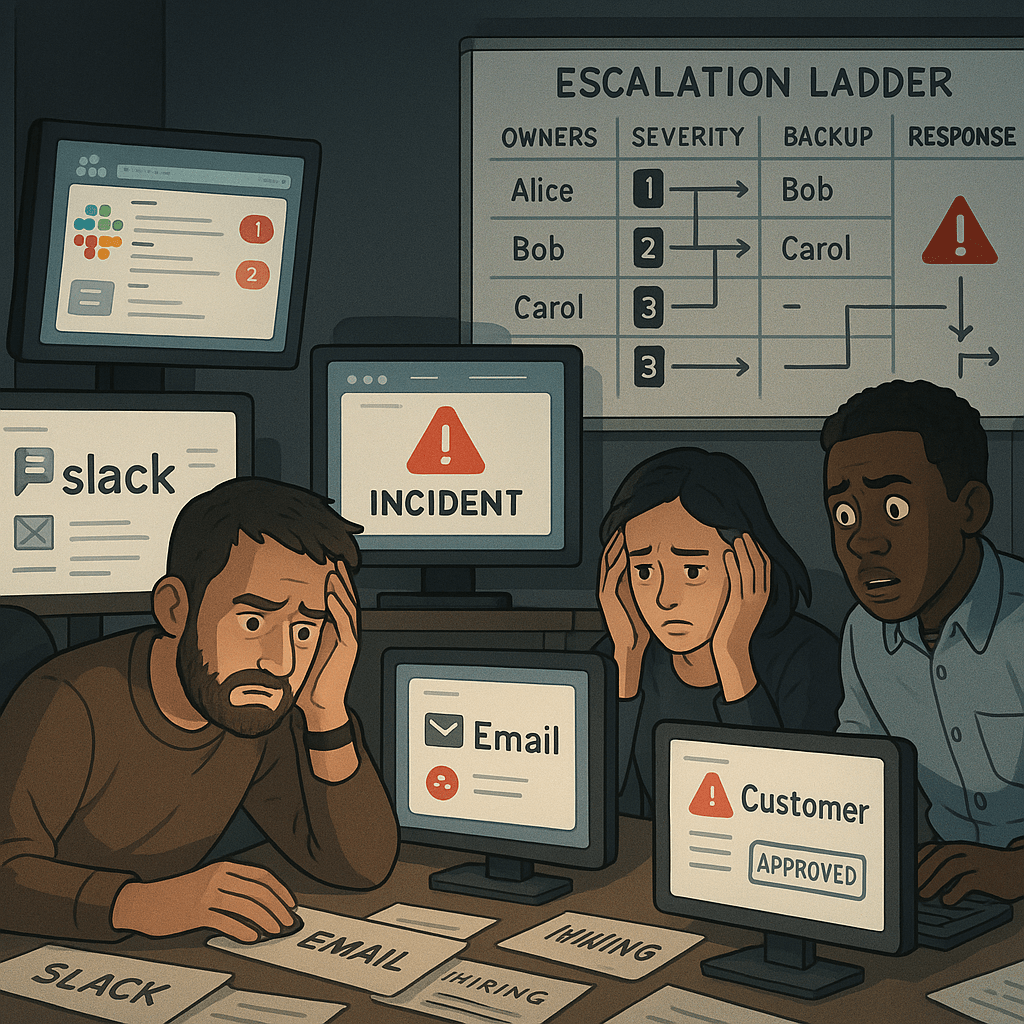
That is the escalation ladder collapse problem.
Every function technically has owners. Customer success has an account lead. Engineering has an on-call engineer and an EM. Security has a point person. Recruiting has a hiring manager. Finance has a controller, ops lead, or outsourced bookkeeper. But when something becomes emotionally loaded, politically risky, revenue-adjacent, or time-sensitive, the official ladder gets skipped and the founder becomes the de facto severity-1 router.
Most teams do not notice this as a systems problem. They experience it as ambient chaos:
- "Everything urgent seems to hit me."
- "We have owners on paper, but people still come straight to me."
- "Our Slack feels fast, but nothing is actually tracked."
- "I’m approving exceptions all day and still worried we’re dropping real fires."
- "If I go offline for six hours, half the company stalls."
This article is a tactical playbook for fixing that. Not by making your startup bureaucratic, and not by pretending urgency goes away, but by rebuilding actual escalation ladders by function, defining severity tiers, assigning backup approvers, instrumenting the channels where urgency actually shows up, and preventing "urgent" from becoming an untracked shadow workflow.
I’ve seen some version of this failure mode in nearly every scaling startup. It is not a people problem first. It is a routing problem. The founder becomes the default path because the organization has not done the uncomfortable work of deciding who is allowed to decide under pressure.
A real failure scenario
Imagine a 45-person B2B SaaS company.
They’ve done enough things right to be in the messy middle:
- ARR is around $6M.
- Enterprise deals are getting bigger.
- Product is still changing fast.
- Support is a mix of Slack, Zendesk, and direct founder texts from early customers.
- Engineering has on-call, but incidents are still half-managed in a private Slack thread.
- Finance is run by a head of ops plus an external firm.
- Recruiting is founder-heavy for executive and "must-close" candidates.
On a Wednesday afternoon, four things happen within 90 minutes:
- A large prospect’s security team flags missing answers in a vendor questionnaire and says legal review will stall unless they get responses today.
- A major customer reports a permissions bug that may have exposed internal data across teams.
- A top engineering candidate gets another offer and wants a comp decision by end of day.
- The company’s largest vendor sends a final notice that payment failed because approval for a new billing entity was never completed.
On paper, each issue has an owner:
- Security questionnaire: sales engineer + security lead
- Permissions bug: engineering on-call + EM + incident lead
- Candidate comp exception: hiring manager + people lead
- Vendor payment: ops/finance lead
In reality, here is what happens:
- The AE DMs the founder because "this deal is too important to wait."
- The customer success manager Slacks the founder because the customer specifically asked for executive visibility.
- The recruiter texts the founder because the candidate wants reassurance and a fast yes/no.
- The ops lead emails the founder because the payment requires someone "comfortable making the call."
None of these are irrational behaviors. Each person is acting based on incentives:
- Revenue risk? Escalate high.
- Reputation risk? Pull in founder.
- Sensitive exception? Ask the person with authority.
- Ambiguous ownership? Go to the one person who can’t say "not my lane."
Now watch the downstream effects.
The founder tries to help, but because each escalation arrives through a different channel, Slack DM, text, email, customer thread, there is no unified queue, no severity model, no clock, no handoff discipline, and no easy way to distinguish "emotionally urgent" from "operationally urgent."
So the founder makes four predictable mistakes:
- They become the triage layer instead of the escalation target. Rather than weighing in at a specific threshold, they now have to gather context, find owners, and decide if the thing is actually real.
- They create precedent by responding quickly. Every fast response teaches the company that bypassing the ladder works.
- They fragment accountability. Once they enter the thread, the original owner often steps back psychologically.
- They lose the ability to see systemic load. Since urgency is spread across channels, nobody can quantify how many "urgent" requests exist, which functions generate them, or which ones should never have reached the founder.
The end result is not just founder overload. It is decision quality decay.
The security questionnaire gets answered with inconsistent claims because nobody owns the final source of truth. The bug response is slow because the engineer waits for founder guidance that should never have been needed. The candidate exception gets approved without compensation guardrails. The vendor issue turns out not to be urgent at all, but because it interrupted everything else, the founder misses the one escalation that did require their judgment.
That is escalation ladder collapse: when urgency stops following a designed path and starts following the path of least resistance.
The pattern underneath the chaos
Founders often think they have an urgency problem. Usually they have one of five underlying problems.
1. Ownership exists for normal work, not exception work
Teams assign owners for the default case:
- support queue
- roadmap decisions
- invoice processing
- candidate process
- incident response
But exceptions live in a fog:
- refund outside policy
- customer promise that requires roadmap deviation
- security answer with legal exposure
- compensation outside band
- wire approval above threshold
- feature flag change affecting contract commitments
If exception handling is undefined, exception routing defaults to the founder.
2. Severity is emotional, not operational
Most startups do not have real severity tiers outside engineering incidents. So "urgent" means whatever the loudest person says it means.
A top customer saying "this is unacceptable" can trigger more executive attention than an actual security event because one is visible and one is still being diagnosed. A candidate deadline can feel more pressing than a billing failure because the recruiter is in your texts and finance is not.
Without severity definitions, urgency becomes social.
3. The company has approval power but not approval design
A lot of founder-only escalation paths are really hidden approval problems.
Examples:
- Only founder can approve non-standard contract terms.
- Only founder can approve compensation exceptions above band.
- Only founder can approve emergency credits over a threshold.
- Only founder can approve spend above a cap.
- Only founder can approve public response language during incidents.
You can’t remove the founder from everything. But if the company does not define alternates, pre-approvals, boundaries, or delegation rules, then every edge case becomes a founder interruption.
4. Critical signals live in unmanaged channels
If urgent decisions arrive via:
- Slack DMs n- personal texts
- direct email to founder
- customer Slack connect channels
- ad hoc Zoom calls
- verbal "quick questions"
then you do not have an escalation system. You have a social graph.
That works until it doesn’t. Especially once there are multiple managers, multiple time zones, and customers who know exactly who can get things done fastest.
5. The founder keeps rescuing the system
This is the hardest truth.
Often the founder is the reason the system never matures.
Not because they want chaos, but because they are competent, fast, and uncomfortable letting high-stakes situations evolve without them. They tell themselves they are protecting quality or speed. In practice, they are subsidizing broken routing with personal attention.
As long as the founder continues to rescue every edge case, the company never feels enough pain to build a real ladder.
Why the standard advice fails
The usual management advice sounds fine and rarely works:
- "Empower your leaders."
- "Clarify roles and responsibilities."
- "Tell people not to escalate everything."
- "Create a RACI."
- "Use better documentation."
- "Delegate more."
None of those are wrong. They are just too abstract for what is actually happening.
Here’s why.
"Clarify ownership" doesn’t solve threshold ambiguity
People may know who owns customer success or finance or recruiting. That does not tell them:
- when to escalate
- to whom
- in what channel
- with what evidence
- what response time is expected
- who acts if the owner is unavailable
- what decisions can be made without founder sign-off
Without thresholds and paths, ownership statements become decorative.
RACIs don’t survive real-time pressure
RACIs are helpful for projects. They are weak tools for live urgency.
In a genuinely urgent situation, nobody opens Notion to find a matrix. They message the person they believe can compress time and remove ambiguity.
If your escalation logic only exists in static docs, the social network will beat it every time.
"Empower your team" ignores political risk
Many escalations go to the founder not because the team lacks capability, but because they lack cover.
A people lead might know the right answer on a compensation exception, but still want founder backing because saying no to a "must-have" candidate feels risky. An engineer might know the correct incident step, but still pull in the founder because the customer account is strategic.
You do not fix this by saying "I trust you." You fix it by specifying decision rights, escalation thresholds, and protected authority.
More docs do not fix invisible inbound
If customers, candidates, investors, vendors, and employees can still reach the founder directly, then informal urgency will keep flowing there no matter how good your internal playbooks are.
The problem is not just knowledge. It is channel architecture.
The better approach: design explicit escalation ladders by function
The right move is not to eliminate escalation. It is to make escalation legible, bounded, and role-based.
Think of every functional area as needing its own ladder with five elements:
- Entry points: where the issue can originate
- Severity tiers: what makes it low, medium, high, critical
- Primary owner: who handles the issue first
- Backup path: who steps in if owner is unavailable or threshold is crossed
- Founder trigger: the explicit conditions that justify founder involvement
You need this for at least five functions:
- customer/product
- engineering/security
- hiring/people
- finance/legal/ops
- external communications
Once you do this, the founder stops being the default path and becomes what they should be: a late-stage escalation point for specific classes of decisions.
Step 1: Map the current shadow escalation system
Before designing the future state, audit the real present state.
Do not ask, "What is our official process?"
Ask:
- In the last 30 days, what came to the founder marked urgent?
- Through which channel did it arrive?
- Who was the first functional owner?
- Was there already a documented path that got skipped?
- Did the founder make a decision, provide reassurance, or just act as router?
- Could someone else have handled it with a pre-defined rule?
Create a simple table like this:
| Date | Issue | Function | Source Channel | Initial Owner | Why Founder Was Pulled In | Was Founder Actually Needed? | Preventable? |
|---|---|---|---|---|---|---|---|
| May 3 | Refund over policy cap | Customer/Finance | Slack DM | CSM | Customer threatened churn | No | Yes |
| May 5 | Candidate comp exception | Hiring | Text | Recruiter | Offer competing | Maybe | Yes |
| May 7 | Access control bug | Product/Security | Slack + email | On-call eng | Strategic customer involved | Yes | Partly |
| May 9 | Vendor payment issue | Finance | Ops lead | Approval unclear | No | Yes |
You will usually find patterns fast:
- certain functions generate most founder urgencies
- certain managers escalate reflexively
- certain channels create more bypassing than others
- many "urgent" items are really policy gaps
This exercise matters because founders routinely overestimate how many decisions truly require them. In many startups, 60–80% of founder-routed urgent issues are preventable with better ladders, thresholds, or delegated approvals.
Step 2: Define severity tiers that travel across functions
You need a shared language for urgency. Not just for engineering incidents.
A practical model is four tiers:
Sev 4, Important, not time-critical
Examples:
- customer frustration without active outage
- candidate wants answer within 48 hours
- vendor billing confusion
- policy exception request with no immediate deadline
Target handling:
- same business day or next business day
- stays with functional owner
- no founder involvement
Sev 3, Time-bound operational risk
Examples:
- security questionnaire blocking a live deal by end of day
- candidate deadline within 24 hours
- invoice or payment issue that impacts service continuity within 48 hours
- contract language requiring response before close
Target handling:
- owner responds within defined SLA, usually 1–4 hours in business hours
- manager or backup pulled in if owner unavailable
- founder only if threshold condition is met
Sev 2, Material business risk or sensitive exception
Examples:
- major customer threatening churn over a live issue
- production degradation affecting multiple accounts
- comp or legal exception outside pre-approved bands
- suspected but unconfirmed security/privacy issue
Target handling:
- immediate acknowledgment
- functional lead plus designated escalation owner engaged
- tracked in a formal incident/escalation channel or ticket
- founder optionally notified, not necessarily engaged
Sev 1, Critical incident requiring executive decisioning
Examples:
- confirmed security breach or likely reportable event
- production outage affecting core product broadly
- urgent legal/financial action above delegated thresholds
- executive-level customer issue with contractual or public risk
- employee safety or serious conduct matter
Target handling:
- page appropriate responders
- formal incident commander or escalation lead assigned
- founder engaged based on pre-defined criteria
- timeline and decisions logged centrally
The key is not making these tiers perfect. The key is using the same model across functions so teams can compare urgency consistently rather than emotionally.
Step 3: Build ladders by function
Here’s what this looks like in practice.
Customer and product escalations
Common founder bypasses:
- strategic customer is upset
- roadmap promise conflict
- refund/credit request outside policy
- implementation issue threatens expansion
A better ladder:
Entry points
- support ticket
- CSM-owned Slack channel
- AE escalation form
- customer success inbox
Primary owner
- CSM or support lead for account issues
- PM for product commitment questions
Secondary owner
- Head of CS or product leader
Founder trigger
- revenue at risk above threshold, e.g. >$100k ARR
- customer requests executive call after functional lead engaged
- ask requires policy exception outside delegated authority
- issue has material brand/public risk
Rules
- no direct founder introduction in customer threads before owner + functional lead are engaged
- all executive escalations logged in CRM or escalation tracker
- credits/refunds pre-approved by band, e.g. CSM up to $2k, CS leader up to $10k, founder only above that
Engineering and security escalations
Common founder bypasses:
- customer says "security issue"
- outage thread becomes executive panic room
- engineer uncertain about external comms
A better ladder:
Entry points
- PagerDuty/Opsgenie alert
- support-to-engineering ticket
- security@ inbox
- bug escalation workflow from CS
Primary owner
- on-call engineer or incident commander
- security lead or designated security owner
Secondary owner
- engineering manager, CTO, or head of engineering
Founder trigger
- Sev 1 outage lasting beyond threshold
- confirmed breach or reportable incident
- customer/account impact above contractual threshold
- public communications or board notification required
Rules
- incidents get a dedicated channel and incident commander
- founder is never the incident commander
- executive updates run on schedule, not ad hoc pings
- customer-facing teams cannot label security incidents externally without designated owner confirmation
Hiring and people escalations
Common founder bypasses:
- must-close candidate wants exception now
- sensitive employee issue jumps straight to founder
- termination or conduct matter feels politically risky
A better ladder:
Entry points
- recruiting ATS note/escalation tag
- people inbox
- manager escalation form
Primary owner
- recruiter + hiring manager for candidate issues
- people lead for employee matters
Secondary owner
- department leader or executive sponsor
Founder trigger
- executive hire
- compensation beyond approved band thresholds
- serious conduct, safety, or legal exposure
- organizational change affecting multiple leaders
Rules
- comp bands and exception bands documented
- same-day candidate urgency has a standard response SLA
- no off-thread text approvals for compensation
- employee issues require logged case ownership, not hallway escalation
Finance, legal, and ops escalations
Common founder bypasses:
- payment approval ambiguity
- contract exception uncertainty
- tax/entity issue appears urgent
- vendor threat creates panic
A better ladder:
Entry points
- AP workflow
- legal/contracts queue
- finance inbox
- vendor escalation form
Primary owner
- finance/ops lead, controller, or legal owner
Secondary owner
- COO, head of ops, external counsel depending on issue
Founder trigger
- wire/spend above threshold
- legal terms outside approved fallback positions
- payroll risk
- banking/security concern
- actions with board-level or fiduciary implications
Rules
- approval matrix published and operationalized in tooling
- each threshold has a backup approver
- urgent payment requests without purchase trail are automatically suspect, not automatically expedited
Step 4: Assign backup approvers and delegated boundaries
This is where most startups fail. They create owners but not alternates.
If the only person who can approve something is unavailable, the system reroutes to founder.
You need a real approval matrix. Not in theory, in living use.
A practical version looks like this:
| Decision Type | Primary Approver | Backup Approver | Founder Required Above | Notes |
|---|---|---|---|---|
| Customer credits | Head of CS | CRO | $10k | Within policy bands |
| Candidate comp exception | People Lead + Hiring Exec | COO | 15% above band | Equity exceptions separately defined |
| Vendor payments | Finance Lead | COO | $25k new/unplanned spend | Payroll exempt |
| Security questionnaire deviations | Security Owner | CTO | Material misrepresentation risk | Legal review if data handling claims involved |
| Incident public statement | Comms owner | CEO delegate | Any public post or customer-wide notice for Sev 1 | Templates pre-approved |
The magic is not in the table. It is in the fact that people know:
- who says yes
- who says yes if the first person is out
- where the threshold changes
- when founder is actually required
This alone reduces a huge amount of false urgency.
Step 5: Instrument the channels where urgency actually appears
This is the operational heart of the fix.
You cannot rely on policy alone. You need to shape the routing behavior inside the tools people already use.
Slack
Slack is where escalation ladders go to die if unmanaged.
Common anti-patterns:
- founder DMs as default escalation
- incident handling in broad channels with no owner
- urgent requests hidden in private groups
- no template for escalation context
Better setup:
- create dedicated channels such as
#exec-escalations,#sev-incidents,#deal-desk,#people-escalationsas needed - require a simple escalation template:
- issue
- severity
- account/team affected
- owner
- deadline/impact
- requested decision
- set channel norms: no "urgent" without owner and ask
- use workflow forms or Slack intake forms when possible
If somebody DMs the founder, the founder should reroute visibly:
"Please move this to #exec-escalations using the template and tag the function owner. I’ll weigh in there if it meets escalation criteria."
That single behavior change matters more than another ops memo.
Shared inboxes and email
Urgent issues often arrive through founder email because external parties do not know your internal structure.
Better setup:
- security@, legal@, billing@, people@ or equivalent role-based aliases
- forwarding rules and triage ownership
- clear auto-routing for common requests
- founder inbox rule: if urgent ops emails arrive directly, forward to alias and owner, do not manage from personal inbox
Important: this is not about making the founder unreachable. It is about ensuring inbound becomes visible and owned.
Ticketing and CRM
If customer or product urgency is not logged, you cannot manage patterns.
Better setup:
- create escalation tags in Zendesk, HubSpot, Salesforce, Linear, Jira, or equivalent
- require owner, severity, and due time
- maintain a view for active escalations by function
- tie executive/customer escalations back to account records
This gives you actual data:
- which accounts generate the most escalations
- how long escalations stay open
- which managers bypass normal flow
- where founder involvement is common
On-call and incident tools
For engineering and security, use the real tools.
Comparisons:
- PagerDuty: strongest for mature on-call rotations, incident workflows, auditability; more expensive and heavier
- Opsgenie: good alerting and escalation chains, often slightly simpler for mid-stage teams
- FireHydrant or incident.io**: strong incident coordination, timelines, status pages, Slack integration
- Plain Slack only: cheap, familiar, and dangerously insufficient past a small team
For a 20–50 person startup, a common stack is:
- PagerDuty or Opsgenie for paging
- incident.io or FireHydrant for incident coordination
- Jira/Linear for follow-up work
- status page if customer-facing uptime matters
The rule is simple: if you page humans out of hours, you need auditable escalation paths. Founder texts do not count.
Tooling comparisons: practical choices by stage
You do not need enterprise software everywhere. But you do need enough system to make urgent work trackable.
Option 1: Lean stack for 10–25 people
- Slack for internal routing
- Google Forms or Slack Workflow Builder for escalation intake
- Zendesk or Help Scout for support
- Linear or Jira for product/eng issues
- shared inbox via Front or Gmail groups
- lightweight AP/approval in Ramp, Brex, or bill pay tool
Pros
- low cost
- fast to implement
- minimal change management
Cons
- relies heavily on discipline
- weaker audit trail across functions
- easy to drift back into DMs
Approx cost
- $500–$2,500/month depending on seats and tools
Option 2: Mid-stage operating stack for 25–100 people
- Slack + structured channels/forms
- CRM escalation tracking in HubSpot or Salesforce
- Front/Zendesk for shared support and inbox routing
- PagerDuty/Opsgenie + incident.io/FireHydrant
- ATS + HRIS with documented approval workflows
- spend controls in Ramp/Brex + AP system
- Notion/Confluence for living runbooks
Pros
- much better visibility
- cross-functional escalation tracking
- cleaner backup coverage
Cons
- more admin overhead
- integration work needed
- can create false sense of maturity if ownership is weak
Approx cost
- $3,000–$12,000/month depending on stack and headcount
Option 3: Enterprise-ish stack too early
- ServiceNow-style process layers
- heavy ticketing for every escalation
- multiple approval systems with rigid workflows
Pros
- auditability
- control
Cons
- startup-hostile if adopted too early
- slower decisions
- easy to route around socially
For most startups, this is overkill unless regulatory or customer requirements demand it.
The answer is usually not "more tools." It is enough tooling plus strong behavioral rules.
A concrete workflow example: customer issue with possible security implications
Here is what good looks like.
Scenario: a strategic customer reports that one user may have seen another team’s data.
Bad workflow
- CSM DMs founder: "Need you ASAP. Big account. Possible data leak."
- founder pings eng lead privately
- eng lead asks for screenshots in thread
- AE asks if this will kill renewal
- customer asks for executive response
- nobody has assigned severity
- nobody has logged decisions centrally
Better workflow
- CSM submits escalation via form or channel template.
- Template requires:
- account
- observed behavior
- time first reported
- number of users impacted known/unknown
- requested deadline
- current customer expectation
- Bot or workflow posts into
#sev-incidentsand creates incident/ticket. - On-call engineering + security owner are tagged automatically.
- Incident commander is assigned.
- Severity is set provisionally: Sev 2 pending confirmation.
- Founder is notified only if criteria met, e.g. strategic account + possible privacy incident.
- Customer updates go through designated external comms owner on a schedule.
- If confirmed as true breach/reportable issue, founder joins executive response.
- Postmortem includes: why did this arrive where it did, and was the founder trigger appropriate?
This is not slower. It is faster in the right way because everyone knows the path.
Time and cost analysis: why this pays off quickly
Founders underestimate the hidden tax of founder-only urgent paths.
Let’s do rough math.
Assume a founder receives 20 urgent escalations per week.
Average time spent per escalation:
- 10 minutes context gathering
- 15 minutes triage/routing
- 10 minutes decision or reassurance
- 10 minutes follow-up / checking status
That is 45 minutes each.
20 x 45 minutes = 900 minutes/week = 15 hours/week.
If even half of those should never have reached the founder, you are burning roughly 7.5 hours/week of executive time on preventable routing failure.
At a fully loaded founder/executive cost that is easy to justify as several hundred dollars per hour, and more importantly, at the opportunity cost of sales, hiring, fundraising, strategy, or actual high-value decisions, this adds up fast.
Now compare with implementation effort.
A focused 2–3 week project can usually get you to a vastly better state:
- 3–5 hours to audit last 30–60 days of escalations
- 4–6 hours with leaders to define severity tiers and ladders
- 3–4 hours to build approval matrix
- 4–8 hours to set up Slack/workflows/tags/aliases
- 2–3 hours to train managers and reset norms
- 1 hour/week to review escalations for a month
Call it 20–35 hours of concentrated operations work, plus leader time.
That is often less than a month of founder interruption waste.
Implementation plan: 30 days to rebuild escalation ladders
Here is a practical rollout.
Week 1: Audit and design
- pull all founder-marked urgent issues from past 30–60 days
- categorize by function, source channel, owner, and preventability
- identify top 3 collapse zones, usually customer, hiring, and finance or customer, product, and security
- define company-wide severity tiers
- draft founder-trigger criteria by function
Deliverables:
- escalation audit
- severity definitions
- draft ladders
Week 2: Decision rights and backup coverage
- create approval matrix with thresholds
- assign primary and backup approvers
- resolve known policy gaps: credits, comp exceptions, emergency spend, incident comms
- decide which founder approvals can be delegated, capped, or templated
Deliverables:
- approval matrix
- delegated authority rules
- backup coverage map
Week 3: Tooling and routing
- create Slack channels, templates, and workflows
- set up aliases and inbox routing
- add escalation fields/tags to support, CRM, ATS, or ticketing systems
- integrate incident tooling for engineering/security if not already present
- create simple dashboard or weekly report of active escalations
Deliverables:
- live routing paths
- structured intake
- reporting views
Week 4: Behavior reset
- train managers on what qualifies as escalation
- founder announces and models new routing behavior
- stop accepting urgent decision requests in DMs unless safety/legal issue demands it
- review every founder escalation for 2 weeks and ask: should this have come here?
Deliverables:
- team adoption
- first review loop
- list of exceptions and process gaps
Founder behavior changes that make or break this
If you are the founder, the system will only improve if you change your behavior visibly.
Here are the rules that matter.
1. Stop rewarding bypasses
If someone DMs or texts you an urgent issue, do not solve it there unless it is truly exceptional.
Reroute it.
Not harshly. Consistently.
"Please route this through the escalation channel and tag the owner. I’ll jump in if it meets the threshold."
2. Separate notification from involvement
Some issues should notify the founder without requiring action.
That is healthy.
You want visibility into Sev 1 and some Sev 2 issues. You do not want to become the active operator in all of them.
Design this distinction explicitly:
- notify founder
- founder optional
- founder required
3. Refuse to be the only approver
If there is an approval category where only you can act, ask why.
Sometimes the answer is valid. Often it is inertia.
Create:
- threshold-based delegation
- pre-approved exception bands
- backup approvers
- time-bound delegated authority when you are offline
4. Review escalations as operating data
Treat founder escalations like incidents in the business system.
Weekly, review:
- count by function
- count by channel
- which were legitimate
- which should have stayed lower
- average time to owner assignment
- repeat patterns
What gets measured becomes redesignable.
Metrics that tell you if the ladder is working
You do not need a complex dashboard. Start with these.
- number of founder-routed urgent issues per week
- % of urgent issues arriving through approved channels
- % of escalations with owner + severity assigned within 15 minutes
- number of escalations lacking backup coverage
- average time from escalation to first accountable owner response
- % of founder escalations deemed preventable in weekly review
- top repeat exception categories
Good trend lines look like:
- founder-routed volume decreasing
- approved-channel usage increasing
- preventable escalations declining
- more issues handled at functional lead layer without delay
Common failure modes during rollout
You over-engineer the system
If it takes 10 minutes to file an escalation, people will DM the founder instead.
Keep intake simple. Most teams need 5–6 fields, not 20.
You make founder involvement taboo
That backfires. The goal is not to hide bad news from the founder. It is to trigger founder involvement intentionally.
You ignore external bypass paths
Customers, candidates, investors, and even employees may already have direct founder access. You cannot fully stop that. But you can decide what happens next when they use it.
The answer should be routing into the system, not continuing outside it.
You fail to protect delegated decision-makers
If leaders get punished for using delegated authority, they will escalate everything right back up.
The company needs to know: if you decide within your lane and threshold, you are backed.
The takeaway
Escalation ladder collapse is one of those startup problems that hides inside a flattering story: the founder is responsive, decisive, close to customers, and trusted in a crisis.
But once urgent decisions start bypassing formal ownership by default, that strength turns into fragility.
The real risk is not just founder exhaustion. It is that your company develops an invisible operating system where the most important work is:
- untracked
- emotionally prioritized
- inconsistently decided
- impossible to audit
- dependent on one human being staying available
That is not speed. That is operational debt.
The fix is straightforward, even if it is culturally uncomfortable:
- map the real escalation paths, not the imagined ones
- define severity tiers across functions
- build explicit ladders with founder triggers
- assign backup approvers and decision thresholds
- instrument the channels where urgency actually lives
- train the company that urgent does not mean founder-first
If you do this well, something subtle but powerful happens.
The company still moves fast. Customers still get responses. Incidents still get escalated. Exceptions still get handled.
But the founder stops being the hidden switchboard.
That is the transition you are actually trying to make as you scale: from personal responsiveness to institutional responsiveness.
One is heroic.
The other is durable.