
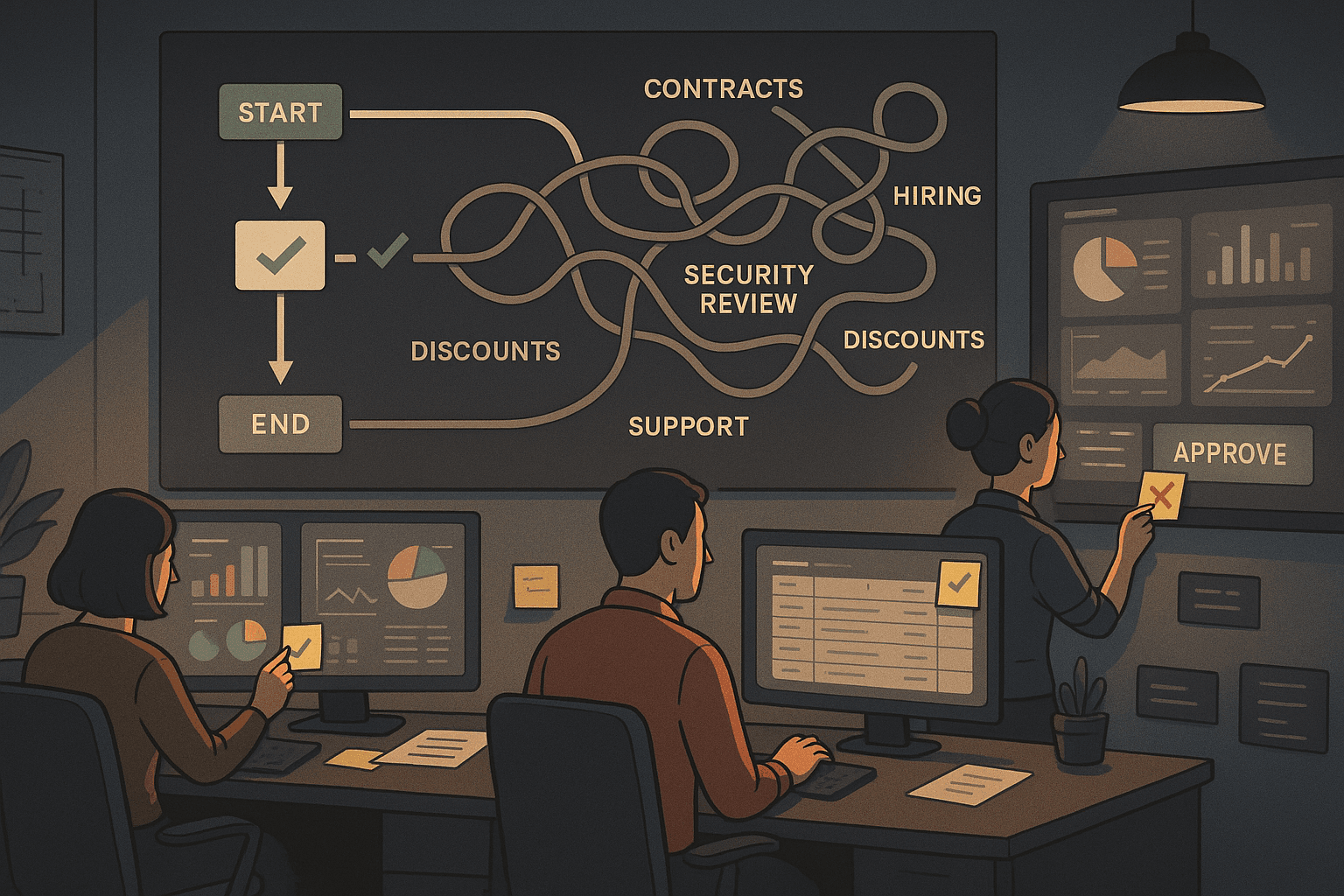
The failure rarely shows up as a dramatic outage. It shows up as a Slack message.
"Can we make an exception just this once?"
A sales rep needs a custom payment term to close a quarter-end deal. A candidate in a new state needs payroll set up outside your current entities. A large prospect wants a security questionnaire, DPA redlines, and SSO before they sign. A customer success manager promises a one-off implementation step because the product doesn’t quite support the workflow yet. Support gives a refund outside policy because the account is loud and strategic.
Everybody tells themselves the same story: this is temporary, this is revenue-protective, this is customer-centric, this is founder-mode, this is just one edge case.
Then six months later the company is running on undocumented exceptions.
Finance has side spreadsheets to track nonstandard billing. HR has backchannel rules for immigration, relocation, contractors, and equity timing. Legal has a graveyard of custom clauses no one remembers approving. Security reviews live in someone’s inbox. Support has VIP logic that exists nowhere in the product. Engineering gets pulled into bespoke asks because GTM sold around the roadmap. Nobody can tell which exceptions are strategic and which are just process debt with a good narrative.
This is the exception path problem: your business appears to have a process, but the real work increasingly happens outside that process whenever reality doesn’t match the happy path.
For early-stage startups, a few exceptions are normal. In fact, they’re often the right move. The problem starts when exception handling is invisible, slow, personality-driven, or easier than fixing the root cause. At that point, the exception path stops being a safety valve and becomes the operating model.
I’ve seen this break companies in predictable ways:
- Revenue gets booked with terms finance can’t actually administer.
- Hiring expands faster than legal, payroll, and manager onboarding can support.
- Enterprise deals stall because security, legal, and product commitments have no owner.
- Support teams create informal policies that conflict with billing, product, and brand.
- Founders become the universal exception approver and bottleneck.
- Teams lose trust in process because following process is slower than bypassing it.
The good news is that this is solvable without building bureaucracy. You do not need a giant operations team or enterprise-grade workflow software to get control. You need a way to identify recurring exceptions, classify them, decide which are worth supporting, and build lightweight handling rules before ad hoc behavior becomes institutionalized chaos.
This article is a tactical playbook for doing exactly that.
A real failure scenario: the quarter-end “strategic deal” that rewired the company
Let’s start with a scenario that looks familiar because it happens in some form at almost every startup.
A B2B SaaS startup sells mostly self-serve and small sales-assisted annual plans. Standard contract: annual prepaid, standard MSA, basic security documentation, onboarding within normal implementation limits, support during business hours, no custom invoice workflows.
Then an enterprise prospect appears.
The deal is 8x bigger than the median contract value. The buyer wants:
- Net 60 payment terms
- Procurement onboarding in a vendor portal
- Custom security questionnaire
- DPA redlines and two liability edits
- SSO and audit log commitments not fully productized
- A pilot period with conditional conversion
- Two implementation steps that require manual work by engineering
- Regional data residency assurances phrased more confidently than the system really supports
Sales says it’s strategic. The founder gets involved. Everybody says yes in pieces.
Here’s what happens next.
Sales tracks the promise set in email threads. Legal redlines in Word documents with version naming chaos. Security answers questionnaires using past responses pulled from Notion, Google Drive, and memory. Engineering agrees to manual workarounds in Slack. Finance creates a special invoice process because the customer procurement system rejects the normal format. Customer success invents a pilot success plan that isn’t tied to product telemetry. Nobody updates the CRM fields because the standard stage flow doesn’t reflect all this complexity.
The deal closes. Everyone celebrates.
Then the hidden cost hits.
- Finance can’t accurately predict cash timing because payment terms differ from policy.
- Renewals inherit custom language no one notices until 11 months later.
- Product is now committed to “temporary” enterprise features that were never prioritized properly.
- Support gets tickets related to a workflow built from manual backend steps.
- Security and legal documents requested by future prospects are answered inconsistently because the company never canonicalized what it promised.
- Sales uses the same concessions on the next two enterprise deals because precedent was set, but no one explicitly approved that precedent.
- The founder becomes the only person who remembers why the original compromises were made.
At first glance, this looks like a deal execution problem. It’s actually an exception path design problem.
The business had a happy path for normal deals. It did not have an operating model for nonstandard deals. So the company improvised at every step. The cost wasn’t just extra work for one deal. The cost was creating an unowned shadow process that now affects revenue, delivery, legal exposure, and product commitments.
The same pattern repeats in hiring, support, finance, and internal workflows.
The pattern: how exception paths silently become the real company
Most startup processes are designed around the median case. That’s rational. If you’re small, you don’t want to overengineer for every scenario. The issue is not that exceptions exist. The issue is that exceptions cluster in predictable categories and compound across functions.
Here are the most common exception classes.
1. Commercial exceptions
These include nonstandard discounts, payment terms, pilot structures, custom procurement steps, unusual packaging, reseller motions, and side-letter commitments.
Symptoms:
- Sales promises things not represented in product, pricing, or contract templates.
- Finance finds out after signature.
- Discounting logic lives in manager judgment, not policy.
- CRM stages and approval rules don’t capture special terms.
2. Legal and compliance exceptions
These include redlines, privacy terms, security reviews, data processing requests, insurance asks, and indemnity/liability edits.
Symptoms:
- Legal review starts late and blocks close.
- Security questionnaires are answered inconsistently.
- There is no approved fallback position for common clauses.
- Teams confuse “needs review” with “needs founder attention.”
3. Product and delivery exceptions
These include custom implementation, one-off integrations, migration requests, service-level asks, support overrides, and temporary manual workarounds.
Symptoms:
- Engineering commits happen in Slack.
- Customer success absorbs product gaps as service work.
- Support uses “just this once” backend fixes.
- No one tracks whether manual work repeats across customers.
4. Hiring and people exceptions
These include international candidates, immigration cases, contractor-to-employee transitions, unusual compensation structures, relocation, leave accommodations, and title leveling edge cases.
Symptoms:
- Recruiting closes candidates before HR/legal/payroll checks feasibility.
- Manager promises compensation or title terms outside framework.
- Payroll and entity setup lag behind hiring decisions.
- Exceptions are solved by “asking the founder” rather than policy.
5. Finance and billing exceptions
These include split invoicing, custom tax handling, special refund requests, credit memos, nonstandard revenue recognition treatment, and expense reimbursements outside policy.
Symptoms:
- Finance maintains manual trackers outside the core system.
- Customers receive inconsistent invoice formats and timing.
- Revenue operations cannot explain the contract-to-cash path for edge cases.
- Refunds and credits are discretionary rather than rule-based.
6. Internal workflow exceptions
These include approval bypasses, urgent vendor purchases, emergency access grants, expedited launches, and unplanned cross-functional requests.
Symptoms:
- Slack replaces systems of record.
- “Urgent” becomes a category that disables process.
- Work is started before ownership or approval is defined.
- Teams optimize for speed locally and create rework globally.
The pattern is almost always the same:
- A nonstandard request arrives.
- The existing workflow can’t absorb it.
- People route around the system to get the outcome.
- The workaround succeeds once, so it becomes precedent.
- The precedent is not codified, priced, staffed, or constrained.
- More exceptions arrive.
- The company now has two operating models: documented process and actual practice.
When those diverge enough, process credibility collapses.
Why standard advice fails
Most advice on startup operations falls into one of three bad buckets.
Bad advice #1: “Just stay flexible”
This sounds pragmatic, and at very early stages it often is. But “stay flexible” usually means “allow local exceptions without tracking system impact.” Flexibility is useful only when paired with visibility and decision rules.
Otherwise, flexibility becomes silent complexity accumulation.
Bad advice #2: “Standardize everything”
This is the opposite trap. Founders who get burned by chaos often overcorrect into heavy approval matrices, rigid forms, and software-driven bureaucracy. That can reduce unauthorized exceptions, but it also slows legitimate opportunities and irritates strong operators.
Over-standardization is especially dangerous when the business is still discovering what should be standard.
Bad advice #3: “Buy an enterprise workflow tool”
Tools help after you know your exception categories, routing logic, approval authority, and recordkeeping requirements. They do not create those things for you.
Buying a fancy workflow platform too early often gives startups an expensive digital version of their confusion.
You end up with:
- More forms, same ambiguity
- More dashboards, same bottlenecks
- More automations, same bad policy
The real issue is not lack of tooling. It’s lack of explicit exception design.
A better approach: treat exceptions as a product you operate
Here’s the mental model that works.
Your startup has a core workflow for each major function: deal desk, hiring, procurement, onboarding, support, billing, security review, etc.
Around each core workflow is an exception layer.
If you don’t design that layer intentionally, people will build it informally through side channels. So design it the same way you’d design a product:
- Define the user request types.
- Define supported and unsupported cases.
- Define service levels and approval paths.
- Define ownership.
- Define what gets recorded.
- Define when repeated exceptions trigger process or product changes.
That’s the key shift: stop treating exceptions as random annoyances. Treat them as an operational surface area with explicit scope.
A good exception handling system does five things:
- Makes exceptions visible
- Separates strategic exceptions from noise
- Routes decisions to the right owner fast
- Captures precedent and commitments
- Feeds recurring exceptions back into process, tooling, or product
This does not require a giant PMO. It requires discipline.
Step 1: Audit recurring exceptions before you try to fix them
Do not start by redesigning workflows in theory. Start by auditing the last 60 to 90 days of exceptions across your most important business processes.
Your goal is to answer:
- What kinds of exceptions keep happening?
- How often do they happen?
- Who approves them?
- Where do they get stuck?
- What manual work do they create?
- What promises get made that no system tracks?
- Which exceptions are actually strategic versus just unpriced chaos?
Build a simple exception log
You can do this in Airtable, Notion, Google Sheets, or your ops system of choice. Simpler is better initially.
Recommended fields:
- Date
- Function area: sales, legal, security, finance, HR, support, product, etc.
- Request type
- Customer/candidate/internal requester
- Trigger: why normal process failed
- Requested exception
- Approver
- Decision: approved, denied, modified
- Time to decision
- Manual teams involved
- Downstream obligations created
- One-time or likely recurring
- Estimated value at stake
- Estimated operational cost
- Notes / links to source records
This log alone will reveal a lot. Most teams discover that their “rare exceptions” aren’t rare at all. They are just unmeasured.
Look for concentration, not anecdotes
Founders tend to react to loud cases. Operators should react to patterns.
After logging 60–90 days, bucket by:
- Volume
- Revenue impact
- Delay caused
- Manual hours consumed
- Cross-functional handoffs
- Risk created: legal, security, payroll, customer trust, margin
You are looking for categories where a small set of exception types creates a large share of friction.
Usually the first 3–5 categories are obvious:
- Nonstandard payment terms
- Security reviews lacking a standard packet
- Discount approvals with inconsistent thresholds
- International hiring feasibility gaps
- Support credits/refunds outside policy
- Product/service promises made during sales
Useful cost framework
Most startups undercount exception cost because they only count immediate labor. Use a fuller model:
Exception cost = approval time + manual execution time + follow-up time + rework risk + precedent risk
Example:
A custom contract clause takes:
- 45 minutes sales coordination
- 30 minutes legal review
- 20 minutes founder input
- 15 minutes finance check
- 30 minutes documentation cleanup later
That’s already 2 hours 20 minutes of direct time. But the real cost may be higher if:
- it slows signature by 5 business days,
- creates a future renewal trap,
- sets a discount or liability precedent,
- requires custom billing steps every year.
If you multiply that across 15 “special” deals per quarter, you’re looking at a recurring operating burden large enough to justify process design or tooling.
Step 2: Classify exceptions into four buckets
Once you have data, classify each exception type. This is where teams get leverage.
Use four buckets.
Bucket A: Allowed and routable
These are exceptions you are willing to support under defined conditions.
Examples:
- Discounts up to a threshold with manager approval
- Net 30 for customers above a certain ACV
- Standard security questionnaire responses from an approved library
- Remote hires in countries supported by your EOR
- Refunds below a fixed amount within policy windows
These should be fast, documented, and delegated.
Bucket B: Allowed but expensive
These are exceptions you may support, but only if the economic or strategic case is strong.
Examples:
- Redlines outside fallback positions
- Net 60 or custom procurement onboarding
- Manual migrations requiring engineering hours
- Unusual compensation packages
- Enterprise security commitments requiring roadmap tradeoffs
These need explicit decision criteria, not vibe-based approvals.
Bucket C: Temporarily unsupported but recurring
These are the most important. They happen often enough that you should either productize, policy-ize, or formally decline them.
Examples:
- Frequent SSO requests from mid-market prospects
- Repeated international hiring asks in the same region
- Regular customer requests for invoice splitting or PO workflows
- Common support edge cases that require backend intervention
These are signals. If you ignore them, ops debt grows.
Bucket D: Not supported
These are requests you explicitly decline.
Examples:
- Unlimited liability clauses
- Security promises your architecture cannot support
- Employment structures that create legal exposure
- Custom product behavior for low-value accounts
- Refunds outside policy without approved escalation basis
Being explicit here is healthy. Good exception handling includes saying no cleanly.
Step 3: Define approval rules that reflect risk, not org politics
Most startup approvals evolve socially: whoever is loudest, closest to the customer, or highest in title gets involved. That creates delay and inconsistent decisions.
A better system maps approvals to risk type.
Approval dimensions that matter
For each exception category, define rules based on:
- Financial impact
- Margin impact
- Legal/compliance risk
- Security/privacy risk
- Product/delivery obligation
- Geographic/employment risk
- Customer tier or strategic value
- Reversibility
The main idea: a 10% discount on a standard annual plan does not need the same path as a custom DPA clause or a payroll setup in a new country.
Example approval matrix for commercial exceptions
Discounting
- Up to 10%: sales manager
- 10–20%: VP Sales
- Above 20% or multi-year pricing locks: CRO + Finance
Payment terms
- Annual prepaid, standard terms: no exception
- Net 30 above threshold ACV: Finance manager
- Net 60 or milestone billing: Finance lead + Sales lead
Custom product/service commitments
- Existing implementation package variance under 2 hours: CS lead
- Engineering-involved work: Product/Engineering owner + CS lead
- Commitments affecting roadmap or supportability: executive review
Example approval matrix for people exceptions
Remote hiring
- Supported state/country with existing payroll/EOR: People ops
- New state with manageable setup: People ops + Finance/Legal as needed
- New country requiring entity, EOR, or immigration review: People + Legal + Finance decision memo
Compensation/title
- Within band and leveling framework: hiring manager + People
- Above-band or nonstandard equity timing: exec + People + Finance
The point is not to create giant tables. The point is to remove ambiguity about who decides what.
Step 4: Create lightweight exception intake, not Slack archaeology
If exceptions arrive through DMs, meetings, and random threads, you cannot manage them. You need a minimum viable intake path.
That does not mean forcing everyone into a terrible ticketing maze. It means creating one reliable doorway.
Minimum viable intake design
For each high-volume function, create a short intake form or request template with:
- What is being requested?
- Why does the standard process not work?
- What value is at stake?
- What deadline matters?
- What commitments have already been made, if any?
- Which teams will be affected?
- Is this likely to recur?
This can live in:
- Airtable form
- Notion form
- Google Form
- Jira Service Management portal
- Zendesk internal form
- HubSpot or Salesforce approval object
- Ashby/Greenhouse notes for hiring exceptions
Pick the tool that fits the workflow volume and team behavior.
Tool comparison: what to use at different stages
Google Sheets / Forms
- Best for: very early stage, low volume, quick audit
- Pros: free/cheap, flexible, immediate
- Cons: weak routing, poor permissions, hard to maintain as scale grows
- Typical cost: near zero to minimal Workspace cost
- Time to launch: 1 day
Airtable
- Best for: ops teams needing structure without engineering help
- Pros: forms, views, automations, decent flexibility
- Cons: can become a pseudo-app with fragile logic, not ideal for deep approval chains
- Typical cost: moderate SaaS cost per seat/base
- Time to launch: 2–5 days
Notion
- Best for: documentation plus lightweight request capture
- Pros: easy docs + templates, good for policy libraries
- Cons: weak for rigorous workflow enforcement, easy for records to drift
- Typical cost: low to moderate
- Time to launch: 1–3 days
Jira Service Management
- Best for: security, IT, internal ops requests with real queueing needs
- Pros: strong ticketing, SLAs, routing, auditability
- Cons: heavier UX, overkill for small teams if used everywhere
- Typical cost: moderate
- Time to launch: 3–10 days
HubSpot / Salesforce approvals
- Best for: deal-path exceptions tied to CRM data
- Pros: lives where sales already works, can gate stages/discounts, keeps revenue context visible
- Cons: can become admin-heavy; needs thoughtful field design
- Typical cost: existing platform cost plus admin time
- Time to launch: 3–14 days depending on complexity
Zendesk / Intercom workflows
- Best for: support exceptions, refunds, escalations
- Pros: sits in existing support motion, easier enforcement for CS/support teams
- Cons: limited for cross-functional approvals unless integrated
- Typical cost: existing support stack cost
- Time to launch: 2–7 days
My rule of thumb:
- If you’re under 30 people and exception volume is moderate, start with Airtable or Forms + docs.
- If the issue is mostly commercial, build in CRM first.
- If the issue is mostly security/IT/internal service requests, use a ticketing tool.
- If you need legal-grade review trails, use tooling that preserves approvals and source docs, not just notes.
Step 5: Build a “fallback positions” library
One major source of exception chaos is re-litigating the same issue repeatedly.
Legal does it with clauses. Security does it with questionnaires. People ops does it with location and compensation edge cases. Support does it with goodwill requests.
You need a library of approved fallback positions.
What belongs in the library
- Standard answers to security and compliance questions
- Approved legal fallback language for common asks
- Discount/payment term policies and thresholds
- Supported hiring geographies and employment models
- Refund/credit/comp policy
- Product commitment language: what sales can and cannot promise
- Escalation paths for unsupported cases
This does two things:
- Speeds decisions on known exception types
- Prevents inconsistency between operators
Practical example: security review library
A lightweight enterprise security packet might include:
- Security overview one-pager
- Architecture diagram
- Subprocessor list
- DPA template
- Standard questionnaire responses
- Current certifications / attestations
- Product roadmap language for unsupported asks
Without this, every enterprise deal becomes custom work. With it, maybe 70–80% of asks are answered from a canonical source and only true exceptions go to technical review.
Practical example: support exception policy
Instead of “use judgment,” define:
- Refundable within X days under conditions Y
- Credit thresholds by role
- What requires finance sign-off
- What to offer when the product lacks a feature
- What never gets promised without product approval
That keeps generosity from turning into policy drift.
Step 6: Separate exception approval from exception execution
This is where many teams fail.
Approving an exception is not the same as operationalizing it.
A founder says yes to a custom procurement flow. Fine. But who actually changes billing setup, updates contract metadata, tells support, configures CRM fields, and ensures renewal handling? If no one owns execution, the approval becomes a minefield handed to downstream teams.
For every approved exception, assign:
- Decision owner
- Execution owner
- System-of-record owner
- Renewal/revisit owner if obligations persist
Example workflow: nonstandard enterprise deal
- Sales submits exception request in CRM or intake form
- Finance reviews payment terms
- Legal reviews redlines against fallback positions
- Security reviews questionnaire against approved packet
- Product/CS reviews implementation commitments
- Exception decision logged with specific approved terms
- Deal closes
- RevOps updates contract metadata fields
- Finance flags billing configuration
- CS receives implementation obligations
- Renewal owner gets reminder of custom terms 120 days before renewal
If steps 8–11 do not exist, you don’t have an exception process. You have an approval ritual.
Step 7: Put expiration dates on temporary exceptions
The most dangerous phrase in startups is “temporary workaround.”
Temporary workarounds need one of three outcomes by a set date:
- Productized
- Policy-supported
- Retired
Otherwise they become permanent invisible labor.
Add an expiration field
For approved exceptions that create ongoing behavior, log:
- Expiration/review date
- What would make this no longer necessary?
- Which team owns the decision to operationalize or stop it?
Examples:
- Manual CSV import promised during onboarding: review after 3 customers or 60 days
- Security promise tied to roadmap item: review at next planning cycle
- Hiring workaround via contractor arrangement: review in 90 days for compliant conversion path
- Billing exception for one customer class: review after quarter-end to determine policy update
This is how you stop edge cases from quietly becoming architecture.
Step 8: Use recurring exceptions as product and ops signals
Founders often treat exceptions as distractions from strategy. In reality, recurring exceptions are strategy data.
A repeated exception can mean one of four things:
- Your process is too rigid
- Your product is missing a high-value capability
- Your pricing/package doesn’t fit the market
- Your policy is unclear or unrealistic
Decision rule for productizing exceptions
A simple framework:
Productize or formalize an exception when it scores high on:
- Frequency
- Strategic value
- Manual burden
- Risk reduction
- Reusability across accounts/cases
Example
If 30% of enterprise prospects ask for SSO and audit logs, and sales keeps creating workaround promises, this is no longer a sales exception. It is a product packaging and roadmap issue.
If 20% of hires require a remote setup outside your original assumptions, this is not “recruiting being creative.” It’s a people infrastructure question.
If support issues the same goodwill credit every week because onboarding creates confusion around a feature, that is likely a product or education problem masquerading as support discretion.
Why standard operating docs alone won’t save you
A lot of teams respond to exception chaos by writing SOPs. Documentation matters, but SOPs usually describe the happy path. They often fail at the exact moment they’re most needed: when reality deviates.
What you need are not just SOPs, but decision rules for deviation.
That means every major process doc should answer:
- What counts as an exception?
- Who can approve which exception types?
- What is the intake path?
- What gets recorded?
- What commitments require downstream notification?
- When does the exception trigger review for policy/tooling/product change?
Without that, documentation becomes aspirational fiction.
A practical 30-day implementation plan
You can get a lot done here in a month without boiling the ocean.
Week 1: Audit and map
Goals:
- Identify top 3 business areas with exception pain
- Build the exception log
- Review last 60–90 days of edge cases
- Quantify frequency, delay, and manual burden
Who to involve:
- Founder or COO/head of ops
- RevOps or finance
- People ops
- Support/CS lead
- Legal/security owner if applicable
Deliverables:
- Top exception categories by function
- Sample cases showing current failure modes
- Rough cost estimate of manual burden
Time investment:
- 6–10 total cross-functional hours
Week 2: Define policies and approval rules
Goals:
- Bucket major exception types into allowed / expensive / recurring unsupported / not supported
- Create simple approval matrix
- Define intake requirements
- Draft fallback positions for top repeated asks
Deliverables:
- One-page exception policy per major function
- Approval ownership table
- Initial fallback library
Time investment:
- 8–12 total hours
Week 3: Implement intake and tracking
Goals:
- Launch one intake path per key function
- Set up system of record
- Add required fields to CRM/helpdesk/ATS if needed
- Define notification steps for approved exceptions
Deliverables:
- Intake form or request object
- Live tracking dashboard/view
- Basic SLA expectations
Time investment:
- 8–16 hours depending on tooling
Week 4: Train and enforce lightly
Goals:
- Teach managers and operators how to use the new process
- Start routing new exceptions through intake
- Review first batch weekly
- Kill off the most obvious side-channel behavior
Deliverables:
- Team enablement session
- First weekly exception review
- Initial improvement backlog from recurring exceptions
Time investment:
- 4–8 hours plus normal operating time
Example weekly exception review agenda
You do not need another bloated meeting. A 30-minute review can be enough.
Agenda:
- New exceptions by category
- Aging requests or blocked approvals
- Exceptions approved without full recording
- Repeated exceptions suggesting policy/product/tooling changes
- Exceptions to retire, formalize, or deny going forward
Metrics to track:
- Number of exceptions per function
- Median decision time
- Percent routed through official intake
- Manual hours consumed
- Repeat exceptions by type
- Revenue or hiring value associated with approved exceptions
- Count of temporary exceptions past expiration date
Tradeoffs: what good exception design does and does not do
Let’s be honest about tradeoffs.
A stronger exception handling system will:
- Slow down some approvals initially
- Force uncomfortable clarity on what you won’t do
- Expose when sales or managers overpromise
- Reveal tooling and policy gaps you’ve been avoiding
That’s good.
What it should not do:
- Require executive involvement in low-risk cases
- Turn every edge case into a committee process
- Create forms so burdensome that people bypass them
- Pretend all exceptions can be eliminated
The objective is not to suppress judgment. It is to make judgment visible, consistent, and less expensive.
Common failure modes when implementing this
1. Making the system too heavy
If your form asks 22 questions and approvals take 4 days, teams will go back to Slack. Keep intake short and approvals proportionate.
2. Capturing requests but not downstream obligations
Logging the exception is useful. Logging what it forces other teams to do is essential.
3. Centralizing all decisions in one operator
This creates a new bottleneck. Delegate what is routable.
4. Never saying no
If everything can be approved, you do not have an exception system. You have a permission theater.
5. Failing to revisit recurring exceptions
If the same request appears every week and remains “special,” leadership is avoiding a real decision.
6. Letting precedent spread informally
A discount, contract clause, support refund, or hiring arrangement used once can quickly become “what we did last time.” If precedent matters, document it explicitly.
Founder guidance: where you personally should stay involved
Founders often over-involve themselves in exceptions because they are the only cross-functional integrator early on. That’s understandable, but dangerous if it persists.
You should personally stay close to exceptions that:
- Change market positioning or roadmap commitments
- Create material legal, regulatory, or security exposure
- Establish major pricing or packaging precedent
- Open a new geography or employment model
- Affect core customer trust in irreversible ways
You should not be the approval layer for:
- Routine discounts within policy
- Standard refunds/credits
- Known contract fallback positions
- Supported hiring location cases
- Repeated support or billing exceptions with established rules
Your job is to define the system, review the pattern, and intervene where the business model is changing, not to answer every “just this once” request.
The simplest operating principle to remember
Here’s the sentence I’d use with any startup leadership team:
If an exception happens more than a few times, it is no longer an exception. It is an unsupported operating requirement.
That sentence cuts through a lot of confusion.
Unsupported operating requirements are dangerous because they sit in the gap between policy and reality. Nobody budgets for them. Nobody staffs for them. Nobody builds tooling for them. But everyone depends on them.
That’s where startup operations break.
Final takeaways
If your systems only work on the happy path, you do not have robust operations. You have a demo environment for your business.
Real companies run into messy deals, unusual hires, enterprise asks, edge-case support situations, odd billing requirements, and internal urgencies. The question is not whether exceptions will happen. The question is whether they’re handled through explicit design or accumulated improvisation.
What works in practice is straightforward:
- Audit the exceptions you already have
- Quantify the cost and risk they create
- Classify which ones are allowed, expensive, recurring, or unsupported
- Define approval rules based on risk
- Create one reliable intake path
- Build fallback positions for repeated asks
- Separate approval from execution
- Put expiration dates on temporary workarounds
- Use recurring exceptions as signals for product, policy, and tooling decisions
This is not bureaucracy for its own sake. It is how you keep edge cases from becoming the real company.
Because once the exception path becomes easier than the standard path, your org chart, systems, and margins start lying to you.
And by the time that becomes obvious, you are usually much bigger, much busier, and much more dependent on a set of informal promises nobody can fully unwind.
Fix it while the exception path is still small enough to see.