
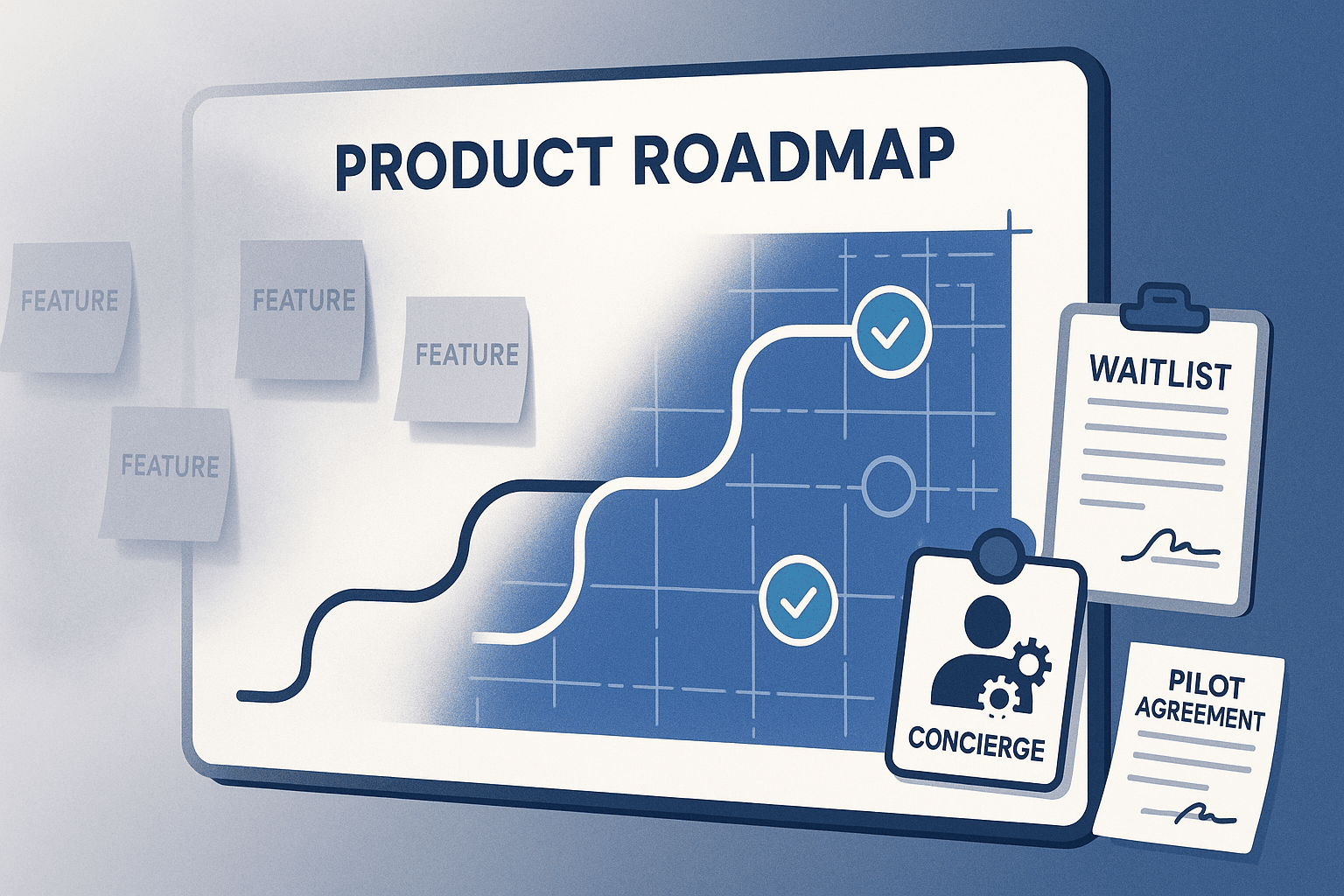
The temptation: “Just put it on the roadmap”
Early-stage founders are under constant pressure to appear decisive and inevitable.
- Investors want conviction and a story that compounds.
- Prospects want certainty and risk reduction.
- Teams want clarity about what they’re building next.
So founders do the thing that seems harmless: they publish a roadmap, imply a timeline, and let customers infer that a feature is essentially “in progress” when it’s not.
Sometimes it’s subtle: “We’re planning SSO next quarter.”
Sometimes it’s explicit: a public roadmap with dates, a pricing page for unreleased tiers, a sales deck that implies the integration already works.
This is the fake roadmap trap: using future product promises as a substitute for present product value.
It can “work” for a few weeks, until it doesn’t. Then it becomes a compounding liability:
- Trust erosion: Customers learn your words don’t map to delivery.
- Sales drag: Prospects demand more proof, more references, more legal protection.
- Churn acceleration: Buyers who purchased based on implied capabilities churn when reality doesn’t match.
- Team dysfunction: Engineering gets whiplash from commitments made without constraints.
- Regretful revenue: You close deals that should not have been closed.
And in some contexts (especially regulated industries or if you materially misrepresent capabilities), it can create legal and compliance risk.
There’s a better approach: validate demand and willingness-to-pay without pretending the product exists.
This article lays out a defensible system founders can use to de-risk building, using concierge pilots, pre-commit contracts, and transparent waitlists.
What “fake roadmaps” actually break
The problem isn’t having a roadmap. The problem is using a roadmap as marketing theater.
A roadmap is supposed to be:
- a planning artifact under uncertainty,
- a communication tool with caveats,
- a prioritization mechanism.
A fake roadmap becomes:
- a sales tool designed to reduce customer anxiety,
- a commitment device that bypasses discovery,
- a credibility loan you can’t repay.
This fails because it violates a basic rule of B2B trust:
Customers don’t mind that you’re early. They mind when you act mature while operating early.
In enterprise and mid-market especially, buyers price risk into every purchase. If they can’t price the risk, they avoid the vendor.
Why founders do it anyway
Founders rationalize roadmap over-promising because:
- They confuse interest with demand. Prospects say “we’d love that” and founders hear “we will pay for that.”
- They confuse urgency with timeline. A prospect says “this is critical” and founders hear “we need it next month.”
- They assume the only way to validate is to ship. So they promise shipping to validate, creating a trap.
- They’re copying late-stage playbooks. Mature companies can publicly roadmap because they have delivery capacity, buffers, and brand trust.
Paul Graham has written about how early startups often do things that don’t scale to get the first customers (e.g., concierge-like behavior) (Y Combinator essays: https://www.ycombinator.com/library). The fake roadmap is the opposite: it’s doing things that pretend you scale before you do.
The goal: validate willingness-to-pay, not “feature interest”
In product discovery, the question isn’t “Do people like the idea?”
The question is:
- Will a specific buyer allocate budget for a specific outcome,
- at a specific price,
- with a specific level of operational risk,
- within a specific time window,
- with a specific implementation burden?
That’s willingness-to-pay.
This aligns with foundational product thinking: build products that solve real problems in a way people will pay for. A classic framing is the mom test idea, avoid leading questions and measure real commitment (Rob Fitzpatrick, The Mom Test).
Commitment signals beat enthusiasm
Here are stronger signals than “sounds cool”:
- sharing real data or granting real access
- introducing you to legal/security/procurement early
- allocating internal resources (ops, IT, analyst time)
- agreeing to a pilot plan with success metrics
- signing a pre-order, LOI with terms, or paid pilot
Not all of these are necessary, but if you’re hearing excitement without any commitment signals, you’re in danger of building for applause.
The ethical alternative: three demand-validation mechanisms
You can validate demand without vaporware by using mechanisms that are explicit about what exists today and what doesn’t.
- Concierge pilots (deliver outcomes manually with software-light workflows)
- Pre-commit contracts (formalize future purchase conditional on delivery)
- Transparent waitlists (capture demand honestly while testing pricing and segmentation)
These tools can be combined, sequenced, and tailored by market maturity.
1) Concierge pilots: sell outcomes, deliver manually, instrument everything
A concierge pilot is when you:
- sell (or pre-sell) the outcome,
- execute much of the work manually or semi-manually,
- learn the workflow deeply,
- then automate the 20% that drives 80% of value.
This is not “consulting disguised as SaaS.” It’s a deliberate transitional step.
Why concierge pilots work
Concierge pilots solve three hard problems:
- They validate the problem is painful enough to pay for.
- They reveal the true workflow, edge cases, and integration points.
- They create early ROI stories and references.
This approach matches the spirit of Customer Development (Steve Blank) and Lean Startup’s emphasis on validated learning (Eric Ries).
How to run a concierge pilot (a practical template)
Step 1: Define the outcome in business terms
Examples:
- “Reduce manual invoice exceptions by 40%.”
- “Cut SOC 2 evidence collection time from 3 weeks to 5 days.”
- “Increase outbound reply rate from 3% to 6% in 60 days.”
Avoid feature language like “We’ll build an AI dashboard.” The buyer wants the result.
Step 2: Define the minimum credible scope
Scope should be narrow enough to ship value in weeks, not quarters.
- One department
- One workflow
- One data source
Step 3: Choose a delivery model (manual → semi-automated)
Common patterns:
- Analysts (your team) produce reports, the “product” is the recurring deliverable.
- Zapier + spreadsheets + a thin UI.
- A single script + a human QA loop.
- A Slack/Teams bot that triggers manual processing behind the scenes.
Step 4: Price it like a pilot, not like a dream
Options:
- Paid pilot fee (e.g., $5k–$25k) tied to a 4–8 week evaluation
- Monthly retainer with clear deliverables
- Setup fee + discounted first months
A paid pilot is a much stronger signal than a free trial in early B2B, because it tests real budget allocation.
Step 5: Define success metrics and a decision date
Write down:
- baseline
- target
- measurement method
- who signs off
- “go/no-go” date
This prevents the pilot from becoming indefinite unpaid labor.
Step 6: Instrument learning
Track:
- time spent per step
- data required
- failure modes
- customer handoffs
- what customers actually use
Then automate the highest leverage bottlenecks.
How to avoid the “concierge trap”
Concierge pilots can become a services business if you don’t set boundaries.
Guardrails:
- Cap the pilot to a fixed duration and fixed deliverables.
- Keep a “manual work budget” per customer (e.g., ≤ 4 hours/week).
- Productize internal tools as you go.
- Design the workflow so automation is a straight-line path, not a rewrite.
A helpful heuristic: if your manual process requires deep custom logic per customer, you’re either too early on segmentation or you’re in a genuinely bespoke market.
2) Pre-commit contracts: make demand real without pretending the feature exists
A pre-commit contract is a way to ask for real commitment now for something you’ll deliver later, without misrepresenting current capabilities.
This can take multiple forms:
- Paid pre-order (rare in enterprise but possible in SMB)
- Pilot-to-paid agreement (most common)
- LOI (Letter of Intent) with price and timeline
- MSA signed now, SOW later contingent on feature readiness
- Conditional purchase agreement tied to acceptance criteria
The key is that the agreement explicitly states:
- what exists today
- what does not exist
- what will be delivered
- the criteria for acceptance
- what happens if you fail to deliver (refund, termination, revised timeline)
This is how you test willingness-to-pay ethically.
Why LOIs are both useful and dangerously overrated
LOIs can be meaningful if they contain:
- specific buyer entity
- defined product scope
- price or price range
- timeline
- signature from an economic buyer
But LOIs can also be low-cost signaling. A non-binding LOI signed by someone without budget authority is closer to “nice conversation” than demand.
Treat LOIs as a spectrum:
- Weak LOI: vague, non-binding, no price, signed by a champion.
- Strong LOI: includes price, success criteria, timeline, signed by budget owner.
- Best: paid pilot or deposit with clear terms.
The pilot-to-paid contract (recommended)
A practical structure:
- Paid pilot agreement (4–8 weeks)
- Auto-conversion clause to annual contract if acceptance criteria are met
- Opt-out if criteria not met
This aligns incentives:
- Customer: reduced risk
- Founder: real revenue path if you deliver
Important: acceptance criteria should be outcome-based where possible, not “feature shipped.”
Pre-commit phrasing that preserves trust
What to say:
- “We don’t support Okta SSO today. We can deliver it by X date for this pilot if we sign by Y, and we’ll write acceptance criteria into the agreement.”
- “Here’s what we can do immediately via a manual workflow, and here’s what we will automate if the pilot succeeds.”
What not to say:
- “SSO is basically done.”
- “It’s on the roadmap, no problem.”
The difference is not politeness, it’s falsifiability.
Legal note (non-advice)
Pre-commit contracts touch legal and procurement. Work with counsel, especially around:
- representations and warranties
- limitation of liability
- timelines and remedies
- data processing and security
Being explicit reduces legal risk rather than increasing it.
3) Transparent waitlists: measure demand honestly (and test pricing)
Waitlists are often used poorly: as vanity metrics.
A transparent waitlist is different. It’s a demand and segmentation instrument that:
- states clearly what exists vs what’s coming
- captures who wants it, why, and how urgently
- tests pricing and packaging
- builds a pipeline for pilots
What makes a waitlist “transparent”
A transparent waitlist includes:
- current product state (“private beta; integration not yet available”)
- expected timeline ranges (“months, not weeks”)
- selection criteria (“we’re onboarding 10 companies in X category”)
- a clear ask (“join if you can commit to a 30-min workflow mapping call”)
If your waitlist implies access is near when it’s not, you’re back in fake-roadmap territory.
How to turn a waitlist into willingness-to-pay validation
Add friction intentionally:
- Ask for company email and role.
- Ask what budget category it comes from.
- Ask what they pay today (or internal cost).
- Offer an option to place a refundable deposit (where appropriate).
- Require a short qualification call.
Then segment:
- high urgency + high authority (pilot candidates)
- high urgency + low authority (needs champion coaching)
- low urgency (content and nurture)
Pricing tests you can run without lying
You can test price sensitivity without shipping by:
- offering pilot pricing tiers
- offering “founding customer” annual pricing for those who commit to a pilot
- using price ranges and seeing where drop-off occurs
In B2B, price isn’t discovered by surveys alone. It’s discovered by negotiated commitments.
A defensible demand-validation sequence (what to do first)
Here’s a practical progression that avoids vaporware while still moving fast.
Phase 1: Problem validation (1–3 weeks)
Goal: confirm the problem is real and the buyer is identifiable.
Deliverables:
- ICP hypothesis (industry, company size, trigger event)
- problem narrative with quantified cost
- buying committee map (economic buyer, champion, IT/security)
Signals to look for:
- buyers quantify pain in dollars/time
- they share internal workflow artifacts
- they ask about procurement steps
Phase 2: Concierge pilot design (1–2 weeks)
Goal: define a pilot you can deliver with today’s capabilities.
Deliverables:
- pilot scope (one workflow)
- success metrics
- implementation requirements
- pricing and timeline
Phase 3: Run 3–10 paid concierge pilots (6–12 weeks)
Goal: prove ROI, find repeatability, identify product wedge.
Deliverables:
- case studies (even internal)
- before/after metrics
- a product requirements doc grounded in reality
Phase 4: Convert the best pilots into pre-commit annuals
Goal: lock in revenue tied to acceptance criteria.
Deliverables:
- pilot-to-paid contracts
- product roadmap internally derived from observed leverage points
Phase 5: Scale with a transparent waitlist + onboarding process
Goal: keep pipeline warm without overpromising.
Deliverables:
- public beta positioning that matches reality
- selection criteria for onboarding
- security posture documentation (even if minimal)
How to talk about the roadmap without lying
A roadmap is often unavoidable. Customers ask.
The honest answer isn’t “we have no roadmap.” It’s “we have a roadmap with uncertainty.”
Use ranges, not dates
Instead of:
- “Q3: Salesforce integration”
Say:
- “Salesforce integration is in our next 1–2 cycles once we validate the workflow in pilots. If it’s a blocker, we can scope a paid pilot with a clear delivery date and acceptance criteria.”
Distinguish between: planned, committed, in progress, available
Adopt explicit labels:
- Exploring (problem research)
- Planned (would build if demand proves out)
- Committed (resourced and scheduled)
- In progress (actively being built)
- Available (in production)
Don’t blur “planned” into “committed.”
Publish “principles,” not promises
A public roadmap can focus on:
- customer outcomes you’re optimizing for
- integration direction (categories, not vendors)
- security trajectory (SOC 2 path, SSO intent)
This is less likely to become a lie.
When it’s acceptable to sell ahead of the product
Selling ahead is not inherently unethical. In fact, many great products started with sales before software.
It becomes unethical when:
- you imply current capability that does not exist,
- you hide critical dependencies,
- you omit material uncertainty,
- you take money without a fair remedy.
A good standard is: Would a reasonable buyer feel misled if they re-read what you wrote?
If yes, stop.
The FTC’s general truth-in-advertising principles are a useful sanity check: advertising should be truthful, not misleading, and substantiated when claims are made (see FTC guidance: https://www.ftc.gov/business-guidance/advertising-marketing).
In B2B SaaS, credibility is an asset. Don’t trade it for a quarter of runway.
Common failure modes (and how to correct them)
Failure mode 1: The pilot has no decision point
Symptom: you’re “helping” forever.
Fix: define a decision date and conversion criteria in writing.
Failure mode 2: You validate with the wrong buyer
Symptom: you get lots of praise from users, but no budget.
Fix: identify the economic buyer early. You can still interview users, but don’t confuse usability with purchasability.
Failure mode 3: You build the demo instead of the workflow
Symptom: beautiful UI, no operational adoption.
Fix: concierge the real workflow first; then build UI around what repeats.
Failure mode 4: You accept “feature requests” as strategy
Symptom: roadmap becomes a collage of one-off asks.
Fix: look for a common job-to-be-done, not common feature phrasing. (JTBD is a useful lens popularized by Clayton Christensen’s work.)
Failure mode 5: Security and compliance are treated as “later”
Symptom: pilots stall in security review.
Fix: even early, have a minimal security posture:
- documented access controls
- data retention policy
- incident response contact
- a basic security overview doc
You don’t need SOC 2 on day one, but you do need to be credible.
The founder’s dilemma: speed vs integrity
Some founders worry: “If I’m fully transparent, competitors will steal the deal.”
In practice, in B2B:
- Customers don’t buy ideas; they buy execution, trust, and risk reduction.
- If honesty loses the deal, that deal was likely to churn anyway.
- The competitor who promises everything may win the signature, but you can win the category by being the vendor that doesn’t create surprises.
There is a real trade-off: transparency can slow you down with some buyers. But it accelerates you with the buyers you actually want, those who value reliability and partnership.
A concrete script library (use and adapt)
If a prospect asks: “Is Feature X available?”
“Not today. We can either (1) run a pilot where we deliver the outcome using a manual workflow while we build it, or (2) put you on a waitlist with updates as we validate demand. If Feature X is a hard requirement by a specific date, we can write that date and acceptance criteria into a pilot-to-paid agreement.”
If a prospect says: “Put it on the roadmap and we’ll sign”
“Happy to discuss it, but we don’t use roadmaps as commitments. If it’s a purchase condition, let’s structure a pilot with clear acceptance criteria and a remedy if we miss it.”
If your sales team wants to promise it anyway
“We can sell what we can deliver. For what we can’t deliver yet, we sell a pilot with transparency and an explicit plan. Anything else creates churn and reference risk.”
Metrics that tell you you’re validating demand correctly
Track metrics that reflect commitment, not attention:
- pilot-to-paid conversion rate
- time-to-economic-buyer conversation
- % of pilots with documented success criteria
- average pilot price (and discounting behavior)
- number of customers willing to sign conditional agreements
- churn reasons tied to “missing promised features” (should be near zero)
If you’re getting many waitlist signups but no one will pay for a pilot, you may have curiosity, not demand.
The bottom line: build the trust flywheel
The fake roadmap trap is seductive because it feels like momentum. But it’s often borrowed momentum, paid back later with interest.
A better system is straightforward and defensible:
- Use concierge pilots to prove outcomes and learn workflows.
- Use pre-commit contracts to validate willingness-to-pay without misrepresentation.
- Use transparent waitlists to segment demand and test pricing honestly.
If you do this well, something counterintuitive happens: you can move faster because you’re honest.
You stop building fantasies and start building what buyers will actually fund.