
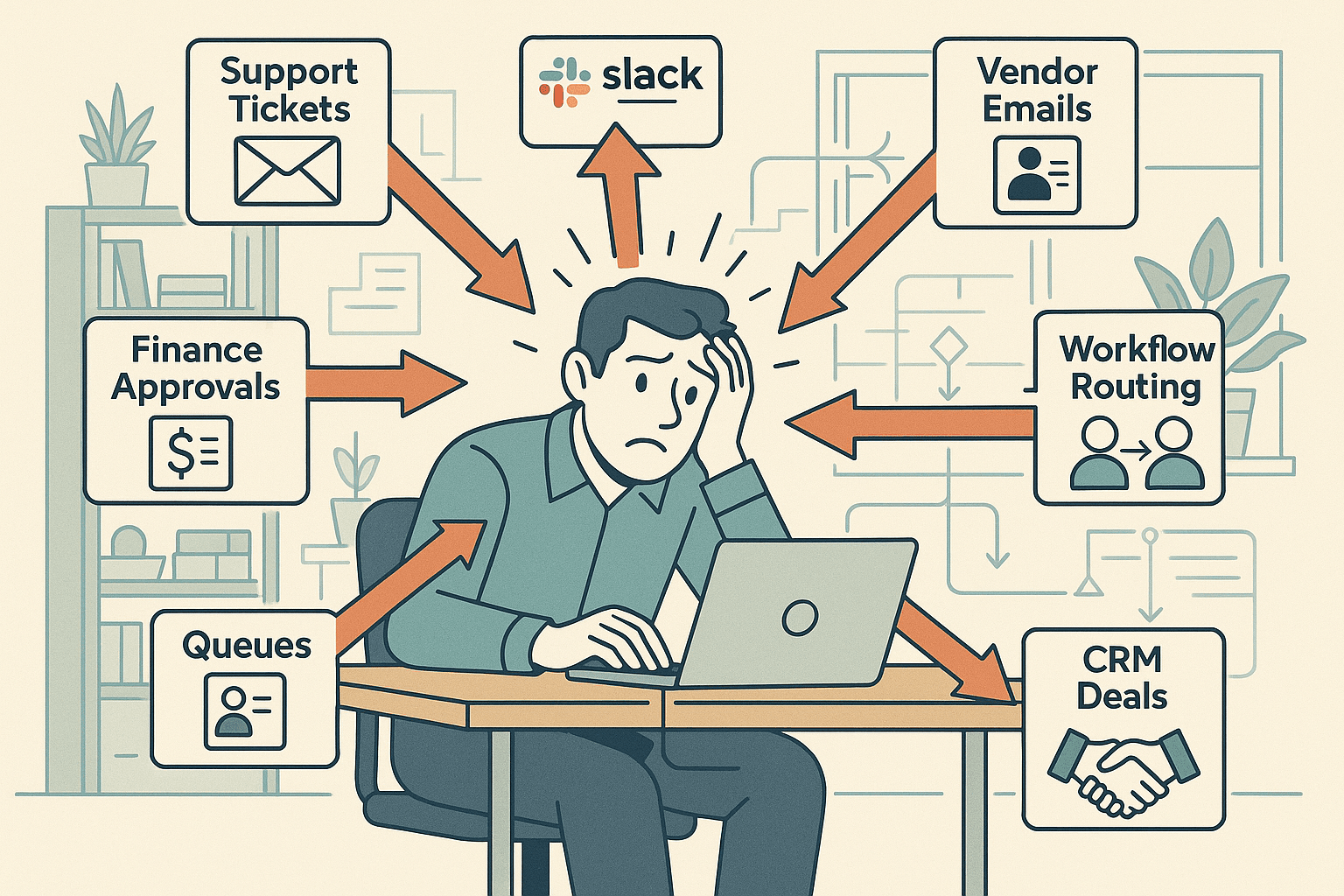
Monday starts with a customer issue that should have gone to support, except the ticket sat untouched over the weekend because the owner was traveling. Finance pings about an invoice over the approval threshold. Recruiting asks whether to move a candidate forward because the hiring manager never submitted scorecards. A vendor wants a security review answer. Sales has a contract exception. An engineer needs a product call on a one-off customer request. None of these are founder-level decisions in theory. In practice, they all land in the same place: the founder’s inbox, Slack DMs, and calendar.
This is one of the least discussed operating failures in startups because it hides inside a flattering story. The founder is “helpful.” The founder is “close to the details.” The founder is “keeping things moving.” But what is actually happening is more structural: every workflow with weak ownership, stale tasks, missing approvals, or unusual edge cases silently routes back to the founder as the default fallback owner.
That pattern feels manageable at 10 people. At 20, it becomes annoying. At 40, it starts to distort the entire company. Teams stop designing durable operating paths because they know there is always a human exception handler at the center. Managers underinvest in backup ownership because the ultimate backup already exists. Cross-functional ambiguity remains unresolved because founder escalation is faster than system design. Meanwhile, the founder becomes the hidden queue for everything the org failed to fully assign.
If this describes your week, the issue is not that your team lacks urgency. The issue is that your company lacks fallback architecture.
This article is a tactical playbook for fixing that. We’ll look at how the pattern shows up, why standard delegation advice fails, and how to build queue design, escalation rules, backup ownership maps, and tooling patterns so exceptions stop boomeranging back to the founder.
The failure scenario: how this breaks in real life
Imagine a 35-person B2B SaaS company. The founder thinks they have delegated well:
- Sales has an account executive team and a head of sales.
- Support has one lead plus outsourced after-hours coverage.
- Finance is run by an external bookkeeper with a fractional finance lead.
- Recruiting is coordinated by a talent partner.
- Product decisions are “owned” by PMs.
- Engineering has team leads.
On paper, there are owners everywhere. In the lived system, there are not.
Here is what actually happens over a two-week period:
1. Support exceptions route upward
A key customer submits a billing complaint mixed with a product bug and a renewal threat. Support can answer the product bug. Finance can explain the invoice. CS can handle the renewal risk. But no one owns the cross-functional exception. The support lead tags the founder because they know the founder can make all three teams move.
2. Deal desk routes upward
A rep asks for redlines and a custom payment term. Sales ops is immature. Legal is external. Finance worries about revenue recognition. The CRO wants speed, but no one has explicit authority for nonstandard commercial terms below a certain threshold. The founder gets pulled in.
3. Hiring stalls route upward
A candidate finishes interviews. One interviewer never submits feedback. The hiring manager is buried. Recruiting wants an answer within 24 hours. There is no rule for who closes feedback gaps or who can make a decision when a scorecard is missing. Recruiting escalates to the founder.
4. Vendor management routes upward
An infrastructure vendor needs a renewal decision before month-end. Engineering says usage is growing. Finance asks whether the price increase is acceptable. Procurement does not exist. Nobody owns vendor criticality scoring, renewal windows, or spend thresholds. The founder makes the call.
5. Internal blockers route upward
Two teams disagree on priority: onboarding improvements versus enterprise feature delivery. PMs debate, eng managers wait, customer pressure rises. There is no pre-agreed tie-break mechanism for priority conflicts at that level. The founder becomes arbiter.
6. Stale tasks route upward
An invoice approval sits for eight days. A security questionnaire waits in someone’s inbox. A payroll issue is unresolved because the ops manager is out sick. None of these tasks are intentionally escalated; they simply age into visibility until someone says, “Can the founder just approve this?”
Notice the common pattern: not every issue is high impact, but every issue becomes founder-shaped because the system has no durable fallback when the named owner is unavailable, overloaded, uncertain, or cross-functionally blocked.
That is the “fallback owner” problem.
Pattern identification: what is really going on
Founders usually diagnose this incorrectly. They say:
- “My team doesn’t take enough ownership.”
- “We need better delegation.”
- “People escalate too quickly.”
- “We need stronger managers.”
Sometimes those are partially true. But the deeper pattern is simpler and more operational:
A named owner is not the same as a durable owner
Most startup workflows have a primary owner but no fallback owner, no service-level expectation, no escalation trigger, and no decision boundary. That means ownership exists only while the primary owner is available, confident, and within normal conditions.
The moment reality deviates, the owner disappears and the workflow looks for a new home.
The founder becomes the default exception queue
Every company has an exception queue whether it designs one or not. If you do not create a formal home for exceptions, stale tasks, edge cases, and blocked approvals, they aggregate informally around the person with the broadest context and highest authority. That person is usually the founder.
Cross-functional work is where ownership dies
Single-function tasks are usually fine. The damage happens in handoffs:
- support to engineering
- sales to finance
- recruiting to hiring manager
- product to go-to-market
- vendor to security to legal to finance
When multiple teams touch a workflow, primary ownership often becomes “coordination by social pressure.” The founder is then used as the only reliable cross-functional forcing function.
Companies confuse escalation with accountability
Many founders fear creating backup owners because they think it dilutes accountability. So they keep accountability concentrated and escalation informal. The result is the opposite of accountability: everybody waits for the founder to bless the exception.
Aging work naturally seeks power
Tasks that remain unresolved past their expected timeline do not stay neutral. They become emotionally and organizationally expensive. People escalate not because the founder should own them, but because delay creates risk and only power seems able to release it.
If you want to fix this, you need to stop treating the founder’s interrupt load as a time-management problem and start treating it as a routing problem.
Why the standard advice fails
Most startup operating advice here is too generic to help.
“Delegate more” is incomplete
Delegation usually addresses primary ownership: who runs support, who approves spend, who owns hiring, who manages a product area. It rarely addresses failure states:
- What happens when the owner is out?
- What happens when the issue spans three teams?
- What happens when an SLA is missed?
- What happens when someone is unsure whether they have authority?
- What happens when the issue is weird but not important enough for the founder?
If delegation design stops at primary owner assignment, the founder remains the true fallback owner.
“Empower people” without decision boundaries creates chaos
Telling teams to make decisions is useful only when they know:
- what they can decide alone
- what thresholds require review
- who steps in when they are unavailable
- where disputes go
- what the maximum acceptable response time is
Without these rules, “empowerment” becomes one of two bad outcomes: risky unilateral decisions or constant founder escalation.
“Use better tools” doesn’t solve poor routing
Founders often respond by buying software: a help desk, an ATS, a procurement tool, a CRM workflow product, a finance stack, maybe a project management upgrade. Tools help, but software does not create fallback ownership by default. It just makes missing ownership happen in a nicer interface.
A ticketing system with no clear backup assignment still escalates to a human hero. A CRM approval flow with no alternate approver still stalls. An ATS with automated reminders still dead-ends if hiring managers ignore scorecards.
“Hire a chief of staff” can become founder load laundering
A chief of staff can be useful, but many startups use the role as a human patch over broken routing. Instead of solving where exceptions belong, they create another smart generalist who absorbs ambiguity and then relays unresolved items to the founder. That may reduce noise temporarily, but it does not fix the operating design.
The right question is not “Who can shield the founder?” It is “Why do so many workflows require shielding in the first place?”
The better approach: design fallback ownership as infrastructure
The solution is not to eliminate escalation. The solution is to make escalation explicit, bounded, and routed somewhere other than the founder by default.
You need five things:
- A queue-based view of operational work
- A backup ownership map for every critical workflow
- Clear escalation rules based on time, risk, and thresholds
- Tooling that routes stale or exception work into managed queues
- Metrics that measure founder interrupt load as an operating failure signal
Let’s go step by step.
Step 1: Inventory your hidden queues
Most founders don’t realize how many queues they are personally carrying because they arrive through different channels:
- Slack DMs
- email forwards
- meeting side conversations
- verbal “quick questions”
- approvals in different systems
- mentions in customer threads
- text messages from managers
You need to normalize these into queue categories.
Start with a two-week audit. Every time something reaches the founder that is not true founder work, tag it into one of these buckets:
- exception handling
- stale task chase
- approval fallback
- cross-functional unblock
- dispute resolution
- owner absent/unavailable
- authority unclear
- system has no owner
Then add the functional area:
- support
- sales/CRM
- hiring
- finance
- vendor/procurement
- product/engineering
- customer success
- security/legal
At the end of two weeks, patterns appear fast.
A simple audit table:
| Date | Issue | Area | Why did it reach founder? | Real owner | Missing fallback? | Preventable? |
|---|---|---|---|---|---|---|
| Mon | Invoice over threshold | Finance | approver on PTO | Ops lead | yes | yes |
| Tue | Candidate decision stalled | Hiring | missing scorecard, no timeout rule | hiring manager | yes | yes |
| Wed | Custom payment terms | Sales/finance | authority unclear | head of sales | yes | yes |
| Thu | Escalated bug + renewal threat | Support/CS/product | cross-functional exception | CS lead | yes | partially |
This exercise does two things. First, it turns founder pain into operating evidence. Second, it shows which queues need actual infrastructure rather than motivational speeches.
Step 2: Define primary, backup, and escalation owner for every critical workflow
For each recurring workflow, define three roles:
Primary owner
The person or role who handles normal operation.
Backup owner
The role that takes over if the primary is unavailable or if a task exceeds a set age without movement.
Escalation owner
The role that resolves exceptions, cross-functional conflicts, or policy-boundary issues before the founder is involved.
This is not the same as a RACI. RACIs often become abstract and stale. You need an operational ownership map tied to actual queues and tools.
Example: invoice approvals
- Primary owner: department manager for spend under their budget
- Backup owner: finance lead after 48 hours of no action
- Escalation owner: COO or head of ops for exceptions, threshold overrides, or absent manager beyond 72 hours
- Founder involvement: only for spend above board-approved limit or strategic vendor commitment
Example: support escalations
- Primary owner: support lead
- Backup owner: CS manager for tickets tagged billing-risk or renewal-risk after 2 hours
- Escalation owner: designated incident manager or on-call cross-functional lead for high-value account issues
- Founder involvement: only for named strategic accounts or severe reputational risk
Example: recruiting decisions
- Primary owner: hiring manager
- Backup owner: functional leader if scorecards incomplete after 24 hours
- Escalation owner: head of people or talent lead for process noncompliance, timeline breach, or panel disagreement
- Founder involvement: only for executive hires or final-stage tie-breaks explicitly defined
The key principle: every workflow should have a known place for “owner is unavailable,” “task is stale,” and “exception occurred.” If you don’t define that place, it will be the founder.
Step 3: Create escalation rules that are based on triggers, not feelings
A lot of startup escalation is vibes-based. Someone feels urgency, gets nervous, and pings the founder. That is not a system.
Use three kinds of escalation triggers:
1. Time-based triggers
If no action occurs within a defined SLA, route to backup.
Examples:
- invoice approval untouched for 48 hours
- candidate scorecard missing 24 hours after interview loop
- support ticket in high-priority state with no owner response for 60 minutes
- vendor renewal within 14 days and no decision memo logged
2. Threshold-based triggers
If the issue exceeds a predefined financial, legal, customer, or strategic threshold, route to escalation owner.
Examples:
- discount above 20%
- contract term over 24 months
- vendor spend above $25k annualized
- security exception involving production data
- customer outage impacting more than 5 enterprise accounts
3. Ambiguity-based triggers
If the issue spans more than one function and no single team has authority, route to a named cross-functional owner.
Examples:
- support + finance + CS billing dispute
- sales + legal + finance deal exception
- product + engineering + CS roadmap conflict
This matters because people need permission not to escalate everything emotionally upward. Rules let them route issues horizontally first.
Step 4: Build queue design by function
This is where most startups improve fast. Below are practical patterns across the systems you mentioned.
Slack: stop using the founder as the universal router
Slack is where fallback ownership becomes invisible because escalation feels cheap.
Common failure pattern:
- People DM the founder instead of posting in channels.
- Channels exist, but nobody is accountable for watching them.
- Messages asking for approval or help have no owner or SLA.
- “Quick questions” become private exception queues.
Better pattern:
- Create functional request channels with explicit owners:
#help-finance,#help-recruiting,#dealdesk,#support-escalations,#vendor-approvals. - Pin channel rules: who monitors, expected response time, what qualifies for escalation.
- Use workflow forms or message templates so requests include required fields.
- Route unanswered posts after SLA to backup owner via automation.
- Ban operational approvals in founder DMs unless they meet explicit founder criteria.
Tooling options:
- Native Slack workflows: cheap, lightweight, good for forms and simple routing
- Zapier/Make: useful for connecting Slack to Airtable, Jira, HubSpot, Asana, or finance tools
- Opsgenie/PagerDuty: overkill for most non-engineering queues, but good for incident-grade routing
Tradeoff: Slack is fast and low-friction, but it is a bad system of record. Use it as the front door, not the final storage layer.
Example workflow:
- Employee submits vendor request in
#vendor-approvalsform. - Workflow posts structured request with budget, term, owner, renewal date.
- If no manager response in 48 hours, bot mentions finance backup owner.
- If annual contract exceeds threshold, request also creates finance review task.
- Founder is not tagged unless request hits strategic threshold.
Cost/time:
- Native Slack setup: 2–4 hours for a few channels
- Zapier-connected routing: 1–2 days initial setup
- Ongoing maintenance: 1–2 hours per month if kept simple
CRM and sales approvals: define a real deal desk, even if tiny
In early-stage startups, every nonstandard deal tends to go to the founder because pricing policy, contract flexibility, and margin logic live in the founder’s head.
Common failure pattern:
- Reps ask founder directly for discounts or terms
- Exception approvals live in Slack
- No thresholds distinguish standard from nonstandard
- Finance and legal review happen ad hoc
Better pattern:
Create a lightweight deal desk process:
- Standard discounts and terms auto-approved within policy
- Mid-range exceptions reviewed by head of sales or finance owner
- High-risk deals routed to a weekly or daily deal desk queue
- Founder only sees strategic or threshold-breaching items
Tool comparisons:
- HubSpot: easy enough for basic approval properties, pipeline stages, and workflows; limited for complex revops logic unless customized
- Salesforce: strongest for mature approval trees and routing; heavier admin burden and higher cost
- Attio/Pipedrive: workable for smaller teams but often need external automation for exception routing
Practical setup in HubSpot:
- Add fields for requested discount, custom payment terms, legal exception, requested close date
- Workflow flags any deal outside policy
- Assign task to sales approver and finance backup owner if untouched for 24 hours
- Post summary to
#dealdesk - Log approval decision in CRM, not Slack
Cost/time:
- HubSpot basic workflow setup: 1–3 days with ops support
- Salesforce robust setup: 1–3 weeks depending on admin resources
- Saved founder time: often 3–10 interruptions per week once policies harden
Support and customer issues: separate queue ownership from relationship ownership
Founders get dragged into support because customer severity, relationship risk, and internal ambiguity all blend together.
Common failure pattern:
- Support owns the ticket but not the customer risk
- CS owns the account but not the operational issue
- Product/engineering own the fix but not communications
- Founder becomes the only person who can coordinate all three
Better pattern:
Split the workflow into explicit roles:
- ticket owner
- account risk owner
- incident/exception coordinator
For high-value or cross-functional cases, assign a temporary coordinator role that is not the founder.
Tool comparisons:
- Zendesk: strong for queueing, SLAs, macros, escalation views
- Intercom: better customer messaging UX, decent routing, lighter operational rigor unless well configured
- Front: useful where email-heavy support and shared inboxes matter, but needs discipline for SLA handling
- Help Scout: simple and affordable, less robust for complicated escalation logic
Practical setup:
- Define tags like
billing-risk,renewal-risk,prod-bug,exec-visible - Any ticket with two or more risk tags creates an escalation task for CS lead
- If high-priority ticket lacks response in 60 minutes, route to support backup owner
- If engineering dependency exists, coordinator remains accountable for updates until resolved
- Founder only auto-notified for explicit strategic account list or severity-1 communications risk
Cost/time:
- Basic SLA and tagging setup: 1–2 days
- Cross-functional escalation workflow design: another 2–3 days
- Founder interrupt reduction: significant if enterprise customers are involved
Hiring: stop allowing interviews to age into founder decisions
Hiring is a classic fallback-owner trap because time pressure creates escalation gravity.
Common failure pattern:
- Interviewers submit late scorecards
- Hiring managers delay decisions
- Recruiters need candidate communication fast
- Ambiguous or split feedback prompts founder involvement
Better pattern:
Design the workflow so lateness and disagreement route elsewhere before they route upward.
Practical process:
- All interview scorecards due within 12–24 hours
- ATS sends reminders at 6 and 18 hours
- Missing scorecard at deadline routes to hiring manager backup owner
- If hiring manager misses decision SLA, functional leader becomes decision owner
- If panel is split, designated debrief owner makes call or escalates to role-specific approver
- Founder involved only for executive roles, founder-direct reports, or predefined tie-break cases
Tool comparisons:
- Greenhouse: strongest for structured interview workflows and scorecard discipline
- Lever: good balance of CRM-style candidate tracking and recruiting workflows
- Ashby: increasingly strong for modern startup recruiting ops and analytics
Cost/time:
- ATS workflow enforcement: 1–2 days
- Process retraining: 1 week of manager reinforcement
- Benefit: founders stop being used as emotional risk absorber for indecisive loops
Finance and approvals: replace person-based approvals with threshold ladders
Finance-related founder interrupts are especially fixable.
Common failure pattern:
- Founder is default approver on bills, reimbursements, exceptions, payroll issues, and renewals
- Approval logic is person-based rather than threshold-based
- When an approver is out, work freezes until founder signs off
Better pattern:
Build threshold ladders plus alternate approvers.
Example approval matrix:
- <$2k: budget owner
- $2k–$10k: department head
- $10k–$25k: finance lead
-
$25k or unbudgeted annual commitment: COO/CFO equivalent
- founder only for strategic, board-sensitive, or unusually risky commitments
Add alternates for each level.
Tool comparisons:
- Ramp: excellent for spend controls, cards, bill pay, and approval chains in startups
- Brex: strong overall finance tooling, especially cards and controls, but workflows vary by plan/use case
- Airbase: more comprehensive AP/procurement workflows, better for growing complexity, heavier implementation
- QuickBooks/Xero alone: accounting systems, not sufficient workflow engines for approvals
Practical setup:
- Publish approval matrix company-wide
- Configure finance tool with backup approvers
- Auto-escalate pending approvals after 48 hours
- Require vendor owner field and renewal date for every contract
- Monthly report on approvals that hit founder and why
Cost/time:
- Ramp/Brex setup: 1–3 days for basic controls
- Airbase: 1–3 weeks if implementing broader procurement/AP rigor
- Payback: usually immediate in reduced founder approval churn
Vendor management: create a renewal queue before it becomes a fire drill
Vendor renewals are where startups repeatedly rediscover the same chaos.
Common failure pattern:
- Contract owner unclear
- Renewal date not tracked
- Usage and ROI not reviewed in time
- Finance finds out when invoice arrives
- Founder approves because deadline is tomorrow
Better pattern:
For every vendor, store:
- business owner
- technical owner if applicable
- renewal date
- notice deadline
- annual spend
- cancellation owner
- backup decision owner
Run a 45/30/15-day renewal queue.
Recommended lightweight stack:
- Airtable or Notion database for early-stage vendor registry
- Finance tool for spend visibility
- Slack reminders or Asana tasks for review windows
As complexity grows:
- Zip or Tropic for procurement workflows if you truly have enough volume to justify it
Tradeoff: Most startups do not need enterprise procurement software early. They do need a clean vendor registry and non-founder renewal routing.
Step 5: Design backup ownership maps, not just org charts
Org charts tell you who reports to whom. They do not tell you who catches the ball when a workflow is dropped.
Create a backup ownership map covering your critical processes. It can fit on one page.
Example:
| Workflow | Primary owner | Backup owner | Escalation owner | SLA | Founder involved when |
|---|---|---|---|---|---|
| Invoice approval | Dept manager | Finance lead | COO | 48h | unbudgeted > threshold |
| Support P1 issue | Support lead | CS manager | incident coordinator | 1h | strategic acct + reputational risk |
| Candidate decision | Hiring manager | functional leader | head of people | 24h | exec hire |
| Deal exception | AE manager | revops/finance | head of sales | 24h | pricing/term beyond policy |
| Vendor renewal | business owner | finance/ops | COO | 15d pre-renewal | strategic commitment |
| Product priority conflict | PM | group PM or eng lead | product council owner | weekly | company-level tradeoff |
This map should be visible, reviewed monthly, and tied to actual system routing.
Step 6: Create a cross-functional exception role
Some work truly does not belong in one function. Instead of letting all such work drift to the founder, define a rotating or standing cross-functional exception owner.
Depending on company stage, this might be:
- head of ops
- COO
- chief of staff with explicit routing authority
- support/CS escalation manager
- on-call incident commander for customer issues
- product ops or biz ops lead
Important distinction: this role should own routing and resolution process, not become another passive relay to the founder.
Their mandate:
- pull in the right teams
- make sure decisions happen within SLA
- use predefined policy thresholds
- escalate to founder only when threshold is actually met
- log root cause when founder involvement occurred
This is how you avoid accountability gaps. Someone is accountable for exception resolution, but they are not allowed to dump by default.
Step 7: Add founder-protection rules without becoming inaccessible
A lot of founders resist this because they worry they will become detached or slow. That fear is legitimate. You do not want systems that hide real risk from the founder.
The fix is to define founder-required categories explicitly.
Example founder-only escalation criteria:
- board, investor, or existential cash issue
- strategic customer at risk above defined ARR threshold
- executive hiring final decision
- material legal/regulatory risk
- company-wide priority tradeoff affecting plan/targets
- unbudgeted commitment above defined limit
Everything else needs a different endpoint first.
Also define communication norms:
- no operational approvals in DMs unless founder-only criteria met
- use channels and systems first
- any founder escalation must include: owner, issue, impact, options, recommendation, deadline
That last part matters. If people must present a recommendation, many pseudo-escalations disappear because they were actually requests for reassurance.
Metrics: measure interrupt load like an operating KPI
If you do not measure this, the old pattern returns.
Track these metrics monthly:
Founder interrupt volume
How many non-founder-level operational items reached the founder?
Interrupt source mix
By function and failure reason:
- no owner
- owner unavailable
- SLA breach
- threshold issue
- authority unclear
- cross-functional dispute
Founder resolution rate
What percentage of items could have been resolved below founder level with better routing or policy?
Queue aging rate
How many tasks exceeded SLA before escalation?
Backup-owner activation rate
How often did backup owners successfully absorb work before founder involvement?
Repeat escalation categories
Which workflow types hit the founder 3+ times in a month?
Time cost estimate
Even rough numbers help. Example:
- 22 founder interrupts/month
- average context switch cost: 18 minutes
- estimated monthly cost: 6.6 hours direct, likely 10+ hours including cognitive fragmentation
That is the visible cost. The hidden cost is worse: managers never learn to own exception systems because the founder keeps absorbing them.
A practical 30-day implementation plan
You do not need a six-month operating redesign to fix this.
Week 1: audit and identify top 5 founder-drain workflows
Do the two-week issue tagging retroactively if needed. Choose the five most common founder fallback categories. Typically they are some mix of:
- approvals
- support escalations
- hiring stalls
- deal exceptions
- vendor renewals
Output:
- list of recurring founder-routed workflows
- frequency count
- reason each one escalated
Week 2: define ownership map and escalation rules
For each top workflow, define:
- primary owner
- backup owner
- escalation owner
- SLA
- threshold triggers
- founder-only criteria
Output:
- one-page backup ownership map
- approval/threshold matrix
- channel/system routing rules
Week 3: implement tooling changes
Make practical updates in your existing stack:
- Slack channels with pinned rules
- CRM approval fields and workflows
- support ticket tags and escalation views
- ATS scorecard reminders and decision SLAs
- finance approval chains and alternates
- vendor renewal tracker with reminders
Output:
- automation handling stale task routing
- structured request intake in each key area
Week 4: train managers and enforce
This is the part people skip.
Run a 45-minute manager session covering:
- why founder fallback is a company problem
- how backup ownership works
- when escalation is appropriate
- what information every escalation must include
Then review every founder escalation for two weeks and bounce back anything that violated routing rules unless it was truly urgent.
Output:
- behavior change, not just process docs
Common tradeoffs and failure modes
No operating fix comes free. Here are the tradeoffs.
Tradeoff 1: slower first response while system forms
At first, routing to proper queues may feel slower than pinging the founder. That is normal. Resist the urge to override too early. Short-term speed often preserves long-term dysfunction.
Tradeoff 2: backup owners can become shadow owners
If primary owners constantly rely on backups, you have a management issue. Track backup activation frequency. The goal is resilience, not permanent hidden reassignment.
Tradeoff 3: too many thresholds create bureaucracy
If every edge case requires forms and committees, you will recreate big-company sludge. Keep policy simple. Focus on the top failure categories and material thresholds.
Tradeoff 4: some founders secretly reward escalation
Be honest: if you tend to answer everything instantly, people will continue routing to you. Process design fails when founder behavior contradicts it. You have to stop acting like the universal catch basin.
Tradeoff 5: chief of staff misuse
A great chief of staff can run this system. A poorly scoped one becomes a sophisticated forwarding service. Give them authority, thresholds, and success metrics, not just “help the founder.”
Tool stack recommendations by stage
Here is a practical way to think about tooling.
10–25 people
Keep it lightweight.
- Slack workflows for intake
- Airtable/Notion for vendor and ownership maps
- HubSpot or simple CRM workflows
- Zendesk/Intercom basic SLA setup
- Ramp/Brex for approval chains
- ATS reminders in Greenhouse/Ashby/Lever
Focus more on ownership clarity than software sophistication.
25–75 people
Add stronger routing and reporting.
- more robust CRM approval workflows
- support escalation tagging and dashboards
- formal incident or exception coordinator role
- Asana/Jira/Linear task routing for stale work
- finance controls with alternate approvers and audit views
At this stage, founder fallback starts to get expensive enough that a half-day of ops setup pays back quickly.
75+ people
Formalize operating governance.
- mature revops and finance approval structures
- clear cross-functional councils or decision forums
- business operations ownership of exception patterns
- integrated metrics on queue aging and escalation quality
At this stage, if the founder is still default fallback owner, the issue is no longer startup scrappiness. It is structural design debt.
The test: how you know you fixed it
You do not solve the fallback owner problem when the founder feels less busy for one week. You solve it when:
- stale tasks route automatically to backup owners
- approvals do not pause when one person is out
- cross-functional customer issues have a designated coordinator
- nonstandard deals go through a defined deal desk path
- hiring decisions happen without founder tie-breaking except where intended
- vendor renewals are reviewed before deadline panic
- managers know exactly when not to escalate upward
- founder interrupts decline without decision quality dropping
The best sign is cultural: people stop saying “let’s ask the founder” as the first response to ambiguity.
Takeaways
The fallback owner problem is not about a founder being too involved. It is about a company failing to define what happens when normal ownership breaks.
Unowned workflows never stay unowned. They drift toward the person with the most context and authority. In startups, that means the founder becomes the hidden exception queue for support issues, stale approvals, vendor questions, hiring stalls, cross-functional blockers, and random edge cases.
Standard delegation advice fails because it covers primary ownership but ignores fallback ownership, escalation triggers, and queue design.
The fix is practical:
- audit what reaches the founder
- identify the hidden queues
- define primary, backup, and escalation owners
- build SLA- and threshold-based routing rules
- wire those rules into Slack, CRM, support, hiring, finance, and vendor workflows
- measure founder interrupts as an operating KPI
If you do this well, you get more than founder time back. You build a company that can absorb exceptions without collapsing into personality-based operations.
That is the real upgrade: not a less busy founder, but a more durable business.