
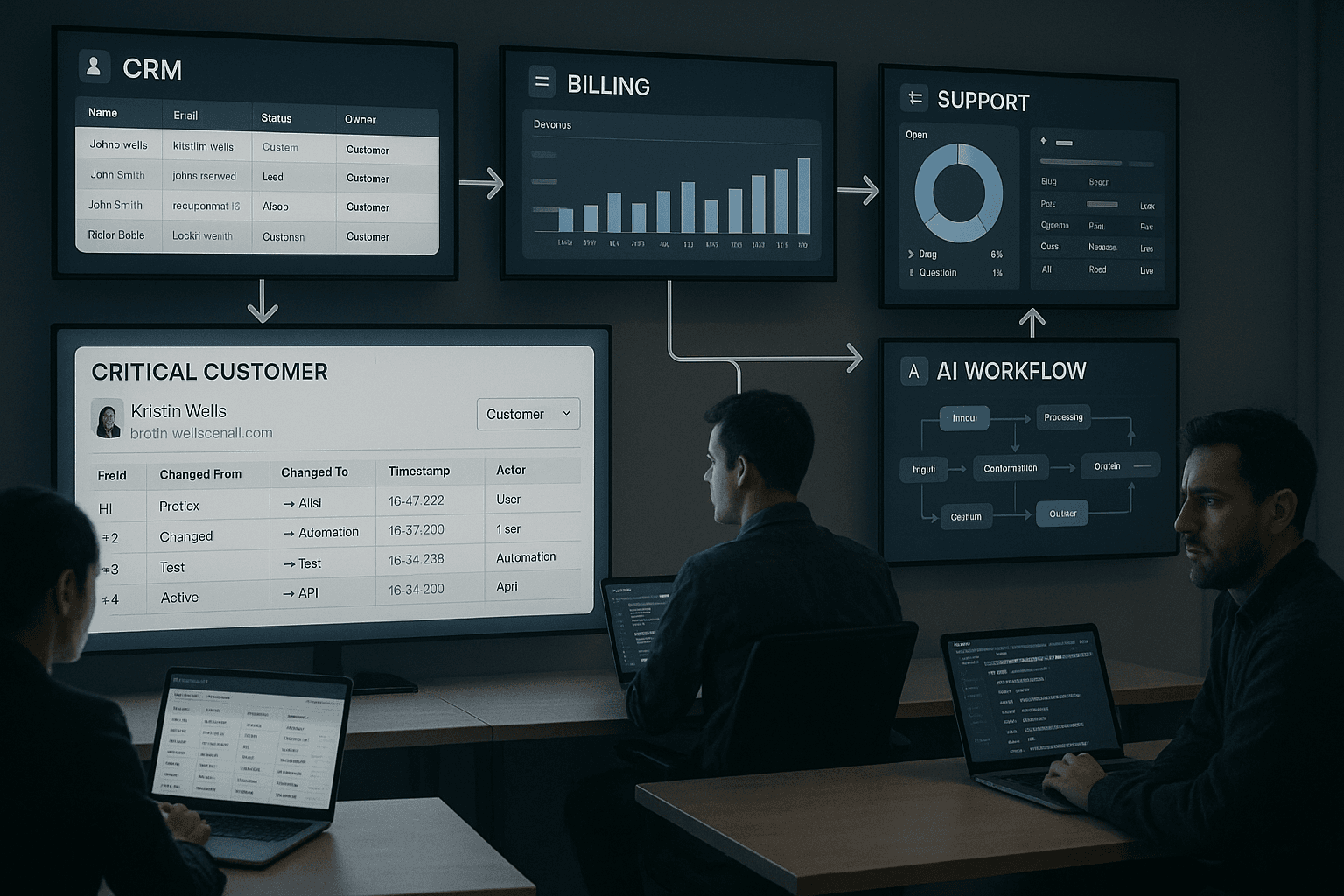
It usually starts as a small argument in Slack.
Sales says the account owner was changed after the deal closed. Support says the customer tier was already wrong when the ticket came in. Finance swears billing terms were updated in Stripe last week. Product says the AI enrichment workflow only writes to two fields and definitely did not touch renewal status. Everyone has screenshots. Everyone has a plausible story. Nobody has proof.
This is the field provenance problem: a company-critical record changes, the downstream outcome gets worse, and no one can answer the most basic debugging question, who or what last changed this field?
At an early-stage startup, this sounds like a process problem. In practice, it becomes a trust problem. Once teams stop trusting the data in Salesforce, HubSpot, Stripe, Zendesk, Intercom, Postgres, or whatever internal table powers the customer dashboard, they route around the system. Reps keep private notes. Finance exports CSVs and reconciles manually. Support creates shadow trackers. Founders ask for “the real numbers” in separate spreadsheets. The company slows down not because the tools are bad, but because nobody believes the current state of critical fields.
The dangerous part is that this usually happens long before anyone says it out loud. On paper, the systems are integrated. In reality, values get overwritten silently by imports, reverse ETL syncs, workflow automation, AI agents, webhook retries, backfills, support macros, and admin “quick fixes.” The startup hasn’t lost data. It has lost explainability.
If you are under 200 people, you probably do not need an enterprise governance program, a master data management committee, or a six-month implementation of a heavyweight observability platform. But you do need a lightweight, disciplined way to answer a simple question for your most important fields:
What is the current value, who last changed it, when did they change it, through which system, and why was that change allowed?
That is field provenance.
This article is a tactical playbook for building it without slowing the company down.
A real failure scenario
Here is what this looks like in the wild.
A B2B SaaS startup has the following stack:
- HubSpot for CRM
- Stripe for billing
- Zendesk for support
- Postgres as the application database
- Segment for event routing
- Zapier and Make for small automations
- An internal AI workflow that summarizes customer calls and updates account health notes
- A reverse ETL tool pushing warehouse-derived values back into HubSpot
The company tracks a few fields that matter a lot:
account_ownerplan_tiercontract_end_daterenewal_riskpayment_statusimplementation_complete
Everything works until it doesn’t.
One Monday, revenue leadership notices that 37 accounts expected to renew this quarter no longer appear in the renewal forecast. The root issue turns out to be a change in contract_end_date on a subset of records. Some dates were moved forward by 12 months, others set to blank, others reverted to an older imported value.
What follows is familiar startup theater:
- Sales ops checks HubSpot property history and finds some changes, but not all of them.
- Finance checks Stripe and sees subscription metadata updates that don’t line up.
- Engineering inspects app logs but only for the production app, not no-code automations.
- The data team checks reverse ETL jobs and warehouse transformations.
- Customer success pulls recent support interactions because an onboarding macro sometimes changes implementation status.
- Someone mentions that an AI workflow writes “helpful structured summaries” into CRM notes and may also map inferred dates into custom properties.
After two days of digging, the actual chain is this:
- A warehouse model recalculated a derived
contract_end_datefor accounts missing a direct sales-entered value. - The reverse ETL sync pushed those values into HubSpot.
- A Zapier automation triggered off the HubSpot update and copied the same date into a Stripe metadata field.
- A separate finance workflow later treated Stripe metadata as the source of truth for certain account updates and synced it back to the warehouse.
- On retry, one job replayed stale records because the watermark was wrong.
- Meanwhile, a human admin bulk-edited several records to “fix” obviously bad dates, but the bulk change itself wasn’t annotated.
The company can eventually reconstruct the story, but only by interviewing four teams and manually comparing logs across six tools.
That’s the real cost of poor provenance: not just bad data, but expensive ambiguity.
The pattern underneath the incident
Most startups do not have a generic “data quality” problem. They have a narrower and more operationally dangerous pattern:
1. A few fields carry outsized business risk
You may have thousands of fields, but maybe 20 to 50 actually drive money, customer experience, reporting, routing, and compliance decisions.
Examples:
- Lifecycle stage n- Account owner
- Renewal date
- Payment delinquency
- Tax status
- Support severity
- Implementation status
- Churn reason
- Security review complete
- AI risk flag
When these fields drift, teams make wrong decisions immediately.
2. Those fields are touched by multiple writers
A field like plan_tier may be changed by:
- Sales rep in CRM
- Billing webhook from Stripe
- Support macro after a service credit
- Warehouse sync back to CRM
- Internal admin tool
- AI categorization workflow
- Script run by an engineer during migration
Any field with more than one writer needs provenance, whether you call it that or not.
3. Most systems show local history, not end-to-end lineage
HubSpot may show property history. Stripe may show object updates. Zendesk may show ticket events. Your app may show audit logs.
But none of these tools natively answer the cross-system question: what was the last effective writer of this business field across the whole stack?
Local audit trails are necessary. They are not sufficient.
4. Automation compounds uncertainty
Humans are usually blamed first, but automation creates most of the ambiguity:
- Syncs replay old records
- Workflows trigger each other recursively
- Defaults overwrite nulls incorrectly
- AI agents infer values with low confidence
- Imports bypass validation
- APIs write fields without preserving actor context
Without provenance, every automation is a black box with side effects.
5. Trust collapses before the system visibly breaks
Before there is a major outage, people start adding caveats:
- “Ignore that field, it’s flaky.”
- “The dashboard is mostly right.”
- “Check with finance before acting on this.”
- “That value gets weird sometimes after syncs.”
That’s the warning sign. Once important fields become socially untrusted, your operating system fragments.
Why standard advice fails
The usual advice sounds reasonable:
- Define a source of truth
- Clean up your integrations
- Add data governance
- Consolidate tools
- Buy an enterprise MDM or observability platform
- Restrict edit permissions
The problem is not that this advice is wrong. It is incomplete for startups.
“Just define a source of truth” is too abstract
Startups often declare:
- CRM is source of truth for account data
- Stripe is source of truth for subscription status
- Product DB is source of truth for usage
Then reality intrudes. Some fields are legitimately mastered in one system but updated by another under narrow conditions. For example:
payment_statusis mostly mastered by Stripe, except when finance manually marks wire transfers.renewal_riskis owned by CS, but an ML score may suggest updates.implementation_completeis primarily in the support system, but onboarding app actions may auto-complete milestones.
The field level matters more than the object level.
“SfDC is source of truth for accounts” is not precise enough if contract_end_date can be written from sales ops, reverse ETL, imports, and billing syncs.
“Lock the field down” often breaks operations
Founders hear the problem and decide only one team can edit the field. That sounds clean until:
- Support needs to correct onboarding data fast
- Finance needs billing overrides
- Migrations require batch updates
- AI workflows need to write structured outputs somewhere
- Backfills are unavoidable
In startups, multiple writers are often a real requirement, not bad hygiene.
“Buy a platform” is usually too much too early
Enterprise tools for data observability, MDM, and governance can help, but they often assume:
- Dedicated data governance owners
- Clean system inventories
- Stable schemas
- Budget for implementation and licensing
- Long procurement cycles
A 40-person startup usually needs a targeted solution for 15 critical fields, not a full governance operating model.
“Rely on built-in audit logs” leaves gaps
Built-in logs differ wildly:
- Some retain history only on certain plans
- Some track changes but not the upstream actor
- Some show that the API changed a field but not which workflow initiated the API call
- Some make bulk edits hard to interpret
- Some have no practical export for incident analysis
You end up with partial truth across systems.
“We’ll document automations better” doesn’t survive speed
Documentation helps during setup. It rarely keeps up with:
- New zaps
- Internal scripts
- AI actions
- Temporary migration jobs that become permanent
- Changed business logic in one system but not another
Provenance has to be captured in the system behavior, not just in Notion.
The better approach: provenance for a small set of critical fields
The right move for startups is not enterprise governance. It is operational provenance.
That means five things:
- Identify your highest-risk fields
- Define allowed writers and precedence rules per field
- Capture last-change metadata every time a critical field changes
- Create one place to inspect field history across systems
- Alert on suspicious or policy-violating changes
This is narrower than full lineage and broader than local audit logs.
You are not trying to model every transformation in the company. You are trying to make a small set of important fields explainable.
A useful mental model:
For every critical field, the current value should travel with a receipt.
That receipt should say:
- Previous value
- New value
- Changed at
- Changed by actor type: human, automation, API, AI, import, script
- Changed by actor id: user email, service account, workflow id, job id
- Origin system: HubSpot, Stripe, Zendesk, app, warehouse sync, etc.
- Reason or trigger: webhook, manual correction, enrichment, migration, ticket macro, AI inference
- Confidence or trust level where relevant
- Correlation id to tie together multi-step workflows
If you can produce that receipt for your top 20 fields, trust comes back surprisingly fast.
Start with a field criticality map
Do not boil the ocean. Make a table.
For each field, define:
- Business impact if wrong
- Systems where the field exists
- Who can write it today
- Desired owner
- Permitted writers
- Precedence logic
- Whether AI can write directly or only suggest
- Whether a human review is required above a threshold
A simple example:
| Field | Impact | Systems | Owner | Permitted writers | Precedence | Notes |
|---|---|---|---|---|---|---|
| contract_end_date | Revenue forecast | HubSpot, Stripe, warehouse | RevOps | Sales ops, signed contract import, approved billing sync | Signed contract > sales ops manual > billing metadata > derived warehouse value | Reverse ETL can fill only if null |
| payment_status | Cash collection | Stripe, CRM, warehouse | Finance | Stripe webhook, finance admin tool | Stripe > finance override during wire transfer window | CRM edits blocked |
| implementation_complete | Onboarding handoff | Zendesk, app DB, CRM | CS Ops | Support workflow, app milestone service, CS manager manual | App milestone + support confirmation | AI cannot write |
| renewal_risk | Forecasting | CRM, CS tool | CS | CSM manual, ML score suggestion | Manual > ML suggestion | AI suggests only |
This exercise does two valuable things immediately.
First, it reveals fields with too many uncontrolled writers.
Second, it forces the team to distinguish between “can technically write” and “should be allowed to write.”
The minimum viable provenance architecture
You do not need a massive platform. Most startups can implement a practical version with three layers.
Layer 1: Field change event capture
Whenever a critical field changes, emit a standardized change event.
Canonical event schema:
json{
  "entity_type": "account",
  "entity_id": "acct_123",
  "field_name": "contract_end_date",
  "old_value": "2025-06-30",
  "new_value": "2026-06-30",
  "changed_at": "2026-01-12T14:03:22Z",
  "actor_type": "automation",
  "actor_id": "reverse_etl_job_47",
  "origin_system": "hightouch",
  "origin_event_id": "sync_run_88931",
  "reason_code": "derived_field_backfill",
  "correlation_id": "acct_123_2026-01-12_sync_88931",
  "confidence": 0.91,
  "policy_result": "allowed_with_warning"
}
You can store these events in:
- A Postgres table
- BigQuery/Snowflake audit table
- A logging system with structured events
- An append-only event stream if you already have one
For a startup, Postgres is usually enough.
Recommended table:
sqlcreate table field_change_events (
  id bigserial primary key,
  entity_type text not null,
  entity_id text not null,
  field_name text not null,
  old_value text,
  new_value text,
  changed_at timestamptz not null,
  actor_type text not null,
  actor_id text not null,
  origin_system text not null,
  origin_event_id text,
  reason_code text,
  correlation_id text,
  confidence numeric,
  policy_result text,
  raw_payload jsonb
);

create index idx_field_lookup
  on field_change_events(entity_type, entity_id, field_name, changed_at desc);
Layer 2: Write-path instrumentation
You need to capture provenance where writes happen.
Typical write paths:
- App backend updates
- Internal admin tools
- CRM automations
- iPaaS tools like Zapier/Make
- Reverse ETL syncs
- ETL backfills and scripts
- AI workflows
- Webhook consumers
Best practice: create a shared write wrapper for critical fields.
Instead of letting every workflow call “update field” directly, route critical field changes through a small service or library that:
- Validates writer permissions
- Attaches actor metadata
- Records a field change event
- Applies precedence rules
- Optionally rejects unsafe writes
Example pseudocode:
pythondef update_critical_field(entity, field, new_value, context):
    current = get_current_value(entity, field)
    policy = get_field_policy(field)

    decision = evaluate_write(
        field=field,
        actor_type=context.actor_type,
        actor_id=context.actor_id,
        origin_system=context.origin_system,
        current_value=current,
        new_value=new_value,
        reason_code=context.reason_code
    )

    if decision.reject:
        log_field_change_event(..., policy_result="rejected")
        raise Exception("Write rejected by provenance policy")

    apply_update(entity, field, new_value)
    log_field_change_event(..., policy_result=decision.result)
You will not get every external tool to use this on day one. That is fine. Instrument the highest-risk paths first.
Layer 3: Cross-system inspection view
When something breaks, teams need a single timeline.
Build a simple internal UI or even a Metabase/Retool view that answers:
For account X, show all changes to critical fields in chronological order with actor, system, and reason.
Columns:
- Timestamp
- Entity
- Field
- Old value
- New value
- Actor type
- Actor id
- Origin system
- Reason
- Policy result
- Correlation id
This alone will cut debugging time dramatically.
Do not overbuild. A searchable table with filters is enough for phase one.
How to implement this across messy startup systems
Let’s get practical by system type.
CRM: HubSpot or Salesforce
What to do:
- Turn on field history/property history for critical fields
- Export or ingest history into your central audit store if possible
- For workflows and integrations, require a source tag in updates
- Add hidden metadata properties where useful, such as
last_modified_by_workflowfor fields that are frequently automated
Pattern that works well:
Whenever an automation updates a critical CRM field, also write companion metadata if the platform allows it:
field_last_actor_typefield_last_actor_idfield_last_reasonfield_last_changed_at
This is not your canonical audit store, but it gives operators in the CRM immediate visibility.
Tradeoff:
- Pro: Fast to implement, useful for non-technical teams
- Con: Pollutes schema if overused, not reliable as sole source
Billing: Stripe
Stripe is often treated as authoritative, but metadata syncs become a trap.
Tactics:
- Treat Stripe core billing state as distinct from copied business fields in metadata
- Avoid using Stripe metadata as a write-back source for fields owned elsewhere unless explicitly approved
- Log webhook processing with event id, object id, and resulting field changes
- Preserve idempotency and record retries so replayed events are visible
If webhook invoice.payment_failed updates payment_status in CRM, your field change event should include:
- Stripe event id
- Webhook consumer name
- Retry count
- Whether this was first-seen or replayed
Tradeoff:
- Pro: Makes finance-related disputes much easier to debug
- Con: Requires discipline in webhook consumers and sync jobs
Support: Zendesk, Intercom, or Help Scout
Support systems often update fields indirectly through macros, forms, and triggers.
Tactics:
- Inventory all macros/triggers touching critical account fields
- Give each macro/workflow a stable identifier
- Log field writes from support actions with ticket id and macro id
- Distinguish between “support agent manually changed field” and “ticket workflow changed field”
This matters because “a support update changed the value” is not actionable enough. You need to know if it was a human judgment call or a deterministic workflow.
Warehouse and reverse ETL
This is where many provenance failures are born.
Tactics:
- Every reverse ETL sync touching critical fields should include model version, sync run id, and source query timestamp
- Never write derived values into critical fields without a policy check
- Tag null-fills, backfills, and overwrite operations differently
- Store the warehouse record hash or snapshot timestamp when practical
For example, the policy for contract_end_date might allow warehouse sync to populate only when:
- Current value is null
- No signed contract date exists
- Change is newer than previous warehouse snapshot
- Writer is approved reverse ETL job
This prevents the classic derived-field overwrite.
AI workflows and agents
This is the new source of silent corruption.
AI systems create two specific provenance issues:
- They infer values probabilistically
- Their write paths are often hidden inside orchestration tools or agent frameworks
Rules I recommend:
- AI should not directly write Tier 1 financial or contractual fields without deterministic validation
- AI can suggest updates into a review queue for sensitive fields
- If AI writes, store confidence, prompt/workflow version, model id, and source evidence pointer
- Separate “AI-generated note” from “AI-updated system field” in both UX and logs
A safe pattern:
- AI reads calls, tickets, emails
- AI proposes
renewal_risk = highwith confidence 0.84 and evidence snippets - CSM reviews suggestion in a queue
- Approved update writes field with actor type
human_reviewed_ai - Provenance event keeps both AI suggestion metadata and human approver id
Tradeoff:
- Pro: You get leverage without invisible field mutations
- Con: Review queues add operational overhead
For less sensitive fields, direct AI writes may be fine if bounded and auditable.
Precedence rules beat generic ownership
This is the most underrated concept.
Ownership answers “who is accountable?” Precedence answers “which write wins?”
You need both.
Example precedence policy for plan_tier:
- Signed contract import can always overwrite
- Stripe subscription state can update only if mapped to an approved SKU table
- Sales rep manual edit allowed before activation
- Support macro cannot overwrite, only suggest
- Warehouse-derived recommendation can fill null only
- AI categorization cannot write directly
These rules should live somewhere executable, not just in a wiki.
Even a YAML file is enough to start:
yamlfields:
  contract_end_date:
    permitted_writers:
      - sales_ops_manual
      - signed_contract_import
      - approved_billing_sync
      - reverse_etl_null_fill
    precedence:
      - signed_contract_import
      - sales_ops_manual
      - approved_billing_sync
      - reverse_etl_null_fill
    restrictions:
      reverse_etl_null_fill:
        only_if_current_value_null: true
      approved_billing_sync:
        require_matching_subscription: true
This gives engineering and ops a concrete contract.
Detect suspicious changes automatically
Do not stop at passive history. Add a few simple detectors.
High-value alerts:
1. Unauthorized writer alert
If an unapproved workflow or user changes a critical field, notify the owner.
Example:
- Slack alert to
#revops-alerts - “
contract_end_datechanged byzap_3921which is not an approved writer”
2. Precedence violation alert
If a lower-precedence writer overwrites a higher-precedence value, flag it.
Example:
- Warehouse sync overwrote a sales-entered contract date
3. Volatility alert
If the same field changes more than N times in 24 hours for one record, something is looping.
This catches automation recursion fast.
4. Bulk change alert
If more than X records have a critical field changed by one actor within Y minutes, trigger review.
This catches bad imports and runaway scripts.
5. AI low-confidence write alert
If AI writes below a confidence threshold, route to review or auto-revert.
These alerts do not need a fancy observability stack. SQL plus scheduled jobs plus Slack works.
Tool comparisons: what to use at startup stage
Here is the practical landscape.
Option 1: Build lightweight in Postgres + Retool/Metabase
Best for:
- 10 to 100 person startups
- Teams with one decent backend engineer and one ops owner
- 10 to 30 critical fields
Stack:
- Postgres audit table
- App/library write wrapper
- Webhook logging
- Scheduled anomaly checks
- Retool or Metabase inspection UI
Pros:
- Cheap
- Fast to ship
- Fully tailored to your fields
- No procurement drag
Cons:
- You own maintenance
- External tool coverage may be partial at first
- Requires some engineering discipline
Rough cost:
- Software: near-zero incremental if you already use Postgres and Retool/Metabase
- Engineering setup: 2 to 6 weeks depending on sprawl
- Ongoing: a few hours per month plus incident-driven improvements
Option 2: iPaaS-centric logging with Zapier/Make/Workato plus audit table
Best for:
- Ops-heavy orgs where many writes already flow through automation tools
Pattern:
- Standardize every automation to call a logging webhook before or after changing critical fields
- Send structured change events into central store
Pros:
- Fast if your workflows are already centralized
- Minimal product engineering needed initially
Cons:
- Harder to enforce consistency across ad hoc scripts and app writes
- No-code workflows drift quickly
- Debugging can still be fragmented
Rough cost:
- Low engineering, moderate ops effort
- More fragile over time
Option 3: Data observability / integration platform extensions
Best for:
- Later-stage startups with larger budgets and existing warehouse discipline
Examples of categories:
- Reverse ETL with better sync auditability
- Integration platforms with execution logs
- Warehouse monitoring tools
- Application audit log vendors
Pros:
- Better packaged visibility
- Stronger logs for specific layers
Cons:
- Rarely solve cross-system field provenance end to end out of the box
- Can become expensive before they deliver operational trust
My recommendation:
Start with Option 1, borrow pieces of Option 2 where useful, and only add specialized tools after you have defined field policies.
A tool cannot fix undefined precedence.
A 30-day implementation plan
Here is a realistic startup rollout.
Week 1: Pick fields and map writers
Deliverables:
- List top 10 to 20 critical fields
- For each field: systems, business owner, all known writers, desired permitted writers, precedence rules
- List highest-risk workflows and AI agents touching them
Time:
- 2 to 3 working sessions
- 1 ops owner, 1 engineer, stakeholders from finance/revops/support/data
Week 2: Stand up central event store and schema
Deliverables:
field_change_eventstable- Standard event schema
- Basic dashboard or SQL queries
- Correlation id convention
Time:
- 1 to 3 engineering days
Week 3: Instrument the highest-risk write paths
Priority order:
- Reverse ETL jobs
- Billing webhooks
- Admin tools and bulk edit scripts
- CRM automations
- AI workflows
Deliverables:
- Shared logging wrapper or webhook endpoint
- Structured events from top 3 to 5 paths
- Companion metadata written where practical
Time:
- 3 to 7 engineering days
- Plus ops work updating automations
Week 4: Add alerts and run one fire drill
Deliverables:
- Unauthorized writer alert
- Bulk change alert
- Volatility alert
- Test scenario: intentionally change a field through several systems and confirm timeline reconstruction in under 10 minutes
Time:
- 2 to 4 days
At the end of 30 days, you will not have perfect provenance. You will have enough coverage to stop most trust erosion.
Workflow example: before and after provenance
Let’s compare what happens when payment_status changes incorrectly.
Before
- Finance notices bad dunning emails
- RevOps checks CRM field history
- Engineering checks app logs
- Support says a macro may have run
- Data team checks warehouse model
- Two days later, someone finds a replayed Stripe webhook after a queue issue
Elapsed time:
- 8 to 16 person-hours
- Customer-facing confusion continues during investigation
After
Finance opens the account timeline and sees:
payment_status: current -> overdue- Changed at 09:14:02 UTC
- Actor type: automation
- Actor id:
billing_webhook_consumer_v2 - Origin system: Stripe
- Origin event id:
evt_1234 - Reason:
invoice.payment_failed - Policy result: allowed
- Correlation id links to retry sequence showing event replayed twice
- Volatility alert fired because field changed 4 times in 20 minutes
Engineering checks the specific webhook consumer and fixes idempotency.
Elapsed time:
- 15 to 30 minutes
- Blame avoided, root cause located quickly
That is the ROI.
Cost and time analysis
Founders usually ask whether this is worth doing before scale. Short answer: yes, if you have even a handful of critical cross-system fields.
The cost of not solving it
For a startup with 5 to 10 functional operators and one small engineering team, a single serious provenance incident often costs:
- 6 to 20 hours of cross-functional debugging
- Reporting rework and forecast uncertainty
- Delayed customer actions
- Loss of confidence in automations
- More manual checks on every future change
The hidden cost is compounding operational drag. Once trust drops, people insert manual verification into every workflow.
That costs far more than the initial incident.
The cost of a lightweight provenance system
Typical MVP:
- 1 backend engineer for 1 to 2 weeks focused effort
- 1 ops/data owner for field policy definition and workflow inventory
- 1 to 2 follow-up weeks of gradual instrumentation
Rough internal cost:
- Maybe $10k to $30k of loaded team time depending on salaries and pace
What you get:
- Faster incident resolution
- Safer automation expansion
- Less shadow reporting
- More confidence using AI suggestions and syncs
- Better onboarding for new ops owners because the system is inspectable
This is one of those rare startup infrastructure projects that saves money both immediately and structurally.
Common mistakes to avoid
1. Tracking everything
If you try to instrument every field, you will stall. Start with top-risk fields only.
2. Capturing actor but not reason
“API updated field” is not enough. You need the workflow, trigger, or business reason.
3. Letting AI write directly to sensitive fields
If the field affects contracts, billing, legal state, or major customer routing, direct AI writes should be heavily constrained.
4. Building logs without policy
A history table tells you what happened. It does not tell you whether it should have happened.
5. Ignoring bulk operations
Imports, scripts, migrations, and one-off admin fixes cause a disproportionate share of provenance failures.
6. Forgetting correlation ids
Multi-step automations are impossible to reconstruct cleanly without a thread tying events together.
7. Not exposing provenance to operators
If only engineers can query the logs, your response loop remains slow. Give RevOps, Finance, and Support a usable inspection view.
The cultural shift this creates
There is a subtle but important organizational benefit here.
Without provenance, debates about bad data become political. Each team defends its tools and assumptions. The loudest narrative often wins.
With provenance, the conversation changes from:
- “Who messed this up?”
to:
- “Which write path is allowed to do this, and should that policy change?”
That is a healthier operating model. It separates blame from system design.
It also makes automation expansion safer. Teams become more willing to ship workflows when they know writes are attributable and reversible.
This matters a lot for AI. Most startups will add AI-assisted updates faster than they add governance. Provenance is the lightweight control layer that keeps AI from becoming a silent corrupter of operational data.
Takeaways
If your team cannot answer who or what last changed a critical field, you do not have a minor tooling inconvenience. You have an operational trust problem.
The fix is not enterprise-heavy governance. It is a startup-scale provenance layer for your most important fields.
The practical playbook is straightforward:
- Identify the 10 to 20 fields that matter most
- Map every current writer for each field
- Define permitted writers and precedence rules
- Log standardized change events with actor, system, reason, and correlation id
- Build one timeline view for cross-system inspection
- Alert on unauthorized, volatile, or bulk changes
- Treat AI as a probabilistic writer and constrain it accordingly
Do this well and several good things happen at once:
- Silent overwrites become visible
- Bad automations are debugged faster
- Shadow systems shrink
- Teams trust the CRM and operational dashboards again
- You can move faster without losing control
In a startup, speed matters. But speed without provenance eventually becomes self-sabotage.
You do not need perfect lineage. You need reliable receipts for the fields that run the company.