
Why “data room as a folder” is the wrong mental model
Most founder data rooms are an archive: a pile of PDFs, a few spreadsheets, an outdated cap table, and a doc called PitchDeck_FINAL_v7_reallyfinal.pdf. That’s not a data room; it’s a stress test.
Investors don’t just evaluate your company, they evaluate your operating system. The most common reason diligence drags is not because the business is unclear; it’s because the information interface is unreliable:
- Metrics are computed differently across deck vs. model vs. dashboard.
- “Current” financials are a month behind; no one knows what “current” means.
- Customer lists don’t match revenue schedules.
- Security/compliance answers are improvised in email threads.
- Legal docs are scattered; signature status is ambiguous.
A great data room doesn’t merely contain information. It guarantees consistency, traceability, and cadence: the same qualities you’d demand from an internal analytics system or an external API.
That’s the central idea of the Founder API:
Build a reusable, versioned diligence interface like a product: define schemas, document contracts, update SLAs, and access logs.
This is not “hype.” It is basic systems engineering applied to fundraising.
The Founder API concept: investors as integrators
In software, an API works when:
- Contracts are explicit (inputs/outputs, schemas, error modes).
- Versioning exists (breaking changes don’t surprise integrators).
- Availability and freshness are predictable (SLOs/SLAs).
- Observability exists (logs, auditing, usage analytics).
Investors are integrators. They need to “integrate” your metrics, legal posture, customer quality, and financial plan into their IC memos, models, and risk frameworks. If your interface is inconsistent, they either:
- slow down to reconcile it,
- discount your numbers,
- or quietly move on.
A data room built as a Founder API signals:
- Maturity: you operate with clear definitions.
- Speed: you can answer diligence questions without chaos.
- Trust: numbers reconcile and don’t shift under scrutiny.
This matters because fundraising is time-bounded. The faster you can reduce uncertainty, the more likely you are to maintain momentum, create competitive pressure, and close on favorable terms.
Opinionated takeaway
If you’re a B2B startup with any real sales motion (even early), you should treat your investor data room as a maintained artifact, not a one-off scramble.
Not because investors “deserve” it, but because you do. A versioned operating data room becomes reusable across:
- seed extension → Series A,
- A → B,
- debt financing,
- M&A diligence,
- security reviews with enterprise customers,
- internal board reporting.
What “standard operating” means
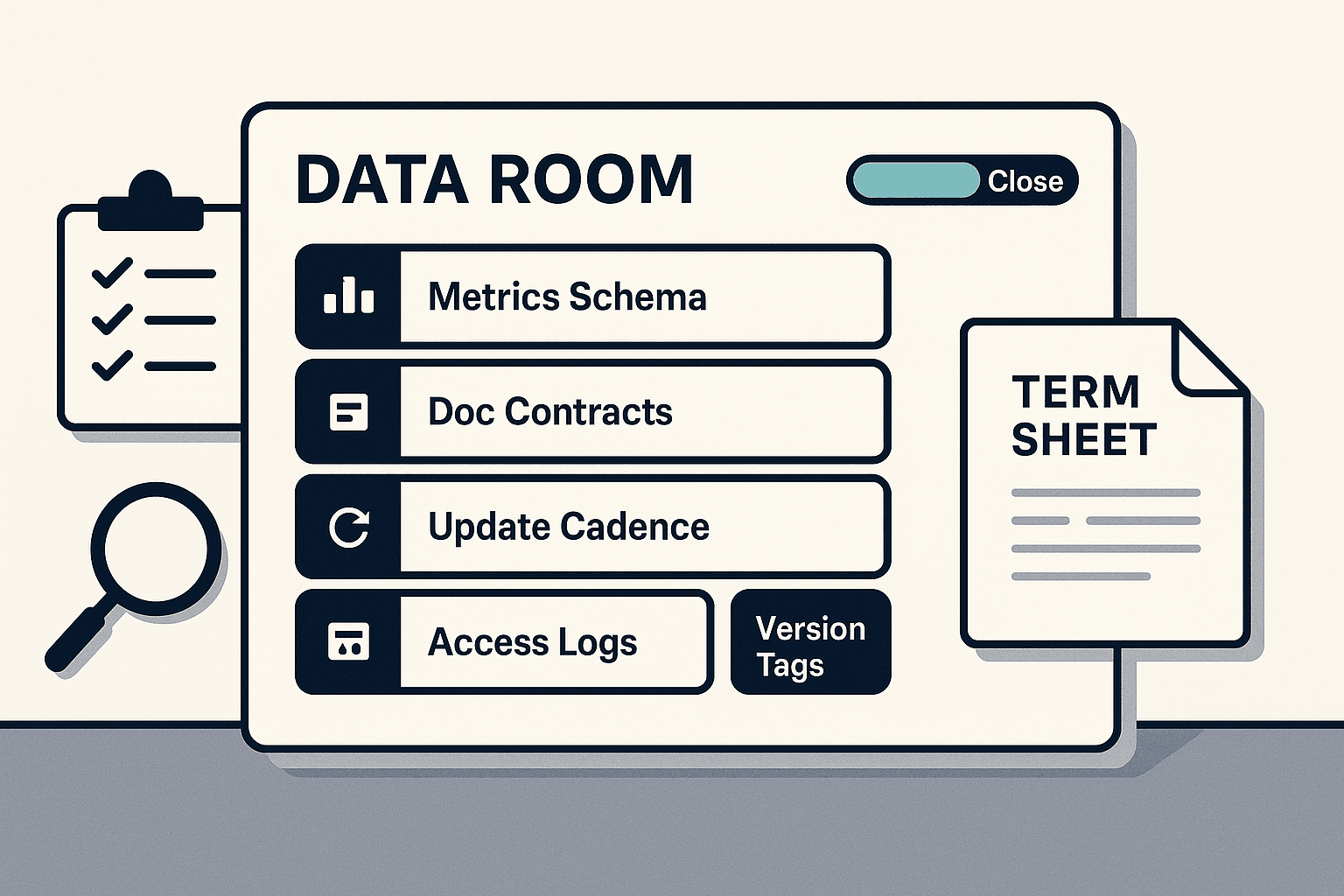
A Standard Operating Data Room (SODR) has four properties:
- A canonical metrics schema (definitions + calculation rules).
- Document contracts (what exists, where, in what format, and how it’s updated).
- Update cadence (weekly/monthly SLAs with timestamps and change logs).
- Access logging (who viewed what, when; principle of least privilege).
This is the blueprint.
Part 1: Metrics schema, your single source of truth
The real problem: metrics drift
Metrics drift happens when different people compute the same metric differently:
- “ARR” includes or excludes non-recurring fees.
- “Gross margin” is calculated on cash basis in one place and accrual in another.
- “Churn” is logo churn in a dashboard but revenue churn in the deck.
- “CAC” includes SDR costs in one model but not in another.
Investors notice drift quickly because they triangulate:
- your deck,
- your financial model,
- your billing exports,
- and your cohort charts.
When those disagree, diligence becomes reconciliation.
Your metrics schema should be a document, not tribal knowledge
Create a Metrics Dictionary that includes:
- Metric name
- Definition (plain English)
- Formula (explicit)
- Source tables/systems (Stripe, Chargebee, QuickBooks, NetSuite, HubSpot, Salesforce, warehouse)
- Time basis (invoice date vs. service period; cash vs. accrual)
- Inclusions/exclusions
- Owner (who maintains it)
- Last updated timestamp
- Version
This can live as a markdown doc, Notion page, or a Google Doc, format matters less than explicitness.
Minimum viable schema (B2B SaaS)
If you’re B2B SaaS, your baseline should include:
- ARR / MRR
- define treatment of annual prepay, discounts, credits, usage, professional services
- Net Revenue Retention (NRR) and Gross Revenue Retention (GRR)
- define cohort rules and time windows
- Logo churn and Revenue churn
- Gross margin
- define hosting, support, COGS allocation rules
- CAC, CAC payback, and Magic Number (if you use it)
- define cost inclusion rules and lag assumptions
- Sales cycle length
- define stage boundaries (SQL? opportunity created? contract sent?)
- Pipeline coverage
- define timeframe and stage inclusion
- Rule-of-40 style metric (if relevant)
- define growth rate basis and margin basis
For usage-based or hybrid models, add:
- net dollar retention by usage cohort,
- expansion decomposition (seat vs. usage),
- committed vs. consumption revenue.
Don’t “pretty” your metrics, make them reconcilable
Investors will often ask:
- “Can you reconcile ARR to your GAAP/financial statements?”
- “How does your bookings relate to revenue?”
- “What portion of ARR is contracted vs. forecasted expansion?”
You don’t need a public-company system. You do need a reconciliation trail.
A practical pattern:
- One canonical export (monthly) from billing/subscription system
- One canonical revenue schedule (even if simple)
- A bridge table: Bookings → Billings → Revenue → ARR
This is standard finance hygiene. For SaaS revenue recognition concepts, see ASC 606 (US) / IFRS 15 (international), which define how revenue is recognized from contracts (even if you’re not audited yet). References: FASB ASC 606 overview and IFRS 15 guidance.
Versioning your metrics
Treat the metrics dictionary like an API:
- v1.0 when you first standardize
- v1.1 for additive changes (new metric)
- v2.0 if you change a definition (breaking change)
Add a changelog:
- what changed
- why it changed
- impact on historical comparability
- whether historical data was backfilled
This is extremely rare in startup fundraising, and exactly why it stands out.
Part 2: Document contracts, what exists, where, and in what shape
“Doc contract” is a simple idea
A document contract specifies:
- Document name
- Purpose
- Format (PDF, sheet, export)
- Owner
- Update rule (monthly close + 5 business days)
- Source of truth
- Sensitivity level (shareable under NDA? restricted?)
If you do this, you eliminate the most common diligence failure: missing artifacts.
The core data room structure (opinionated)
Use a consistent top-level taxonomy. Example:
- 00_ReadMe
- 01_Company
- 02_Financials
- 03_Metrics
- 04_Customers & GTM
- 05_Product & Tech
- 06_Security & Compliance
- 07_Legal
- 08_HR & People
- 09_Board & Governance
Inside each, include:
- a short index doc,
- versioned files,
- and an “as-of” timestamp.
00_ReadMe: the single most leverageful file
Your README (one page) should include:
- Data room purpose (e.g., Series A diligence)
- Last updated date/time
- Point of contact (who answers questions)
- How to request access (least privilege)
- Metrics schema link
- Update cadence (e.g., weekly KPIs every Monday; financial package monthly after close)
- Glossary (especially acronyms)
This is the equivalent of an API landing page.
What investors typically expect (and what to prepare)
Below is a practical list. You don’t need all of it on day one, but you should know what you’re choosing not to provide.
Financials
- P&L (monthly, last 12–24 months)
- Balance sheet (monthly)
- Cash flow statement (monthly if available)
- Budget vs. actuals
- Financial model (driver-based, not just top-down)
- Revenue by customer (or anonymized by segment, depending on stage)
- Deferred revenue schedule if applicable
Metrics
- ARR/MRR bridge
- Retention cohorts (logo + revenue)
- Gross margin breakdown
- CAC and payback assumptions + pipeline funnel
- Segment-level performance (SMB/mid-market/enterprise)
Customers & GTM
- Customer list (often redacted/anonymized early)
- Top customer concentration analysis
- Case studies
- Pipeline report (by stage)
- Sales playbook overview
- Pricing and packaging
- Partner/channel strategy (if any)
Product & Tech
- Product roadmap (now/next/later)
- Architecture overview
- Reliability posture (uptime, incident history if material)
- Dependency risks (single points of failure)
Security & Compliance
- Security policy overview
- Access controls summary
- Pen test summary (if you have it)
- SOC 2 status (Type I/II) if relevant
- Data processing addendum template (DPA)
Enterprise buyers often require security documentation; having it organized helps both sales and diligence. References: AICPA SOC 2 framework overview; NIST Cybersecurity Framework (CSF) for a common baseline.
Legal
- Certificate of incorporation
- Cap table
- Option plan + grants
- Material contracts
- IP assignment agreements
- Prior financing docs (SAFEs/notes)
- Litigation summary (if any)
People
- Org chart
- Headcount plan
- Key employment agreements
- Compensation bands (if mature enough)
Redaction vs. transparency: the balanced approach
Two legitimate viewpoints exist:
- Transparency-first: Share detailed customer and contract data early to build trust.
- Need-to-know: Share aggregate metrics first; reveal sensitive details after term sheet.
The right answer depends on stage, competitive risk, and investor quality.
A workable compromise:
- Phase 1 (pre-term sheet): aggregated metrics, anonymized customer list, sample contracts with redactions.
- Phase 2 (post-term sheet, before close): fuller customer details under tighter permissions.
Your SODR should support phasing through permissions rather than by creating new messy folders.
Part 3: Update cadence, SLAs for diligence
Most diligence chaos is freshness ambiguity
If an investor asks “what’s your current ARR?”, the real question is “as of when?”
A standard operating data room answers that automatically.
Set explicit cadences
Examples:
- Weekly KPI update: every Monday by 12:00 local time
- pipeline, ARR/MRR, cash balance, burn multiple
- Monthly financial package: by the 10th business day after month-end close
- P&L, balance sheet, budget vs actuals, commentary
- Quarterly deep dives: retention cohorts, segment analysis, pricing experiments
Put these in the README.
Use “as-of” labeling everywhere
Every key artifact should carry:
as_of_YYYY-MM-DDvX.Y
Example filenames:
P&L_as_of_2026-01-31_v1.0.pdfMetrics_Dictionary_v2.1.mdARR_Bridge_as_of_2026-01-31_v1.3.xlsx
This seems pedantic until you’re in a live process with multiple partners asking questions against different snapshots.
Publish a short weekly changelog
Add a CHANGELOG.md (or a simple doc):
- new uploads
- updated files
- definition changes
- corrections (and what caused them)
Correction transparency is a trust accelerant. Quiet changes without explanation are not.
Part 4: Access logs, security, signaling, and internal clarity
Why logs matter beyond security
Yes, permissions and access logs reduce leak risk. But they also help you:
- see which investors are active (signal of seriousness)
- understand what is being scrutinized (what questions are coming)
- avoid over-sharing sensitive info prematurely
Use a platform that provides:
- per-user permissions
- link expiry
- view logs
- watermarking (optional)
Tools vary (Dropbox, Google Drive, DocSend, specialized data room providers). The tool is less important than the practice: least privilege + auditing.
A pragmatic permission model
- Group A (initial): deck, metrics summary, high-level financials
- Group B (serious): model, detailed cohorts, legal overview
- Group C (post-term sheet): customer contracts, full cap table, sensitive security docs
Avoid public links. Avoid “anyone with link can view” for material diligence artifacts.
Building the Founder API: a step-by-step blueprint
Step 1: Define the interface (your diligence endpoints)
Think in “endpoints” (categories) rather than files:
/metrics/arr/metrics/retention/financials/monthly-close/legal/cap-table/security/soc2
You’re designing discoverability.
Deliverable: Data Room Map (one-page index with links).
Step 2: Establish contracts for each endpoint
For each category, specify:
- format
- owner
- update SLA
- sensitivity
Deliverable: Document Contract Table.
Step 3: Implement versioning rules
Rules worth adopting:
- Never overwrite without bumping a version or preserving an archive.
- If you must correct a file, keep the old version in an
_archivefolder. - Breaking definition changes require a major version bump in the metrics dictionary.
Deliverable: Versioning Policy (short and strict).
Step 4: Create reconciliation artifacts
At minimum:
- ARR bridge
- bookings vs revenue explanation
- headcount and opex mapping to model
Deliverable: Bridges that tie your story to your statements.
Step 5: Add cadence and changelog
- weekly update post
- monthly close package
Deliverable: CHANGELOG and Update Calendar.
Step 6: Add access controls and logging
- groups
- expirations
- audit trail
Deliverable: Access Policy and viewer log review (weekly during process).
What this looks like in practice: a minimal “Founder API” template
Below is a compact template you can copy.
Folder structure
text00_ReadMe/
  README.md
  CHANGELOG.md
  DataRoom_Map.md

01_Company/
  Pitch_Deck_vX.Y.pdf
  One_Pager_vX.Y.pdf
  Market_Research_Notes_vX.Y.pdf

02_Financials/
  Monthly_Close/
    2026-01/
      P&L_as_of_2026-01-31_v1.0.pdf
      Balance_Sheet_as_of_2026-01-31_v1.0.pdf
      Cashflow_as_of_2026-01-31_v1.0.pdf
      Budget_vs_Actual_as_of_2026-01-31_v1.0.xlsx
      Commentary_as_of_2026-01-31_v1.0.md
  Model/
    Financial_Model_as_of_2026-02-15_v1.2.xlsx
    Assumptions_Dictionary_v1.0.md

03_Metrics/
  Metrics_Dictionary_v2.1.md
  ARR_Bridge_as_of_2026-01-31_v1.3.xlsx
  Retention_Cohorts_as_of_2026-01-31_v1.1.xlsx
  Pipeline_Funnel_as_of_2026-02-19_v1.0.xlsx

04_Customers_GTM/
  Customer_List_Anonymized_as_of_2026-02-15_v1.0.xlsx
  Case_Studies_v1.0.pdf
  Pricing_Packaging_v1.1.pdf
  Sales_Playbook_Overview_v1.0.pdf

05_Product_Tech/
  Product_Roadmap_as_of_2026-02-01_v1.0.pdf
  Architecture_Overview_v1.0.pdf
  Reliability_Notes_v1.0.md

06_Security_Compliance/
  Security_Overview_v1.0.pdf
  Access_Control_Policy_v1.0.pdf
  PenTest_Summary_v1.0.pdf
  SOC2_Status_v1.0.md

07_Legal/
  Cap_Table_as_of_2026-02-15_v1.0.xlsx
  Charter_and_Bylaws_v1.0.pdf
  Option_Plan_v1.0.pdf
  Material_Contracts_Index_v1.0.xlsx
  IP_Assignments_Index_v1.0.xlsx

08_HR_People/
  Org_Chart_as_of_2026-02-01_v1.0.pdf
  Headcount_Plan_as_of_2026-02-01_v1.0.xlsx

09_Board_Governance/
  Board_Decks/
  Board_Minutes_Index_v1.0.xlsx
README.md (minimum)
md# Investor Data Room

**As of:** 2026-02-26
**Owner:** finance@company.com / ceo@company.com

## Update cadence
- Weekly KPIs: Mondays by 12:00
- Monthly financial close: 10 business days after month end

## Metrics
See: /03_Metrics/Metrics_Dictionary_v2.1.md

## Requesting access
Email owner with the documents you need; permissions follow least-privilege.
This is simple, but it’s already an order of magnitude better than most processes.
How a standard operating data room speeds up the close
1) It compresses “trust building” time
Investors are pattern matchers. When they see:
- consistent definitions,
- clean versioning,
- predictable updates,
- reconciliations,
they infer the company can likely:
- forecast realistically,
- manage budgets,
- execute GTM experiments,
- and survive surprises.
That reduces perceived risk, which is the currency of fundraising.
2) It reduces back-and-forth Q&A
A lot of diligence Q&A is retrieval work:
- “Do you have last quarter’s retention by segment?”
- “Can you break out services revenue?”
- “What’s the customer concentration?”
If those are already “endpoints,” the investor team self-serves.
3) It prevents narrative contradictions
When deck, model, and exports match, you avoid the silent killer: the investor who thinks, “If this is messy, what else is messy?”
4) It supports competitive dynamics
Fundraising momentum often depends on synchronized timelines. A clean SODR helps you:
- keep multiple firms moving at a similar pace,
- avoid “one firm slows you down” gravity,
- and get to parallel partner meetings faster.
Tradeoffs and counterarguments (and when not to overbuild)
Counterargument: “This is overkill for pre-seed/seed”
Sometimes true. If you’re pre-revenue with a small team, a heavy data room can be performative.
What still matters at seed:
- a simple metrics dictionary (even if metrics are few)
- cap table clarity
- basic financial hygiene (cash, burn, runway)
- clean legal and IP assignment
You can adopt the principles without the full system.
Counterargument: “Investors don’t read half of this”
They don’t read everything. But they do react to:
- how quickly you answer,
- whether numbers reconcile,
- and whether you’re organized.
Also, even if a partner doesn’t read it, their associate, platform, finance, or legal diligence will.
Counterargument: “Releasing too much can create risk”
Correct, hence permissions and phased access. The Founder API blueprint is explicitly compatible with least privilege.
The right level of build
Aim for:
- 80% completeness with high reliability
- rather than 100% completeness with stale or contradictory data
Freshness and consistency beat volume.
Advanced moves: turning the data room into a compounding asset
1) Add a “diligence FAQ” that maps questions to artifacts
Create a doc:
- common questions (retention, CAC, pipeline quality)
- link to the canonical artifact
- short explanation
This reduces repetitive email threads and keeps answers consistent.
2) Treat your KPI pack like a release
Each week:
- publish the KPI snapshot
- bump minor versions
- append to changelog
This turns diligence into a predictable rhythm rather than an interruption.
3) Instrument investor engagement (ethically)
Use view logs to learn:
- which sections get attention
- what’s ignored
Then refine your packaging. This is product thinking applied to fundraising.
4) Add “data lineage” notes for key metrics
For your most scrutinized metrics (ARR, NRR, GM), include a small note:
- data sources
- transformations
- known limitations
This mirrors analytics best practices and helps prevent misinterpretation.
References: modern analytics teams commonly use data dictionaries and lineage tooling (e.g., principles embodied by dbt docs and data catalogs). Even if you don’t use those tools, you can adopt the discipline.
A practical checklist (printable)
Must-have for most B2B SaaS Series A processes
- README with as-of date and cadence
- Metrics dictionary with explicit definitions
- ARR/MRR bridge (reconcilable)
- Retention cohorts (NRR/GRR) with cohort rules defined
- Monthly financial statements (P&L + balance sheet at minimum)
- Driver-based model with assumptions documented
- Cap table (current, accurate)
- Option plan + key financing documents
- Security overview (even if lightweight)
- Folder structure with versioning
- Access permissions by phase
- Changelog during the process
Nice-to-have (differentiators)
- Diligence FAQ mapped to artifacts
- Revenue recognition notes (even if simplified)
- Customer concentration analysis + anonymized list
- Architecture + reliability overview
- Incident history summary (if relevant)
- Data lineage notes for top metrics
Closing: fundraising rewards operational clarity
The “Founder API” blueprint is not about impressing investors with bureaucracy. It’s about reducing uncertainty with engineering discipline:
- schemas instead of vibes,
- contracts instead of scavenger hunts,
- cadence instead of stale snapshots,
- logs instead of uncontrolled sharing.
When you build a Standard Operating Data Room, you don’t just speed up a round, you create a reusable diligence system that compounds across every future financing, enterprise deal, and strategic event.
In a market where attention is scarce and trust is expensive, the fastest way to make investors say yes is to make your company easy to understand, verify, and believe.
References (selected)
- FASB: ASC 606 Revenue from Contracts with Customers (overview and guidance): https://asc.fasb.org/
- IFRS 15 Revenue from Contracts with Customers (overview): https://www.ifrs.org/issued-standards/list-of-standards/ifrs-15-revenue-from-contracts-with-customers/
- AICPA SOC 2 (Trust Services Criteria) overview: https://www.aicpa.org/
- NIST Cybersecurity Framework (CSF): https://www.nist.gov/cyberframework
- dbt documentation concepts (data dictionaries, lineage as a practice pattern): https://docs.getdbt.com/