
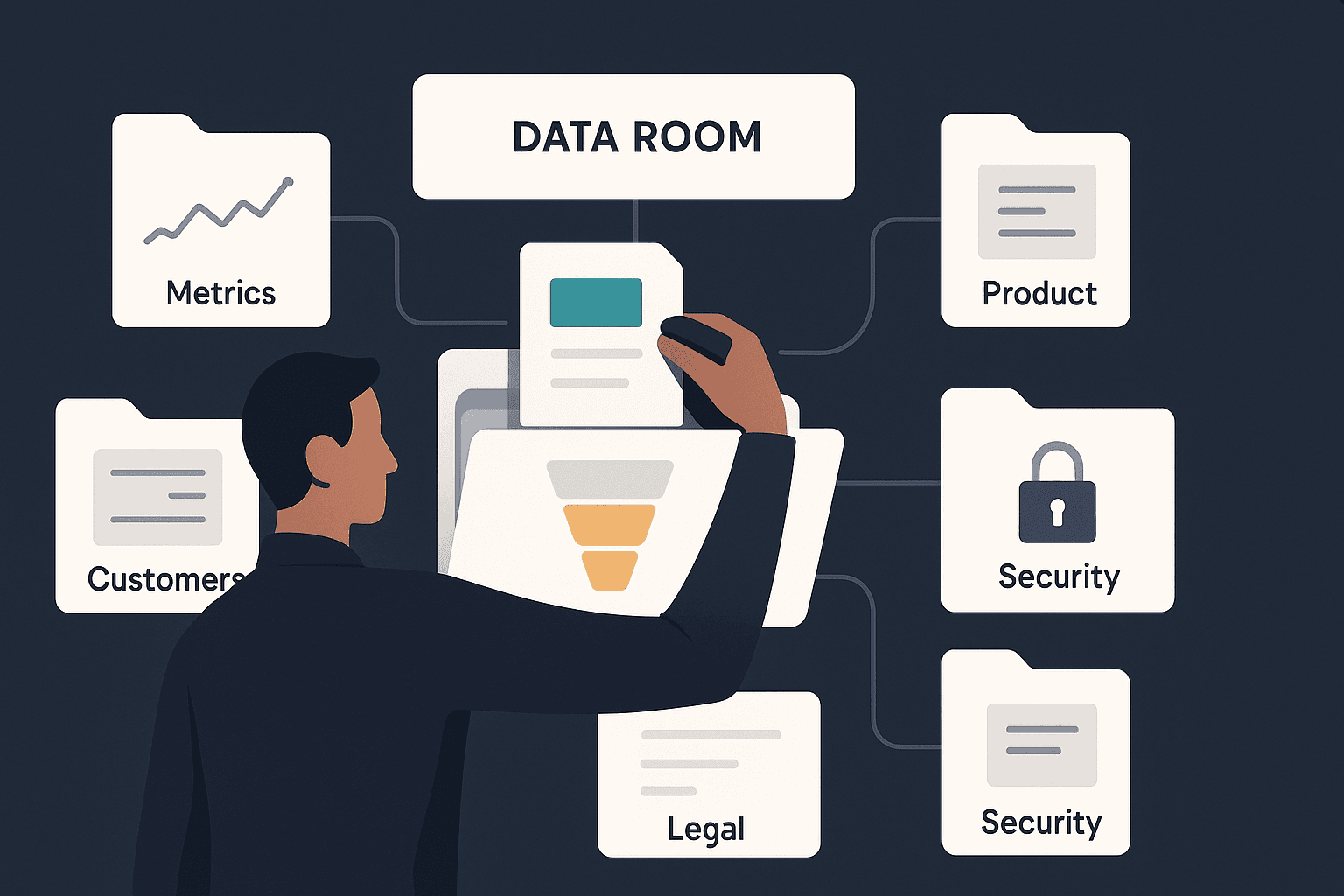
Why a “Founder Data Room” changes the fundraising game
Most founders treat the data room as a late-stage artifact, something you scramble to assemble once an investor is already interested. That’s backwards.
A Founder Data Room is a share-ready diligence hub built before you ever pitch, designed to:
- Convert intros faster (less back-and-forth, fewer “can you send…” emails).
- Control the narrative (you decide what “truth” looks like via clean metrics and context).
- Shorten diligence (no document hunts, fewer inconsistencies).
- Increase trust (investors interpret preparedness as execution capacity).
This isn’t about making a 200-folder monster. It’s about creating a lightweight, opinionated package that answers the most common diligence questions with links you can confidently share.
Investors rarely penalize you for being early; they do penalize you for being sloppy. A founder data room is a way to be early and crisp.
Opinion: If you can’t produce basic metrics, a customer list, and an IP summary in under 30 minutes, you’re not “too early for process”, you’re accumulating execution debt.
What investors are really buying (and how the data room helps)
At seed through Series A, the “data” investors want is mostly a proxy for three things:
- Clarity: Do you understand your market, your buyer, and your constraints?
- Consistency: Do your story, numbers, and customer reality line up?
- Cadence: Are you running the company in a way that scales (weekly metrics, pipeline hygiene, shipping velocity, support loops)?
A strong data room isn’t just a storage space. It’s a credibility engine.
When to build it
Build a Founder Data Room when you can answer “what are you building?” and “for whom?”, even if revenue is $0.
Practical triggers:
- You’re starting outbound or partner conversations that may lead to investor intros.
- You’re about to run a beta with 5–20 design partners.
- You’re collecting payments or signing annual contracts.
- You’re considering raising within the next 6–12 months.
If you wait until you’re actively fundraising, you’ll build it under time pressure, which is how inconsistencies creep in.
Principles: what makes a founder data room work
1) “Share-ready” beats “comprehensive”
A good data room is easy to navigate and safe to share. That means:
- Simple folder structure
- Clear naming
- A short index
- Limited permissions
You’re optimizing for a partner at a firm opening your link between meetings, not for a forensic accountant.
2) One source of truth
The fastest way to kill trust is conflicting numbers across your deck, model, and dashboard.
Your data room should enforce:
- One canonical metrics sheet
- One canonical financial model
- One canonical pitch deck
Everything else should reference those.
3) Narrative with receipts
Investors want context, not just docs.
Each major folder should include a short README that explains:
- What’s here
- What’s missing and why
- How you measure the key thing
4) Progressive disclosure
Not everyone should see everything.
A smart approach is to have:
- Level 1 (Intro-safe): high-level metrics, deck, short memo, customer logos (if allowed).
- Level 2 (Partner diligence): deeper pipeline, cohort retention, security posture.
- Level 3 (Final diligence): legal, cap table, bank statements, contracts.
This reduces leakage and keeps early conversations focused.
The step-by-step playbook
Step 0: Choose a tool and permissions model
Common choices:
- Google Drive (fast, universal, decent permissions)
- Notion (great for narrative + links, weaker for heavy file workflows)
- DocSend (strong tracking, good for decks and docs)
- Dropbox (fine, less startup-native)
- Carta Launch / Pulley (cap table specific)
A practical setup for many founders:
- Drive for files + Notion as the front-door index.
Permissions:
- Create a dedicated shared drive or folder separate from your internal mess.
- Use “view-only” by default.
- Avoid “anyone with link” until you’re comfortable; prefer inviting specific emails.
- Watermark sensitive PDFs where appropriate.
Reference: investors increasingly expect clean access control and auditability; DocSend-like tooling is common for tracking engagement, but it’s optional early.
Step 1: Create a one-page Data Room Index (your hub)
This is the most underused asset.
Your index should include:
- Company name, date, and version
- Contact info
- A short “what this is” paragraph
- Links to each section
- A short “key metrics snapshot”
Treat it like an API README.
Suggested key metrics snapshot (tailor to stage):
- Revenue: MRR/ARR, growth rate
- Gross margin (if relevant)
- Net revenue retention (if relevant)
- Sales cycle length, ACV, win rate
- Activation metric (your definition)
- Retention (logo and/or revenue)
- Burn, runway
References for metric definitions (useful to align language):
- SaaS metrics definitions: Bessemer State of the Cloud materials and common SaaS KPI frameworks (e.g., Rule of 40, NRR) are widely cited in venture discussions.
Step 2: Build the “Intro-Safe” pack (the default share)
This is what you should be able to send after a warm intro without panic.
Folder: 00-Intro-Safe
Include:
-
Pitch deck (PDF)
- Keep a single canonical file.
- Date-stamp it.
-
1–2 page “Founder Memo” (PDF/Doc)
- What you’re building, why now, why you, wedge strategy.
- The goal: answer questions your deck can’t without bloating it.
-
Metrics snapshot (PDF)
- 1–2 pages, with definitions.
- Include charts with time range labels.
-
Product overview (short doc + screenshots/GIFs)
- A short loom/video is optional but powerful.
-
Customer proof (sanitized)
- Logos only if contractually allowed.
- Otherwise: anonymized case studies.
-
Security posture (one pager)
- Even at seed, a short “we take security seriously” page with what you do today and what you’ll do next reduces friction for B2B buyers and investors.
Opinion: If your “intro-safe” pack is messy, you’ll lose momentum before you even get a first meeting.
Step 3: Create a canonical metrics layer (the thing everything references)
Most diligence pain is metrics pain.
You need a canonical metrics sheet that answers:
- What is a customer?
- What is revenue (cash vs accrual)?
- What is churn (logo vs revenue)?
- What is “active” or “retained”?
Deliverables:
- 01-Metrics/metrics-dictionary.md (or Doc)
- 01-Metrics/monthly-kpis.xlsx
- 01-Metrics/dashboard-links.md (links to Stripe, Chargebee, HubSpot, etc.)
Metrics dictionary should include:
- Metric name
- Definition
- Data source
- Query logic (if applicable)
- Owner
This is standard practice in data teams; early-stage startups should steal it.
References:
- Data governance best practices emphasize consistent definitions and sources of truth; applying a lightweight version early reduces downstream chaos.
Step 4: Financials that don’t insult the reader
Investors expect that early models are wrong. They don’t expect them to be incoherent.
Folder: 02-Financials
Include:
- Historical P&L (even if tiny)
- Current burn and runway calculation
- 12–24 month operating model
- Hiring plan (roles, timing, cost)
- Revenue model assumptions (pricing, conversion rates, pipeline)
What “good” looks like:
- Inputs clearly separated from outputs
- Assumptions explicit
- A scenario toggle (base / conservative / aggressive)
Avoid:
- 18-tab spaghetti
- Hard-coded numbers in random cells
- Forecasts with no connection to capacity (e.g., pipeline or product constraints)
Reference: Many venture firms publish guidance on what they expect in a financial model (structure, assumptions, scenario planning), and common startup CFO playbooks recommend input/output separation.
Step 5: Product and roadmap: show you can choose
Investors are not only betting you can build, they’re betting you can prioritize.
Folder: 03-Product
Include:
- Product narrative doc: problem → user → workflow → value
- Roadmap (next 2–3 quarters)
- Changelog or shipping cadence evidence
- Architecture overview (one diagram)
- Tech stack summary
What to emphasize:
- The “why” behind roadmap items
- The constraints you’re managing (security, latency, integrations)
- The wedge and expansion path
Multiple sides:
- Some investors like detailed roadmaps; others consider them fiction. The compromise: provide a roadmap that’s principles-driven (themes + near-term commitments) instead of feature-by-feature promises.
Step 6: Go-to-market: pipeline reality, not vibes
If you’re B2B, investors will interrogate your distribution.
Folder: 04-GTM
Include:
- ICP definition (firmographics + triggers)
- Buyer/user map (economic buyer, champions)
- Positioning and messaging doc (simple)
- Pricing and packaging
- Funnel metrics
- Sales pipeline export (sanitized)
- Customer acquisition channels performance
If you’re pre-revenue:
- Show design partner pipeline and conversion assumptions.
- Show outreach experiments and response rates.
If you’re post-revenue:
- Cohorts (retention by signup month)
- Sales cycle and stage conversion
- Expansion motion (if any)
References:
- GTM frameworks like ICP definition and funnel metrics are standard in SaaS playbooks; many firms (and operators) emphasize pipeline hygiene and cohort-based retention as diligence staples.
Step 7: Customer evidence that stands up to scrutiny
“Customers love us” is not diligence. Evidence is diligence.
Folder: 05-Customers
Include:
- Customer list (with status: pilot, paid, churned)
- Top 10 accounts deep dive (why they bought, use case)
- Case studies (even lightweight)
- Testimonials (with permission)
- Call notes or win/loss notes (sanitized)
Be careful:
- Don’t share confidential customer info without permission.
- Redact sensitive pricing or security details if needed.
Opinion: A founder who can explain churn with precision is more fundable than a founder with zero churn but no understanding of usage.
Step 8: Team and hiring: show coverage, not just resumes
Folder: 06-Team
Include:
- Org chart (current + planned)
- Short bios (LinkedIn links)
- Hiring plan (tied to roadmap and GTM)
- Culture/operating principles (optional)
Investors look for:
- Missing functions (e.g., no clear sales ownership)
- Single points of failure
- Hiring realism
Step 9: Legal and corporate hygiene (keep it boring)
This is where deals drag.
Folder: 07-Legal-Corp
Include:
- Certificate of incorporation, bylaws
- Board consents (if any)
- IP assignment agreements (founders + contractors)
- Option plan and grants summary
- Material contracts (customer/MSA templates)
- Any disputes or claims (hopefully none)
Also include:
- Cap table export (Carta/Pulley)
- SAFEs/notes documents
References:
- Standard venture financing diligence checklists consistently ask for corporate formation docs, IP assignments, cap table, and material contracts.
Step 10: Security & compliance (especially for B2B)
Even if you’re early, enterprise buyers and investors will ask.
Folder: 08-Security-Compliance
Include:
- Security overview one-pager
- Data flow diagram (where customer data goes)
- Access controls (SSO, MFA)
- Incident response plan (simple)
- Backups and disaster recovery outline
- Vendor list (Stripe, AWS, etc.)
If you’re pursuing SOC 2:
- Readiness checklist
- Policies (or placeholders + timeline)
References:
- SOC 2 is a common expectation for B2B SaaS selling into mid-market/enterprise; a lightweight posture doc early reduces friction even before formal certification.
Step 11: The “Open Questions” doc (a power move)
Add a document titled:
09-Notes/open-questions.md
Include:
- Top 5 risks you see
- What you’re doing to mitigate
- What you want help with (hiring, distribution, partnerships)
This signals maturity and frames diligence as collaborative.
Investors are already thinking about risks. The question is whether you can articulate them without collapsing.
Recommended folder structure (copy/paste)
Use this as a starting point:
textFounder-Data-Room/
  00-Index/
    Data-Room-Index.md
    Access-and-Contact.md
  00-Intro-Safe/
    Pitch-Deck.pdf
    Founder-Memo.pdf
    Metrics-Snapshot.pdf
    Product-Overview.pdf
    Customer-Proof.pdf
    Security-One-Pager.pdf
  01-Metrics/
    Metrics-Dictionary.md
    Monthly-KPIs.xlsx
    Dashboard-Links.md
  02-Financials/
    Historical-PnL.xlsx
    Operating-Model-24mo.xlsx
    Hiring-Plan.xlsx
  03-Product/
    Product-Narrative.md
    Roadmap.pdf
    Architecture-Diagram.png
    Tech-Stack.md
  04-GTM/
    ICP-and-Personas.md
    Positioning-Messaging.md
    Pricing-Packaging.pdf
    Funnel-Metrics.xlsx
    Pipeline-Snapshot.xlsx
  05-Customers/
    Customer-List.xlsx
    Case-Studies/
    Win-Loss-Notes.md
  06-Team/
    Team-Bios.md
    Org-Chart.pdf
    Hiring-Roles.md
  07-Legal-Corp/
    Incorporation/
    Cap-Table.pdf
    SAFEs-Notes/
    IP-Assignments/
    Material-Contracts/
  08-Security-Compliance/
    Security-Overview.pdf
    Data-Flow-Diagram.png
    Policies/
  09-Notes/
    Open-Questions.md
    Change-Log.md
Opinionated naming tip: prefix folders with numbers to keep them ordered across systems.
What to include by stage (so you don’t overbuild)
Pre-seed (idea to early traction)
Focus on:
- Founder memo
- Problem definition + why now
- Early customer discovery notes
- Product direction + wedge
- Basic model and burn/runway
- Cap table and incorporation basics
Seed (some traction, early revenue)
Add:
- Cohorts (activation/retention)
- Pipeline and GTM experiments
- Pricing rationale
- Customer references (with permission)
- Security posture one-pager
Series A (repeatability scrutiny)
Add:
- NRR / GRR (if applicable)
- Sales capacity model
- Segment performance
- Unit economics by channel
- Deeper security/compliance
- More complete legal/contracts
Reference: While exact expectations vary by investor, the general shift from seed to A is moving from “is there a wedge?” to “is there a repeatable machine?”
How to keep diligence from dragging: the operational layer
A data room is only as good as its maintenance.
Maintain a “weekly update” cadence
Every week (or every two weeks), update:
- KPI sheet
- Pipeline snapshot
- Burn and runway
- Key wins/losses
If you do this consistently, fundraising becomes a distribution task, not a data assembly task.
Add a changelog
In 09-Notes/Change-Log.md, track:
- What changed
- When
- Why
This prevents confusion when investors reference an older file.
Version your key docs
Pitch-Deck_2026-02-22.pdfMetrics-Snapshot_2026-02-22.pdf
Then your index links to “latest” while you keep history.
Pre-answer FAQs in a Q&A doc
Create:
09-Notes/Investor-QA.md
Include crisp answers to:
- Why this market?
- Why now?
- Who is buyer and what budget?
- What’s the wedge?
- What’s churn and why?
- What are key risks?
This doesn’t replace meetings. It reduces repetitive calls.
Controlling the narrative: how to present metrics honestly
A Founder Data Room should not be a propaganda machine. But it is a narrative asset.
Guidelines:
-
Lead with the metric that matches your stage
- Pre-product: customer discovery volume and learning velocity
- Early product: activation and retention of a narrow ICP
- Early revenue: ARR growth + pipeline quality
- Scaling: NRR, payback, efficiency
-
Always define terms
- “Active user” is meaningless without definition.
-
Show time series, not one-point-in-time
- A single MRR number is easy to game; a 12-month chart is harder.
-
Explain anomalies
- If MRR dips due to annual prepay accounting or a churn event, annotate it.
This is aligned with how good analytics teams communicate: a chart plus context.
Common mistakes (and what to do instead)
Mistake 1: Dumping raw exports
Raw Stripe exports and CRM dumps create noise. Investors don’t want to become your analyst.
Do instead: Provide curated summaries plus a link to raw sources only when requested.
Mistake 2: Oversharing sensitive information too early
Sharing customer contracts, security details, or employee info broadly is risky.
Do instead: Progressive disclosure. Ask: “What do they need at this stage?”
Mistake 3: Inconsistent numbers
Deck says $50k MRR, model shows $42k, Stripe shows $47k.
Do instead: Declare a canonical figure and reconcile differences in a note.
Mistake 4: Treating the data room as a one-time project
It becomes outdated within weeks.
Do instead: Make it part of operating cadence; assign an owner.
Mistake 5: No proof of customer value
A deck with slogans but no evidence doesn’t survive partner meetings.
Do instead: At minimum, show usage, retention, and specific customer outcomes.
A lightweight diligence workflow (so you don’t lose weeks)
Here’s a pragmatic process:
- After first call: share Intro-Safe pack (view-only)
- After partner interest: share Metrics + Financials + GTM
- Before term sheet: share Legal + Security
- Before close: finalize cap table, closing docs, confirm no surprises
Keep a single email template with the index link and what’s newly available.
Templates you should create (fast)
If you want this done in a weekend, create these seven docs first:
- Data Room Index (Notion or Google Doc)
- Founder Memo (1–2 pages)
- Metrics Snapshot (1–2 pages)
- Metrics Dictionary (definitions)
- Operating Model (simple)
- Security One-Pager
- Customer Proof pack (logos/case studies)
Everything else can follow.
References and further reading
Because diligence expectations vary, these categories of references are worth consulting:
- Venture diligence checklists published by law firms and VC platforms (corporate docs, IP, cap table, contracts).
- SaaS KPI frameworks widely used in venture (NRR/GRR, CAC payback, Rule of 40) such as Bessemer’s State of the Cloud perspectives and common operator playbooks.
- Security/compliance frameworks (SOC 2 readiness guides; vendor security questionnaires as a proxy for what enterprise buyers will ask).
- Data governance basics (metrics definitions, single source of truth) as used in analytics teams.
When you build your data room, you’re not trying to satisfy every possible checklist, you’re trying to satisfy the highest-frequency questions with minimal friction.
The real payoff: fundraising becomes a byproduct of operating well
A Founder Data Room is not merely a fundraising tool. It’s an operating system artifact.
If your metrics are defined, your pipeline is visible, your customer evidence is organized, your security posture is understood, and your legal house is in order, then:
- You move faster in fundraising.
- You close deals faster (customers ask for the same diligence).
- You onboard hires faster (clarity of strategy and roadmap).
- You make better decisions (because you can see reality).
The best time to build your data room is before you “need” it. The second-best time is this week.
If you do it right, you’ll notice something subtle: investor conversations stop being interrogations and start being collaborations, because you’ve already done the work to make the truth legible.