
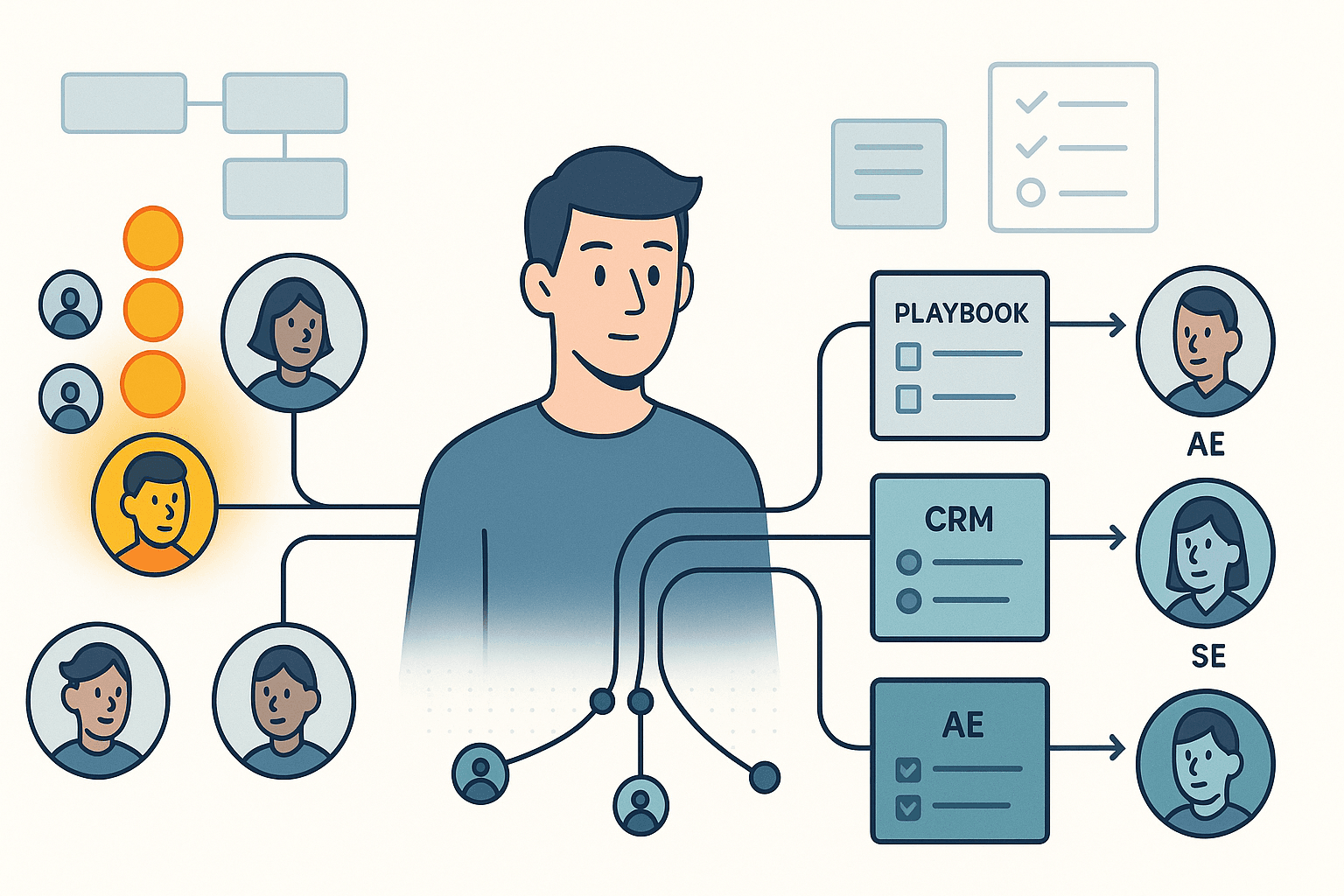
Founder-led sales is a feature, until it becomes a constraint
In the early days of a B2B startup, founder-led sales (FLS) is often the only realistic path to revenue. You don’t yet have a repeatable message, a stable product, or a market segment you truly understand. The founder is usually the only person who can:
- Translate ambiguous customer pain into a product narrative.
- Patch product gaps in real time.
- Build trust quickly (especially in enterprise).
- Make pricing and scope decisions without a committee.
But the same forces that make founder-led sales effective early can turn it into a growth bottleneck later. The “trap” is not doing founder-led sales, it’s staying there too long, without systemizing what you learned.
This article explains:
- How to spot when founder-led sales is stalling growth (with concrete signals).
- Why it stalls (structural reasons, not just “you’re busy”).
- A step-by-step handoff plan to hire, train, and systemize sales without killing early momentum.
- Multiple valid paths: sales-led, product-led, founder-assisted, and hybrid.
Throughout, the bias is practical: if your goal is predictable growth, you need a system where revenue is not a founder-only capability.
The core problem: FLS doesn’t scale because it’s mostly tacit knowledge
Founder-led sales works because the founder carries a lot of unwritten context:
- What the product really does (and doesn’t).
- Which features are real vs roadmap.
- Which objections matter vs which are noise.
- Which customer profiles succeed.
- How to thread value through a messy org chart.
This is not a “sales skill” problem. It’s a knowledge transfer and process maturity problem.
A useful frame is the difference between:
- Tactic success: “I can close deals.”
- System success: “Someone else can close deals using what I built.”
Until you can reliably achieve the second, growth will be capped by founder bandwidth.
When founder-led sales becomes a bottleneck: the signals
You don’t need to guess. The trap has clear leading indicators.
1) Sales throughput is linearly tied to founder calendar
If pipeline generation, qualification, discovery, scoping, pricing, negotiation, and onboarding all route through the founder, then every deal is a bespoke project.
Diagnostic: If you took two weeks off, would revenue creation slow materially? If yes, you don’t have a sales engine, only a hero.
2) You can’t explain why you win or lose (beyond vibes)
Early on, “we won because they liked us” is acceptable. Later, it’s dangerous.
You should be able to articulate:
- Ideal Customer Profile (ICP) with disqualifiers.
- Top 5 buying triggers.
- Common objections and proven rebuttals.
- Deal stage conversion rates.
If you can’t, a sales hire will amplify chaos, not revenue.
Reference: The discipline of documenting assumptions and iterating toward repeatability maps well to the Customer Development approach (Steve Blank) and The Lean Startup (Eric Ries), even if you’re not “lean” in practice.
3) The product roadmap is being hijacked by prospect-specific requests
Founder-led sales often turns into founder-led custom solutions.
If the founder is promising “yes” to close deals, engineering becomes a professional services team. This inflates:
- Cycle time
- Support burden
- Churn risk (because outcomes don’t generalize)
Signal: A rising share of engineering time is dedicated to features used by only one customer.
4) Pipeline quality is inconsistent and unpredictable
If you’re relying on founder networking, inbound luck, or opportunistic partnerships, you might get deals, but not a system.
Signal: You can’t forecast next quarter without “hoping” a few big fish land.
5) Your close rate depends on founder presence
The moment a non-founder runs the call, deals stall.
That usually means one (or more) of these is true:
- The message isn’t crisp.
- Trust is founder-specific.
- The product needs too much contextual explanation.
- Pricing and packaging aren’t standardized.
6) Expansion revenue exists, but only the founder can unlock it
In B2B, expansion is often the real growth engine. If renewals and upsells require founder escalation, the business is fragile.
7) You are becoming the organizational “router”
Every path leads back to you:
- “Can you join this call?”
- “Can you review this proposal?”
- “Can you talk to their VP?”
- “Can you approve this discount?”
This is not merely a workload issue. It is a single point of failure.
Why founder-led sales traps startups (structural causes)
Understanding the mechanics helps you escape without losing what works.
Cause A: Early wins are inherently unrepeatable
Your first customers often buy for reasons that do not scale:
- They trust you personally.
- They’re unusually motivated.
- Their org is flexible.
- They accept rough edges.
These customers are valuable, but they can mislead you. If you build the sales motion around them, the next 50 customers may not behave the same.
Reference: Geoffrey Moore’s Crossing the Chasm highlights the discontinuity between early adopters and the early majority, one of the most common reasons early sales patterns stop working.
Cause B: The founder’s sales motion is implicit and non-transferable
Founders often improvise:
- They change the pitch based on the room.
- They do live product design during discovery.
- They negotiate on instinct.
This is powerful early, but impossible to teach without codifying:
- stages
- exit criteria
- scripts
- qualification
- deal strategy
Cause C: You can’t hire your way out of product-market uncertainty
Hiring a sales team too early is a classic failure mode:
- Reps need repeatability.
- Startups in flux change messaging weekly.
- Product gaps get blamed on sales.
So founders delay hiring. But delaying is only safe if you actively convert learning into a system.
Cause D: Founders often create a “bespoke” go-to-market
Custom pricing, custom security terms, custom integrations, custom onboarding. The founder makes it happen, until it becomes the default expectation.
That creates a business that scales headcount, not revenue.
The escape plan: a step-by-step handoff without killing momentum
The goal isn’t to “stop founder-led sales” overnight. The goal is to move from:
Founder-led → Founder-assisted → System-led
Here is a pragmatic sequence.
Step 1: Define the minimum viable sales process (MVSP)
Before hiring anyone, you need a process that’s simple enough to follow and strict enough to measure.
Build these 7 artifacts (lightweight, but explicit)
-
ICP v1
- Firmographics: industry, size, region
- Technographics (if relevant): stack dependencies
- “Must have” pain: what is broken today?
- Disqualifiers: who should not buy?
-
Core narrative
- Problem → cost of inaction → why now → why you → proof
-
Qualification checklist
- Budget reality
- Authority & champions
- Urgency timeline
- Integration/security constraints
- “Success definition” (what outcome will they measure?)
-
Deal stages + exit criteria Example:
- Stage 1: Qualified intro (pain + ICP match)
- Stage 2: Discovery completed (use case + stakeholders mapped)
- Stage 3: Demo/solution fit (success criteria agreed)
- Stage 4: Proposal (commercial terms drafted)
- Stage 5: Security/procurement (blockers tracked)
- Stage 6: Closed-won
-
Pricing & packaging rules
- List price anchor
- Discount authority
- What is configurable vs non-negotiable
-
Objection bank
- Top 10 objections
- Best responses
- Evidence (case studies, benchmarks)
-
Implementation promise
- Onboarding timeline
- Customer responsibilities
- “Time to first value” definition
This converts founder intuition into a baseline system. Not perfect, just teachable.
Reference: Many of these artifacts align with sales process fundamentals popularized in B2B sales methodology literature (e.g., Miller Heiman concepts around qualification and stakeholder mapping), regardless of your chosen methodology.
Step 2: Instrument your funnel (so you’re not hiring blind)
You need basic metrics to avoid cargo-cult sales.
Minimum set:
- Lead source mix (inbound/outbound/partner/founder network)
- SQL rate (what % of leads are qualified)
- Stage conversion rates
- Median sales cycle length
- Win/loss reasons (coded)
- ACV (average contract value)
- Gross margin impact (services, onboarding)
If you don’t have this, the first sales hire becomes a narrative contest: “I’m doing great, the product is bad” vs “Sales is failing.” Data prevents that.
Step 3: “Productize” what you’ve been customizing
This is where many startups quietly break.
You need to decide:
- What is core (same for all customers)?
- What is configurable (bounded options)?
- What is professional services (paid, scoped)?
- What is not supported (explicitly no)?
If you don’t draw these lines, sales will keep selling exceptions.
Practical move: Create a one-page “commercial boundaries” doc:
- Supported integrations
- SLA tiers
- Security posture (SOC 2 timeline, data residency)
- Implementation scope
This reduces founder escalation and de-risks hiring.
Step 4: Choose the right first sales hire (it’s rarely a “closer”)
The most common mistake is hiring a stereotypical enterprise AE too early.
What you actually need depends on your reality
If messaging is still evolving and deals are mid-market
Hire a founding AE who can also do discovery + light outbound.
Traits:
- Comfortable with ambiguity
- Can write and iterate messaging
- Can run structured discovery
- Will document what they learn
If pipeline is weak but product is clear
Hire a demand gen/outbound-first profile (often SDR/BDR lead or growth marketer) before scaling AEs.
If onboarding is the real bottleneck
Hire solutions engineering / implementation first. Revenue is not “closed-won”; it’s “retained and expanded.”
Reference: A recurring theme in modern B2B go-to-market thinking (e.g., HubSpot’s inbound frameworks and the broader RevOps movement) is that bottlenecks can sit in any part of the funnel, not just closing.
A practical heuristic
- If the founder is spending >30–40% of time on sales and sales cycles are repeatable, hire an AE.
- If deals close but churn/implementation is messy, hire CS/SE.
- If there aren’t enough qualified conversations, fix pipeline first.
Step 5: Run a “shadow → reverse shadow → certify” handoff
This reduces the risk of the “new rep kills momentum” problem.
Phase 1: Shadow (1–2 weeks)
The hire attends calls silently and takes notes on:
- ICP signals
- discovery questions
- objection handling
- pricing conversations
Deliverable: a written “call playbook” draft.
Phase 2: Reverse shadow (2–4 weeks)
The hire runs the call; founder observes. Founder intervenes only if:
- The deal is about to die
- A major product commitment is being made
- Pricing/terms exceed policy
After each call: 15-minute debrief; update playbook.
Phase 3: Certification (by deal stage)
Don’t certify “you can sell.” Certify discrete competencies:
- Can qualify ICP correctly (with examples)
- Can run discovery and produce a usable summary
- Can map stakeholders and buying process
- Can write a proposal that matches boundaries
- Can handle top 10 objections
Only then do you remove the founder from routine stages.
Step 6: Introduce rules for founder involvement (so you don’t become the crutch)
Founders staying involved is not automatically bad. The trap is unstructured involvement.
Create “founder assist triggers”
Founder joins only when:
- Deal size > X
- Strategic logo value high
- Exec-to-exec needed
- Competitive takeout situation
- Unusual security/procurement risk
Everything else must run without you.
This is similar to how mature orgs use executive sponsorship, only you’re formalizing it early.
Step 7: Build a repeatable sales enablement loop
Enablement isn’t a department; it’s a cadence.
Weekly loop (60–90 minutes)
- Review 3 deals (one early, one mid, one late)
- Review 3 recorded calls
- Update objection bank
- Update ICP notes
- Confirm any roadmap commitments are real
Monthly loop
- Win/loss review with coded reasons
- Pricing/packaging review
- Funnel conversion review
- Update collateral: 1-pager, deck, case study
The outcome is a continuously improving system, not static “training.”
Step 8: Systemize around RevOps early (lightweight)
You don’t need a giant ops function, but you do need someone accountable for:
- CRM hygiene and definitions
- stage exit criteria enforcement
- forecasting discipline
- attribution basics
Without this, founder and reps argue about stories, not numbers.
Reference: The RevOps model has become a standard way to align sales, marketing, and CS around shared funnel metrics (popularized by practitioners across the SaaS ecosystem; see also industry benchmarks and frameworks from firms like OpenView, a16z GTM content, and Salesforce ecosystem best practices).
Step 9: Fix the “first customers” distortion
Your first customers can mis-train your company.
Common distortions:
- Overweighting edge cases: building for the loudest user.
- Over-crediting relationships: believing “networking” is the channel.
- Underestimating adoption cost: early customers tolerate complexity.
Practical countermeasure: segment your wins
For every closed-won, tag:
- Customer type: early adopter vs mainstream buyer
- Buying reason: urgent pain vs innovation budget
- Complexity: low/medium/high implementation
- Champion type: IC, manager, exec
Then ask: Which segment do we want 50 of?
That becomes your real ICP.
How to know you’ve escaped the trap (clear outcomes)
You’re not looking for “sales feels better.” You want observable, repeatable capability.
Signs you’re out
- A non-founder can run discovery and produce consistent notes.
- Forecast accuracy improves (even if still imperfect).
- Deals don’t require founder to move stages.
- Pricing is stable; discounting is controlled.
- Engineering isn’t surprised by sales promises.
- Win/loss reasons converge into patterns.
A good practical milestone:
At least 50% of new revenue is closed without founder participation in routine calls.
Founder still helps on strategic deals, but is no longer the engine.
The nuanced truth: founder-led sales isn’t “bad”, it’s a phase you must graduate from
It’s worth acknowledging: there are cases where founder-led sales remains a long-term strategy.
When staying founder-led longer can be rational
- Very high ACV enterprise where founder credibility is essential.
- Deeply technical product where selling is product architecture.
- Regulated industries where trust and risk dominate.
Even then, you still need systemization. Otherwise you’re building a consultancy with a product wrapper.
The real goal: founder-led learning, system-led execution
Founder involvement should migrate to:
- Defining ICP and positioning
- Recruiting and training sales leadership
- Executive relationships for strategic accounts
- Product strategy informed by structured feedback
Not: every demo, every proposal, every negotiation.
Common failure modes (and how to avoid them)
Failure mode 1: Hiring an AE before you have a message
Symptom: rep can’t get traction; founder concludes “sales doesn’t work.”
Fix: founder documents narrative + ICP + qualification; run a structured pilot with 1 rep.
Failure mode 2: Hiring a “big company” seller who needs infrastructure
Symptom: lots of talk about territories and enablement, few closed deals.
Fix: hire for ambiguity tolerance; test with a paid working session: have candidates run discovery on a real lead.
Failure mode 3: Founder keeps overriding the process
Symptom: reps can’t learn; every deal becomes bespoke again.
Fix: create explicit boundaries; review exceptions weekly; don’t make commitments live on calls.
Failure mode 4: Sales scales faster than onboarding and CS
Symptom: churn rises; NRR stalls; support load explodes.
Fix: throttle bookings until time-to-value is consistent; invest in implementation playbooks.
Failure mode 5: Confusing “activity” with pipeline
Symptom: outbound volume grows; SQL quality drops.
Fix: enforce qualification gates; measure meeting-to-opportunity and opportunity-to-win.
A pragmatic 90-day roadmap (for a founder currently doing all sales)
Days 1–15: Codify and instrument
- Write ICP v1 and disqualifiers
- Define stages + exit criteria
- Standardize pricing guardrails
- Start win/loss coding
- Create a single updated deck + demo path
Days 16–45: Pilot the handoff
- Hire or designate first sales owner (AE/BDR/SE depending on bottleneck)
- Run shadow → reverse shadow
- Record calls; build objection bank
- Remove founder from early-stage calls first
Days 46–90: Enforce process and scale what works
- Introduce founder assist triggers
- Start weekly enablement loop
- Tighten qualification gates
- Produce 1–2 case studies and a ROI narrative
- Decide whether to add pipeline generation or another closer
The goal at day 90 is not “a full sales org.” It’s a repeatable motion someone else can execute.
Closing perspective: your job is to make yourself unnecessary, selectively
The best founders don’t stop selling. They stop being the single point of failure.
Founder-led sales is one of the highest leverage activities in the first phase of a B2B startup. But if it stays the only way revenue happens, it limits growth, distorts product strategy, and prevents the company from becoming a real system.
Escape looks like this:
- What used to be intuition becomes a playbook.
- What used to be relationships becomes a channel.
- What used to be ad hoc becomes measurable.
And the founder returns to the role only they can do: setting direction, recruiting talent, and building advantage, rather than routing every deal through their inbox.
References and further reading
- Steve Blank, The Four Steps to the Epiphany (customer development, repeatability)
- Eric Ries, The Lean Startup (validated learning loops)
- Geoffrey A. Moore, Crossing the Chasm (early adopters vs early majority dynamics)
- Miller Heiman Group, strategic selling / qualification concepts (stakeholder mapping; methodology varies by edition)
- HubSpot, inbound sales and funnel frameworks (lead qualification and lifecycle stages)
- OpenView, a16z, Salesforce ecosystem, RevOps and SaaS GTM benchmark content (general industry practice and metrics)