
The uncomfortable truth: hiring sales doesn’t create product–market fit
Many startups treat sales hires like a milestone: “We raised seed, now we hire an AE.” Or worse, like a fix: “Growth is slow, let’s bring in someone who can sell.”
That instinct is understandable, but often backwards.
In early-stage B2B, sales is not primarily a revenue function. It is a learning function. Founder-led sales is the fastest feedback loop you have for:
- whether your ICP is real or imagined
- whether your positioning is legible
- whether your pricing is anchored to value
- whether onboarding actually works
- whether renewals and expansion are plausible
A sales rep can execute a system. They cannot reliably invent it from scratch, especially when the product is evolving weekly, the ICP is still fuzzy, and the founder is the only person who can change the roadmap in real time.
The hidden breakpoint that decides your fate is this:
You should hire sales only when your sales motion is repeatable enough that execution beats invention.
This article is a practical framework for finding that breakpoint using signals from deal cycles, ICP clarity, and retention, plus the operational steps to systemize before you hire.
Why this decision is so often fatal
Sales is expensive and time-consuming to get right. Getting it wrong can burn:
- cash (base salary, commission, tools, lead sources)
- time (ramp, pipeline creation, onboarding)
- momentum (misleading signals, morale hits)
- product direction (building features to satisfy the loudest, not the best-fit)
Early sales hiring fails for predictable reasons:
- No defined ICP → rep sells to anyone who will take a meeting.
- No crisp positioning → rep improvises, creating inconsistent expectations.
- No proven pricing model → discounting becomes the strategy.
- No onboarding/activation path → churn kills growth and poisons referrals.
- No repeatable channel → pipeline depends on heroics, not process.
The result is often negative learning: you conclude “sales doesn’t work for us,” when the truth is “we tried to scale before we had something to scale.”
There’s a reason many top investors push founders to do sales early. It’s not because reps aren’t valuable; it’s because founders are uniquely equipped to find truth quickly.
Reference context: This aligns with the classic lean startup loop of build–measure–learn (Ries) and the emphasis on early customer development (Blank) before scaling.
Founder-led sales: what it’s actually for
Founder-led sales is not merely “the founder can sell better.” It’s that founders can:
- translate vague pain into precise product changes immediately
- make credibility leaps that early brands can’t (vision, roadmap, trust)
- take exploratory conversations without needing a rigid playbook
- decide tradeoffs live (pricing, packaging, security posture, integrations)
In early stages, your job is to discover:
- Who buys (ICP)
- Why they buy (value & urgency)
- How they buy (process & stakeholders)
- What success looks like (activation & retention drivers)
- What they pay (pricing & willingness)
A rep is optimized for converting opportunities within known boundaries. A founder is optimized for defining those boundaries.
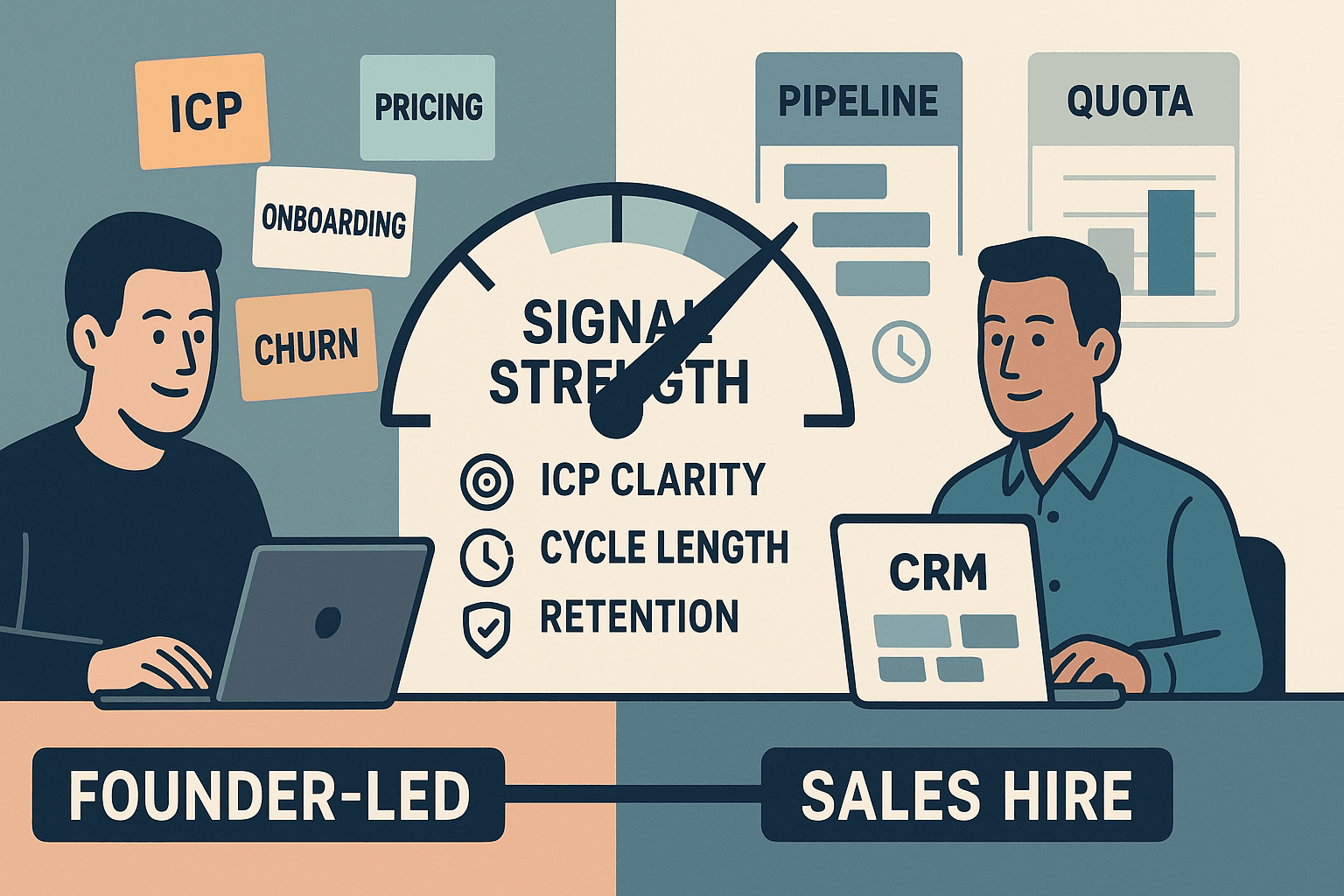
The breakpoint framework: three signals that determine “keep selling” vs “systemize” vs “hire”
Use three primary signals:
- Deal cycle characteristics (time, steps, stakeholders, predictability)
- ICP clarity (who reliably converts and succeeds)
- Retention health (do customers stick and expand)
Think of them as a tripod: if one leg is missing, scaling sales usually collapses.
Signal 1: Deal cycle characteristics (repeatability over speed)
A common mistake is to focus only on cycle length (“we need shorter cycles”). Cycle length matters, but predictability matters more.
Ask:
- Are the steps consistent (discovery → demo → security → procurement → close)?
- Do deals stall at the same points?
- Does a defined “next step” exist after each call?
- Do you know which objections are real vs. polite exits?
Green flags (ready to systemize):
- 70–80% of deals follow a similar sequence of stages
- you can name the top 5 objections and your best answers
- you can estimate probability-to-close based on stage, not vibes
Red flags (stay founder-led):
- every deal is bespoke: different buyer, different use case, different integration
- your pitch changes materially each week
- close reasons are inconsistent (sometimes pricing, sometimes features, sometimes “not now”)
Practical metric:
- Stage conversion stability: if stage-to-stage conversion rates swing wildly month to month, you don’t have a stable motion to hand off.
Reference context: Sales process standardization is a core theme in enterprise sales methodologies (e.g., MEDDIC/MEDDPICC) that rely on consistent qualification signals; if those signals don’t exist yet, the methodology becomes theater.
Signal 2: ICP clarity (the “who” is the strategy)
“ICP” is often written as a persona slide: “mid-market IT managers at SaaS companies.” That’s not ICP clarity.
Real ICP clarity means:
- you can predict who will buy and succeed
- you can identify a customer in 60 seconds from public info
- you can say no confidently to plausible but wrong-fit leads
A strong ICP definition includes:
- Firmographics: size, vertical, geography (where relevant)
- Technographics: stack dependencies (tools you integrate with)
- Trigger events: hiring, compliance changes, migrations, incidents, growth milestones
- Pain intensity: quantified cost of status quo
- Buying constraints: security requirements, data residency, procurement norms
- Success conditions: what must be true for value realization in 30–90 days
Green flags (systemize):
- 60–70%+ of closed-won customers share the same 2–3 traits that are not generic
- you can articulate a “disqualifier list” that saves time
- outbound messaging to the ICP gets consistent reply quality
Red flags (stay founder-led):
- your best customers look nothing like each other
- you can’t tell whether churn is “bad customer” or “bad product”
- growth depends on referrals from personal networks rather than a defined segment
Reference context: Geoffrey Moore’s “bowling pin” model and the broader category design thinking emphasize focusing on a narrow beachhead where you can dominate before expanding.
Signal 3: Retention health (sales without retention is a leaky bucket)
You can brute-force early revenue by closing the wrong customers. That’s often what happens when a startup hires sales too early: the rep optimizes for closing, not for durable value creation.
Retention is the ultimate truth serum.
Key questions:
- Do customers renew without founder intervention?
- Do they adopt the core workflow consistently?
- Are there organic expansion signals (more seats, higher usage, more data)?
Green flags (hire-ready):
- churn is explainable and decreasing
- customers reach a defined “activation event” quickly
- support load per customer is not exploding
Red flags (do not hire yet):
- churn is high and you don’t know why
- onboarding requires custom founder work every time
- customers say “love it” but don’t use it
Practical metric:
- Time-to-first-value (TTFV) and retention by cohort.
Even if you’re early, you can track whether customers hit a meaningful outcome in days vs. weeks, and whether the cohorts are improving.
Reference context: Net revenue retention (NRR) and logo retention are standard SaaS health metrics; while benchmarks vary by segment, the principle is stable: scaling acquisition ahead of retention increases burn and masks product issues.
The decision matrix: keep selling, systemize, or hire
Here’s an opinionated matrix you can use.
1) Keep it founder-led when:
- ICP is still being discovered
- close reasons vary wildly
- onboarding is bespoke
- retention is inconsistent
- you’re still changing positioning and packaging frequently
Goal in this phase: learning velocity.
What to build (not hire):
- a living doc of call notes tagged by segment and outcome
- a simple qualification rubric (even if it’s rough)
- 3–5 repeatable customer stories with before/after and metrics
2) Systemize before hiring when:
- you can close deals repeatedly but it’s still founder-dependent
- there’s a recognizable pipeline shape, but it’s not documented
- you can predict success for a segment, but onboarding is fragile
Goal in this phase: transferability.
What to build:
- a sales narrative (positioning, differentiation, proof)
- a defined ICP + disqualifiers
- baseline pricing and packaging rules
- an onboarding checklist and success milestones
3) Hire sales when:
- you have repeatable wins in a defined segment
- sales stages are consistent enough to forecast
- onboarding and customer success aren’t held together by founder labor
- you know what a “good lead” looks like
Goal in this phase: throughput.
Who to hire first is its own decision (more below), but the trigger is repeatability.
The hidden breakpoint: when execution becomes more valuable than invention
You’ve crossed the breakpoint when:
- The best next improvement is more at-bats, not more insight.
In other words, additional sales conversations yield diminishing learning returns. You’re hearing the same objections, seeing the same evaluation pattern, and closing the same buyer persona.
At that point, the bottleneck becomes:
- lead volume
- follow-up speed
- multi-threading stakeholders
- disciplined pipeline management
Those are execution problems. A good sales rep should outperform a founder there, because that’s their craft.
Before that point, the bottleneck is usually:
- not knowing who to target
- unclear value proposition
- product gaps that must be prioritized
- unclear ROI story
Those are invention problems. Founder-led is superior.
What “systemize” actually means (and why most founders skip it)
Systemizing isn’t buying a CRM. It’s converting tacit founder intuition into explicit assets that someone else can use.
Here’s the minimum viable sales system.
1) A one-page ICP definition (with disqualifiers)
Include:
- Ideal firmographics + technographics
- Top 3 trigger events
- Top 3 disqualifiers
- “Why now” narrative
Disqualifiers matter because they prevent your first rep from chasing dead-end revenue.
2) A consistent qualification method
You don’t need to implement full MEDDPICC on day one. But you do need to answer consistently:
- What pain is this solving?
- Who owns that pain?
- What happens if they do nothing?
- What is the decision process?
- What is the timeline and why?
If you can’t answer those, your pipeline is hope.
3) A pricing and packaging decision tree
Early pricing should be simple, but not arbitrary.
Document:
- what drives price (seats, usage, value metric)
- when you discount (and when you never do)
- how you handle pilots
- what “enterprise” includes (SSO, audit logs, SLA, security review support)
This prevents reps from inventing pricing under pressure.
4) Proof assets that match the ICP
You need at least:
- 2–3 case studies with measurable outcomes
- 1–2 short technical validation artifacts (security overview, architecture, ROI model)
In many B2B motions, especially technical ones, the “sale” is risk reduction. Proof is a sales tool.
5) An onboarding path with success milestones
Document:
- activation event (what must happen for value to begin)
- required inputs (data, integrations, roles)
- time expectations
- ownership (customer vs you)
If onboarding is ambiguous, sales will sell dreams and success will inherit nightmares.
The most common failure modes of “hire a sales rep”
Failure mode 1: hiring an AE when you need a founder + SDR or founder + growth
If pipeline is weak and your motion is not proven, hiring a closing AE can be premature. They’ll spend months prospecting, get demoralized, and you’ll conclude they “can’t sell.”
In many early B2B startups, the founder should still close while experimenting with:
- founder-driven outbound
- partnerships
- content and community
- targeted SDR support (carefully)
Failure mode 2: the rep sells a different product than the one you think you have
Reps will adapt messaging to what gets meetings. If your positioning is unclear, they will improvise. Then:
- customers buy for mismatched reasons
- churn increases
- roadmap becomes chaotic
Failure mode 3: discounting becomes the strategy
In early markets, you often lack brand trust. The temptation is to discount to close.
But discounting:
- attracts price-sensitive, low-retention customers
- reduces your ability to fund onboarding and support
- trains the market that your list price is fiction
Failure mode 4: “enterprise” deals suck you into a tarpit
A rep chasing bigger ACV may pull you into security questionnaires, custom contracts, and integration demands that drown a small team.
Sometimes enterprise is right. Often it’s a trap until your product and process can handle it.
Who to hire first (and why “sales rep” is too vague)
“Hire a sales rep” hides critical role differences.
Option A: Hire an SDR first (when you have a pitch but need at-bats)
Best when:
- founder can close
- ICP is reasonably clear
- outbound lists are identifiable
- you need meeting volume
Risk:
- SDR can fill calendar with wrong-fit meetings if ICP isn’t tight
Option B: Hire a founding AE (when the motion is repeatable)
Best when:
- deals follow a consistent process
- pricing is stable
- you can provide proof and onboarding support
- you can generate at least some inbound/outbound pipeline
Look for:
- comfort selling ambiguity but within a defined ICP
- strong discovery skills
- willingness to document and improve process
Option C: Hire sales ops / rev ops earlier than you think (when complexity appears)
This sounds crazy early, but part-time or fractional ops can help when:
- you have multiple channels
- you need clean attribution
- you need consistent pipeline stages and reporting
Option D: Hire customer success before scaling sales (when retention is fragile)
If customers require heavy onboarding and value realization is complex, a CS hire may unlock growth more than an AE.
Opinionated take: If churn is high, a new AE is often gasoline on a fire.
A practical readiness checklist (score yourself honestly)
Give yourself 0–2 points each.
ICP clarity (0–10)
- We can describe ICP in 2 sentences with specific traits (0–2)
- We have clear disqualifiers and use them (0–2)
- We know the top trigger events that create urgency (0–2)
- Closed-won customers look meaningfully similar (0–2)
- We can source lead lists for ICP reliably (0–2)
Deal cycle repeatability (0–10)
- We have defined stages and they match reality (0–2)
- We know top objections and responses (0–2)
- Stakeholders are predictable (economic buyer, champion, IT/security) (0–2)
- We can forecast based on stage with some accuracy (0–2)
- We have a standard pilot / evaluation approach (0–2)
Retention / success (0–10)
- We know our activation event and customers reach it consistently (0–2)
- Onboarding does not require founder heroics every time (0–2)
- Churn reasons are known and trending down (0–2)
- Customers are expanding usage or expressing clear expansion intent (0–2)
- Support burden per customer is stable/declining (0–2)
Interpretation:
- 0–12: stay founder-led; focus on learning and product/positioning
- 13–22: systemize; build assets; consider SDR or fractional support
- 23–30: hire to scale; consider founding AE + CS coverage
This is not “science,” but it forces specificity.
Handling deal cycles: the trap of optimizing for speed too early
Technical founders often try to “productize” their way to a short cycle immediately. Sometimes that’s correct (PLG). But in many B2B categories, security, data, compliance, infrastructure, buyers move slower because risk is real.
Instead of obsessing over cycle length, optimize for:
- stage clarity: everyone knows what “evaluation” means
- multi-threading: you’re not dependent on one champion
- risk removal: security docs, architecture diagrams, clear roll-out plan
If you can make a 90-day cycle predictable and high-converting, you can scale. If you chase a 14-day cycle by discounting and overpromising, you might close faster, then churn.
The founder’s new job after you hire
Hiring sales does not mean the founder stops selling. It means the founder’s sales work changes.
Founder responsibilities post-hire:
- stay close to calls (at least listen to recordings weekly)
- own narrative: positioning, category framing, pricing philosophy
- handle edge cases: strategic accounts, complex negotiations, key references
- align product with revenue truth: prioritize features that increase win rate and retention
If you disappear after hiring, your first rep becomes the de facto product strategist. That rarely ends well.
When hiring sales will burn cash (clear “do not hire” scenarios)
Be blunt with yourself. Don’t hire sales if:
- You can’t explain why you win (beyond “they liked us”).
- Your best customers churn or fail to activate.
- Every deal requires major product changes to close.
- Your ICP is “any company with a problem.”
- You don’t have distribution (no outbound list, no inbound engine, no partners).
In these cases, a sales hire often produces:
- activity without progress
- misleading pipeline
- pressure to build random features
The right move is usually: sharpen ICP, fix onboarding, narrow scope, and keep founder-led.
When you should hire sooner than you feel comfortable
There are also scenarios where delaying a hire is costly.
Hire earlier if:
- you’re consistently closing and turning away leads due to bandwidth
- the process is known but founder time is the bottleneck
- you have clear inbound demand and slow response times are losing deals
- you’ve found a repeatable niche and competitors are waking up
If you wait too long, you risk:
- slower growth than the market window allows
- founder burnout
- underinvestment in pipeline and process
The key is that you’re hiring to increase throughput of a known motion, not to discover one.
A lightweight playbook: the 30-day pre-hire sprint
If you’re considering a sales hire, do this sprint first.
Week 1: Document reality
- Write your current sales stages (even if messy)
- Review the last 10 deals (won and lost)
- Tag each by segment, trigger, objections, close reason
Week 2: Define ICP and disqualifiers
- Choose one “beachhead” segment
- Create a lead list of 100 accounts you would bet on
- Define 3 disqualifiers that you’ll actually enforce
Week 3: Create minimal assets
- One-page pitch (problem → impact → why now → why us)
- Security/architecture one-pager (for technical buyers)
- Two customer stories with measurable outcomes
Week 4: Prove repeatability
- Run 15–20 conversations in the ICP
- Track stage conversions and time-to-next-step
- Confirm your activation and onboarding steps
If you can’t produce a stable story and process in 30 days, you likely aren’t ready to scale sales.
References and further reading (practical, widely cited)
These are useful conceptual anchors for the ideas above:
- Steve Blank, The Four Steps to the Epiphany (customer development; don’t scale before you learn)
- Eric Ries, The Lean Startup (validated learning loops)
- Geoffrey Moore, Crossing the Chasm (beachhead markets and expansion)
- MEDDIC / MEDDPICC frameworks (qualification discipline in complex B2B)
- Common SaaS retention metrics practices (logo retention, NRR, cohort analysis) as discussed widely across SaaS operator literature (e.g., industry benchmarks from firms like OpenView historically popularized NRR concepts; benchmarks vary by era and segment)
Bottom line: hire sales when the motion is repeatable, not when you’re impatient
Founder-led sales is how you discover truth. Hiring sales is how you exploit truth.
The breakpoint is not a revenue number or a funding round. It’s when:
- your ICP is crisp enough to target,
- your deal cycle is predictable enough to train,
- and your retention is healthy enough to scale.
Until then, “hire a sales rep” is often just an expensive way to avoid the hard part: deciding who you’re for, what you promise, and what you can consistently deliver.
If you get that right, your first sales hire won’t be a gamble. They’ll be leverage.