
Founder–market fit is real, and it’s often the reason you start
“Founder–market fit” (FMF) is one of startup culture’s most repeated heuristics. The idea is straightforward: if you’ve lived the problem, know the domain, speak the customer’s language, and have relevant distribution, you’re more likely to build the right thing and sell it faster.
In practice, FMF can be a genuine advantage:
- Speed to insight: You don’t need six months to learn the vocabulary, roles, and buying dynamics.
- Credibility: Customers will take meetings, trials, and pilots faster when you’re “one of them.”
- Network access: Early design partners, hires, and channel introductions are easier.
There’s empirical and anecdotal support for this. Research on entrepreneurial outcomes consistently highlights the role of prior industry experience, relevant human capital, and networks in opportunity recognition and execution (see: Shane, 2000; Baron, 2006; Gompers et al., 2010).
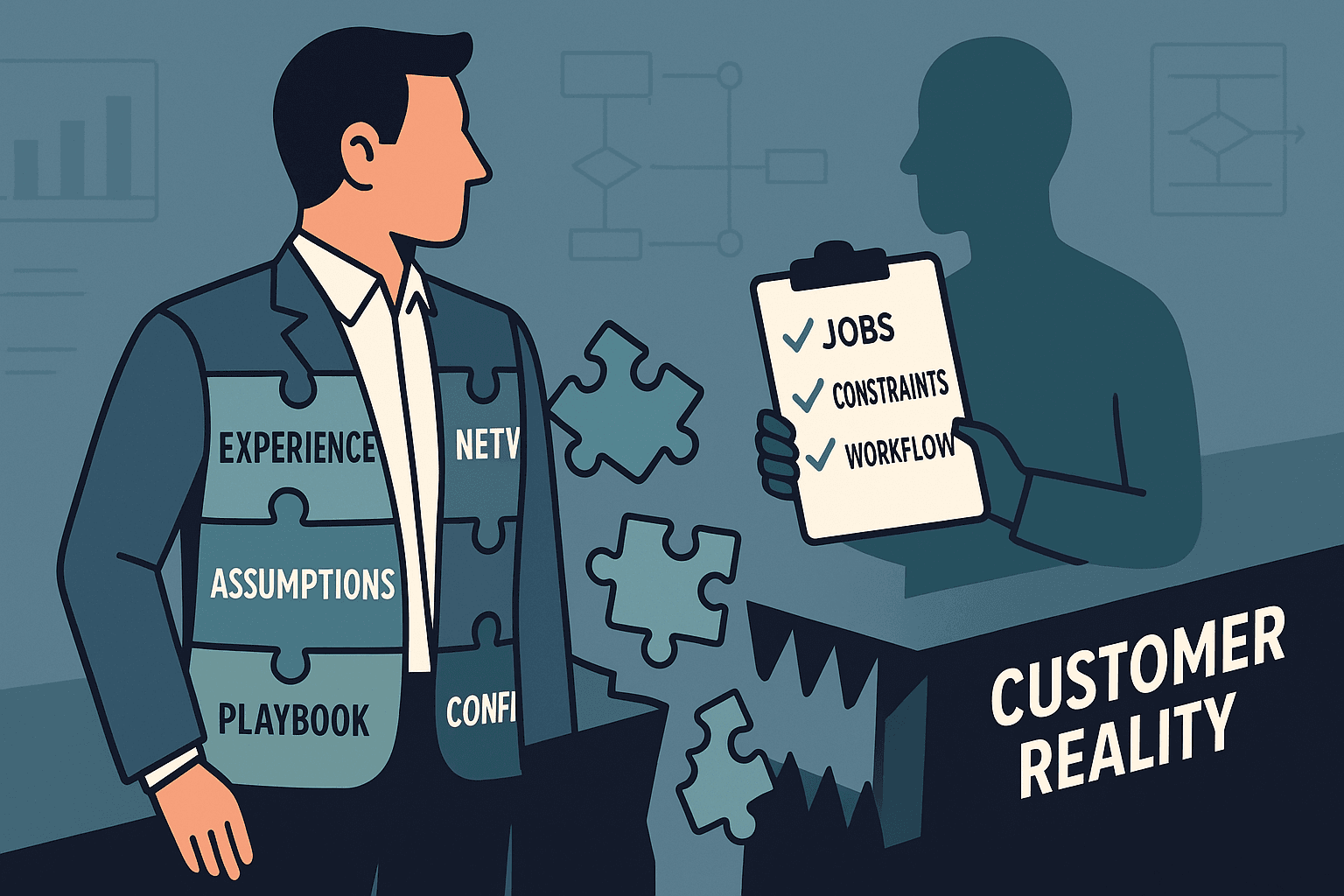
But FMF has a shadow side, especially in B2B, where markets evolve fast and where “knowing the industry” can become a reason you stop learning.
This article argues a contrarian thesis:
Founder–market fit is often a temporary advantage that quietly turns into a discovery-killing liability.
Not because experience is bad, but because experience is sticky. It anchors you to legacy workflows, yesterday’s constraints, and status-quo mental models. When that happens, your “fit” becomes a trap.
You’ll learn how the FMF trap happens, what it looks like in product planning and go-to-market, and how to run a practical audit to test whether your background is helping, or blocking, real customer discovery.
What founder–market fit actually means (and what people pretend it means)
A useful definition:
Founder–market fit is when a founder’s capabilities and context materially increase the odds of correctly identifying a valuable problem, building a differentiated solution, and distributing it.
That breaks down into four components:
- Problem intimacy (you’ve experienced the pain repeatedly)
- Domain fluency (you understand workflows, constraints, stakeholders)
- Credibility and trust (buyers believe you’ll deliver)
- Distribution leverage (access to customers, partners, talent)
The distorted version is something like:
- “I worked in this industry for 10 years, therefore I know what customers need.”
- “I ran this function at Company X, therefore I know the best practices.”
- “I already know the buyer, therefore discovery is optional.”
That’s not FMF; that’s a shortcut narrative.
And shortcuts are exactly what early-stage startups can’t afford when the job is not execution, it’s truth-seeking.
The FMF trap: when your background becomes your biggest source of bias
The core failure mode is simple:
You confuse familiarity with accuracy.
Your experience provides a set of compressed beliefs:
- how work “normally” gets done
- which stakeholders matter
- what budgets look like
- what objections mean
- what people will or won’t change
Those beliefs were often correct in your old context, a specific company, time period, regulatory climate, tooling stack, and economic environment.
But startups don’t win by reenacting the past. They win by exploiting discontinuities: new tooling, changed incentives, new constraints, new distribution, new compliance regimes, new buyer behavior.
FMF becomes a trap when it:
- pre-loads your roadmap before you’ve learned what actually changed
- narrows your customer discovery to people who look like your former self
- locks your positioning into legacy language that no longer maps to buyer intent
- causes overconfidence in what you think is “obviously needed”
The cognitive mechanisms behind the trap
This is not just motivational talk; it maps cleanly to well-studied biases:
- Confirmation bias: You overweight signals that support your existing belief (Nickerson, 1998).
- Authority bias: Your own expertise becomes “authority,” and you discount contradictory evidence.
- Availability heuristic: The most memorable incidents from your career become your default priors (Tversky & Kahneman, 1973).
- Survivorship bias: You copy what worked in your previous environment without seeing what failed elsewhere.
- Overconfidence effect: Experts can be more confident and still wrong outside their domain specifics (see the broader literature in behavioral decision-making).
In B2B startups, these biases show up as product decisions disguised as “industry best practice.”
How the FMF trap kills startups (in real operating terms)
FMF doesn’t usually kill a startup with one catastrophic mistake. It kills it with a series of reasonable decisions based on stale assumptions.
1) You build “the system you wish you had” instead of the system customers will adopt
Founders with deep domain experience often build an internally elegant product that matches their ideal workflow.
But customers don’t buy elegance; they buy outcomes with low switching costs.
If your product requires:
- re-platforming
- role redesign
- new approvals
- net-new process
- heavy integrations
…then you’re selling organizational change. That can work, but you need to price, package, and sell like a change-management product, not like a simple SaaS tool.
This mismatch is a common FMF failure: you assume adoption because you would adopt it.
Reference points:
- Geoffrey Moore’s adoption framing and “whole product” concept remains relevant for understanding why good tech fails without surrounding change enablers (Crossing the Chasm).
- The “switching costs” and “complements” literature in economics and strategy explain why better products can lose to incumbent ecosystems.
2) You over-index on feature completeness and under-index on willingness to pay
Experienced founders know the edge cases. They’ve lived the exceptions. They can envision the “enterprise-grade” version from day one.
So they build it.
The trap: the early market may not pay for that completeness, or may not value it as much as speed, integration simplicity, auditability, or risk reduction.
This is essentially a version of the “build trap” that product leaders warn about: shipping features without validating value (see: Melissa Perri, Escaping the Build Trap).
3) You pick the wrong ICP because it matches your resume
A subtle FMF failure:
- You sell to the company size you used to work at.
- You target the buyer persona you used to sit next to.
- You assume the stack you know is “standard.”
But the highest-leverage wedge often lives elsewhere:
- smaller teams with higher urgency
- regulated segments with clear budget ownership
- a different buyer with direct ROI accountability
In other words: your “natural” ICP might be the hardest place to start.
4) Your discovery interviews become performance instead of learning
Founders with domain authority often lead interviews like this:
- “Don’t you hate when X happens?”
- “Wouldn’t it be great if Y?”
- “In my experience, the biggest problem is Z, do you agree?”
This is not discovery. It’s coaching the witness.
The classic customer development advice (Steve Blank) and Lean Startup experimentation principles (Eric Ries) push the opposite:
- ask about specific recent events
- measure frequency and severity
- map current alternatives
- test willingness to pay with concrete trade-offs
Expertise makes you speak more. Discovery requires you to talk less.
5) You confuse “pain” with “priority”
A problem can be painful and still not get budget.
Founders from the domain often remember pain vividly, so they assume it’s a top buying priority.
But buying priority is shaped by:
- who owns the budget
- timing (renewals, audits, outages)
- executive narratives (AI, security, cost reduction)
- internal political capital
- risk posture
A seasoned founder should be better at this, yet FMF sometimes causes a false certainty that “pain = purchase.”
6) You get trapped in legacy language and miss the new category
Markets shift, and language shifts with them.
If you describe your product using “how we used to talk about it,” you can miss:
- new buyer search terms
- new category boundaries
- new evaluation criteria
This matters for SEO, outbound, and partnerships. Positioning is not just storytelling; it’s market interface.
April Dunford’s positioning framework is useful here: you must identify the real alternatives and the differentiated value in the customer’s current context, not your past one.
When founder–market fit is most dangerous
FMF becomes most dangerous in conditions that make your prior experience least transferable.
1) The market is in the middle of a platform shift
Examples (recent years):
- cloud migration and the decline of on-prem assumptions
- API-first workflows replacing manual ops
- LLM-enabled automation changing cost curves and product expectations
- security and compliance regimes shifting buyer checklists
If you built your worldview in the “before,” you may overfit to old constraints.
2) Your prior company was unusually mature (or unusually broken)
If you come from a company with:
- exceptional talent density
- world-class ops
- unusually high budgets
- bespoke internal tools
…you may misread what normal teams can adopt.
Conversely, if your prior company was chaotic, you may assume chaos is universal and build heavy governance features that smaller teams reject.
3) You were a power user, not a buyer
A lot of B2B founders were operators in the function, not the economic buyer.
You understand the workflow, but not:
- budget ownership
- procurement gates
- security reviews
- ROI narratives
This creates a product that users love and buyers don’t fund.
4) You have a strong network, and it lies to you
Networks are helpful for access, but they can distort truth.
- People are polite.
- Friends want to encourage you.
- Early conversations skew toward innovators, not mainstream buyers.
You can get “validation” that doesn’t translate to a scalable sales motion.
Counterpoint: when FMF is legitimately decisive
The trap narrative shouldn’t swing into the opposite extreme (“experience is bad”). Many categories reward deep context.
FMF is decisive when:
- The domain has hard tacit knowledge. Example: healthcare billing, supply chain compliance, security operations. Tacit knowledge reduces fatal mistakes.
- Sales requires credibility. Regulated industries and risk-heavy buyers often require trust.
- The wedge is a workflow insight. If you’ve lived the workflow daily, you can identify a wedge others miss.
- Distribution is concentrated. Networks can accelerate early traction in tightly knit industries.
The right conclusion is not “ignore FMF.” It’s:
Treat FMF as a hypothesis about advantage, not a substitute for discovery.
Symptoms: how to tell if your experience is quietly blocking you
Here are high-signal indicators you’re in the FMF trap.
Product symptoms
- Your roadmap is suspiciously similar to tools you used before.
- You’re building “enterprise features” pre-revenue.
- You keep saying: “In this industry, they always…”
- You can’t clearly articulate the cheapest, narrowest wedge that still delivers value.
- Your MVP requires 5 integrations “to be usable.”
GTM symptoms
- Your ICP is “companies like my last employer.”
- You rely on warm intros but cold outbound doesn’t work.
- Your messaging is heavy on features, light on measurable outcomes.
- Sales cycles are long and stall at security/procurement.
- You get lots of interest, few conversions.
Discovery symptoms
- You do fewer than ~10 high-quality customer conversations per month.
- You talk more than the customer.
- You interpret objections as “they don’t get it” instead of signal.
- You avoid segments that contradict your beliefs.
Team symptoms
- Early hires are mostly “people like us” from the same industry/company.
- Dissent is low; everyone agrees too quickly.
The Founder–Market Fit Trap Audit (practical and blunt)
Use this audit quarterly (or anytime you feel stuck). Score each question 0–2:
- 0 = no / rarely true
- 1 = sometimes
- 2 = yes / often true
Add up the totals and follow the interpretation.
A) Belief freshness (max 10)
- In the last 30 days, I changed my mind about a core customer assumption based on evidence.
- I can name 3 ways the market has changed since I last worked in it (tooling, budgets, regulations, buyer incentives).
- I can clearly explain what we believe that competitors don’t, and what evidence supports it.
- I can name 3 credible alternative explanations for why customers aren’t buying.
- Our strategy explicitly distinguishes between what we know vs what we assume.
B) Discovery integrity (max 12)
- We do at least 8–12 structured customer conversations per month (not friends, not investor intros only).
- In discovery, we ask about specific recent incidents (last 30–90 days), not hypotheticals.
- We measure problem frequency, severity, and current workaround cost.
- We routinely test willingness to pay using trade-offs (budget ranges, replacement vs add-on, procurement constraints).
- We intentionally seek disconfirming interviews (people who rejected us, churned, or chose a competitor).
- We record, transcribe, and tag interviews; we don’t rely on memory.
C) ICP reality (max 10)
- Our ICP is defined by conditions (triggers, constraints, stack, maturity), not just firmographics.
- We have at least one segment where sales cycles are consistently shorter.
- We know who the economic buyer is and what budget it comes from.
- We can describe the “day-1 value” that does not require organizational change.
- We can name the top 3 reasons we lose deals, and they’re not vague (“timing,” “budget”).
D) Build vs validate balance (max 10)
- For the last 6 weeks, we shipped more experiments/learning loops than major features.
- Every major roadmap item has a validation artifact (interview evidence, pilot commitments, LOIs, pre-sales).
- We actively kill features/ideas (documented) when evidence is weak.
- We can deliver value with minimal integrations; deeper integrations are a scale step, not a prerequisite.
E) Ego and incentives (max 8)
- I feel comfortable saying “I don’t know” to customers and my team.
- I can name a respected person in the industry who disagrees with me, and I’ve explored their argument.
- My identity is not overly tied to being “the expert.”
- We track leading indicators of truth (activation, retention, conversion), not just vanity metrics (meetings, signups).
Interpretation
- 0–18: High risk FMF trap. Your experience is likely substituting for discovery.
- 19–32: Moderate risk. You have some learning loops but may be selectively validating.
- 33–50: Healthy. FMF is probably an advantage, not a blocker.
What to do if you score low:
- Pick the lowest-scoring section and run a 2-week sprint to improve it.
- Don’t “fix” everything. Fix the bottleneck.
How to escape the trap without throwing away your edge
The goal isn’t to become inexperienced. The goal is to make your experience legible, testable, and updateable.
1) Write down your “industry truths” and mark them as assumptions
If you can’t write it, you can’t test it.
Create a simple table:
| Belief | Source (where did I learn this?) | Confidence | How to test in 14 days |
|---|
This forces you to confront outdated priors.
2) Red-team your strategy with someone who has different experience
Not another person from your exact background.
Look for:
- someone in the same industry but different segment
- someone who sells to your buyer but in a different category
- a skeptic who has no reason to be polite
Run a structured critique:
- What would have to be true for this to work?
- What assumptions are most likely outdated?
- What is the simplest wedge we’re ignoring?
3) Rebuild your discovery motion around “last time” questions
Avoid “Would you use…” questions. Prefer:
- “Walk me through the last time this happened.”
- “What did you do instead?”
- “Who was involved?”
- “What did it cost (time, risk, money)?”
- “What else did you consider?”
This aligns with robust qualitative interviewing practice and reduces hypothetical bias.
4) Force willingness-to-pay tests earlier than you want
Technical founders (especially with FMF) often delay pricing.
Don’t.
You don’t need perfect pricing, but you need price discovery. Techniques:
- offer 2–3 packaging tiers and ask which they’d choose
- ask what budget line it comes from
- propose a paid pilot with clear success criteria
The goal is not extraction; it’s truth.
5) Replace “best practices” with “current constraints” in product planning
Best practices are often aspirational.
Constraints are real:
- data quality
- permissions
- security reviews
- integration budgets
- change-management bandwidth
Build for constraints first, then expand.
6) Build the smallest product that can survive in the customer’s ecosystem
In B2B, the product is never just the app.
It’s also:
- security posture
- onboarding
- integrations
- admin model
- audit logs
- support
The FMF trap is building a huge product. The escape is building a survivable wedge.
A wedge is survivable when:
- it provides value in <14 days
- it reduces risk or effort immediately
- it doesn’t require permission from 5 stakeholders
7) Treat your network as a distribution channel, not a validation engine
Use warm intros to:
- accelerate pilots
- get fast feedback loops
- recruit design partners
But validate with:
- cold outbound performance
- conversion metrics
- retention/usage
- expansion behavior
If your startup only works with warm intros, it may not be a company, it may be a consulting practice with software.
A practical 30-day reset plan (for technical B2B founders)
If you suspect your background is driving you into stale assumptions, run this plan.
Week 1: Evidence inventory
- List top 10 roadmap items.
- For each item, link to evidence: transcripts, quotes, pilot requests, churn notes.
- Mark items with no direct evidence.
Deliverable: a one-page “evidence map.”
Week 2: Disconfirming discovery
- Interview 10 people who are not in your immediate network.
- Include at least 3 who rejected you or chose alternatives.
- Use a strict script focused on last-time events and alternatives.
Deliverable: tagged transcript highlights + a summary of contradictions.
Week 3: ICP and wedge rewrite
- Define 2–3 ICP candidates by constraints and triggers.
- For each, write:
- trigger event
- buyer + budget source
- must-have integrations
- adoption blockers
- day-1 value
Deliverable: updated ICP doc + a single chosen wedge.
Week 4: Monetization and pilot conversion
- Offer a paid pilot to 5 prospects in the chosen ICP.
- Make it concrete: 30 days, success criteria, price.
- Measure conversion and objections.
Deliverable: pilot conversion rate + top objections ranked.
If you can’t convert any paid pilots after credible discovery, you don’t have a product problem, you have a value hypothesis problem.
The real point: experience should make you faster at learning, not slower
The best founders with strong FMF use their background like a high-quality set of priors, then update aggressively.
The worst founders use their background like a shield:
- against uncertainty
- against disconfirming evidence
- against the discomfort of beginner-mode learning
Markets change. Buyers change. Tooling changes. Your job is not to be right because you were there before.
Your job is to be right now.
If you want a simple operating principle:
Founder–market fit earns you the right to test better hypotheses, not the right to skip testing.
References and further reading
- Blank, Steve. The Four Steps to the Epiphany (customer development and discovery discipline).
- Ries, Eric. The Lean Startup (build–measure–learn loops and hypothesis-driven execution).
- Perri, Melissa. Escaping the Build Trap (product outcomes over feature output).
- Dunford, April. Obviously Awesome (positioning, alternatives framing).
- Moore, Geoffrey. Crossing the Chasm (adoption dynamics and “whole product”).
- Nickerson, R. S. (1998). “Confirmation bias: A ubiquitous phenomenon in many guises.” Review of General Psychology.
- Tversky, A., & Kahneman, D. (1973). “Availability: A heuristic for judging frequency and probability.” Cognitive Psychology.
- Shane, S. (2000). “Prior knowledge and the discovery of entrepreneurial opportunities.” Organization Science.
- Baron, R. A. (2006). “Opportunity recognition as pattern recognition.” Academy of Management Perspectives.
- Gompers, P., Kovner, A., Lerner, J., & Scharfstein, D. (2010). “Performance persistence in entrepreneurship.” (Work on experience and outcomes; see related NBER/academic publications).