
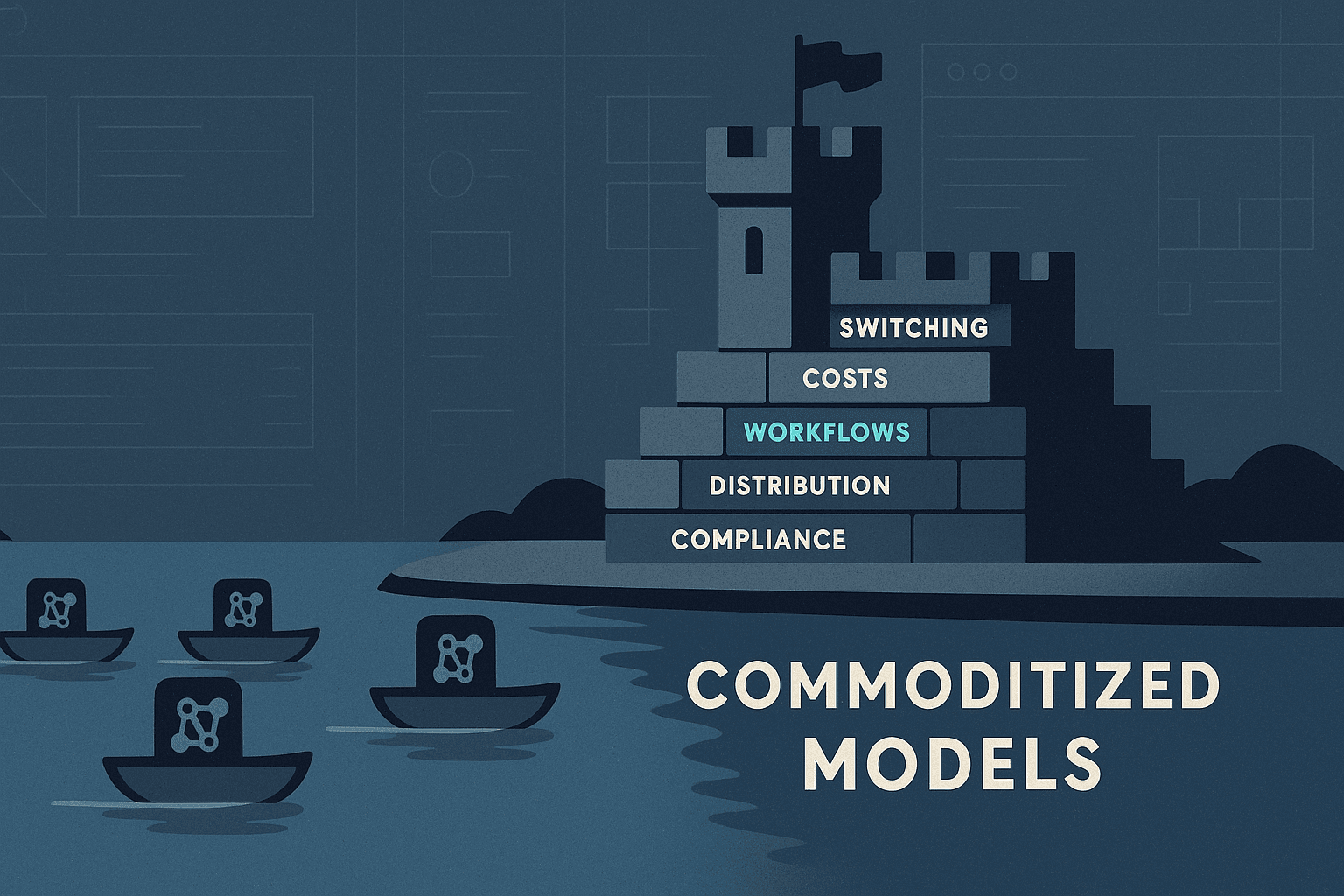
The uncomfortable truth: most “AI moats” are a demo, not a defensibility strategy
If your company’s core claim to defensibility is “we use GPT-4/Claude/Gemini plus some prompts,” you don’t have a moat, you have feature parity with a timer on it.
This isn’t a hot take anymore; it’s a pattern:
- Frontier models are broadly available via API, and capabilities diffuse quickly.
- Model performance is converging on many tasks, especially the ones that look good in demos.
- Switching LLM providers is getting easier (abstraction layers, router frameworks, standardized prompt formats).
- Competitors can copy UX patterns fast, especially in B2B where the UI surface is often forms + tables + chat.
The result: AI features (summarize, draft, classify, extract, chat-with-X) are increasingly table stakes rather than defensible advantage.
Yet, plenty of startups still pitch an “AI moat.” It often sounds like:
- “We fine-tuned our model.”
- “We have proprietary prompts.”
- “We built an agent.”
- “We use RAG over customer data.”
These can matter, but they rarely hold up as a moat unless they’re tied to assets that accumulate and compound over time.
This article is about what actually compounds.
We’ll argue that durable defensibility in AI products mostly comes from:
- Proprietary workflows (deeply embedded in how work gets done)
- Data capture loops (data that is unique, improving, and hard to recreate)
- Distribution (channels and trust that competitors can’t instantly buy)
- Compliance and risk posture (security, governance, auditability as a wedge)
- Switching costs and operational lock-in (integration depth, process change, and institutional knowledge)
And we’ll end with a practical checklist early-stage teams can use to evaluate whether they’re building a real moat, or just shipping an AI feature.
Why “we use the best model” is not a moat
1) Model access is increasingly non-exclusive
With rare exceptions (some enterprise partnerships, on-prem deployments, or strategic distribution deals), most teams buy intelligence the same way they buy cloud compute.
Even if you have early access today, it’s usually not defensible:
- Alpha/beta access becomes general availability.
- Competitors can route to a near-equivalent model.
- Open-source improves and closes gaps (sometimes fast, sometimes slower depending on domain).
Reference: This mirrors the historical diffusion of core infrastructure advantages: cloud hosting, payments APIs, maps, OCR, and speech-to-text all became commoditized over time. Classic strategy framing applies: if suppliers are plentiful and offerings are substitutable, the supplier input is unlikely to be your moat (see Porter’s Five Forces for the general structure).
2) Prompts aren’t proprietary for long
Prompt engineering can produce meaningful performance gains, but it’s fragile as defensibility.
- Many “breakthrough” prompts are rediscovered independently.
- Prompt patterns are widely shared.
- Competitors can distill your behavior via output observation.
Prompts are best treated as implementation detail, not strategic positioning.
3) Fine-tuning is real, but not automatically defensible
Fine-tuning can help when you have:
- A stable task with clear labels (classification, extraction)
- A consistent domain language (legal, medical coding, support taxonomy)
- Enough high-quality data
But fine-tuning by itself isn’t a moat because:
- Others can fine-tune too.
- The base model improves, shrinking your delta.
- The hardest part is often not model weights, it’s data quality, task definition, evaluation, and integration into workflows.
4) “Agents” are not a moat; operational reliability might be
Autonomous or semi-autonomous agents look impressive, but competitors can build agents using the same tooling.
The moat is not “agent-ness.” The moat is:
- Reliability (measured, monitored, bounded)
- Domain-specific toolchains (actions that actually work end-to-end)
- Human-in-the-loop control that matches business risk
- Governance for why something happened
Most of that is product + systems + process, not just “AI.”
Reference: In software history, the defensible advantage is typically in the system around the algorithm, data pipelines, QA, monitoring, deployment, UX, and distribution, more than in the algorithm itself.
What a real AI moat looks like: assets that accumulate
If you want defensibility, you need mechanisms where being in the market longer makes you harder to catch, not just more known.
A useful mental model: compounding assets.
Compounding assets tend to have at least one of these properties
- They grow with usage (the product gets better as customers use it)
- They are hard to copy quickly (time, trust, integrations, compliance)
- They create dependency (switching requires significant effort/risk)
- They are networked (value rises with more participants/data sources)
- They improve unit economics (cost advantage competitors can’t match)
Now let’s map that to the five defensibility pillars that actually work in AI.
1) Proprietary workflows: win by owning the “job,” not the model
AI features are easy; workflow ownership is hard
Many AI startups begin with an impressive capability and then hunt for a use case.
The durable companies reverse that:
- Pick a high-frequency, high-value workflow.
- Reduce cycle time, error rate, or headcount load.
- Become the place work actually happens.
If your product becomes the system of record for decisions, approvals, exceptions, and audit trails, competitors can’t beat you just by matching your model output.
Examples of workflow moats (B2B)
- Security triage: not “AI that summarizes alerts,” but end-to-end workflow for deduplication, assignment, evidence collection, remediation steps, and reporting.
- Procurement: not “draft an RFP,” but intake → vendor comparison → approvals → contract redlines → renewals.
- Customer support: not “AI replies,” but knowledge curation, macros, QA scoring, escalation logic, and feedback loops.
In each case, the moat is the process integration, not the generation step.
How to build workflow defensibility early
- Identify the irreducible steps in the workflow (what must happen for the business to accept the outcome).
- Design the AI to augment those steps, not bypass them.
- Build UI and controls that map to real roles: operator, reviewer, approver, admin.
- Make outputs actionable (create tickets, update CRM fields, trigger approvals), not just readable.
Reference: The “jobs to be done” (JTBD) framing is useful here: customers don’t buy “AI,” they buy progress in a workflow. Workflow ownership creates stickiness because it changes how people work.
2) Data capture loops: create unique data competitors can’t conjure
Not all data is moat-worthy
A common pitch is “we have proprietary data.” Often it’s one of these:
- Public data scraped at scale (copyable)
- Customer-provided documents (non-exclusive)
- Commodity labels generated by cheap labor (replicable)
Moat data is typically:
- Behavioral: derived from interactions, preferences, corrections
- Contextual: tied to a specific workflow and user intent
- Temporal: sequences over time (trends, drift, changes, outcomes)
- Feedback-labeled: especially where labels are created as a byproduct of doing work
The best data loops are “exhaust,” not “projects”
If improving the model requires a special labeling initiative, you’ll do it once, then stop.
If labels are created naturally because users correct, approve, edit, or choose between options, you get a compounding loop.
Practical examples of strong loops
- A sales enablement tool that tracks which generated messages get sent, which get replies, which lead to meetings → creates outcome labels.
- A contract review tool where lawyers accept/reject clause suggestions → creates high-signal preference data.
- A SOC triage tool where analysts mark alerts as true/false positive and link evidence → creates structured adjudication data.
Designing the loop: what to capture
Ask:
- What is the “ground truth” outcome? (closed-won, churn, incident resolved, claim paid)
- Where can we instrument decisions? (approve/reject, edit distance, time-to-resolution)
- How do we store it in a reusable schema? (events, traces, versioned artifacts)
- How do we turn it into evals? (offline benchmarks + online metrics)
This is not glamorous work, but it’s often the real differentiator.
References:
- Data network effects are discussed in strategy literature and widely referenced in tech analysis; the key nuance is that many “data network effects” are weak unless the data is unique and improves the product in a way users can feel.
- Modern AI engineering best practice emphasizes evals and feedback loops as core to reliability and iteration.
3) Distribution: the moat everyone pretends not to need
In AI, distribution often beats marginal model quality
If two tools are close in output quality, the winner is frequently the one that:
- Is already in the buyer’s workflow
- Is trusted by security/compliance
- Has brand credibility
- Has partnerships and channel leverage
- Has lower perceived risk
Model deltas are hard for buyers to evaluate, especially in early-stage categories. Distribution becomes the deciding factor.
Types of distribution advantages that compound
a) Embedded distribution (platform adjacency)
If you build where users already work, Slack, Teams, Salesforce, ServiceNow, Jira, Zendesk, you reduce adoption friction.
But beware: building on platforms can create platform risk. A distribution moat is strongest when:
- The platform is a channel, not your only home.
- You own key data and workflow objects.
- You can migrate users if platform terms change.
b) Trust distribution (brand + proof)
In B2B, trust is distribution.
- Case studies
- Security posture
- References
- Procurement readiness
These take time. Time is defensibility.
c) Sales motion fit
A team that masters a specific sales motion, PLG, sales-led, channel-led, can outcompete technically better products.
AI adds a twist: buyers increasingly ask about hallucinations, data privacy, and auditability. If your go-to-market can answer these crisply, you win deals.
Reference: Classic startup lessons apply: distribution is not separate from product; it’s part of the product. The best “AI-first” teams design the product around a scalable acquisition and expansion path.
4) Compliance & risk posture: the moat hiding in paperwork
This is the least sexy moat, and one of the strongest in regulated or risk-sensitive categories.
Why compliance can be a real wedge
In many mid-market and enterprise contexts, the real competition is not “another startup.” It’s:
- Doing nothing
- Using Microsoft/Google/native tools
- Internal builds
If you can clear security and compliance faster than competitors, and provide credible governance, you become the default choice.
What “compliance moat” actually means
Not just a SOC 2 PDF.
It’s the ability to provide:
- Data isolation and tenancy controls
- Audit logs (who did what, when, and why)
- Model governance (versioning, evals, approvals)
- PII handling, retention, and deletion
- Access controls (RBAC, SCIM, SSO)
- Policy enforcement (what the model is allowed to do)
- Incident response maturity
Once a customer builds internal policy around your system (how they use it safely), switching becomes costly.
Regulatory tailwinds (and constraints)
Depending on geography and industry, AI governance requirements are tightening:
- EU AI Act (risk-based approach)
- Privacy regimes (GDPR, CPRA)
- Sector rules (HIPAA, FINRA/SEC guidance in financial services, etc.)
You don’t need to be a lawyer to notice the strategic point: risk management is product surface area.
Teams that treat compliance as a product feature, configurable controls, logs, and evidence, build a defensible position.
Reference: Regulators and enterprise buyers increasingly emphasize transparency, risk controls, and accountability in automated decision systems. Even when rules are evolving, procurement teams behave conservatively.
5) Switching costs: the moat built from integrations, habits, and proof
Switching costs are not just “data export is hard.” In B2B, switching costs often come from:
- Integrations (CRM, ticketing, data warehouse, IAM)
- Workflow change (training, process updates, role definitions)
- Custom configurations (rules, templates, policy settings)
- Institutional knowledge (how the org uses the tool)
- Outcome proof (historical baselines, reporting continuity)
AI can amplify switching costs if you productize learning.
The right kind of personalization
“Personalization” that lives in a user’s prompt box is not a switching cost.
Personalization that lives in:
- org-level policies
- reusable playbooks
- structured decision rules
- evaluation dashboards
- historical performance reports
…is much harder to replace.
Build switching costs without trapping users
There’s a fine line between stickiness and hostage-taking.
In 2026, buyers are sensitive to vendor lock-in. A good strategy is:
- Offer exports and transparency.
- Win by being better operationally, not by making exit impossible.
That paradoxically increases trust, and increases retention.
Counterpoint: when AI can be a moat
The thesis here is not “AI never matters.” It’s “AI features are rarely sufficient.”
There are cases where model advantage can be defensible, at least for meaningful periods:
1) You have proprietary data with exclusive rights
If your company has a contractual or structural advantage to collect unique data, e.g., exclusive partnerships, hardware deployment, or a marketplace where you own interaction data, that can be real.
2) You’re building for a domain with high labeling cost and deep expertise
In certain verticals (some medical, legal, industrial contexts), high-quality labeled data and evaluation expertise are scarce.
If you build the best dataset + eval harness + domain tooling, you may create a defensible performance and trust gap.
3) Latency, cost, or on-device constraints matter
If you deliver:
- dramatically lower inference cost,
- specialized models that run on-device,
- or performance under strict latency budgets,
…then model engineering can be a durable advantage.
4) You have distribution control over a model surface
If you’re a platform vendor (cloud, OS, major SaaS) or have privileged distribution, you can turn model access into leverage.
But note: that’s not a “founder moat.” That’s a position moat.
The practical defensibility checklist (early-stage friendly)
Use this as a blunt instrument in planning sessions, fundraising prep, and roadmap debates.
A) Workflow ownership
- Do we own a business-critical workflow end-to-end? Or are we an add-on feature?
- What happens if the LLM output becomes free inside Microsoft/Google/Salesforce? Do we still win?
- Are we the system of record for decisions/actions? (approvals, tickets, commits, payments, compliance artifacts)
- Can we quantify ROI in operational terms? (time saved, SLA improvements, fewer errors, revenue lift)
B) Data capture loop strength
- What unique data do we collect that competitors can’t easily obtain?
- Is data created as a byproduct of usage (exhaust), or does it require manual labeling projects?
- Do we capture outcomes, not just activity?
- Do we have an eval harness that turns captured data into measurable improvements?
- Is the loop fast? (days/weeks, not quarters)
C) Distribution advantage
- What is our primary acquisition channel, and why is it defensible?
- Do we have wedge integrations where users already live?
- Do we have credible trust signals? (security page, customer stories, references)
- Is the sales motion aligned with the product? (PLG vs sales-led clarity)
D) Compliance and governance
- Can we pass a security review without heroics?
- Do we have audit logs, RBAC, SSO/SCIM, data retention controls?
- Can customers control model behavior with policy (what it can/can’t do)?
- Do we support human review paths for high-risk steps?
- Can we explain outputs sufficiently for the buyer’s risk tolerance? (citations, sources, traceability)
E) Switching costs (earned, not forced)
- How many systems do we integrate with? (and are those integrations sticky?)
- Do customers configure us deeply? (playbooks, rules, templates)
- Do we provide reporting/benchmark continuity over time?
- If a customer left, what would they actually lose besides the UI?
F) Unit economics and cost leverage
AI changes cost structure. Defensibility can come from being able to serve customers profitably.
- Do we have a clear path to healthy gross margins given inference costs?
- Do we have routing/caching strategies?
- Do we know our cost per action and can we reduce it over time?
Cost advantage is under-discussed as a moat, but it matters, especially when competitors subsidize with venture money until they can’t.
A concrete playbook: turning “AI feature” into “defensible product”
If you’re building an early-stage B2B AI product, here’s a pragmatic sequence.
Step 1: Pick a narrow workflow with high pain and clear ownership
Choose something where:
- the buyer is clear,
- the outcome is measurable,
- and switching from “current state” is plausible.
Avoid generic “AI for X” platforms unless you already have distribution.
Step 2: Ship the minimum lovable workflow, not maximum model sophistication
Build the scaffolding:
- roles and permissions,
- review flows,
- integrations,
- structured outputs.
Then make AI accelerate the workflow.
Step 3: Instrument everything and start capturing training/eval data immediately
From day one:
- log prompts/inputs safely,
- store model outputs with versions,
- track user edits/approvals,
- measure outcomes.
This becomes your compounding asset.
Step 4: Build “governance UI” early
If you sell B2B, governance isn’t optional.
Even basic elements help:
- citations,
- confidence indicators,
- policy toggles,
- audit logs.
These reduce risk and increase adoption.
Step 5: Earn expansion by owning adjacent steps
Once you own one workflow wedge, expand to adjacent steps that strengthen:
- data uniqueness,
- integration depth,
- and switching costs.
This is how you turn an initial feature into a platform inside a specific domain.
What to say to investors (and what not to say)
Investors have heard “AI moat” hundreds of times. The ones paying attention now ask:
- “Why won’t incumbents copy this?”
- “What happens when models get better?”
- “Where does proprietary data come from?”
- “What makes customers stick?”
Avoid weak moat claims
- “We use the best model.”
- “We have prompts.”
- “We have an agent framework.”
Make stronger, testable claims
- “We own the workflow for X, including approvals and audit trails.”
- “Our product generates unique outcome-labeled data through daily usage.”
- “We integrate with Y and Z systems and become the operational layer.”
- “We pass security reviews faster due to built-in governance controls.”
- “Switching costs are driven by playbooks + historical benchmarks + integrations.”
These claims can be diligenced.
The bottom line
Most “Founder’s AI Moats” are wishful thinking because they confuse capability with defensibility.
Models are increasingly a commodity input. The advantage goes to teams that build compounding assets around the models:
- proprietary workflows,
- data capture loops,
- distribution,
- compliance readiness,
- and earned switching costs.
If your roadmap doesn’t explicitly strengthen at least two of those pillars every quarter, you’re likely shipping impressive demos that will be copied, and priced down, faster than you expect.
The good news: real moats are available to early-stage teams.
They just don’t look like “we have an LLM.” They look like the unsexy work of owning the workflow, instrumenting outcomes, building trust, and making the product operationally indispensable.