
The backlog is not a plan, it’s an anxiety dump
Most startup backlogs are not product strategy artifacts. They’re containers for discomfort.
They collect:
- customer requests you don’t want to disappoint
- ideas that felt smart in the moment but never earned a slot
- sales promises made in a deal cycle
- engineering “nice to haves” that signal craftsmanship
- competitive reactions (“they launched X, we need X”)
And because backlogs feel like progress (“we captured it”), they grow. Quietly. Until they become a shadow roadmap nobody believes but everyone is afraid to delete.
The irony: a large backlog doesn’t make you more prepared. It makes you less decisive. It lets you avoid tradeoffs, the one thing startups cannot afford.
This is where the contrarian move comes in.
Instead of treating the backlog as a queue of future work, treat it as a liability that accrues interest. Then manage it like a founder manages runway.
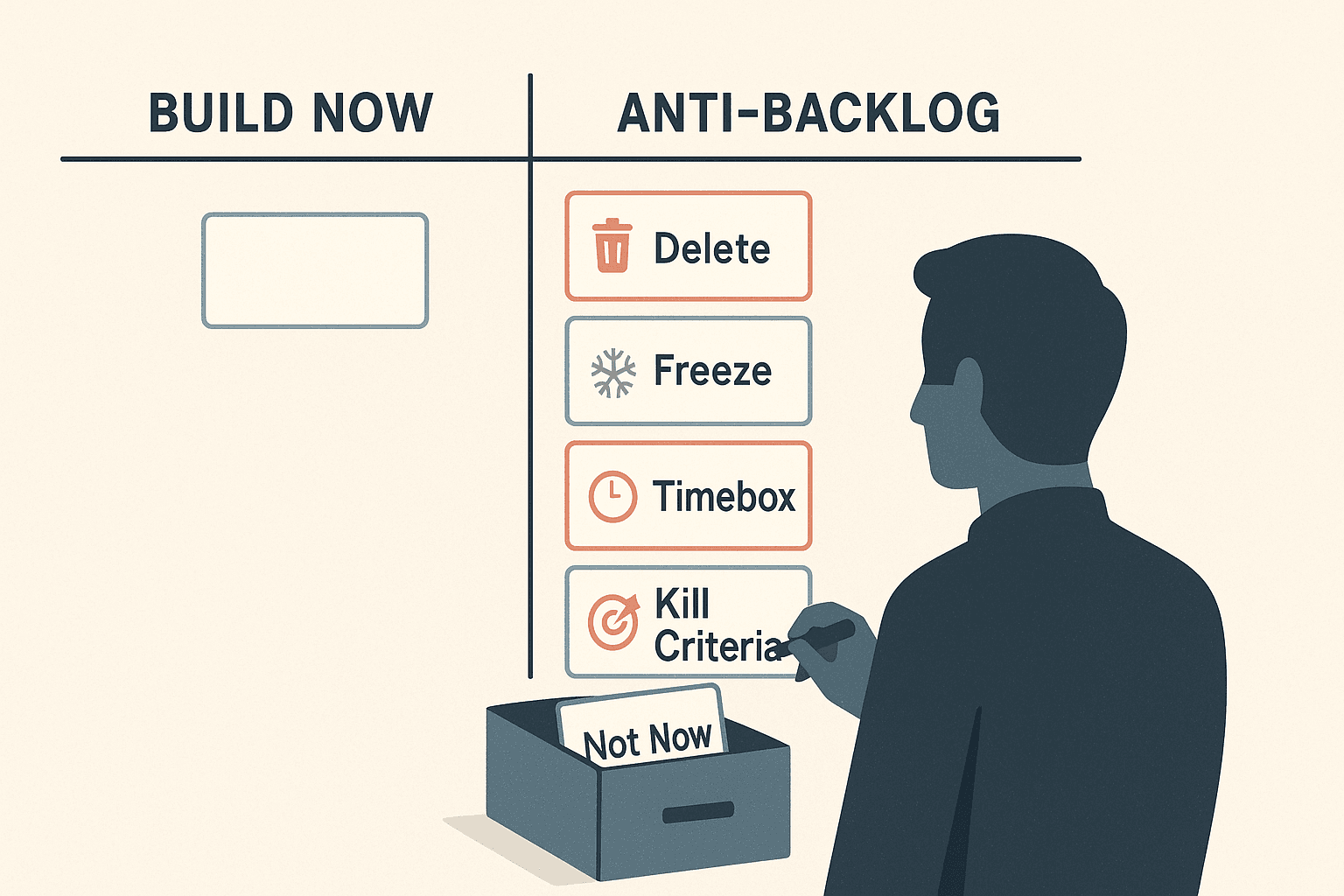
The Founder’s Anti-Backlog (definition)
An Anti-Backlog is a deliberate, visible system for:
- Deleting ideas that shouldn’t exist in your product universe.
- Freezing ideas that are plausible but not relevant for a defined window.
- Timeboxing exploration so “maybe” doesn’t become “forever.”
- Setting kill criteria so ongoing work can be stopped without blame.
- Aligning the team around what won’t be built, with the same seriousness as what will.
A normal backlog asks: What could we do next?
An anti-backlog asks: What must we refuse to do in order to win?
This is less about being negative and more about protecting momentum. Focus is not a vibe; it’s a set of constraints.
Why backlogs get toxic in B2B startups
Backlog dysfunction is universal, but B2B startups are especially vulnerable because:
- Sales cycles inject urgency. Feature requests get framed as “deal blockers.”
- Customer concentration is high. One account can distort the product.
- Integrations multiply surface area. Every “small” request is a combinatorial expansion.
- Founders are close to customers. You hear pain firsthand and want to help.
- Roadmaps become trust contracts. Once you say “it’s on the roadmap,” it’s sticky.
In B2B, the backlog becomes a customer relationship management tool, which is not its job.
If you recognize this pattern, you’re not alone. The broader product literature has long warned about feature creep and the cost of unchecked scope (see The Lean Startup by Eric Ries on validated learning loops, and Escaping the Build Trap by Melissa Perri on product teams shipping output without outcomes). The anti-backlog is a concrete operational antidote.
The core principle: runway is burned by indecision, not just by building
Founders usually account for runway in dollars and headcount. But runway is also burned by:
- context switching
- partially-built features
- never-finished integrations
- “just in case” platform work
- long-lived branches and stalled PRs
- meetings to re-litigate old decisions
The anti-backlog attacks these indirect costs.
A good heuristic: If an item consumes recurring attention, it is already costing you. Even if you never build it.
Anti-backlog architecture (the four bins)
Implement the anti-backlog as a set of explicit states. The point is not tooling, it’s governance.
1) Delete (hard no)
Deleted items are not “rejected.” They are resolved.
Deletion criteria (strong signals):
- Not on the critical path to your next revenue milestone.
- Misaligned with ICP (Ideal Customer Profile). You’re solving for a segment you don’t want.
- Creates ongoing support burden disproportionate to upside.
- Requires a new competency (e.g., security posture, data compliance, real-time infra) you cannot staff.
- Adds permanent complexity (new permission models, new billing dimensions, custom workflows).
Deletion is not cruelty; it’s honesty. A dead idea can’t drain you later.
Founder script:
“We’re not building that because it pulls us away from [ICP + core job-to-be-done]. If that becomes strategic later, we’ll revisit, but it’s a no for this company right now.”
2) Freeze (not now, and we mean it)
Freezing is underrated. Most teams only have “backlog” and “in progress.” Freeze creates a middle state that prevents constant resurfacing.
Freeze rules:
- Frozen items have a review date (e.g., quarterly).
- Frozen items cannot be referenced in sales as roadmap commitments.
- Frozen items should have a one-paragraph rationale attached.
Freezing works best when it’s time-bound: “Frozen until we reach $X MRR” or “Frozen until we complete onboarding v2.”
3) Timebox (explore without marrying)
A timebox is a controlled way to learn without allowing the work to sprawl.
Examples:
- 2 days: customer interviews + prototype
- 1 week: technical spike to validate feasibility
- 2 weeks: design sprint + pricing implications
Timeboxing forces you to answer: What would we need to believe for this to be worth building?
This aligns with the “test assumptions early” theme of Lean approaches, but with an explicit cap to prevent exploration becoming a permanent side quest.
4) Kill criteria (stop work without drama)
Kill criteria are pre-agreed conditions that, if met, terminate an initiative.
This is the founder’s equivalent of a stop-loss order.
Kill criteria are useful because sunk-cost bias is real, especially in technical teams where craft and pride run deep.
Examples of kill criteria:
- Adoption: “If fewer than 20% of activated accounts use this weekly within 30 days, we stop iterating.”
- Revenue impact: “If it doesn’t improve conversion by 10% in the onboarding funnel, we revert.”
- Performance: “If p95 latency increases by >15% in production, we roll back.”
- Sales utility: “If it’s not mentioned in 30% of late-stage deals within 60 days, it’s not strategic.”
- Support cost: “If tickets per account increase after launch, we halt expansion and simplify.”
Kill criteria can feel harsh, but they are actually protective. They create psychological safety: teams can commit fully because stopping is not a failure, it’s part of the agreement.
The anti-backlog meeting cadence (lightweight governance)
You don’t need more meetings. You need one decision loop that prevents backlog entropy.
Weekly: The “No Review” (15–30 minutes)
Agenda:
- New requests since last week (from sales, CS, founders, support)
- Quick classification: Delete / Freeze / Timebox / Candidate for roadmap
- Assign owner and next action (if any)
Rule: If it’s not assigned a state, it doesn’t exist.
Monthly: The “Kill Criteria Check” (30–45 minutes)
Agenda:
- Review active initiatives
- For each: are we on track to meet success metrics?
- Are any kill criteria triggered?
Rule: If success metrics aren’t measurable, the work is exploratory and must be timeboxed.
Quarterly: Anti-backlog audit (60 minutes)
Agenda:
- Frozen items: thaw or delete?
- Deleted items: any that are now strategic due to ICP shift?
- Roadmap drift: are you still building the company you intended?
How to define “kill criteria” that actually work
Most teams fail here by choosing criteria that are either too vague (“users love it”) or too rigid (“must hit 50% adoption in a week”).
A practical framework:
1) Choose the primary outcome metric (one)
Pick the metric that represents the reason this exists:
- activation rate
- retention
- expansion revenue
- sales cycle length
- number of integrations enabled
- support ticket volume
2) Choose a measurement window
Examples:
- 14 days post-launch for onboarding improvements
- 60–90 days for mid-funnel B2B features
- 1–2 quarters for platform work (but then it must be a strategic bet)
3) Define the “minimum viable win”
Not a dream outcome; the smallest result that justifies continued investment.
4) Define rollback or containment
If the criteria fails, what happens?
- revert behind a flag
- keep for a subset of accounts
- stop iterating and document
- remove UI entry points
Kill criteria without rollback options turn into arguments. Kill criteria with a path to unwind become executable.
The hidden backlog: promises, Slack, and “we should”
Even if your Jira backlog is clean, you can still be drowning in a social backlog:
- “Can we just add…” messages in Slack
- sales calls where founders say “We can do that.”
- customer success decks that imply future capabilities
- internal assumptions that a feature is “coming soon”
The anti-backlog must include a policy for promises.
A simple policy: the Roadmap Commitment Ladder
Use explicit language levels:
- Exploring – “We’re learning about this problem.”
- Considering – “We may build it, but no timeline.”
- Planned – “We intend to build it this quarter (still subject to change).”
- Committed – “We will deliver by X date; we staffed it.”
Only level 4 should be used in customer-facing commitments.
This is consistent with good product communication practice: separate discovery from delivery so the business doesn’t confuse curiosity with obligation.
Saying “no” without killing momentum (language that keeps trust)
Founders often avoid “no” because it feels like losing energy. But unclear yeses kill more momentum than clean noes.
Here are templates that preserve relationships:
No, because it’s not our ICP
“That’s a real problem, but we’re focused on teams who [ICP]. Building for this use case would push us into a different product category.”
Not now, because we’re protecting a milestone
“We’re freezing requests like this until we finish [milestone]. If it’s still urgent then, we’ll reassess with fresh data.”
Yes to the problem, no to the solution
“I agree the workflow is painful. I don’t think adding a new settings layer is the right fix. Let’s test a lighter approach first.”
Conditional yes (with kill criteria)
“We’ll try this behind a feature flag for 30 days. If adoption doesn’t hit [threshold], we’ll stop investing.”
No, but here’s an alternative
“We won’t build that integration. But we can support it via webhook + Zapier, and we’ll document the pattern.”
The last one matters in B2B: refusing to build doesn’t mean refusing to help. Often the correct move is enabling a workaround that doesn’t permanently expand your product surface area.
The anti-backlog as a product strategy tool (not just triage)
A backlog is reactive. An anti-backlog can be strategic.
When you delete and freeze systematically, patterns emerge:
- which customer segments keep asking for things you don’t want to become
- which parts of the product generate complexity pressure
- where your architecture is brittle
- which competitors you’re reflexively reacting to
This becomes a mirror.
If you repeatedly freeze requests around, say, permissions, analytics, or enterprise security, that’s not random. It’s a signal about what market tier you’re drifting toward, and whether you’re equipped to serve it.
How to align engineering, product, and go-to-market around “won’t build”
Misalignment usually looks like this:
- Engineering thinks product is chaotic.
- Product thinks engineering is slow.
- Sales thinks no one cares about revenue.
The anti-backlog is a shared agreement that creates a common language.
Create a “Won’t Build” page (public internally)
A living doc with:
- list of explicitly refused features/categories
- rationale (1–3 bullets)
- alternatives/workarounds
- review cadence
Examples of categories:
- “On-prem deployments (until $XM ARR)”
- “Custom per-customer workflows”
- “Full BI suite”
- “Native mobile apps”
This is not a manifesto; it’s an operational boundary.
Tie it to positioning
If your marketing says “simple,” your product cannot become infinitely configurable.
If your positioning is “enterprise-grade,” refusing compliance work will cause trust issues.
Your anti-backlog should match your wedge.
Classic positioning literature (e.g., Obviously Awesome by April Dunford) emphasizes making deliberate tradeoffs so customers can understand you. The anti-backlog is where those tradeoffs become enforceable.
Make sales part of the decision loop
If sales is excluded, they’ll create their own roadmap.
Include sales leadership in the weekly No Review. The goal isn’t to let sales dictate priorities, it’s to make sure refusals are:
- communicated consistently
- backed by rationale
- paired with viable alternatives
The “Backlog Interest Rate”: a founder metric
Here’s a practical founder-level concept:
Backlog Interest Rate = the rate at which unbuilt work generates recurring cost.
Signs your backlog interest rate is high:
- the same items resurface every week
- your team spends more time debating than shipping
- you have many half-started initiatives
- support and success keep asking “when will this be done?”
- sales uses roadmap as a closing tool
How to reduce it:
- delete more aggressively
- freeze with dates
- convert debates into timeboxed experiments
- add kill criteria to anything taking >2 weeks
This isn’t a perfect quantitative metric, but it’s a useful lens: if a request keeps charging interest, refinance it (timebox) or write it off (delete).
When not to use the anti-backlog (counterpoints)
Ruthlessness is not always correct. There are situations where a traditional backlog (or heavier planning) is appropriate.
1) Regulated or safety-critical domains
If you’re building in healthcare, fintech infrastructure, aerospace, etc., some work cannot be casually timeboxed or deleted because compliance and risk management require traceability and longer planning horizons.
In these environments, you still need “won’t build” boundaries, but governance may need to be more formal.
2) Platform teams with many internal customers
If you’re a platform team supporting multiple product teams, a backlog can be a legitimate intake mechanism. Even then, the anti-backlog is valuable as a triage overlay: what requests will you explicitly refuse because they create long-term platform complexity?
3) Mature product lines with contractual obligations
If enterprise contracts require specific deliverables, you can’t delete commitments without legal and relationship consequences. Here the anti-backlog should apply before commitments are made, via a sales/solutioning gate.
The framework is not an excuse to be flaky; it’s a way to avoid accidental obligations.
A step-by-step implementation guide (you can do this this week)
Step 1: Declare backlog bankruptcy (1 hour)
Take your current backlog and ask:
- What is older than 90 days?
- What has no clear customer or metric attached?
- What would we not build even if we had infinite time?
Delete aggressively. Archive is fine, but remove it from the active system.
Rule: If no one is willing to champion it with a measurable reason, it doesn’t get to live.
Step 2: Create the four bins (30 minutes)
In your tool of choice (Linear/Jira/Notion), create views:
- Delete (Archive)
- Freeze (with review date)
- Timebox (with owner + deadline)
- Active Bets (with kill criteria)
Step 3: Require a “Why now?” field (immediately)
Every new request must include:
- ICP impacted
- expected outcome metric
- “why now” (what changes if we delay?)
- cheapest alternative/workaround
This single change reduces low-signal intake.
Step 4: Add kill criteria to anything bigger than a sprint (ongoing)
If it’s going to take real time, it deserves an exit plan.
Step 5: Publish “Won’t Build” and enforce sales language (this month)
Make it visible. Repeat it. Correct violations quickly.
In early-stage startups, consistency is leverage.
Examples of anti-backlog decisions (realistic scenarios)
Scenario A: “We need custom roles per customer”
- Temptation: enterprise readiness, deals
- Anti-backlog move: Freeze
- Rationale: roles/permissions create permanent complexity and testing matrix
- Timebox: 1-week spike to estimate the true surface area (UI + API + audit logs)
- Kill criteria for any implementation: if fewer than X accounts enable it within 60 days, stop expanding the model
Outcome: you avoid half-building an RBAC system that becomes a forever project.
Scenario B: “Build native Salesforce integration”
- Temptation: common B2B demand
- Anti-backlog move: Timebox first
- Timebox deliverable: validated mapping of objects, auth model, data sync direction, failure modes
- Alternative: webhook + Zapier + documented recipe
- Kill criteria: if integration doesn’t reduce churn in CRM-heavy segment or unlock pipeline, keep it as partner-led
Outcome: you learn whether it’s truly strategic or just conventional.
Scenario C: “Competitor added AI summarization; we need it”
- Temptation: FOMO, marketing pressure
- Anti-backlog move: Delete (sometimes)
- Rationale: if it doesn’t attach to core workflow or measurable retention, it’s a distraction
- Exception: timebox a prototype if it directly reduces time-to-value
Outcome: you avoid shipping a gimmick that adds infra and support burden.
The deeper point: focus is a product feature
In startups, focus isn’t just internal discipline. It becomes visible in the product:
- fewer settings
- clearer workflows
- faster onboarding
- more coherent messaging
- less brittle code
Customers can feel when a product is designed vs accumulated.
An anti-backlog is how you prevent accumulation.
A compact founder checklist
Use this to make decisions quickly:
- Does this move our ICP’s core job forward? If not, delete.
- Is there a cheaper workaround? If yes, prefer it.
- Will this add permanent complexity (permissions, billing, config, integrations)? If yes, require a higher bar.
- What must be true for this to be worth it? Timebox to validate.
- What will cause us to stop? Write kill criteria before writing code.
- Can we explain the no in one paragraph? If not, you haven’t decided.
Closing: the anti-backlog is how you stay a startup
A startup’s advantage is not that it can build anything.
It’s that it can choose.
The backlog tempts you into believing every request is a future asset. The anti-backlog treats most requests as what they are: distractions, liabilities, or mispriced bets.
Delete what doesn’t belong. Freeze what isn’t timely. Timebox what you haven’t validated. Set kill criteria so work can end cleanly.
Do this, and you’ll preserve the rarest resource in early-stage companies: momentum with coherence.
References & further reading
- Eric Ries, The Lean Startup (validated learning, build-measure-learn)
- Melissa Perri, Escaping the Build Trap (output vs outcome)
- April Dunford, Obviously Awesome (positioning through deliberate tradeoffs)
- Daniel Kahneman, Thinking, Fast and Slow (biases relevant to sunk cost and decision-making)
- Teresa Torres, Continuous Discovery Habits (structured discovery; pairs well with timeboxing)