
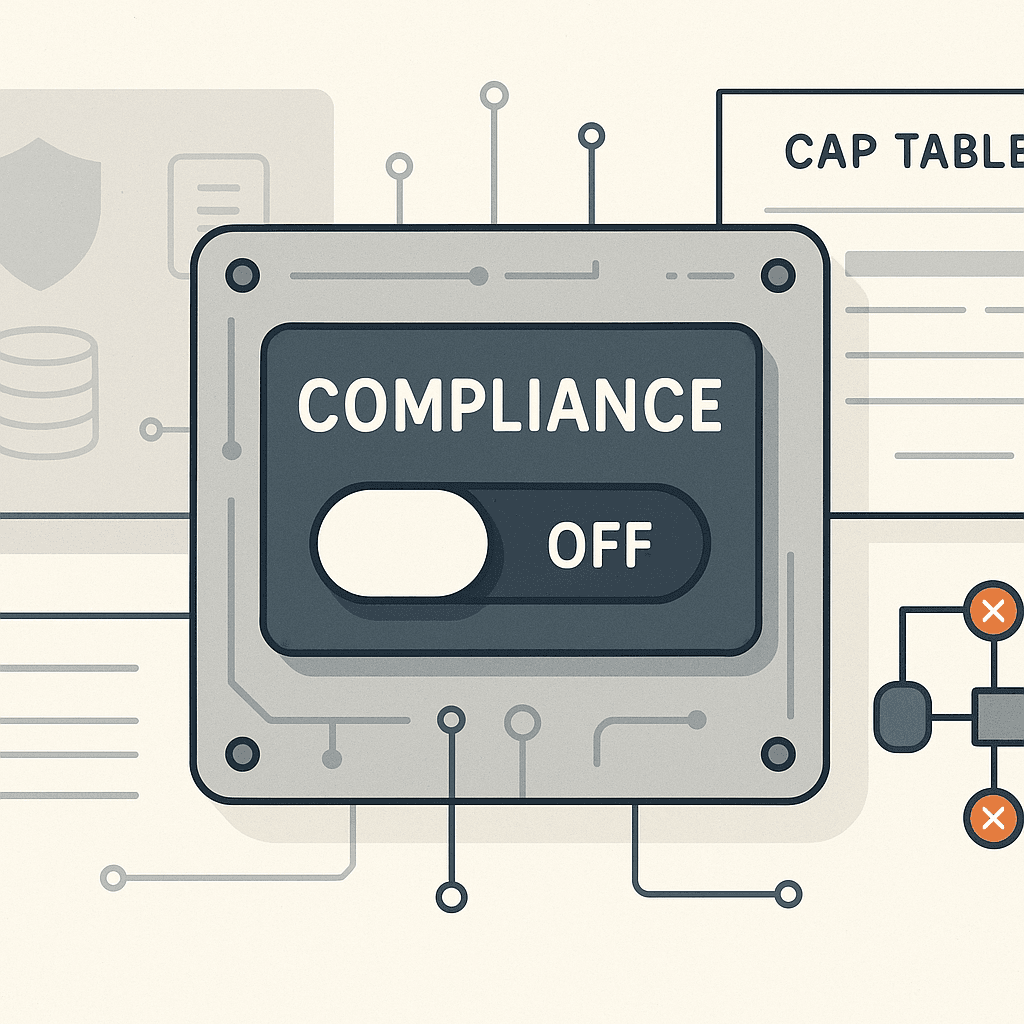
Seed rounds don’t usually die because a founder can’t explain the product. They die because diligence uncovers a second, unspoken product: your company’s operational reality.
That reality is where silent compliance lives.
Silent compliance isn’t “we’re breaking the law.” It’s more like: you’ve built a real business, revenue is coming in, customer data is flowing, contractors are shipping code, and money is moving, but the paperwork, controls, and policies that make all of that investable are missing, outdated, or contradictory.
And because it’s silent, it’s easy to ignore… until a seed investor asks for three documents and you realize you can’t produce any of them without creating new risk.
This article is a tactical guide for technical founders and early operators. It covers:
- What silent compliance is and why it kills seed deals
- The common gaps founders overlook: data handling, contractor/IP, taxes, and industry regs
- How investors and counsel actually interpret these gaps
- A 7-day cleanup plan to get investor-ready quickly
- An investor-ready checklist you can use before diligence starts
Important note: This is not legal or tax advice. It’s a diligence-oriented, operational playbook. For decisions with real exposure, involve qualified counsel and tax professionals.
1) What “Silent Compliance” Actually Means
In early-stage startups, “compliance” is often treated like a Series C problem. That’s a category error.
Most compliance issues that break seed deals are not complicated regulatory puzzles. They’re basic ownership, data, and money hygiene: the stuff that makes an investor confident that:
- The company owns what it sells.
- The company can legally sell it.
- The company won’t trigger avoidable liabilities the day after the investment.
Silent compliance is what happens when:
- You are implicitly making promises (in contracts, privacy claims, invoices, tax filings, employment practices),
- But you haven’t implemented the operational system needed to keep those promises true.
Why it’s a kill switch
Seed investors are buying options: the option that you can scale. Silent compliance removes that optionality by adding “unknown unknowns.”
Diligence isn’t just about finding issues, it’s about assessing whether issues are bounded, fixable, and priced. Silent compliance is scary because it’s often:
- Unbounded (How many contracts are wrong? How much data is exposed?)
- Time-sensitive (You can’t retroactively paper ownership cleanly in every case)
- Contagious (One weak policy implies other weak controls)
The seed deal may not “collapse.” More commonly it gets:
- Delayed (investor waits for remediation)
- Repriced (valuation haircut)
- Restructured (holdbacks, special indemnities, legal fees paid by the company)
- Or quietly abandoned (“not a fit right now”)
2) How Investors See Compliance Risk (Even When They Don’t Say It)
Founders often interpret diligence questions as bureaucratic checkboxes. Investors interpret your answers as a proxy for execution quality and risk maturity.
At seed, investors aren’t expecting a Fortune 500 compliance program. They are expecting:
- Clean corporate formation and cap table
- Clear IP ownership
- Reasonable handling of customer data
- No obvious tax landmines
- No regulatory claims that contradict reality
What makes them nervous
Investors get nervous when:
- You can’t produce documents you should have (e.g., contractor IP assignment)
- You say “we don’t really do that” but your product clearly does (e.g., tracking, analytics, ad pixels)
- Contracts contradict your sales claims (e.g., “SOC 2 compliant” marketing with no controls)
- You’ve crossed borders (customers, contractors, data) without thinking about implications
Their fear isn’t that you’re unethical. It’s that you’re unpredictable, and unpredictability is what turns a seed investment into a legal and reputational mess.
3) The Big Four Silent Compliance Gaps That Wreck Seed Deals
Gap #1: Data Handling (Privacy, Security, and “We Don’t Collect That”)
If you build B2B software, you handle data. If you handle data, you have compliance exposure, whether you want it or not.
The silent failure mode
Founders often believe:
- “We only store emails.”
- “We don’t process personal data.”
- “It’s B2B, so GDPR doesn’t matter.”
But “personal data” is broader than most teams assume. Under the EU’s GDPR, an identifiable person’s email address is personal data; so are device identifiers in many contexts. California’s CCPA/CPRA similarly treats identifiers broadly.
References:
- GDPR (Regulation (EU) 2016/679) definition of personal data, Art. 4(1): https://eur-lex.europa.eu/eli/reg/2016/679/oj
- California Consumer Privacy Act (CCPA) / CPRA definitions: https://oag.ca.gov/privacy/ccpa
Typical diligence questions
Investors (or their counsel) will ask things like:
- Do you have a privacy policy that matches your actual data flows?
- Do you have DPAs (Data Processing Addendums) with vendors and customers?
- Where is data stored? Any cross-border transfers?
- What security controls exist (access control, logging, encryption, backups)?
- Any incidents or breaches?
Where startups get caught
- Privacy policy mismatches reality. Marketing site says “we don’t share data,” but you use tracking pixels, session replay, or enrichment tools.
- No DPA chain. You process customer data but don’t have DPAs with subprocessors (e.g., analytics, support tools). In regulated procurement, this is a deal-breaker.
- No access governance. Everyone has admin access. Former contractors still have credentials.
- Security posture is implied, not demonstrated. Saying “we take security seriously” isn’t a control.
A pragmatic standard at seed
You don’t need SOC 2 Type II at seed (though some startups pursue it early). You do need:
- A clear data inventory (what you collect, where it goes)
- Basic access control and offboarding
- Encryption in transit (TLS) and reasonable encryption at rest where applicable
- Documented incident response owner/process
- Vendor list with security notes and DPAs where needed
Reference (practical control baseline): NIST Cybersecurity Framework: https://www.nist.gov/cyberframework
Gap #2: Contractor and IP Ownership (The “Who Actually Owns the Code?” Trap)
This is one of the most common seed diligence failures because it’s so easy to create accidentally.
If any meaningful code was written by:
- contractors
- agencies
- overseas developers
- a friend “helping out”
- a cofounder before incorporation
…then ownership may be unclear unless you have proper written assignments.
The silent failure mode
Founders assume:
- “We paid them, so we own it.”
- “It’s in GitHub under our org.”
- “They said it’s fine.”
In many jurisdictions, paying for work does not automatically transfer IP. You generally need written assignment language.
What diligence looks for
- Signed contractor agreements with IP assignment and confidentiality
- Invention assignment agreements for employees
- Proof that pre-incorporation work was assigned to the company
- Open-source usage policy and basic tracking
The biggest landmines
- No invention assignment for early team. A key engineer can later claim rights.
- Agency contract assigns IP to the agency by default. Or grants you a limited license.
- Missing IP assignment from a departed cofounder. This can halt a financing.
- Open-source license contamination. Not all OSS is risky, but failing to track it is.
Reference (open-source licensing basics):
- ChooseALicense overview: https://choosealicense.com/
- GNU GPL FAQ: https://www.gnu.org/licenses/gpl-faq.html
Seed investors want confidence you can be acquired later. IP ambiguity is poison in M&A; seed investors see it early.
Gap #3: Taxes and Entity Hygiene (The Quiet Cap Table and Payroll Disaster)
Tax compliance is a silent killer because it often produces liabilities that don’t show up as obvious operational problems: until someone looks.
The silent failure mode
Common patterns:
- Contractors treated like employees (misclassification risk)
- Employees in states/countries where you’re not registered for payroll taxes
- Sales tax/VAT obligations ignored
- Delaware C-Corp formed, but state registrations and filings neglected
- 409A valuations delayed while options are granted
Typical diligence questions
- Are you current on federal/state filings?
- Any nexus for sales tax? (or VAT/GST if international)
- Are contractors properly documented?
- Are equity grants properly approved and priced?
The landmines investors care about
- Misclassification: Labor agencies can assess penalties; customers can trigger scrutiny.
- Sales tax exposure: Especially for SaaS, depends on states and product classification.
- International contractor payroll risk: Permanent establishment concerns for some jurisdictions.
- Equity mess: Options granted without board approval or without 409A can create tax issues and employee resentment.
References (starting points):
- IRS independent contractor guidance: https://www.irs.gov/newsroom/understanding-employee-vs-contractor-designation
- U.S. sales tax nexus concepts (state-by-state, but overview): https://www.streamlinedsalestax.org/
(For sales tax and global VAT, you’ll likely need a specialist or a platform, but diligence expects you to have identified whether you have exposure.)
Gap #4: Regulatory Claims and “Accidental Regulated Business” Problems
Many startups drift into regulated territory without noticing because the product roadmap moves faster than the legal category.
Examples:
- You touch healthcare data → potential HIPAA exposure (U.S.)
- You process payments → PCI DSS obligations; money transmission concerns in some cases
- You handle education records → FERPA considerations
- You do background checks or credit-like scoring → FCRA issues (U.S.)
- You market “AI compliance,” “SOC 2 ready,” or “GDPR compliant” without substantiation → consumer protection / deceptive practices risk
Even if you’re not directly regulated, your customers may be. That means procurement will push requirements onto you (security addenda, DPAs, audit rights).
References:
- HIPAA overview (HHS): https://www.hhs.gov/hipaa/index.html
- PCI DSS overview: https://www.pcisecuritystandards.org/
- FTC on deceptive practices (general): https://www.ftc.gov/business-guidance/advertising-marketing
What seed investors want
Not perfection, clarity:
- Which regulations apply (or don’t) and why
- What you’ve done to meet customer-driven requirements
- What your roadmap is for compliance maturity
Saying “we’re not sure” is acceptable. Saying “doesn’t apply” when it clearly might is not.
4) The Founder’s Diligence Paradox: “We’ll Fix It Later” Becomes “You Can’t Close Now”
Silent compliance problems tend to compound due to a paradox:
- Fixing them properly takes time (collecting signatures, migrating systems, mapping data, cleaning cap table)
- But founders postpone them because they’re busy building
- Then fundraising compresses time: investors want answers this week
This is why compliance is a financing issue, not just a legal issue.
A seed round is often 30–60 days from first serious term sheet conversations to close. If you need 45 days just to get signatures from three ex-contractors in different countries, you’re now fundraising on a clock you don’t control.
5) A 7-Day Silent Compliance Cleanup Plan (Fast, Realistic, Investor-Oriented)
This plan is designed for a typical seed-stage startup: small team, limited ops support, but real product and early customers.
The goal is not to “be compliant with everything.” The goal is to:
- eliminate the highest-probability diligence blockers
- document what you know
- create a credible remediation roadmap for what you don’t
Day 1: Build the Diligence Room Skeleton
Create a structured folder (Google Drive, Dropbox, or a proper data room tool). Use a simple index doc.
Minimum folders:
- Corporate: formation docs, bylaws, board consents
- Cap table & equity: cap table, option plan, grants, 409A
- IP: contractor agreements, employee invention assignment, trademarks/patents (if any)
- Customer & vendor contracts: MSAs, DPAs, SOWs
- Security & privacy: policies, data flow notes, vendor list
- Finance & tax: financials, filings, payroll setup
Output: A data room that makes you look organized even if you’re still patching holes.
Day 2: IP and Contractor Triage
Make a list:
- everyone who wrote code, designed product, created brand assets, or authored key docs
- their relationship (employee/contractor/cofounder)
- whether you have a signed agreement with IP assignment
Then:
- prioritize the top 5 contributors
- get missing assignments signed
If you can’t get signatures fast, create a written memo of the gap and your remediation plan. Investors can accept known issues with a credible fix; they hate surprises.
Day 3: Data Inventory and Privacy Reality Check
Do a lightweight data map:
- what personal data you collect (users, admins, end customers)
- sources (forms, product telemetry, support)
- where it’s stored (DBs, logs, data warehouse)
- vendors that receive it (analytics, email, support, payments)
- retention and deletion approach
Then compare:
- privacy policy vs. actual behavior
- marketing claims vs. actual controls
Fix obvious mismatches immediately (update policy, remove risky tracking, adjust cookie banner if applicable).
Day 4: Security Controls You Can Actually Defend
Seed diligence rarely requires a full audit, but it does require sanity.
Implement/document:
- MFA on all critical services (email, cloud, GitHub)
- least-privilege access basics (no shared admin accounts)
- offboarding checklist (even if it’s just a doc)
- backups and restore ownership
- vulnerability/patching responsibility
Create a 1–2 page “Security Overview” doc: what you do today, what you’ll do next.
Framework to borrow structure from: NIST CSF.
Day 5: Tax and Payroll Reality Pass
Work with your bookkeeper/CPA if you have one. If not, do a basic self-audit:
- Are you registered where employees work?
- Are payroll filings current?
- Have you issued 1099s (US) if relevant?
- Any meaningful sales tax/VAT exposure?
If you have multi-state or international activity, capture it in a memo and assign an owner to resolve.
Day 6: Contract Hygiene (Customers and Vendors)
Collect:
- top customer contracts (especially enterprise-ish customers)
- all vendor contracts that touch data (hosting, analytics, support)
Identify:
- nonstandard liabilities (uncapped indemnities)
- data obligations (DPAs, breach notice timelines)
- security promises you can’t meet
You’re looking for “we promised SOC 2” or “we promised encryption at rest” when neither is true.
Day 7: Create the Investor-Ready Narrative
Silent compliance cleanup isn’t just fixing issues, it’s communicating maturity.
Produce three short documents:
- Compliance Snapshot (1 page): what applies, what you’ve done, what’s next
- Risk Register (1–2 pages): known gaps, severity, remediation ETA
- Diligence Index: where everything is in the data room
This is the difference between “messy startup” and “capable operator.”
6) The Investor-Ready Checklist (Use This Before You Start Seed Conversations)
Below is a practical checklist optimized for seed diligence. You won’t have everything. The goal is to know what you have, what you don’t, and what the plan is.
Corporate & Equity
- Certificate of incorporation and bylaws
- Board and shareholder consents for major actions
- Cap table (current, correct)
- Stock purchase agreements for founders
- Option plan documents
- Option grant approvals (board consents) and grant notices
- 409A valuation (or documented plan/timing to obtain one)
IP Ownership
- Employee invention assignment agreements (PIIA)
- Contractor agreements with IP assignment + confidentiality
- Assignment of pre-incorporation IP to the company
- OSS usage awareness (basic policy + list of critical dependencies)
- Trademark filings (if relevant) or at least a clearance check for the brand name
Data Privacy
- Privacy policy consistent with actual data collection/sharing
- Cookie banner/consent mechanism if required by your target markets
- Data map (what, where, who has access)
- Vendor/subprocessor list
- DPAs in place where needed (customers and key vendors)
- Basic retention/deletion approach
Security
- MFA on critical systems
- Access control policy and offboarding checklist
- Backups documented and owned
- Incident response owner + process
- Security overview doc (controls today + roadmap)
Tax & Finance
- Basic financial statements (P&L, balance sheet)
- Evidence of filed taxes and payroll compliance (as applicable)
- Contractor classification documented
- Sales tax/VAT assessment (even if preliminary)
Contracts & Regulatory
- Standard customer MSA template
- Top customer contracts organized and reviewed
- Standard vendor terms for key providers
- Clear statement of regulatory posture (HIPAA/PCI/FCRA/etc.)
- Marketing claims (security/compliance) reviewed for accuracy
7) What to Do If You Find a Serious Gap Mid-Fundraise
Some gaps are genuinely hard to fix quickly (missing cofounder assignment, unclear IP from an agency, international tax exposure).
Here’s the playbook:
- Stop guessing. Document facts only.
- Quantify scope. How much code/data/revenue is implicated?
- Propose a remediation plan with dates. Investors care about credible sequencing.
- Offer risk containment. For example, switch vendors, remove a feature, stop collecting a data field, or rewrite a contract template.
- Decide what must be fixed pre-close vs post-close. Some investors will accept post-close remediation with covenants; others won’t.
The worst move is to hide it and hope diligence doesn’t notice. It usually does, and then you lose trust, the one asset you cannot replace in a financing.
8) The Counterpoint: When “Compliance” Becomes Performative
It’s also possible to over-rotate.
Some founders burn months chasing certifications, writing 50-page policies no one follows, or hiring expensive consultants before they have product-market fit.
Investors don’t reward performative compliance. They reward:
- clarity
- ownership
- fit-for-stage controls
- a believable plan
A lightweight but real system beats a glossy PDF every time.
If you’re deciding between:
- shipping a customer-critical feature
- and implementing MFA + access hygiene + basic DPAs
…do both, but if you must choose, do the controls that prevent existential risk first.
9) A Practical “Silent Compliance” Operating System (So This Doesn’t Happen Again)
Once you’ve done the 7-day cleanup, keep it from regressing.
A simple operating cadence:
- Monthly (30 minutes): review vendor list + access list, ensure offboarding happened
- Quarterly (60 minutes): update risk register, review marketing claims, check contract template drift
- Annually (half day): tax review, insurance review, security posture check, update privacy policy/data map
Assign an owner. At seed, that’s often a founder or a senior engineer/ops lead. Ownership beats complexity.
Conclusion: Silent Compliance Is a Fundraising Problem Wearing a Legal Mask
Silent compliance wrecks seed deals because it introduces uncertainty at the exact moment you’re asking investors to take a bet on your ability to scale.
The fix is not to become a compliance-heavy company overnight. The fix is to become legible:
- You own your IP.
- You understand your data flows.
- You have basic security discipline.
- You’re not sitting on avoidable tax or classification liabilities.
- You can explain which regulations matter and what your plan is.
If you do nothing else, do the 7-day cleanup plan and produce an investor-ready narrative. When diligence starts, the goal is simple: no surprises, no scrambling, no ambiguity about ownership or risk.
Further Reading / References
- GDPR full text (EU): https://eur-lex.europa.eu/eli/reg/2016/679/oj
- California CCPA resources: https://oag.ca.gov/privacy/ccpa
- NIST Cybersecurity Framework: https://www.nist.gov/cyberframework
- U.S. IRS contractor vs employee overview: https://www.irs.gov/newsroom/understanding-employee-vs-contractor-designation
- PCI Security Standards Council (PCI DSS): https://www.pcisecuritystandards.org/
- U.S. HHS HIPAA overview: https://www.hhs.gov/hipaa/index.html
- GNU GPL FAQ (open-source licensing): https://www.gnu.org/licenses/gpl-faq.html
- Choose a License (license summaries): https://choosealicense.com/
- FTC advertising and marketing guidance (deceptive practices): https://www.ftc.gov/business-guidance/advertising-marketing