
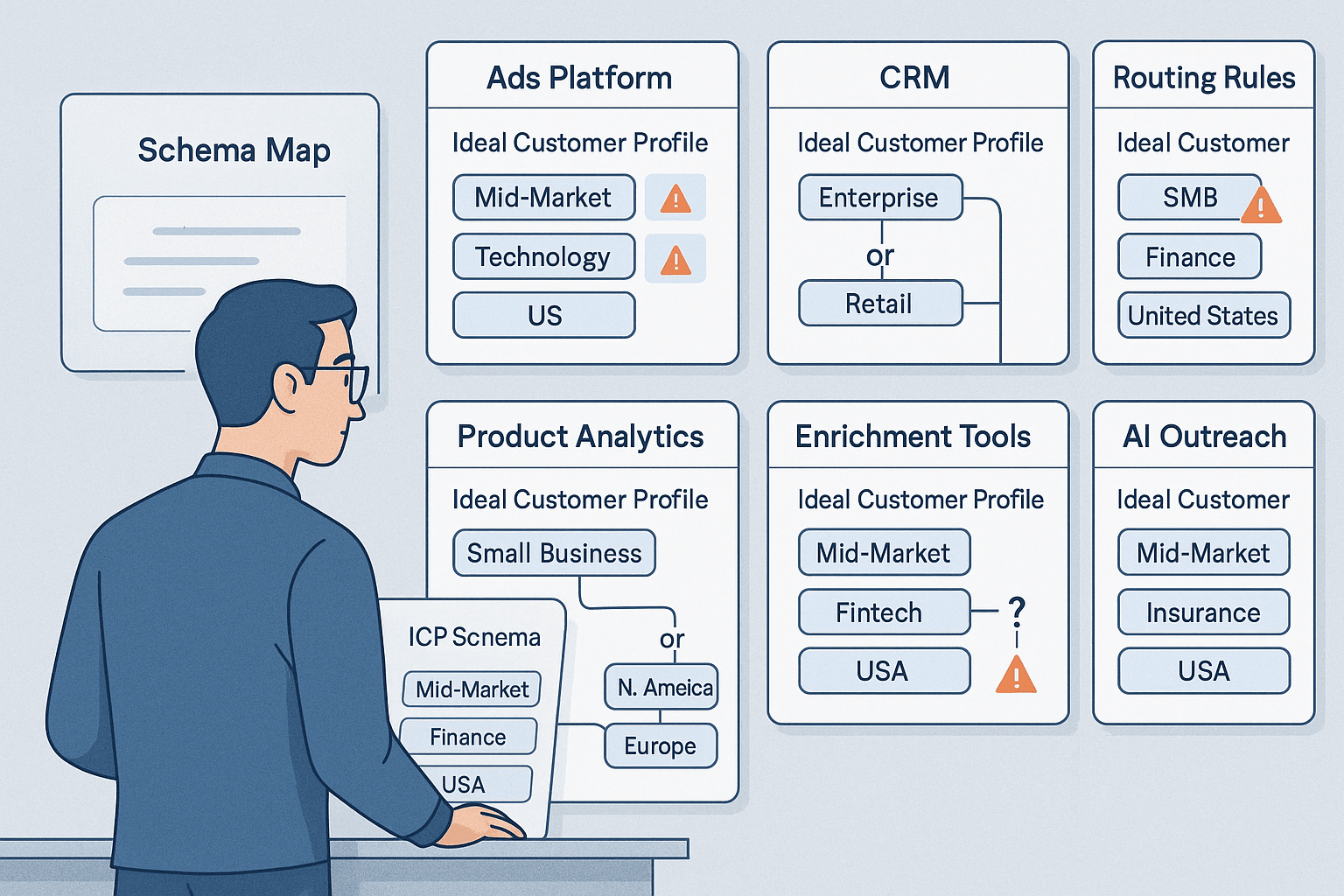
A familiar startup failure story goes like this: the team says they sell to mid-market B2B companies with 50–500 employees in regulated industries, selling a high-velocity workflow product to operations leaders. That is the strategy on the board slide. But the ad account targets companies with 11–200 employees because the audience is cheaper. The CRM marks any lead with a manager title as sales-qualified because the SDR team needed more volume. The enrichment tool overwrites employee count using a provider that lags six months behind reality. The routing logic sends healthcare companies to one AE only if the NAICS field is present, which it often is not. The product team’s PQL model scores accounts highly when they invite five users in a week, even though the best customers usually have longer, security-heavy rollouts. The founder’s AI outbound workflow scrapes LinkedIn for “head of ops” and writes personalized sequences to venture-backed startups because those are easiest to identify.
Nothing looks obviously broken in isolation. CAC dashboards still move. Demo volume rises. Product signups increase. Pipeline gets created. The team has enough local evidence to defend each decision. But six months later, something feels wrong. Win rates are noisy. Sales says marketing is sending junk. Marketing says sales is cherry-picking. Product is building for power users who never convert to expansion. Customer success says the happiest users look nothing like the accounts being targeted in paid channels. The founder can’t tell whether the company has traction or just activity.
This is the “ICP drift in the stack” problem.
It is not just a positioning problem. It is not just bad RevOps hygiene. It is a systems problem where the logic that defines the ideal customer profile quietly mutates as it passes through every operating layer: ads, enrichment, CRM, routing, sales workflows, product scoring, onboarding, support segmentation, and now AI-generated outreach and qualification agents. Every team encodes its own practical version of the customer. Over time, those versions diverge.
When they diverge far enough, your go-to-market machine starts optimizing for contradictory realities.
The pattern: every system creates its own version of the customer
Most early-stage companies think they have an ICP because they have a paragraph in a deck or a Notion page that says something like:
- B2B SaaS
- 50–500 employees
- US-based
- Ops or finance buyer
- Fast-growing
- Pain around fragmented workflows
That is not an operational ICP. That is a slogan.
Operationally, your ICP only exists in the logic your systems use to make decisions. If your stack cannot consistently answer the same customer-definition questions in the same way, then you do not have one ICP. You have many.
Here is where drift typically appears.
1. Paid acquisition uses proxy variables that do not match sales reality
Ads platforms rarely let you target exactly the variables your team actually uses in closing deals. So marketers use proxies:
- Job titles instead of actual budget owners
- interest categories instead of tech-stack fit
- lookalikes based on website visitors instead of closed-won accounts
- broad company-size bands because narrower ones are too expensive
That is reasonable. The problem starts when the proxy becomes the truth. The ad audience is now treated as “the market,” even though it was originally just a practical approximation.
2. CRM fields degrade into inconsistent human judgment
AEs and SDRs create shortcuts because they have to move fast. One rep uses “mid-market” to mean 100–500 employees. Another uses it for any deal over $15k ARR. One SDR marks “industry = fintech” if a company processes payments. Another only uses it for companies regulated as financial institutions.
Soon, reports are drawing strategic conclusions from fields that were never tightly governed.
3. Enrichment providers create false precision
Apollo, Clearbit, Clay, ZoomInfo, People Data Labs, 6sense, and others can fill gaps fast. They can also create a dangerous feeling of certainty.
Common failure modes:
- employee counts vary materially across vendors
- headquarters location is outdated
- funding stage is stale
- industry labels are inconsistent
- parent/subsidiary relationships are wrong
- title parsing is messy, especially outside standard GTM roles
Teams rarely decide which data source is authoritative for which field. So fields get overwritten by whichever workflow ran most recently.
4. Routing logic hardcodes assumptions nobody remembers
Inbound routing is where strategy turns into software. And once encoded, old assumptions stay alive far longer than the company’s actual strategy.
Examples:
- enterprise leads route to senior AEs based on employee count > 1000, but product-led motion now works best up to 2000 employees
- healthcare accounts route to a specialist only if SIC code is populated
- non-US leads are disqualified automatically even though the company has started winning in the UK and Australia
- “student,” “consultant,” or “agency” filters block good prospects because the company originally had too much junk inbound
Founders often discover this only after hearing “we never saw those leads.”
5. Product-qualified lead logic reflects convenience, not fit
The product team often defines a PQL around observable activation behaviors:
- invited 3+ teammates
- connected an integration
- created 10+ objects
- used feature X twice in 7 days
Those are useful signals, but they are not automatically ICP signals. Sometimes your best customers adopt slowly due to procurement, security review, migration work, or cross-functional rollout. Meanwhile, lightweight users can look highly activated in self-serve metrics while never becoming durable revenue.
6. AI workflows amplify whatever definition they are given
This is the new multiplier. AI outbound systems, lead scoring agents, auto-research workflows, and LLM-based qualification prompts often sit on top of already-messy data.
If the prompt says “identify high-fit prospects based on title, company size, and signs of growth,” but the input fields are inconsistent and the examples were derived from noisy CRM history, the AI doesn’t fix the problem. It scales it.
Worse, AI systems often hide drift behind fluent output. The email sounds personalized. The score looks reasoned. The summary appears thoughtful. But the underlying customer logic may be garbage.
Why the standard advice fails
The standard advice on ICP is usually one of four things:
- Interview your best customers
- Align sales and marketing
- Tighten your qualification criteria
- Use better intent and enrichment tools
All useful. None sufficient.
“Interview your best customers” is directionally right but operationally incomplete
Customer interviews can help identify who gets value fastest, who buys with less friction, and who expands reliably. But an interview does not tell you how “regulated industry” should map across LinkedIn audiences, a Salesforce picklist, a Clay waterfall, a HubSpot workflow, a product analytics trait, and an LLM scoring prompt.
The issue is not insight scarcity. It is execution inconsistency.
“Get sales and marketing aligned” breaks when systems remain misaligned
Founders run an offsite, everyone agrees on target accounts, and for two weeks the language sounds cleaner. But unless the logic gets translated into field definitions, ownership rules, source-of-truth decisions, and workflow enforcement, local teams revert to whatever helps them hit near-term numbers.
Alignment without system design is temporary theater.
“Use better tools” usually adds more layers of drift
A new enrichment vendor, ABM platform, or AI SDR tool can improve coverage or efficiency. But every additional tool introduces:
- new field taxonomies
- new matching logic
- new fallback rules
- new overwrite behavior
- new scoring models
- new hidden defaults
If you do not have a canonical schema already, more tools typically mean more ICP versions.
“Tighten qualification” often happens too late
Founders try to solve bad pipeline quality at the AE or SDR level: stricter MEDDICC, tighter discovery, higher bar for SQLs. That can improve rep time allocation, but it does not fix corrupted upstream signals.
If your ad account, website conversion paths, routing rules, and AI prospecting workflows are all tuned to attract and process the wrong kinds of accounts, better sales qualification just means you reject junk more efficiently after already paying for it.
The better approach: treat ICP as a canonical schema, not a narrative
You need to manage ICP like a product interface or financial model: explicit definitions, controlled mappings, ownership, change management, and regular audits.
The practical move is to create a canonical ICP schema.
That sounds abstract. It is not. It simply means you define the minimum set of customer attributes that determine fit, how each attribute is represented, what values are valid, where the truth comes from, what confidence you have in that truth, and how every downstream system should consume it.
Think of it as your customer-definition API.
What a canonical ICP schema looks like
For an early-stage startup, keep this lightweight. You do not need a giant MDM project. You need enough structure that the company stops contradicting itself.
A workable canonical schema usually includes six layers.
Layer 1: Firmographic fit
Core account attributes:
- employee count range
- annual revenue band if relevant
- geography
- industry
- business model
- funding stage if useful
- public/private
- parent/subsidiary status
For each field, define:
- business meaning
- allowed values
- source of truth
- fallback source
- confidence score logic
- update cadence
Example:
Field: employee_count_canonical
Meaning: estimated current full-time employee count at the buying entity level
Allowed values: exact integer plus standardized bands
Primary source: ZoomInfo
Fallback: LinkedIn company headcount; manual AE verification
Override rule: manual verification can supersede vendor data for 90 days
Confidence scoring: high if vendor and LinkedIn within 20%; medium if only one source; low if mismatch > 50%
Layer 2: Buying-center fit
Who needs to exist for a sale to happen?
- functional owner
- executive sponsor
- technical evaluator
- economic buyer
- implementation owner
Not every startup needs all of these, but most have some pattern. Define role archetypes and acceptable proxies.
Example: “operations leader” might include VP Operations, Head of RevOps, Director of Enablement, COO in sub-200 employee companies, or founder in sub-30 employee companies.
That is more useful than simply saying “target ops.”
Layer 3: Problem fit
This is where most teams stay too qualitative. Make it operational.
Define explicit problem indicators such as:
- number of tools involved in a workflow
- evidence of manual handoffs
- hiring trend for roles linked to the pain
- compliance requirements
- support-ticket categories
- workflow volume thresholds
- time-to-action or cycle-time issues
Even if some of these are inferred, naming them forces clarity.
Layer 4: Motion fit
How should this account be served?
- self-serve
- sales-assisted
- mid-market AE-led
- enterprise motion
- partner-led
A lot of GTM pain comes from confusing “good customer” with “good customer for this motion.”
Some accounts are good-fit but terrible for your current sales model. Your schema should separate these.
Layer 5: Exclusion logic
Most companies are much too vague here.
Define who looks similar to your ICP but should be excluded:
- agencies n- outsourcers
- very small subsidiaries inside large enterprises
- students or hobbyists
- consultants using the product on behalf of clients
- countries you cannot support well
- verticals with unusable procurement cycles at current stage
Exclusions prevent expensive ambiguity.
Layer 6: Confidence and provenance
This is the layer almost everyone skips.
For every critical field or classification, store:
- where the value came from
- when it was last updated
- whether it was inferred or observed
- confidence score
- override history
Without provenance, teams argue emotionally about data quality because there is no institutional memory.
A practical framework to map ICP across the stack
Once you have a canonical schema, the next step is mapping. This is where most of the operational value comes from.
Create a simple ICP system map with columns like:
- canonical field
- canonical definition
- system name
- local field name
- transform logic
- allowed local values
- sync direction
- overwrite rule
- owner
- downstream decisions powered
- known risks
You can do this in Airtable, Notion, Google Sheets, or your RevOps documentation tool. The point is not elegance. The point is explicitness.
Here is a simplified example.
| Canonical field | System | Local field | Transform logic | Risk |
|---|---|---|---|---|
| industry_canonical | LinkedIn Ads | audience industry | map canonical healthcare to LinkedIn healthcare + hospital + medical practice subsets | broad proxy may over-include |
| industry_canonical | Salesforce | Industry | normalized picklist | rep free-text must be blocked |
| employee_band_canonical | HubSpot | company size | map exact count to 1-10, 11-50, 51-200, 201-500, 501+ | provider mismatch |
| buyer_role_canonical | Clay outbound table | title persona cluster | LLM classification from title + summary | hallucination risk |
| motion_fit_canonical | routing workflow | assigned segment | if employee band 51-500 and problem fit high, route to MM | stale counts create bad routing |
| problem_fit_score | product analytics | pql score | combine usage + integration + workflow complexity | activation bias |
Do this for every system that materially affects demand generation, qualification, routing, scoring, prioritization, or product feedback loops.
At minimum, include:
- ad platforms
- CRM
- marketing automation
- enrichment tools
- outbound sequencing/prospecting tools
- routing workflows
- product analytics
- warehouse/BI
- customer success platform
- AI scoring/outreach agents
How to detect ICP drift before it poisons decisions
Most teams only notice drift when revenue misses show up or when cross-functional complaints get loud. You need leading indicators.
Here are the most useful ones.
1. Closed-won profile mismatch vs top-of-funnel profile
Each month, compare:
- paid audience composition
- inbound lead composition
- SQL composition
- pipeline composition
- closed-won composition
- retained/expanded customer composition
If the distributions differ sharply on key ICP dimensions, you likely have drift.
Example:
- 45% of MQLs are from 11–50 employee companies
- 38% of demos are from 51–200
- 70% of closed-won is from 201–500
- 80% of expansion revenue is from regulated industries
- only 15% of paid budget targets regulated industries specifically
That is a strong signal your stack is sourcing one market while your business succeeds in another.
2. Stage-conversion cliffs by attribute confidence
Break down conversion by data confidence, not just by field value.
Example:
- leads with manually verified industry convert from SQL to win at 18%
- leads with vendor-only industry convert at 7%
- leads with low-confidence employee counts no-show 2x more often
This reveals where bad data is distorting segmentation decisions.
3. Rep override frequency
Track how often reps manually reclassify:
- segment
- industry
- employee band
- routing owner
- qualification status
Frequent manual overrides are not just process noise. They are evidence that system logic no longer matches reality.
4. PQL-to-revenue mismatch
Compare top-scored product-qualified accounts against:
- sales acceptance rate
- close rate
- retention
- expansion
- support burden
If your PQL leaders generate low-quality pipeline or poor downstream economics, product scoring is likely encoding a different ICP than GTM.
5. AI output audit failure rate
Sample AI-generated prospect lists, scores, summaries, and outreach weekly.
Ask:
- Would a top rep agree this is a target account?
- Are the reasons cited actually tied to your canonical ICP?
- Is the AI inferring from weak or irrelevant signals?
- Does tone of personalization mask bad account selection?
If more than 10–15% looks questionable, the workflow needs correction.
Tool comparisons: where drift tends to enter and how to use tools responsibly
There is no perfect stack, but different categories fail in different ways.
CRM: Salesforce vs HubSpot
Salesforce
- Best for: complex objects, governance, custom logic, mature RevOps control
- Drift risk: high complexity means old workflows and field sprawl accumulate fast
- Good practice: lock down picklists, define field-level ownership, maintain a data dictionary
HubSpot
- Best for: speed, ease of use, startup simplicity, marketing-sales alignment early on
- Drift risk: teams create duplicate properties and lightweight automations everywhere
- Good practice: aggressively prune properties, centralize lifecycle and segmentation logic
Tradeoff: Salesforce supports stronger governance but is easier to turn into a maze. HubSpot keeps velocity high but requires discipline to avoid property chaos.
Enrichment: ZoomInfo vs Apollo vs Clay waterfalling
ZoomInfo
- Better coverage in some B2B segments, useful for direct dials and firmographics
- Drift risk: teams trust vendor labels too much
- Cost: relatively expensive for early-stage teams
Apollo
- Strong all-in-one value for prospecting and enrichment
- Drift risk: convenient enough that it becomes the de facto truth without governance
- Cost: generally more startup-friendly
Clay + waterfall providers
- Best for custom workflows and multi-source enrichment
- Drift risk: maximum flexibility means maximum chances for inconsistent transforms and overwrite rules
- Cost: can be efficient at small scale; can also become ops-heavy quickly
Battle-tested view: for seed to Series A, a simpler stack with explicit source-of-truth rules beats a more powerful enrichment architecture nobody governs.
Product analytics: Segment + warehouse vs Amplitude/Mixpanel-native scoring
Warehouse-centric
- Best for joining CRM, product, and billing data for more reliable fit analysis
- Drift risk: longer setup time, dependence on data engineering quality
- Benefit: strongest way to test whether usage signals actually correlate with revenue quality
Tool-native scoring
- Best for speed and team accessibility
- Drift risk: teams optimize what is easiest to measure inside the product tool, not what predicts customer quality
- Benefit: fast iteration early on
Tradeoff: if you are pre-PMF, native scoring may be enough. Once product signals start influencing sales prioritization materially, warehouse-backed validation becomes worth it.
AI sales tooling: sequence writers, research agents, qualification copilots
These tools can save real time. They can also industrialize nonsense.
Use them for:
- summarizing account research after canonical fit is established
- drafting outbound based on verified fields
- flagging missing data for human review
- explaining scores that come from governed models
Do not use them as the first or only layer deciding who your ICP is.
A realistic implementation plan for an early-stage team
You do not need a quarter-long transformation project. You need a 4-week cleanup with clear owners.
Week 1: define the canonical schema
Owner: founder + head of sales/marketing + product lead + RevOps or ops generalist
Deliverables:
- 8–15 canonical ICP fields
- definitions and allowed values
- exclusions
- source-of-truth and fallback rules
- confidence methodology
- motion-fit rules
Keep it tight. If a field does not drive a decision, leave it out.
Sample starter fields:
- account_name_canonical
- account_domain_canonical
- industry_canonical
- employee_count_canonical
- employee_band_canonical
- geography_canonical
- buyer_role_canonical
- problem_fit_tier
- motion_fit_canonical
- exclusion_reason
- icp_fit_score
- fit_confidence_score
Time cost: 6–10 hours of concentrated work.
Week 2: map the stack
Owner: RevOps/ops generalist with stakeholders from marketing, sales, product, and engineering
Deliverables:
- system-field mapping sheet
- list of every workflow that writes or transforms ICP-related data
- list of workflows that consume ICP logic for decisions
- conflict log where definitions differ
Questions to answer:
- Which systems can overwrite which fields?
- Where does free text still exist?
- Which tools infer values versus store verified values?
- Which routing or scoring rules use stale assumptions?
Time cost: 10–15 hours depending on stack complexity.
Week 3: fix the highest-leverage breakpoints
Start with the places where bad logic creates the most downstream waste.
Usually that means:
- CRM property cleanup and governance
- inbound routing updates
- ad audience remapping
- outbound list-building rules
- PQL scoring review
- AI prompt and input cleanup
Practical fixes:
- convert free-text industry to controlled picklist
- separate exact employee count from normalized band
- store source and timestamp for key firmographic fields
- prevent enrichment from overwriting manually verified fields blindly
- add “fit confidence” and “needs verification” flags
- require AI workflows to reference canonical fields only
- rewrite routing logic using confidence-aware fallbacks
Time cost: 1–3 days of implementation plus QA.
Week 4: stand up drift monitoring
Owner: RevOps or founder if team is very small
Create one weekly dashboard and one monthly review.
Weekly dashboard
Track:
- inbound lead volume by canonical employee band and industry
- SQL rate by ICP tier
- rep override count
- routing exceptions
- AI-audited misfit rate
- PQL acceptance rate by sales
- percent of records with low-confidence key fields
Monthly review
Review:
- closed-won vs MQL distribution by ICP attributes
- retention and expansion by ICP tier
- pipeline sourced outside target profile
- excluded-account leakage
- major schema change requests
Time cost: 2–4 hours initial setup, then 30–60 minutes per week.
Cost and time analysis: what this actually costs vs what drift costs
Founders often avoid this because it sounds like internal plumbing. But the economics are straightforward.
Lightweight implementation cost
For a team with:
- 1 founder
- 1 head of GTM or sales leader
- 1 marketer
- 1 product lead
- 1 ops generalist or part-time RevOps support
Expected cost:
- 25–40 hours of internal time
- maybe $2k–$10k of external RevOps help if needed
- some short-term slowdown while workflows are cleaned up
That is annoying but manageable.
Typical drift cost
In contrast, ICP drift usually creates:
- 15–40% wasted paid spend on misfit audiences
- SDR time burned on leads that should never have routed
- AEs chasing pipeline that inflates activity but not bookings
- product roadmap distortion from loud, low-fit users
- false positives in self-serve traction metrics
- customer success burden from poor-fit accounts
- leadership confusion about where PMF actually exists
For even a modest startup spending $15k/month on paid, paying a small sales team, and making roadmap bets under uncertainty, the cost of drift can easily exceed $100k–$300k annually in direct waste and opportunity cost.
That is before you count the strategic damage of learning the wrong lessons.
Workflow example: how a canonical ICP should actually operate
Let’s say your real best-fit customer is:
- US or UK
- 100–700 employees
- regulated or compliance-heavy environments
- multi-step operational workflows across 3+ teams
- likely buyer: head/VP of operations, RevOps, compliance operations, or COO in smaller accounts
- sales-assisted motion works best
Here is how this should propagate.
Ads
- Build audiences using closest proxies: industry clusters, size ranges, operations/compliance titles
- Explicitly tag campaigns with targeted canonical ICP segment
- Measure not just CPL, but downstream fit rate and win rate by campaign
Website and forms
- Capture employee band, industry, and role in normalized values
- Ask one smart qualifying question tied to problem fit
- Use progressive profiling rather than giant forms
Enrichment
- Append exact company size, normalized industry, and compliance indicators
- preserve provenance for each field
- if sources disagree materially, mark low confidence rather than pretending certainty
CRM
- Store canonical fields separately from raw vendor fields
- allow manual verification with expiration window
- calculate ICP fit score from canonical fields only
Routing
- high-fit + high-confidence leads route directly to AEs
- high-fit + low-confidence leads route to SDR verification queue
- low-fit or excluded leads go to nurture, not straight disqualification if uncertainty exists
Product scoring
- PQL requires both usage activation and account-fit threshold
- heavy compliance setup patterns are treated as positive, not ignored because they are slower
AI outbound
- prompt references canonical attributes and approved role archetypes
- workflow blocked from generating outreach if fit confidence is below threshold
- output includes cited evidence fields for human spot-checking
Reporting
- dashboards show volume, conversion, retention, and expansion by canonical ICP tier
- leadership reviews differences between sourced demand and retained revenue profile monthly
That is what an aligned GTM stack looks like. Not perfect, but coherent.
Common implementation mistakes
Mistake 1: making the schema too philosophical
If the schema cannot be used in routing, scoring, segmentation, and reporting, it is too abstract.
Mistake 2: trying to define every edge case upfront
You need 80/20 clarity, not encyclopedic completeness. Start with the fields that actually change decisions.
Mistake 3: letting one team own ICP in isolation
Marketing alone cannot own this. Neither can sales. Product must be involved because product signals often become de facto fit signals.
Mistake 4: ignoring exclusions
A fuzzy “who we serve” without a sharp “who we do not serve” guarantees leakage.
Mistake 5: trusting AI output without provenance
If an LLM cannot cite the actual fields and evidence used to classify fit, treat the output as draft assistance, not truth.
Mistake 6: not versioning changes
If you change the definition of mid-market, target verticals, or motion fit, log it. Otherwise trendlines become uninterpretable.
The governance model that works at startup scale
You do not need a data council. You need clear ownership.
Use this simple model:
- Founder/CEO: final approver on strategic ICP changes
- Head of GTM or sales leader: owner of commercial applicability
- Product lead: owner of product-signal interpretation and PQL alignment
- RevOps/ops: owner of field definitions, mappings, workflow enforcement, and monitoring
- Marketing: owner of upstream proxy translation into channels
- Sales managers: owner of rep adherence and feedback on false positives/negatives
Run a 30-minute monthly ICP operations review:
- What changed in closed-won and retention patterns?
- Where are reps overriding system logic?
- Which campaigns or workflows are producing misfit volume?
- Which fields are low confidence or conflict-prone?
- Are AI workflows helping or multiplying errors?
- Does the canonical schema need a version update?
That is enough governance for most seed to Series B companies.
The deeper point: ICP drift corrupts learning, not just efficiency
The biggest danger is not that you waste spend or annoy reps. The biggest danger is epistemic.
Startups survive by learning faster than they burn. If every layer of the stack defines “customer” differently, then your feedback loops are contaminated.
You will hear product requests from non-ideal users and mistake them for market demand. You will see demo volume from cheap audiences and mistake it for traction. You will watch self-serve activation spike in poor-fit segments and think onboarding is improving. You will interpret outbound reply rates as proof of resonance when the accounts should never have been targeted.
In other words, ICP drift causes startups to optimize around false signals.
That is why this issue feels so disorienting. The company is not merely inefficient. It is learning the wrong lessons from its own data.
The takeaways
If you remember only a few things, remember these:
- Your ICP is not your deck language. It is the decision logic encoded across your stack.
- If ads, CRM, enrichment, routing, product scoring, and AI workflows use different customer definitions, GTM will quietly break.
- Customer interviews and alignment meetings help, but they do not solve system-level drift.
- Build a canonical ICP schema with explicit fields, definitions, source-of-truth rules, exclusions, and confidence levels.
- Map that schema across every system that creates or consumes fit logic.
- Monitor for drift using profile mismatch, rep overrides, confidence-based conversion analysis, PQL-to-revenue gaps, and AI output audits.
- Keep tooling simpler than your governance capacity. A smaller stack with clear rules beats a powerful stack with conflicting logic.
- Treat AI as an amplifier. If the underlying customer definition is messy, AI will scale the mess.
- This is not a data project for later. It is a GTM control system for now.
Founder to founder: if your team keeps arguing about lead quality, pipeline quality, product feedback quality, or “what market is really responding,” there is a good chance the root problem is not effort. It is definitional drift.
Fix the customer logic first. Then go scale the machine.