
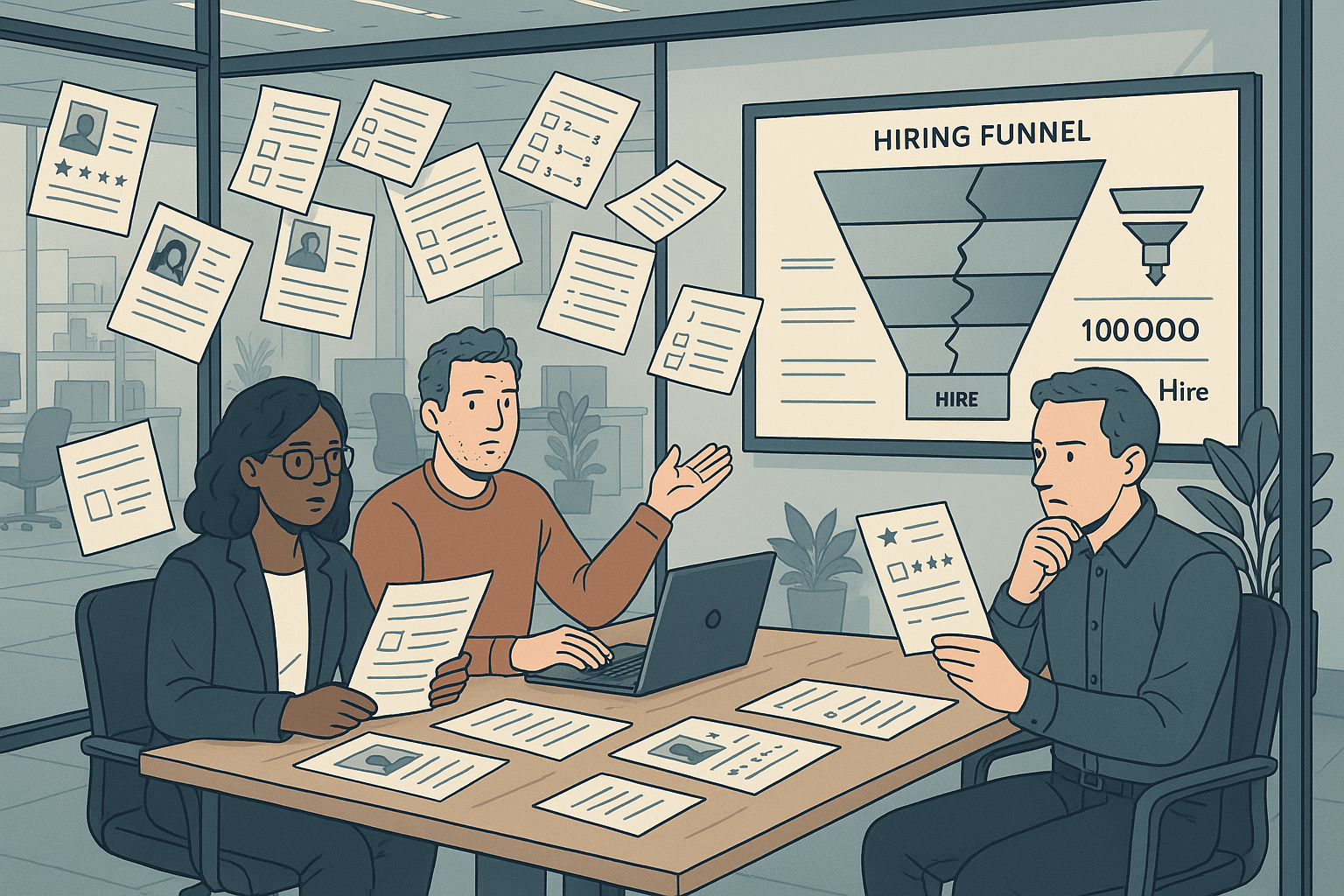
The failure mode usually starts small enough that nobody names it.
You hire your first three or four employees with a lot of founder involvement. Everyone knows what “great” looks like because the founding team is in every interview, the company story is fresh, and the role requirements are still attached to actual work that needs to get done next week. The process is scrappy, but it works. Candidates move fast. Debriefs are sharp. Offers get accepted. People you hire tend to perform.
Then the company grows just enough for the loop to decentralize.
A recruiter joins or the founder steps out of first screens. The hiring manager adds a technical screen “just to check depth.” One interviewer starts probing for startup grit. Another decides they care a lot about polish. Someone else asks a version of the same behavioral question every time because it “gets to judgment.” The scorecard still exists in the ATS, but half the panel treats it as a compliance artifact and half treats it as an actual evaluation framework. Debriefs get longer and less clear. Candidate feedback becomes more articulate but less useful. Close rates start slipping. A few hires look good on paper but underperform in exactly the areas the loop was supposed to test.
No single dashboard tells you what broke.
Pipeline volume may look fine. Time-to-fill may only drift a little. On-site pass-through may still appear normal. Interviewers are busy, nobody wants more process, and every role feels “special.” So the hiring system quietly decays while everyone keeps talking about talent market conditions, compensation pressure, or candidate quality.
That decay has a name: interview loop drift.
Interview loop drift is what happens when a startup’s hiring process stops being a system and becomes a loose federation of interviewer preferences. Scorecards remain nominally standardized, but in practice they’re interpreted differently by each panelist. Interviewers freelance new criteria. Recruiters sell one version of the role while the panel evaluates another. Hiring managers think they are screening for execution while the team screens for pedigree, communication style, or familiarity with a previous company’s tooling. Debriefs become exercises in persuasion rather than evidence aggregation.
The dangerous part is that it does not look like obvious dysfunction. It looks like smart people applying judgment.
And that’s exactly why founders miss it.
What loop drift looks like in the wild
Here’s a very common early-stage example.
A Series A company is hiring its second product manager. The original PM was hired directly by the founder and has been successful. The team decides to “codify” the process using four interviews:
- Recruiter screen
- Hiring manager interview
- Cross-functional panel
- Founder close
On paper, the scorecard has four dimensions:
- Product judgment
- Execution / operating cadence
- Stakeholder management
- Startup slope / ambiguity handling
Looks reasonable.
Three months later, the actual loop has mutated:
- The recruiter optimizes heavily for story, polish, and compensation closability.
- The hiring manager uses a broad unstructured interview and believes they are testing product judgment.
- The engineer on the panel mainly screens whether the PM can write clear tickets and understand technical tradeoffs.
- The designer screens for taste and collaboration style.
- The founder increasingly uses the final interview to “gut check founder-market fit,” which really means charisma, speed of thinking, and whether the candidate sounds like prior successful employees.
None of those perspectives is individually irrational. The problem is that they are no longer aligned to a shared definition of what success in the role actually requires.
Now layer in the predictable second-order effects:
- Different interviewers ask overlapping questions, so coverage is worse than it appears.
- Some competencies are tested three times while others are barely tested at all.
- Interviewers assign the same numeric score for different reasons.
- “No hire” votes carry different thresholds depending on interviewer seniority.
- Debriefs reward the most confident speaker, not the most diagnostic evidence.
- Recruiters cannot coach candidates well because they no longer know what the panel really values.
- Candidates experience the process as repetitive, inconsistent, and oddly political.
The company starts seeing outcomes like these:
- More false positives: people pass interviews but struggle in execution.
- More false negatives: strong candidates get rejected because one interviewer free-styled a criterion unrelated to role success.
- Longer debrief cycles because evidence is hard to reconcile.
- Lower offer acceptance because candidates sense inconsistency and lose confidence.
- More post-hire disagreement because stakeholders think they “signed up for” different profiles.
That’s loop drift. It hurts signal quality on the front end and close rates on the back end.
The pattern behind the problem
If you strip away the details, loop drift happens when three things become decoupled:
- Role design: what the company actually needs someone to do.
- Evaluation design: what the interview process claims to measure.
- Loop execution: what interviewers actually reward or penalize.
In the first few hires, those three are tightly coupled because the founders hold them together manually.
Later, they drift apart because startups add process components faster than they add process discipline.
That sounds like a critique of startups, but it’s really a normal scaling problem. Early on, coherence comes from proximity. Later, coherence has to come from systems. If you don’t build those systems intentionally, local interviewer behavior fills the gap.
There are five recurring drivers.
1. Scorecards are too generic to constrain behavior
Most startup scorecards use familiar categories like:
- Strategic thinking
- Communication n- Culture fit
- Ownership
- Technical depth
These categories feel standardized but are too abstract to create consistent judgments. One interviewer maps “ownership” to initiative. Another maps it to willingness to work long hours. Another maps it to cross-functional influence. Because everyone uses the same label, the team thinks they are aligned when they are not.
A scorecard category only works if it has:
- A role-specific definition
- Observable indicators
- Clear positive and negative anchors
- A known level expectation
Without those, the scorecard is a spreadsheet-shaped illusion of rigor.
2. Interviewers optimize for avoiding embarrassment, not maximizing predictive signal
Most interviewers are not trained assessors. They are operators with day jobs. So they naturally drift toward criteria they can judge confidently.
An engineer may avoid evaluating product judgment because it feels subjective and instead overweight technical fluency. A founder may over-index on intensity and communication because those traits are obvious in a one-hour conversation. A functional leader may favor people who “feel easy to work with” because it reduces interpersonal risk.
Again, individually rational. Systemically damaging.
When left alone, panels don’t become more accurate. They become more comfortable.
3. The role evolves, but the loop doesn’t
This one is brutal in startups because roles mutate every six months.
The first AE needed founder-like hustle and broad generalism. The sixth AE needs process adherence, pipeline discipline, and cleaner forecasting. The first product hire needed zero-to-one instincts. The third needs cross-functional operating rhythm and prioritization discipline.
If the loop isn’t updated, interviewers keep selecting for the old version of success. Then everyone is confused when “great interviewers” are no longer producing great hires.
4. Debriefs turn into courtroom arguments instead of evidence synthesis
When panels lose trust in the underlying rubric, debriefs become political. Interviewers show up with impressions, isolated anecdotes, and often a preferred conclusion. The goal subtly shifts from “What did we learn?” to “Can I persuade the room?”
The person with the strongest status, strongest rhetoric, or strongest emotional reaction often wins.
That is not a hiring system. That is an internal influence contest with candidate consequences.
5. Candidate selling and candidate evaluation split apart
Startups often separate hiring quality from close rate analysis. They treat evaluation quality as one problem and candidate experience / offer acceptance as another.
In reality, loop drift degrades both.
Why? Because candidates infer organizational quality from the interview process itself. If one interviewer pitches speed and autonomy while another describes heavy process and undefined responsibilities, candidates notice. If questions are redundant, if panelists seem misaligned, if interviewers can’t explain how decisions get made, strong candidates correctly infer that the company itself may be operating the same way.
Close rates do not just reflect compensation competitiveness. They reflect candidate confidence in team coherence.
Why the standard advice fails
The usual advice for startup hiring problems sounds something like this:
- Use structured interviews.
- Add scorecards.
- Train interviewers.
- Run debriefs.
- Track funnel metrics.
None of that is wrong. It’s just too generic to fix loop drift.
Here’s why.
“Use structured interviews” is directionally right but operationally weak
Founders hear this and translate it into “make sure each interviewer has a topic.” So they assign one interviewer to leadership, one to execution, one to technical depth, and call it done.
But a topic is not a structured interview.
A structured interview requires:
- A defined competency
- A consistent prompt set
- Behavioral anchors
- A rating scale with examples
- A clear decision threshold
- A separation between evidence capture and overall recommendation
Without those pieces, you’ve just created themed conversations.
“Add scorecards” often creates fake standardization
Most ATS tools make it easy to attach scorecards. They do not make it easy to ensure people interpret them similarly.
This is the core issue. Startups often mistake scorecard completion for scorecard calibration.
If your panelists all submit feedback, but one person’s “3/4” means “meets bar,” another’s means “borderline,” and another uses “strong no hire unless exceptional elsewhere,” you don’t have comparable data. You have decorative numerics.
“Train interviewers” usually means one kickoff session and then entropy
A lot of startup interviewer training is a 45-minute meeting when the panel is first formed. Everyone nods, agrees to avoid illegal questions, maybe gets told about bias, and then goes back to running interviews from memory.
That is not enough.
Interviewer quality is not set-and-forget. It decays. People improvise. New panelists inherit local habits. The role changes. The company narrative changes. You need ongoing recalibration, not a one-time ritual.
“Track funnel metrics” misses the hidden failure layer
Time-to-fill, pass-through rates, and acceptance rates matter. But they’re lagging indicators and they flatten the process.
Two loops can show the same on-site pass-through rate while one has far better signal quality. One may reject weak candidates consistently and close strong ones. The other may generate noisy debriefs, inconsistent candidate experiences, and random interviewer decisions that cancel out in aggregate.
If you only track top-line funnel numbers, loop drift can survive for months.
A better approach: treat hiring loops like operating systems, not meeting sequences
The right mental model is not “How do we make interviews more professional?”
It is: How do we preserve decision quality as founder intuition gets distributed across a small organization?
That requires a lightweight hiring operating system with five properties:
- Role-specific competencies tied to actual performance outcomes
- Clear interview ownership so each panelist evaluates distinct signal
- Rubric calibration so the same score means the same thing across interviewers
- Reliability instrumentation so you can see which interviewers produce useful signal
- Tight handoffs between recruiter, hiring manager, and panel so candidates move through one coherent process
This does not require big-company bureaucracy. It requires more precision in fewer places.
Step 1: Audit loop drift before you redesign anything
Do not start by rewriting all your scorecards. First, diagnose where drift is happening.
A fast audit can be done in one to two weeks for a single role family.
What to collect
Pull the last 15 to 25 candidates who went through a similar loop, ideally including:
- Stage progression
- Interview panel composition
- Written scorecards
- Final debrief notes
- Offer / reject outcome
- Offer acceptance outcome
- If available, post-hire performance for hires made through the loop
You’re looking for pattern mismatches, not statistical perfection.
What to examine
1. Scorecard completion quality
Review submitted scorecards and classify them:
- Specific evidence with clear rating rationale
- Vague positive / negative impressions
- Restated resume or interview summary
- Missing / late feedback
If more than 20 to 30 percent of scorecards are vague, delayed, or non-evidentiary, your system is already degrading. Late scorecards are especially damaging because interviewers get contaminated by debrief conversation.
2. Competency coverage overlap
Map each interviewer against the competencies they were supposed to assess and what they actually commented on.
A simple table works:
| Interviewer | Assigned competency | Actual themes in feedback |
|---|---|---|
| HM | Execution | Product sense, culture fit, communication |
| Engineer | Collaboration | Technical fluency, PM instincts |
| Founder | Company sell | Founder energy, ambition, polish |
This usually reveals the truth quickly: there is much more overlap than the loop design implies.
3. Rating distribution by interviewer
Look at each interviewer’s scoring pattern over 10 to 20 interviews.
Questions to ask:
- Who rarely gives strong yes or strong no?
- Who is systematically harsher than peers?
- Who gives high ratings with weak evidence?
- Who often dissents from the final outcome?
You’re not trying to eliminate differences. You’re trying to understand whether those differences are diagnostic or just noise.
4. Debrief dynamics
Read debrief notes or ask participants to reconstruct recent debriefs.
Signs of drift:
- Re-litigation of what each competency means
- New criteria introduced during the debrief
- Heavy dependence on founder or hiring manager interpretation
- Vetoes based on ambiguous “concerns” with no rubric tie-back
- Minimal discussion of recruiter signal and candidate motivations
If the debrief is where criteria are decided, the loop is already broken.
5. Candidate experience inconsistencies
Have the recruiter summarize where candidates seemed confused, surprised, or less enthusiastic after specific stages.
Common symptoms:
- “I got asked the same question three times.”
- “I’m still not sure what the team really needs in this role.”
- “Different interviewers described very different expectations.”
- “The final conversation felt like a totally different bar.”
Candidates are often your earliest warning system.
A simple loop drift audit score
You do not need a complex maturity model. Score each role’s loop on a 1–5 scale across these dimensions:
- Competency clarity
- Interview ownership clarity
- Scorecard evidence quality
- Inter-interviewer consistency
- Debrief discipline
- Candidate narrative consistency
- Post-hire signal validity
Any role with two or more dimensions at 1 or 2 deserves intervention first.
Step 2: Rewrite scorecards as rubrics, not labels
This is the highest leverage change.
Most startups don’t need more interview stages. They need sharper rubrics.
A good startup hiring rubric has four elements for each competency:
- Definition: what this competency means in this role
- Observable evidence: what the interviewer should probe for
- Anchors: what weak, acceptable, and strong answers look like
- Non-goals: what should not be inferred from this competency
Here’s an example for an early-stage PM role.
Weak scorecard item
Execution
Rate 1–4.
This is useless.
Better rubric item
Execution / operating cadence
Definition: Can translate ambiguous goals into an operating plan, maintain momentum across functions, and close loops without founder-level intervention.
Probe areas:
- Examples of taking a fuzzy problem and creating a scoped plan
- How they tracked decisions, risks, and dependencies
- Evidence of driving follow-through across engineering, design, GTM
- Tradeoffs made when timelines or scope changed
Strong evidence:
- Describes a concrete planning system they used
- Shows prioritization discipline under constraints
- Demonstrates follow-through mechanisms, not just influence language
- Can explain a missed outcome and what changed operationally afterward
Weak evidence:
- Talks mostly in strategic framing without operational detail
- Relies on others for follow-through
- Uses generic collaboration language with little evidence of cadence management
- Cannot articulate how tradeoffs were made over time
Do not infer from:
- Presentation polish
- Familiarity with your current tools
- Seniority of past employers
That one change does three things at once:
- It improves interviewer consistency.
- It reduces freelancing.
- It makes debriefs evidence-based instead of vibe-based.
How many competencies should a startup use?
Usually fewer than you think.
For most startup roles, 4 to 6 competencies is enough. More than that and the loop gets mushy.
Example sets:
Founding AE / early sales
- Discovery and customer insight
- Process ownership and follow-through
- Objection handling and deal control
- Startup resilience / pace tolerance
- Market communication
Product designer
- Problem framing
- Interaction and systems thinking
- Cross-functional collaboration
- Feedback integration
- Speed-quality tradeoff judgment
Engineering manager
- Technical judgment through others
- Delivery management
- Talent density / coaching
- Cross-functional communication
- Ambiguity reduction
Keep them role-specific and tied to what failure in the role would actually look like.
Step 3: Assign single-threaded ownership for each signal
One of the biggest drivers of loop drift is that everyone interviews “for a little bit of everything.” That feels thorough but creates duplication and accountability gaps.
Instead, assign primary ownership.
For each interview stage, define:
- Primary competency ownership
- Secondary observations allowed
- Explicit out-of-scope areas
Example:
| Stage | Owner | Primary competencies | Out of scope |
|---|---|---|---|
| Recruiter screen | Recruiter | Motivation, narrative coherence, logistics, top-level role match | Deep functional assessment |
| HM interview | Hiring manager | Core role outcomes, operating style, role-level expectations | Candidate close / comp negotiation |
| Cross-functional | Partner function | Collaboration patterns, handoff quality, role-specific interfaces | Re-testing HM competencies |
| Founder | Founder | Company context fit, mission pull, high-level risk review, candidate sell | Surprise bar-raising criteria |
The phrase that matters is out of scope.
If the founder is allowed to improvise new criteria in the final round, the whole system becomes unstable. The founder can still identify risk, but those risks need to map back to defined competencies or trigger a deliberate follow-up, not an ad hoc rejection.
Step 4: Instrument interviewer reliability without turning this into HR theater
This is where most startups stop because it feels too corporate. That’s a mistake.
You do not need industrial-organizational psychology. You need a lightweight way to know whether your interviewers produce useful signal.
The simplest reliability dashboard
For each interviewer, track over time:
- Number of interviews conducted
- On-time scorecard submission rate
- Evidence quality score (simple 1–3 review by recruiter or HM)
- Average rating by competency
- Rating variance versus peer interviewers
- Correlation with final hiring decisions
- For hires: rough correlation with 90-day or 180-day performance outcome
No single metric should determine interviewer quality. But together they surface patterns.
Examples:
- An interviewer who writes thoughtful evidence, spots issues others miss, and whose no-hire calls often map to later performance issues is valuable, even if they’re somewhat harsher than average.
- An interviewer who consistently gives strong yes votes with thin evidence and whose candidates underperform is diluting the loop.
- An interviewer who submits scorecards late and changes their view during debrief is creating contamination risk.
A practical way to score evidence quality
Use a simple rubric:
3 = Strong
- Specific observations
- Tied to rubric
- Clear rationale for rating
- Includes examples or candidate statements
2 = Adequate
- Some evidence present
- Rating understandable but not deeply anchored
1 = Weak
- Vague impressions
- Little or no connection to rubric
- Summary without evaluation
You don’t need perfection. You need visibility.
Beware overfitting to “agreement”
Not all disagreement is bad. If your goal becomes making everyone score the same, you may remove useful dissent.
The question is not “Do interviewers agree?”
It is “Do they disagree for understandable, rubric-grounded reasons?”
Healthy systems allow disagreement but make it legible.
Step 5: Fix the recruiter–hiring manager–panel handoff gaps
A lot of loop drift is really a handoff problem disguised as an interviewer problem.
The recruiter, hiring manager, and panel often operate from different versions of the truth.
The three handoffs that matter
1. Role kickoff: founder / hiring manager to recruiter
Before sourcing starts, align on:
- Must-have outcomes in first 6 to 12 months
- What a strong yes actually looks like
- What backgrounds are acceptable substitutes
- Which risks are tolerable vs disqualifying
- What story the recruiter should tell candidates
If this is fuzzy, everything downstream gets fuzzy.
2. Loop briefing: hiring manager to panel
Before interviews begin, give each interviewer a brief with:
- Role context
- Competencies they own
- What not to test
- Suggested prompts
- Rating anchors
- Any known candidate context that is appropriate to share
This can be a one-page doc. It just needs to exist.
3. Candidate progression: recruiter to panel and back
After each stage, the recruiter should know:
- What signals strengthened or weakened
- What open questions remain
- How the candidate is feeling
- What expectations have been set
That prevents the all-too-common startup issue where the panel is optimizing for evaluation while the candidate is silently losing conviction.
The recruiter’s role is larger than scheduling
In good startup hiring systems, the recruiter is not just an air traffic controller. They are the process integrity owner.
That means they should be empowered to:
- Flag repetitive or off-rubric interviews
- Chase late or low-quality scorecards
- Note candidate confusion patterns
- Escalate when interviewer behavior is degrading close rates
- Push for loop updates when role realities change
If the recruiter lacks standing to do this, drift accelerates.
Tooling: what you actually need and what you don’t
You do not need an enterprise talent stack to fix loop drift.
You need a minimal workflow that supports clear rubrics, evidence capture, and review.
Option 1: ATS-native setup
Examples: Greenhouse, Lever, Ashby
Best for: Startups already doing moderate hiring volume and wanting everything in one system.
Pros:
- Centralized scorecards
- Interview kit templates
- Stage reporting
- Permissioning and audit trail
- Easier panel coordination
Cons:
- Native scorecards can still be too shallow
- Calibration workflows are limited unless intentionally managed
- Teams often confuse feature availability with process quality
Typical cost:
- Lever / Greenhouse / Ashby can range from low five figures annually upward depending on company size and modules
Founder takeaway: If you already have one, use it better before buying more tools.
Option 2: ATS + lightweight docs / Notion layer
Best for: Seed to Series A teams that need process precision without heavy systems investment.
Use:
- ATS for workflow and scorecard collection
- Notion or Google Docs for role briefs, rubric definitions, interviewer guides
- Spreadsheet or simple BI layer for interviewer reliability tracking
Pros:
- Cheap
- Fast to implement
- Flexible role-by-role
- Easy to update as roles evolve
Cons:
- Requires discipline to keep docs current
- Some reporting is manual
- Can break if ownership is unclear
Typical cost:
- Existing ATS + near-zero incremental software cost
- Main cost is operator time
Founder takeaway: This is the sweet spot for most early-stage startups.
Option 3: Dedicated interview intelligence / analytics tools
Examples vary and change quickly; many focus on interview recording, note quality, or analytics.
Best for: Teams with enough volume to justify deeper QA and calibration.
Pros:
- Better reviewability of interviewer behavior
- Easier coaching on interview quality
- More data on question usage and consistency
Cons:
- Extra complexity
- Candidate consent / privacy considerations
- Easy to over-implement relative to startup hiring volume
Typical cost:
- Meaningful incremental spend plus change management overhead
Founder takeaway: Useful later. Rarely the first fix.
A lightweight workflow that actually works
Here is a practical operating cadence for a startup hiring loop without turning the company into a bureaucracy machine.
Before opening the role
Hiring manager + recruiter + founder / exec sponsor, 45 minutes
Produce:
- 6–12 month outcomes for the role
- 4–6 competencies tied to those outcomes
- Interview plan with single-threaded ownership
- Candidate narrative / sell points
- “What would make us reject someone late?” list
Before panel starts interviewing
Interviewer briefing, 30 minutes or async doc review
Each interviewer gets:
- Role brief
- Their competency rubric
- Sample prompts
- Rating anchors
- Reminder of out-of-scope areas
- Deadline for same-day scorecard submission
Weekly during active hiring
15-minute loop health review: recruiter + HM
Review:
- Stage conversion anomalies
- Candidate confusion patterns
- Late or weak scorecards
- Repeated overlap in interviews
- Whether role requirements changed
Every 5 to 10 candidates
30-minute calibration review: HM + recruiter + key panelists
Discuss:
- Are we interpreting competencies consistently?
- Which interview prompts are producing useful signal?
- Where are we seeing duplicate assessment?
- Are we filtering too hard / too soft?
- Are candidates leaving more or less excited after each stage?
After each hire or late-stage reject
10-minute retro
Ask:
- What did the loop correctly detect?
- What remained uncertain too late?
- Did anyone introduce surprise criteria?
- Did the candidate experience reinforce or hurt our close odds?
This sounds like more process than most startups want. In practice, it usually saves time because it reduces repetitive debriefs, avoids wasted interviews, and improves close rates.
Cost and time analysis: the real tradeoff
Founders often resist this work because they assume lightweight standardization equals slower hiring.
Usually the opposite is true.
Here’s a realistic comparison for a startup hiring 10 to 20 roles per year.
Unmanaged loop drift
Visible cost:
- Minimal upfront process work
Hidden cost:
- 15–30 minutes extra per interviewer per debrief due to ambiguity
- More late-stage candidate losses from inconsistent experience
- More wasted interviews from duplicate coverage
- Higher risk of a mis-hire or false negative
- More founder time spent adjudicating opinions
If a five-person panel wastes even 20 extra minutes each across debrief and redundant interviewing, that is 1.5 to 2.0 hours per candidate. Across 30 candidates in a role family, it compounds quickly.
And that ignores the real cost driver: one bad hire in an early-stage company can cost months of team drag, severance, backfill time, and lost momentum. Conservatively, that’s often $50,000 to $150,000+ in direct and indirect cost depending on role seniority.
Lightweight loop discipline
Upfront cost per role setup:
- 2–4 hours to define outcomes, competencies, and rubric
- 30–45 minutes to brief panel
- 15 minutes weekly during active hiring
- 30 minutes every 5–10 candidates for calibration
Benefits:
- Cleaner debriefs
- Higher confidence yes / no decisions
- Better recruiter guidance
- Better candidate experience
- Easier scaling when additional interviewers join
For most startups, this is one of those rare operational improvements that saves both money and executive attention.
How to run better debriefs
If your debrief is broken, everything upstream gets distorted because interviewers learn that persuasive storytelling beats rigorous evidence.
Use a simple debrief structure:
1. Silent scorecard submission before meeting
No exceptions unless there’s an emergency. If feedback comes after the discussion starts, it is contaminated.
2. Recruiter or moderator restates the role and competencies
One minute. Set the frame.
3. Each interviewer gives evidence first, recommendation second
Good format:
- Competency owned
- Key evidence observed
- Rating and rationale
- Open questions
Bad format:
- “I just didn’t feel great.”
4. Map disagreements to competencies, not personalities
Instead of “I trust Alex’s judgment here,” ask:
- Which competency are we disagreeing on?
- What evidence supports each interpretation?
- Is the issue that the rubric is unclear or the candidate signal is mixed?
5. Separate risk discussion from candidate selling discussion
Especially for strong candidates, startups often blend “Should we hire them?” with “Can we close them?”
Discuss hiring bar first. Then discuss close strategy.
6. Record loop learnings, not just decision outcome
Capture:
- Which competency remained weakly assessed
- Whether prompts worked
- Any process confusion observed
- Whether a follow-up is needed because of loop design, not candidate weakness
That last part matters. Sometimes the right answer is not “no hire.” It is “our loop did not actually test the thing we’re debating.”
Preserving signal without importing big-company sludge
The fear founders have is legitimate: a cleaner hiring system can become a bureaucratic trap.
That happens when process is optimized for compliance, not decision quality.
To avoid that, follow three rules.
Rule 1: Standardize only where inconsistency destroys signal
Standardize:
- Competencies
- Ownership
- Rating anchors
- Debrief format
- Scorecard timing
Do not over-standardize:
- Every interview question word-for-word
- Every conversational style
- Every candidate path for unusual senior roles
You are trying to preserve comparability, not script humanity out of the process.
Rule 2: Update loops when the role changes
Every time a role family shifts materially, revisit:
- What success now looks like
- Which competencies matter most
- Which interview stage owns them
- Which old criteria should be removed
A startup loop should feel versioned. If your first PM loop is still your fourth PM loop unchanged, that’s a smell.
Rule 3: Treat interviewer quality as an operating metric
Interviewing is real work. If you don’t inspect it, it will decay.
That does not mean humiliating panelists with league tables. It means coaching, calibrating, and rotating people out when they consistently add noise.
Some operators are excellent at the job and bad at interviewing. Those are different skills.
What founders should personally own
Founders should not stay in every loop forever. But they also should not disappear entirely.
There are four founder-level responsibilities that matter.
1. Set the hiring philosophy
What is the company actually optimizing for in talent?
Examples:
- Raw slope over pedigree
- Evidence over polish
- Role outcomes over “culture fit” language
- Fast, candidate-friendly loops without surprise gates
If this is not explicit, every panelist substitutes their own philosophy.
2. Protect against criterion creep
When new standards appear mid-process, founders should shut it down unless they are explicitly folded back into role requirements.
Criterion creep is one of the fastest ways to break trust with candidates and with your own team.
3. Review hiring quality retrospectively
Not every week. But quarterly, founders should ask:
- Which hires are outperforming and why?
- Which interview signals were truly predictive?
- Where did the loop miss?
- Which interviewers are helping or hurting?
4. Ensure close strategy is coordinated
A founder’s close power is wasted if the loop before it created confusion.
The best founder close is not a magical last-minute charisma blast. It is the final reinforcement of a coherent process the candidate already trusts.
A practical warning about “raising the bar”
Many startups diagnose drift incorrectly. They notice misses and conclude the team needs a higher bar.
Sometimes that is true. Often it is not.
A fuzzy process with a higher bar just becomes a slower, more political fuzzy process.
Before you tighten pass rates, ask:
- Are we evaluating the right things?
- Are interviewers using the same definitions?
- Are debriefs evidence-based?
- Are candidates getting a coherent story?
Bar raising without rubric clarity usually lowers throughput without improving hire quality.
The simplest version of the fix
If you did nothing else in the next 30 days, do this for one role:
- Define 4–6 role-specific competencies tied to actual outcomes.
- Assign one primary interviewer owner per competency.
- Rewrite scorecards with strong / acceptable / weak anchors.
- Require scorecards before debriefs.
- Run one calibration review after the next 5 candidates.
- Ask candidates where the loop felt inconsistent.
- Track which interviewers submit evidence-rich feedback on time.
That alone will fix more than most teams expect.
The real takeaway
Interview loop drift is not just a hiring ops nuisance. It is a systems failure in how startups distribute judgment.
In the beginning, founders compensate for process weakness through attention, intuition, and proximity. As the company grows, that stops scaling. If you don’t replace founder coherence with lightweight operating discipline, interview panels will quietly invent their own rules.
Then the company starts paying for it in exactly the ways that are hardest to attribute: muddier signal, slower decisions, weaker candidate conviction, lower close rates, and more inconsistent hires.
The answer is not a bloated recruiting machine.
It is a small amount of rigor in the places where rigor preserves signal:
- clear competencies
- owned evaluation areas
- calibrated rubrics
- disciplined debriefs
- visible interviewer quality
- tight recruiter / hiring manager / panel handoffs
Do that well and you get what early-stage companies actually need: a hiring system that still feels fast and human, but no longer depends on everyone magically meaning the same thing when they say “strong candidate.”