
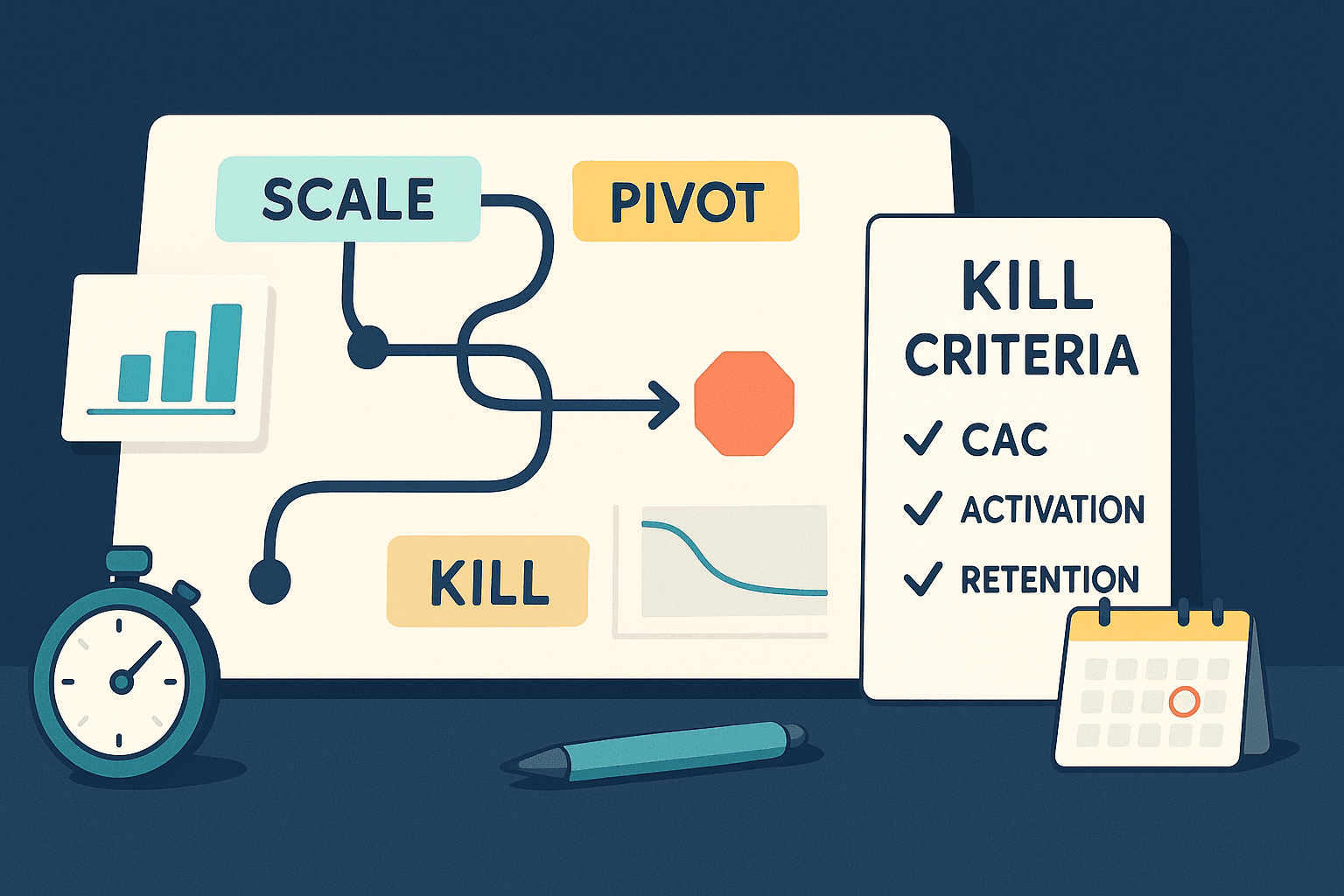
The most expensive startup habit: letting ideas linger
Most founders don’t fail because they start the “wrong” idea. They fail because they keep an idea alive long after the evidence has turned, because stopping feels like losing.
The cost isn’t just money. It’s time, team morale, and opportunity cost.
- Every month spent on a low-probability idea is a month you don’t spend on a better one.
- Every ambiguous “maybe it’ll turn around” burns trust in leadership.
- Every delayed decision compounds technical debt and market drift.
In technical startup environments, especially B2B, momentum can disguise misalignment. You can ship features weekly and still have a product that doesn’t earn the right to exist.
The solution is not “work harder” or “be more optimistic.” It’s to pre-commit to kill criteria: measurable thresholds and decision dates that force the question: Do we continue, pivot, or stop?
This article is a playbook for doing that rigorously.
What “kill criteria” really means (and what it’s not)
Kill criteria are pre-defined conditions under which you will stop, pivot, or significantly change direction, before you start the work.
They are:
- Measurable: tied to metrics you can actually observe.
- Time-bound: evaluated on a fixed cadence or decision date.
- Decidable: they produce a clear action, not a discussion loop.
Kill criteria are not:
- Vibes-based: “If it doesn’t feel right…”
- Retrospective rationalizations: metrics chosen after outcomes are known.
- A commitment to quit no matter what: you’re committing to a process, not a predetermined failure.
The goal is not to build a culture of quitting. It’s to build a culture where continuation must be earned.
This aligns with a core principle in lean experimentation: treat ideas as hypotheses and test them with real customer evidence, not internal belief. (See: Eric Ries’ The Lean Startup; Steve Blank’s Customer Development framework.)
Why founders avoid killing ideas (even smart ones)
If you’re technical and rational, you might assume decisions follow evidence. In practice, founders run into predictable cognitive traps:
- Sunk cost fallacy: “We already built so much.” (Classic behavioral economics; see Kahneman & Tversky work on decision-making under uncertainty.)
- Identity attachment: the product becomes a proxy for founder worth.
- Coordination costs: changing direction feels expensive because it requires re-aligning the team, re-selling investors, and rewriting the roadmap.
- Narrative bias: we prefer stories of heroic persistence over stories of strategic stopping. Startup media amplifies this (survivorship bias).
- Local maxima: early traction in a narrow niche can trap you in a low-ceiling business.
Kill criteria are a structural fix: they shift the burden of proof from “why stop?” to “why continue?”
The anatomy of a kill-criteria system
A robust system has five parts:
- A clear hypothesis (what must be true)
- A minimal test plan (what you’ll do to test it)
- Leading and lagging indicators (what you’ll measure)
- Kill thresholds (the line you won’t cross)
- A decision date (when you’ll decide)
Founders usually do 1–3. They often skip 4–5. That’s where the months get wasted.
Step 1: Write hypotheses that are actually falsifiable
Bad hypothesis:
“Teams will love an AI assistant for product managers.”
This is not falsifiable because “love” is undefined, and “teams” is too broad.
Better:
“In mid-market B2B SaaS companies (200–2000 employees), at least 20% of product managers who see a demo will start a 14-day trial, and at least 30% of trial users will return 3+ days in week 2.”
Now it’s falsifiable. And it implies a specific market.
A useful template:
For [specific persona] who [specific job-to-be-done], our product [does X], and we believe [measurable outcome] because [reason].
Use this to anchor kill criteria to reality.
Step 2: Choose metrics that match the stage (don’t kill on the wrong signal)
A common failure mode is picking metrics that are either too early (vanity) or too late (revenue) for your stage.
A practical stage map:
Stage A, Problem discovery
Goal: prove the problem is painful and frequent.
Signals:
- % of interviews where the problem is ranked top 3
- Evidence of existing spend (tools, contractors, internal headcount)
- Time-to-problem (how often it occurs)
Stage B, Solution validation
Goal: prove users want your solution.
Signals:
- Demo-to-trial conversion
- Willingness to give data access / install / invite teammates
- “Pull” behaviors: inbound requests, follow-ups, referrals
Stage C, Early retention
Goal: prove recurring value.
Signals:
- Activation rate (defined as “first value moment”)
- Cohort retention (week 1/2/4 depending on product cadence)
- Time-to-value (TTV)
Stage D, Monetization
Goal: prove pricing and willingness to pay.
Signals:
- Paid conversion
- Expansion intent
- Pipeline quality (not just top-line)
Stage E, Go-to-market scale
Goal: prove you can grow efficiently.
Signals:
- CAC payback period
- Gross margin
- LTV:CAC (with caution early)
Opinionated take: In B2B, founders kill too late because they wait for revenue signals that require months of sales cycle. You can often kill earlier using commitment proxies: security review willingness, champion strength, ability to get on the calendar, and whether prospects will integrate data.
Step 3: Define kill thresholds that are brutal but fair
A kill threshold is not “if growth isn’t great.” It’s something like:
- “If we can’t get 15 qualified discovery calls with ICP prospects in 30 days, we stop.”
- “If activation is below 25% after fixing onboarding twice, we pivot.”
- “If we cannot close 2 paid pilots at $X within 60 days, we end the experiment.”
How to set thresholds without guessing
You will guess somewhat, early-stage data is sparse. But you can anchor thresholds using:
- Comparables: Benchmarks from similar products and motions.
- For B2B SaaS funnel benchmarks, sources like OpenView reports, SaaS benchmarks from KeyBanc Capital Markets surveys, and Reforge essays can be directional (treat as context, not truth).
- Back-solving economics: What must be true for the business model to work?
- If your ACV is $12k and your sales cycle is 60–90 days, you need either a cheap acquisition channel or strong conversion.
- Capacity constraints: How many shots on goal can you take?
- A team with 2 engineers and 1 founder-selling can’t run five parallel bets.
Brutal but fair: the calibration rule
A good kill threshold has these properties:
- If you miss it, you’ll genuinely stop (otherwise it’s theater).
- If you hit it, you’ll genuinely continue (otherwise it’s rigged).
- It’s within your control to test (don’t hinge on macro events).
If a threshold doesn’t cause a decision, remove it.
Step 4: Set decision dates (the thing that changes behavior)
Without a decision date, metrics become “interesting” rather than decisive.
A decision date is a pre-scheduled moment when you will choose one of:
- Scale (double down, invest)
- Pivot (change ICP, problem, channel, or product shape)
- Kill (stop the idea or shelve it)
Recommended cadence
- Discovery bets: 2–4 weeks
- Prototype / MVP bets: 4–8 weeks
- GTM experiments: 4–6 weeks per channel test
Longer than this, and you risk building a mini-company around a hypothesis.
Opinionated take: If your team can’t make a meaningful decision in 6 weeks, you’ve likely defined the experiment too vaguely.
Step 5: Run a brutal pre-mortem (before you build)
A pre-mortem asks:
“It’s 90 days from now. This idea failed. What happened?”
This technique is credited in popular form to Gary Klein and used widely in high-stakes decision-making because it reduces overconfidence and surfaces hidden risks.
Pre-mortem agenda (45–60 minutes)
- Restate the hypothesis and experiment plan (5 min)
- Silent writing: everyone lists failure reasons (10 min)
- Group clustering: merge themes (10 min)
- Rank top 3 risks by likelihood × impact (10 min)
- Convert each risk into a kill criterion or mitigation (10–20 min)
Common failure modes your pre-mortem should force you to face
- The ICP isn’t reachable (no channel, no warm intros, no outbound conversion).
- The buyer isn’t the user (misaligned incentives).
- The “problem” is a symptom (root cause is elsewhere).
- Switching costs are too high.
- Data access/integration is the real product.
- Compliance/security blocks you.
- The market already has an adequate solution.
If the pre-mortem doesn’t change your plan, you likely did it performatively.
The Kill Criteria Canvas (copy/paste template)
Use this as a one-page contract with yourself and your team.
textKILL CRITERIA CANVAS

1) Idea / Bet Name:

2) Target ICP (specific):

3) Problem statement (observable):

4) Hypothesis (falsifiable):

5) Experiment plan (minimum viable test):
   - What we will build/do:
   - What we will not build/do:

6) Metrics:
   Leading indicators (early signals):
   Lagging indicators (outcomes):

7) Kill thresholds (numbers + timeframe):
   - If X is below ___ by date ___, then we will ___ (kill/pivot).
   - If Y is below ___ by date ___, then we will ___.

8) Decision date(s):

9) Pre-mortem top risks:
   - Risk #1:
   - Risk #2:
   - Risk #3:

10) Owner + reviewers:

11) What “success” means (what we do if it works):

12) What “kill” means (what we do if it fails):
   - Repo archived? Landing page taken down?
   - Team reassigned?
   - Customer comms?
The last section matters. If “kill” isn’t operationally defined, you’ll avoid it.
Choosing kill criteria by startup surface area (product, GTM, market)
Not all kills are product kills. Often the product is fine; the channel or ICP isn’t.
1) Product kill criteria
Use when you’re unsure if the solution delivers value.
Examples:
- Activation rate below 20% after two onboarding iterations.
- Median time-to-value above 30 minutes for a tool that should be “instant.”
- Retention: fewer than 15% of activated users return weekly by week 4 (for a weekly-workflow product).
2) Channel kill criteria
Use when the product resonates in small tests but growth is unclear.
Examples:
- Outbound: fewer than 3% positive reply rate after 1,000 ICP emails with strong personalization.
- Content: fewer than 5 SQLs after publishing 10 high-intent posts and building relevant distribution.
- Partnerships: zero co-sell intros after signing 3 partners.
3) ICP kill criteria
Use when some users love it, but the segment might be wrong.
Examples:
- Sales cycle exceeds 120 days consistently at your target ACV.
- Security review blocks 80%+ of deals (you’re selling too high in the org).
- Champions can’t get budget approval even with ROI.
4) Business model kill criteria
Use when value exists but economics don’t.
Examples:
- Services required exceed 30% of deal value with no path to productization.
- Gross margin < 60% for SaaS-like expectations (context-dependent).
- Customers only buy at a price that can’t support acquisition costs.
This “surface area” framing prevents a common mistake: killing the entire startup when only one dimension is failing.
Making kill criteria measurable in B2B (where cycles are long)
B2B founders often protest: “We can’t know in 30 days.”
You can’t know everything. But you can know enough to avoid wasting quarters.
Use commitment milestones as proxies
Instead of waiting for revenue, track commitments that correlate with eventual purchase:
- Prospect agrees to share data or grant read access
- Prospect introduces you to security/IT
- Prospect schedules a pilot kickoff with multiple stakeholders
- Prospect allocates internal resources (someone is assigned)
- Prospect agrees to a paid pilot (even small)
These are harder to fake than “interest.”
Instrument your pipeline like a product
Treat pipeline stages as a funnel with conversion targets:
- Contacted → Replied
- Replied → Qualified
- Qualified → Demo
- Demo → Pilot
- Pilot → Paid
Kill criteria can be placed on stage conversion, not just the final stage.
Example:
“If after 30 demos we can’t convert at least 20% into pilots, our value proposition is not landing.”
The decision stack: what to do when you hit (or miss) thresholds
Kill criteria only work if they map to actions.
If you hit success criteria
Don’t just celebrate, escalate commitment.
- Increase investment (headcount, spend) deliberately.
- Raise the bar: new metrics for the next stage.
- Lock learnings into documentation: what messaging worked, which ICP responded, which objections dominated.
If you miss criteria: kill vs pivot
A miss doesn’t always mean “stop everything.” Use a structured triage:
- Is the signal trustworthy? (sample size, data quality)
- Is the bottleneck fixable within one more cycle? (time-boxed)
- Is the upside worth the next cycle? (expected value)
If you can’t answer “yes” convincingly, kill.
A pivot is justified when:
- You see strong pull from a different ICP than expected.
- Users are hacking the product for another job-to-be-done.
- One channel fails but another shows promise.
A kill is justified when:
- You cannot reach the ICP reliably.
- The problem is not sufficiently painful.
- Switching costs dominate benefits.
- Differentiation is weak and defensibility is low.
How to avoid “kill criteria theater” (the most common failure)
Teams often create kill criteria and still don’t kill. Here’s why, and how to fix it.
1) Ambiguous ownership
Fix: assign a single DRI (directly responsible individual) for the bet and for the decision memo.
2) Moving goalposts
Fix: write thresholds down before you run the experiment; require a documented reason to change them, approved by someone not emotionally attached.
3) Overfitting to small samples
Fix: specify minimum sample sizes (e.g., “at least 20 qualified demos” or “at least 200 unique visitors from ICP sources”).
4) Confusing effort with evidence
Fix: explicitly ban input metrics as success criteria (“we shipped 10 features”). Inputs can be tracked, but they don’t decide continuation.
5) Avoiding hard conversations
Fix: schedule the decision meeting on day 1 and invite stakeholders. Put it on calendars.
The kill memo: turning a shutdown into organizational learning
If you kill an idea and learn nothing, you just paid tuition without taking notes.
Write a short memo (1–2 pages):
- Hypothesis
- What we did
- Data (funnels, cohorts, pipeline)
- What surprised us
- Why we’re killing/pivoting
- What we’d do differently
- Assets to reuse (code, content, relationships)
This creates institutional memory and reduces the emotional sting, because the work becomes a reusable asset.
Amazon popularized a culture of written narratives for decision quality; while you don’t need Amazon’s scale, the principle holds: writing forces clarity.
When not to use kill criteria (yes, sometimes)
There are cases where strict thresholds can harm you.
1) Deep tech / long research cycles
If you’re building something with genuine R&D uncertainty (e.g., novel ML systems, biotech-like validation, infrastructure with long sales), early thresholds may be misleading.
Still, you can use kill criteria, just shift them to:
- feasibility milestones (latency, accuracy, cost)
- access milestones (design partners, data rights)
- risk retirement (prove a key technical assumption)
2) Founder-market fit exploration
Early on, you might be exploring where you have unique advantage. Overly rigid kill criteria can prevent you from discovering adjacent opportunities.
The compromise: use short cycles and learning goals, but keep decision dates.
3) Market timing bets
If success depends heavily on timing (regulation change, platform shift), you may choose to “hold” an idea rather than kill it.
In that case, define “hibernation criteria”:
- minimal maintenance budget
- monitoring signals that trigger reactivation
Practical examples (with numbers)
Example 1: B2B developer tool (PLG motion)
Hypothesis: GitHub-first teams will adopt a tool that automatically enforces deployment policies.
Experiment: build a GitHub app + onboarding flow + docs.
Success criteria (6 weeks):
- 1,000 ICP visitors to docs/landing
- 8% visitor→install
- 40% install→activated (first policy enforced)
- Week-4 retention: 25% of activated repos still running policies weekly
Kill criteria:
- If install rate < 3% after two landing iterations, kill messaging/positioning and reassess ICP.
- If activation < 20% after fixing onboarding twice, kill product approach (too complex or wrong workflow).
- If week-4 retention < 10%, kill the bet (value not recurring).
Example 2: Mid-market ops SaaS (sales-led)
Hypothesis: Ops leaders in logistics companies will pay $2k/month for automated exception handling.
Experiment: no full product; sell a paid pilot using light automation + manual ops behind the scenes.
Success criteria (8 weeks):
- 20 qualified discovery calls
- 10 demos
- 3 paid pilots at $5k each
Kill criteria:
- If fewer than 20 qualified calls can be sourced (with outbound + intros) in 4 weeks, kill ICP/channel combination.
- If demo→pilot conversion < 20% after iterating pitch twice, kill value prop.
- If pilots require >40 hours/week of founder time with no path to automation, kill business model or reposition as services.
These examples illustrate a key point: you can test value and willingness-to-pay without building the full system.
The meta-advantage: kill criteria make you faster, not smaller
Founders often fear that kill criteria reduce ambition. In reality, they increase your rate of learning.
When you pre-commit to stopping:
- You run tighter experiments.
- You instrument earlier.
- You avoid “feature drift.”
- You preserve energy for the next bet.
This is how quitting becomes a strategic advantage: you’re not quitting because it’s hard; you’re quitting because the evidence says the expected value is poor.
In portfolio terms (how VCs and good product organizations think), your job is to allocate time and capital to the highest expected value opportunities. Kill criteria are your internal capital allocation discipline.
Implementation checklist (what to do this week)
- Pick one active initiative that has been “in progress” for too long.
- Write a one-page Kill Criteria Canvas.
- Schedule a decision meeting 4–6 weeks out.
- Run a pre-mortem with your team.
- Instrument the minimum metrics needed to decide.
- On decision date, write the memo and execute the outcome.
If you do this consistently, you’ll notice something subtle but powerful: your roadmap stops being a graveyard of half-believed ideas. It becomes a sequence of bets with clear outcomes.
That’s what high-performing teams do differently.
References and further reading
- Eric Ries, The Lean Startup (hypothesis-driven entrepreneurship, validated learning)
- Steve Blank, The Startup Owner’s Manual (customer development, testing before scaling)
- Gary Klein, pre-mortem technique (decision-making and reducing overconfidence)
- Daniel Kahneman, Thinking, Fast and Slow (cognitive biases like sunk cost fallacy; decision-making under uncertainty)
- KeyBanc Capital Markets annual SaaS survey (benchmark context for SaaS metrics; use cautiously)
- OpenView and Reforge essays on SaaS growth and retention (directional benchmarks and frameworks)