
The case for raising without a deck
Pitch decks became default because they’re easy to forward, easy to present, and give investors a fast “pattern match.” But for pre-seed, especially for technical, product-led, B2B builders, decks often create more friction than they remove:
- They freeze your company in time. Your product, ICP, pipeline, and pricing change weekly. A deck is a snapshot that goes stale in days.
- They optimize for storytelling over truth. A polished narrative can disguise weak fundamentals; conversely, a rough narrative can hide a strong business.
- They create a meeting dependency. Investors rely on your live pitch to fill gaps, which slows down diligence and drags momentum.
- They encourage generic claims. “Large market, strong team, unique insights” is table stakes, and frequently unprovable in slide format.
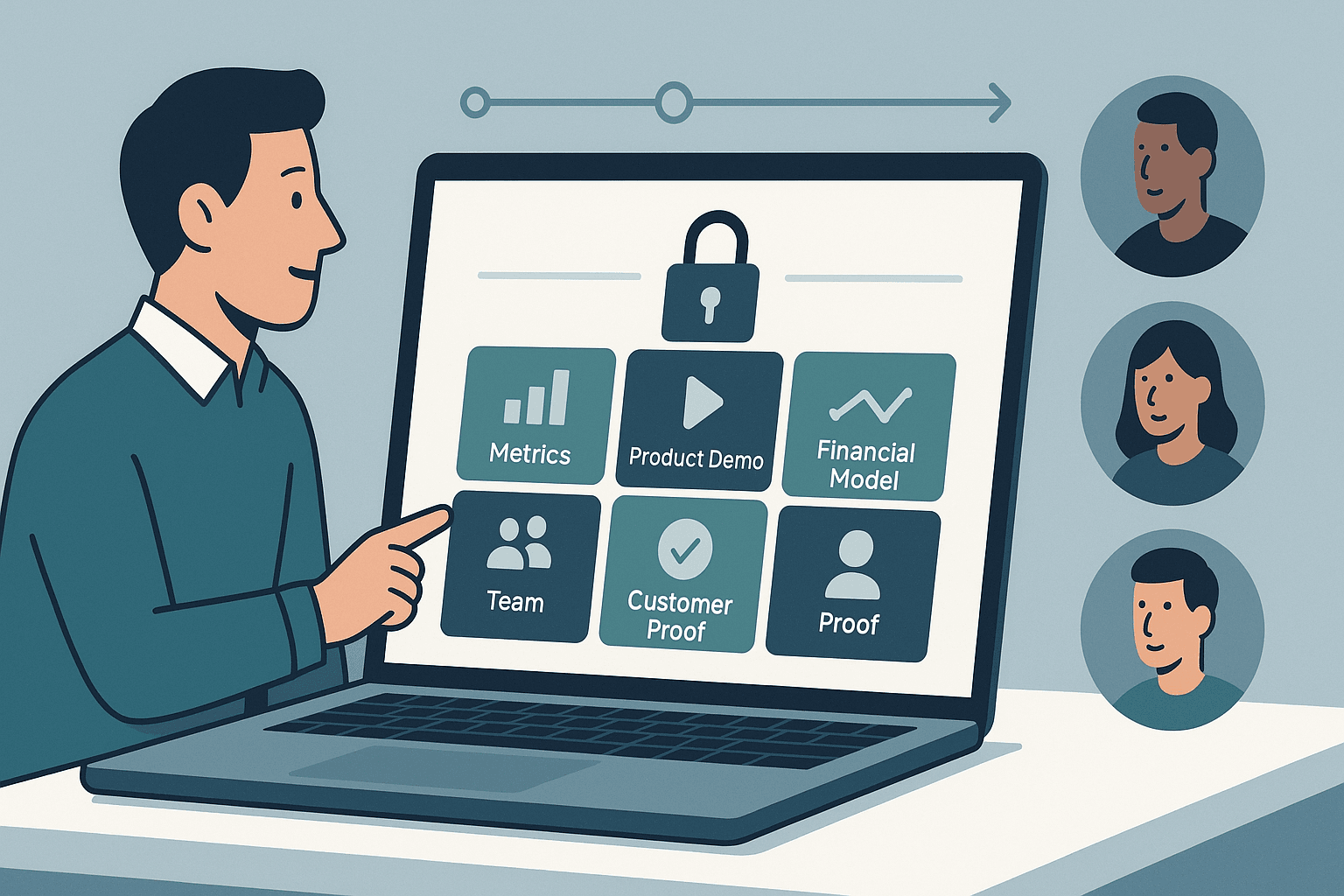
A better approach for many pre-seed rounds is a living data room: a structured, permissioned hub that answers the diligence questions before they’re asked, updates continuously, and makes it easy for investors to build conviction quickly.
This isn’t “no narrative.” It’s narrative grounded in evidence.
What follows is a founder playbook: how to build a pre-seed living data room, which artifacts matter, what metrics to include (even pre-revenue), and how to run outreach so investor calls convert into real commitments.
What a “living data room” actually is
A living data room is a set of documents, dashboards, and short explanations that:
- Prove you’re building something real (product, customers, usage, pipeline).
- Show you can reason clearly (market, strategy, risks, tradeoffs).
- Reduce investor workload (answers are discoverable, links are current, evidence is attached).
- Updates without you re-sending a deck (the source of truth is always current).
Think of it like a private mini-site for your company.
Typical tools (pick one, keep it simple)
- Notion: fastest to build, good for narrative + embedded assets.
- Google Drive: universal, less elegant, but fine.
- DocSend: strong analytics + controlled sharing; often paired with Notion/Drive.
- Coda / Slab / Confluence: workable, depends on your workflow.
The key is not the tool. The key is structure + credibility + update cadence.
When “no-deck” works best (and when it doesn’t)
It works best when:
- You have anything verifiable: early usage, LOIs, pilots, design partners, waitlist conversion, inbound, strong outbound pipeline, or clear technical differentiation.
- Your product is easier to understand through a demo than a story.
- Your buyer and motion are specific (e.g., “IT admins at 200–2000 employee fintechs”) rather than vague (“SMBs”).
- You want to run a tight process with fast updates and fewer “re-pitches.”
It’s riskier when:
- You’re truly pre-everything (no prototype, no users, no pipeline) and you need a compelling vision to carry the round.
- You’re raising from investors who are rigidly deck-driven.
- Your market requires significant education and the deck is your teaching tool.
Even then, the solution is often hybrid: a one-page memo + living data room.
The investor’s real questions (build your room to answer these)
Different investors say different things, but diligence converges on a predictable set of questions:
- What problem are you solving, for whom, and why now?
- What’s your wedge? Why you, why this approach, why it wins.
- Is there evidence of demand? Users, pipeline, signed pilots, retention signals.
- Can this become a big business? Market, pricing power, expansion.
- Can this team execute? Speed, judgment, technical ability, founder-market fit.
- What’s the plan for the next 12–18 months? Milestones and use of funds.
- What are the risks, and do you understand them?
A living data room should map 1:1 to these questions.
The “No-Deck” Data Room blueprint (recommended structure)
You want a structure that is scannable in 10 minutes, but deep enough for 2 hours.
Top-level folders/pages
- Start Here (2–5 minutes)
- Product (Demo + technical overview)
- Traction & Metrics
- Go-To-Market (ICP, pipeline, pricing, motion)
- Market & Competition
- Team
- Financials (model + burn + runway)
- Round (terms, target, timeline, allocation)
- Legal & Admin (cap table, incorporation, IP)
Below are opinionated contents for each.
1) “Start Here”: your investor onboarding page
This replaces the deck’s opening.
Include:
- One-liner: “We help [ICP] achieve [outcome] by [mechanism].”
- The wedge: what is uniquely true about your approach.
- Current status: stage, what’s live, what’s not.
- Traction in one screen: 3–6 bullets with numbers.
- The ask: amount, instrument, high-level use of funds, and timeline.
- Quick links: demo, metrics dashboard, pipeline page, model.
Template: Start Here
markdown## What we do
We help [ICP] do [job-to-be-done] by [product mechanism].

## Why now
- [Trigger 1: regulatory/tech/platform change]
- [Trigger 2: buyer behavior shift]

## What’s different
- [Differentiator 1]
- [Differentiator 2]

## Proof so far
- Usage: [DAU/WAU/MAU], [growth %] MoM
- Pipeline: [$X] qualified in last [N] days, [#] pilots in flight
- Customer proof: [logos/anonymized], [quotes], [case study link]

## Fundraise
Raising: $[X] pre-seed via [SAFE/notes/equity]
Use of funds: [product], [GT M], [hiring]
Target close: [date]

## Links
- 3-min product demo (video)
- Metrics dashboard
- Pipeline + GTM notes
- Financial model
This page should feel like a calm, factual “control panel.”
2) Product: demo-first, explanation second
For pre-seed, investors rarely need a full PRD. They need to see:
- The user experience (what happens when someone uses it).
- The technical advantage (why it’s hard to copy / why it performs).
- The scope discipline (what you’re not building yet).
What to include
-
3–6 minute demo video (Loom is fine)
- Show: onboarding → core workflow → output/value.
- Narrate who the user is and what “success” looks like.
-
Clickable prototype (optional)
- Figma for UI-heavy products.
-
Architecture + wedge (1–2 pages)
- Avoid a giant diagram. Include only what supports differentiation.
-
Roadmap: next 90 days
- Investors want to see velocity and prioritization.
Template: Product overview (technical)
markdown## Core workflow
1) User does X
2) System ingests Y
3) Product produces Z

## Differentiation
- Data advantage: [source/access rights/partnerships]
- Model/system advantage: [latency/cost/accuracy/workflow]
- Distribution wedge: [embedded channel, SEO, integrations]

## What we’re not doing (yet)
- [Non-goal 1]
- [Non-goal 2]

## Next 90 days
- Milestone A: [definition of done]
- Milestone B: ...
If you’re AI-heavy, be crisp about what’s proprietary vs. commodity. Investors increasingly expect clarity here (and many will ask about data rights, evaluation, and operational cost).
3) Traction & metrics: evidence over adjectives
At pre-seed, “traction” can mean many things. The goal is not to pretend you have Series A metrics. The goal is to show:
- Motion (things are moving in the right direction)
- Signal (users/customers are actually getting value)
- Learning speed (you iterate quickly and measure outcomes)
What metrics matter depends on your model
If you’re pre-revenue but have active users
- Activation rate (define activation event)
- Retention (cohorts; even 2–4 weeks helps)
- Engagement depth (events per active user)
- Time-to-value
- Qualitative feedback tied to usage
If you’re B2B with pilots / design partners
-
of design partners, stage, start dates
- Conversion: intro → discovery → pilot → paid
- Sales cycle length (even early averages)
- Stakeholders involved (signals enterprise complexity)
- Expansion potential (seats, usage, modules)
If you’re B2B with pipeline but not closed-won
- Qualified pipeline $ (with definitions)
- Meetings set per week
- Reply rates by segment
- Pilot proposals sent
- LOIs (careful: include terms and seriousness)
If you’re revenue-generating
- MRR/ARR and MoM growth
- Net revenue retention (if you have expansions)
- Gross margin (even estimated)
- CAC signals (even messy, be transparent)
- Payback assumptions (model-based is fine, label it)
A strong pre-seed metrics page includes definitions
Investors lose trust when metrics are vague. Include:
- Metric definition (what counts, what doesn’t)
- Time window (e.g., trailing 28 days)
- Source (Stripe, PostHog, HubSpot)
- Caveats (small sample size, product changes)
Template: Metrics dashboard (copy/paste)
markdown## North Star Metric
NSM: [e.g., weekly active teams completing X]
Why: correlates with retention and value realization.

## Current (last 28 days)
- WAU: [#] (+[%] MoM)
- Activated users: [#] / [# signups] = [%]
- D7 retention: [%] (cohort)
- Median time-to-value: [X minutes/hours/days]

## B2B funnel
- SQLs: [#]
- Pilots active: [#]
- Proposals sent: [#]
- Qualified pipeline: $[X]

## Notes
- Product change on [date] impacted activation by [effect]
- Cohorts are small; confidence improving as volume increases.

## Links
- Cohort chart
- Event taxonomy
- Raw export (optional)
Tools that help
- Product analytics: PostHog, Amplitude, Mixpanel
- CRM: HubSpot, Salesforce (early: HubSpot is enough)
- Data warehouse: BigQuery/Snowflake (optional early)
If you don’t have a dashboard tool, a Google Sheet with clear cohorts beats a beautiful but empty chart.
4) Go-To-Market: show you understand distribution, not just product
Pre-seed investors increasingly underwrite distribution because building is cheaper than ever. Your data room should show you have a credible plan to reach customers.
Include these components
a) ICP + segmentation
- Firmographics: size, industry, region
- Technographics: stack requirements
- Buyer vs. user vs. champion
- “They feel pain when…” triggers
b) Positioning and messaging tests
Show what you’ve tried and what worked:
- Email angles
- Landing pages
- Ads (if any)
- Content topics
c) Sales motion
- PLG, sales-led, hybrid
- Pilot structure (duration, success criteria)
- Security/compliance needs (SOC2, HIPAA, etc.)
d) Pricing hypotheses
- Price metric (per seat, per usage, per workflow)
- Packaging tiers
- Willingness-to-pay evidence (quotes from calls)
Template: GTM page
markdown## ICP
Primary: [title] at [company type]
Secondary: ...

## Pain + trigger
They start looking when: [trigger events]
Current alternatives: [manual process/competitor]

## Motion
- Channel 1: outbound to [segment]
- Channel 2: partner/integration with [platform]
- Channel 3: content for [keywords]

## Funnel (last 30 days)
- Prospects contacted: [#]
- Positive replies: [#] ([%])
- Meetings held: [#]
- Pilots started: [#]

## Pricing hypothesis
We expect pricing at $[X] / [unit] because [ROI logic].
This is where many founders hand-wave. Don’t. Even if you’re wrong, show you’re running a measurable process.
5) Market & competition: replace TAM theater with buyer reality
Investors are tired of the “$100B market” slide. A living data room lets you be more honest and more useful.
What to include
- A narrow starting market you can win first
- Expansion paths (adjacent personas, workflows, verticals)
- Competitive map based on workflows, not logos
- Your unfair advantages (data access, workflow lock-in, distribution)
Good market analysis looks like:
- “We start with SOC2 readiness for 200–2000 employee SaaS firms using AWS and Vanta; expand into continuous controls monitoring and vendor risk.”
Competition: show “do nothing” and “DIY”
Your biggest competitor is often:
- spreadsheets
- internal tools
- existing platform features
References you can cite (useful sources)
- Industry reports: Gartner, Forrester (if you have access)
- Public filings and annual reports for buyer spend patterns
- Government data (BLS, census)
- Platform marketplaces (Salesforce AppExchange, AWS Marketplace) for category demand
- Keyword demand (Google Trends, Ahrefs/Semrush) cautiously, intent matters
Include links and quotes inside the data room. Investors like primary evidence.
6) Team: prove execution capacity, not just credentials
A good team page is short:
- Founders’ 1-paragraph bios focused on why this problem
- Key hires and gaps
- Advisory help (if real)
Add evidence of execution:
- shipping cadence
- previous products shipped
- open source or technical writing (if relevant)
If you’re early, avoid a bloated org chart fantasy. Show what you can do with a small team.
7) Financials: simple model, explicit assumptions
Pre-seed financials are not about accuracy. They’re about:
- Whether you understand unit economics drivers
- Whether you can plan runway responsibly
- Whether your milestones match your burn
Include
- Current burn + cash
- 18-month model (monthly)
- Hiring plan tied to milestones
- Best/base/worst cases (optional)
Template: Financial assumptions
markdown## Revenue model assumptions (base case)
- ACV: $[X]
- Sales cycle: [Y] days
- Win rate: [%]
- Gross margin: [%]

## Hiring plan
- Month 1–3: [role]
- Month 4–6: ...

## Runway
Cash: $[X]
Burn (current): $[X]/mo
Runway: [N] months

## Use of funds
- Product/engineering: [%]
- GTM: [%]
- G&A: [%]
If you’re pre-revenue, model pipeline conversion and timeline rather than “hockey stick ARR.”
8) The round page: make it easy to say yes
This is where you remove ambiguity.
Include:
- Target raise: e.g., $1.5M pre-seed SAFE
- Cap: if you’re using one (optional)
- Discount: if any
- Allocation: how much is “spoken for” (be truthful)
- Timeline: first close date and final close date
- Why now: what the money unlocks
Opinionated guidance
- Run a real process. “We’re casually raising” kills urgency.
- Avoid bespoke terms for every investor; complexity slows closing.
- Have a minimum viable close (e.g., $500k) to start executing.
(If you need legal clarity on instruments and securities rules, talk to counsel; don’t wing it.)
9) Legal & admin: keep it clean
Pre-seed diligence often fails due to sloppiness:
- Cap table confusion
- IP assignment missing
- Contractor agreements messy
Include:
- Cap table (Carta export or spreadsheet)
- Incorporation docs
- IP assignment agreements
- Material customer contracts (if any)
- Any existing SAFEs/notes
Make it boring. Boring is good here.
The outreach system: converting data room access into commitments
A data room doesn’t raise money by itself. It raises money when paired with an outreach process that:
- creates fast initial interest
- gives investors a clear next step
- makes progress visible
Step 1: Build a “one-screen” teaser
You still need a small artifact to replace the deck attachment.
Use either:
- A tight email + link to Start Here (best)
- A 1-page memo (PDF) that links into the data room
Template: cold/warm intro email
textSubject: [ICP] → [outcome] in [timeframe] (pre-seed)

Hi [Name]—

We’re building [one-liner]. Early signal:
- [metric/proof 1]
- [metric/proof 2]
- [metric/proof 3]

Raising a $[X] pre-seed to hit [milestone] by [date].
If helpful, here’s a 5-minute “Start Here” with demo + metrics: [link]

Open to a 20-min intro next week?
—[Name]
Step 2: Control access, but don’t over-gate
You want to know who is engaging, but you don’t want to create friction.
Good options:
- Notion page shared to “anyone with link” + separate “sensitive docs” folder gated
- DocSend for the “Start Here” page to get analytics
Step 3: Run the call like a working session, not a performance
Because the room has the story, your call can focus on:
- clarifying the wedge
- pressure-testing GTM
- discussing the round and process
A simple agenda:
- 2 minutes: your one-liner + why now
- 8 minutes: questions they have after reviewing
- 8 minutes: discuss milestones + round mechanics
- 2 minutes: next step (partner meeting, references, follow-up)
Step 4: Use updates to manufacture momentum (ethically)
Weekly update emails are the secret weapon of the living data room.
Include:
- what changed (metrics, pilots, product)
- what you learned
- what you’re doing next
- the round status (e.g., “$700k of $1.5M committed”)
Template: weekly update
textSubject: [Company] pre-seed update — week of [date]

Progress
- Product: shipped [feature], impact: [metric]
- GTM: [#] new meetings, [#] pilots started, pipeline now $[X]
- Metrics: WAU [#] (+[%]), activation [%]

Learnings
- [What surprised you]

Asks
- Intros to: [roles/companies]

Round
- Raising $[X]; committed $[Y]; aiming to close by [date]
- Data room (always current): [link]
Investors invest when they see speed. Updates are how they feel speed.
What to measure inside the data room (yes, track investors)
A living data room is also an instrument panel for your fundraise.
Track:
- who opened Start Here
- time spent on metrics/pipeline/model
- whether they watched the demo
- what they forwarded internally
DocSend provides this. Notion doesn’t natively, but you can approximate via gated PDFs or unique links.
Use this to prioritize follow-ups:
- If someone spent 6 minutes on the metrics page, follow up with metrics context.
- If they only skimmed, ask if they want the 3-minute version.
Be respectful: don’t say “I saw you spent 43 seconds…” Just act on the signal.
Templates: the minimum viable living data room (MVDR)
If you want the fastest path, build these seven things first:
- Start Here page (links to everything)
- 3–6 minute demo video
- Metrics dashboard (even if it’s a sheet)
- Pipeline + GTM notes
- 1-page product + wedge explanation
- Simple financial model (18 months)
- Round page (ask, timeline, allocation)
Then add market, competition, team depth, and legal docs as diligence progresses.
Common failure modes (and how to avoid them)
1) “It’s just a folder of random docs”
A data room without curation is worse than a deck.
Fix: one Start Here page, a clear left-to-right reading path, and consistent naming.
2) “No definitions”
If your metrics are undefined, investors assume cherry-picking.
Fix: definitions + source links + caveats.
3) “Too much technical detail, not enough buyer detail”
Engineers often over-index on architecture.
Fix: add ICP, pain triggers, and pipeline reality. Prove distribution.
4) “Gated to death”
Passwords, permission requests, and broken links kill momentum.
Fix: keep 80% accessible via link; gate only sensitive financial/legal items.
5) “No update cadence”
If it’s not living, it’s just a messier deck.
Fix: weekly updates + visible changelog on the Start Here page.
The balanced view: why some investors still prefer decks
Decks are not evil. They’re just overused.
A deck can still be valuable when:
- the story requires careful sequencing
- you’re raising on vision more than evidence
- you’re selling a new category that needs framing
Some investors also use decks as a standardized input for partner meetings.
Compromise option: maintain a barebones 8-slide deck (problem, solution, wedge, traction, GTM, market, team, ask) and use it only when required, while keeping the living data room as the source of truth.
This gets you the best of both worlds: low friction for traditional workflows, high fidelity for diligence.
A practical “day-by-day” build plan (one week)
Day 1: Structure
- Create top-level pages
- Draft Start Here
- Decide what’s public vs gated
Day 2: Demo
- Record Loom
- Add a short written “demo map” with timestamps
Day 3: Metrics
- Define NSM + activation
- Build a simple dashboard or sheet
- Add 2 cohort charts
Day 4: GTM + pipeline
- Document ICP and triggers
- Export pipeline and summarize stages
- Add messaging experiments
Day 5: Financials + round page
- Build 18-month model
- Write use-of-funds milestones
- Set target close dates
Day 6: Market + competition
- Write starting wedge market
- Add competitive notes + DIY alternatives
- Link references
Day 7: Clean-up
- Fix naming, permissions, and broken links
- Add a changelog
- Test on a friend: “Can you understand this in 10 minutes?”
Why this converts: the real mechanics of conviction
At pre-seed, investors are buying a bundle:
- belief in the team’s execution
- belief that a real customer problem exists
- belief that distribution is possible
- belief that the wedge is defensible enough to matter
A living data room increases conversion because it:
- compresses diligence (answers are already assembled)
- reduces uncertainty (definitions, sources, and updates)
- creates momentum (weekly progress is visible)
- invites internal forwarding (partners can review without scheduling you)
In short: it makes your company feel inevitable, not because of hype, but because the evidence is organized and current.
Suggested references (useful starting points)
These aren’t required reading, but they’re relevant frameworks you can cite or adapt:
- Y Combinator Startup Library (fundraising, pitch advice, metrics): https://www.ycombinator.com/library
- Paul Graham essays on startups and fundraising context: https://paulgraham.com/articles.html
- Sequoia’s writing on company building and narratives (various essays; useful for memo style): https://www.sequoiacap.com/articles/
- Stripe Atlas guides (company formation, SAFEs, basics): https://stripe.com/atlas/guides
- SaaStr resources for B2B SaaS metrics and GTM: https://www.saastr.com/
Use references to support claims about process, but remember: your data room’s power is primary evidence: your own numbers, customers, and learnings.
Closing: the standard you’re aiming for
The goal of the “no-deck” fundraise is not to be contrarian. It’s to be efficient.
If an investor opens your Start Here page and, within 10 minutes, can answer:
- what you do
- why anyone cares
- why you might win
- what proof exists
- what you’re raising and why
…then your living data room is doing its job.
Build it once, keep it updated weekly, and let it compound, across investors, hires, partners, and even customer trust.