
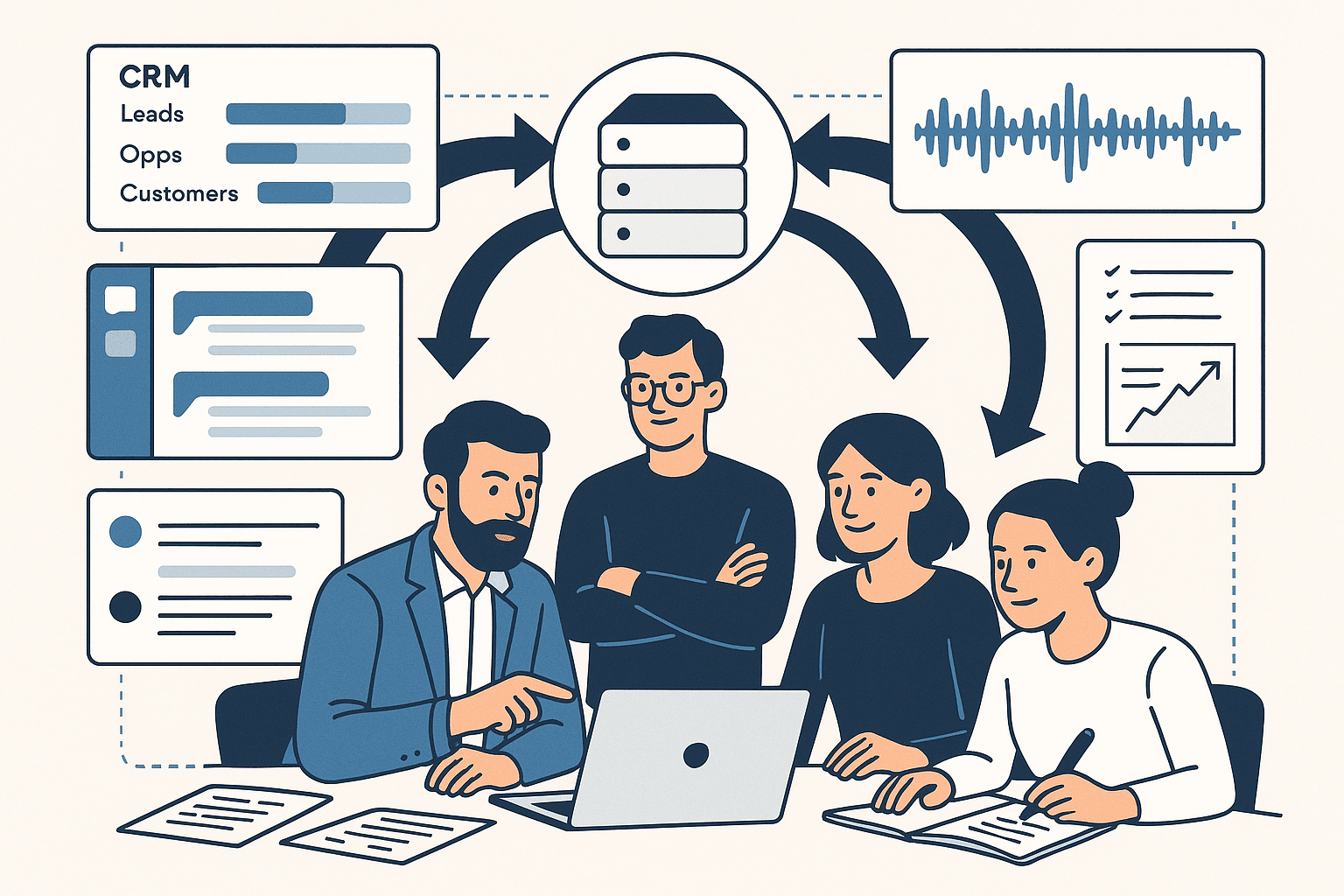
A founder hires two SDRs, one AE, and a part-time RevOps contractor. The outbound engine starts moving. Calendars fill a little. A few prospects reply with useful pushback. Someone discovers a line that suddenly doubles positive responses in one vertical. Another rep uncovers a killer disqualification question that saves hours every week. The AE hears the same implementation objection six times in demos and figures out the exact two-minute explanation that calms buyers down.
None of that becomes a system.
Instead, the insight lives where it was born: in a rep’s notes doc, in a Slack DM to the founder, in Gong snippets nobody re-watches, in a CRM field nobody trusts, in someone’s inbox, or in the vague team memory that “I think healthcare really cared about integration security, right?”
This is the outbound memory leak problem.
It is one of the most expensive invisible failures in early-stage go-to-market. Not because companies lack activity, but because they fail to convert activity into organizational learning. Outbound does not break only when reps are not sending enough emails or making enough calls. It breaks when every hard-won prospect insight dies as a private observation instead of becoming shared operating knowledge.
That failure compounds. The team keeps relearning the same lessons. Messaging lags the market by weeks. Bad-fit segments stay in sequences too long. Good-fit signals stay anecdotal. Objections get handled differently by each rep. Founders think they have a volume problem. In reality, they have a memory problem.
And the worst part: adding more people and more tools usually makes it worse.
Once you see this pattern, a lot of startup GTM pain starts to make sense.
The real failure scenario: pipeline is lost between conversations and campaigns
Let’s make it concrete.
A startup selling workflow automation into operations teams runs outbound across three ICP hypotheses:
- Mid-market logistics companies
- Multi-location healthcare operators
- PE-backed home services platforms
The team uses Apollo for lists and sequencing, HubSpot as CRM, Slack for internal communication, Gong for call recording, and Notion for docs. On paper, this is already “pretty good” tooling for a seed or Series A company.
Here’s what happens over six weeks:
- SDR #1 gets several replies from logistics leaders saying the offer sounds interesting, but they already built a lightweight internal workflow layer using Airtable and Zapier.
- SDR #2 notices healthcare operators respond much better when the email mentions reducing compliance-related handoff errors instead of general efficiency.
- The AE hears repeated concern from home services operators that rollout across franchisees will fail unless local managers can customize workflows.
- The founder learns in two late-stage calls that the product’s strongest wedge is not automation broadly, but standardizing exception handling across distributed teams.
- RevOps notices that booked meetings from logistics have low conversion, while healthcare converts better once they show up.
All of those are high-value signals. Each one should change the operating system:
- Targeting filters should update.
- Messaging should update.
- Sequence branches should update.
- Qualification questions should update.
- Discovery talk tracks should update.
- Objection handling should update.
- Pipeline forecasting assumptions should update.
But they don’t.
Instead:
- SDR #1 mentions the Airtable/Zapier pattern in Slack.
- SDR #2 updates their own personal opener but not the shared sequence.
- The AE records a good call, but nobody tags the objection pattern.
- The founder says in the weekly meeting, “we should probably lean harder into compliance,” but no one owns rewriting copy.
- RevOps exports conversion data, but there is no agreed process for connecting performance shifts back to message or segment changes.
So what happens next?
The next 1,500 outbound touches still hit logistics accounts with stale messaging. The healthcare sequence still underplays the pain point that actually resonates. The AE keeps manually reframing the franchisee customization objection instead of arming SDRs with better expectation-setting. The founder still thinks the market is noisy and inconsistent. The team still debates ICP quality using opinions instead of captured patterns.
Pipeline is not only lost at the top of funnel. It is lost in the translation layer between raw conversations and updated execution.
That translation layer is where most startup GTM teams are weak.
Pattern identification: startups don’t have an activity problem, they have a signal capture and distribution problem
Early GTM teams usually over-focus on visible execution:
- number of emails sent
- calls made
- meetings booked
- opportunities created
- sequences launched
- verticals tested
Those matter. But they are outputs. What determines whether outbound gets better over time is whether the team can identify, encode, and redistribute market signal.
The problem follows a predictable pattern.
Pattern 1: insights are generated at the edge
The most valuable GTM learning usually appears first in frontline interactions:
- reply emails
- call objections
- no-show reasons
- deal slippage notes
- onboarding friction
- customer success escalations
This means the people closest to the interaction often see the truth before leadership does. But unless there is a simple system for extracting it, leadership only hears fragments.
Pattern 2: insights are stored in the wrong medium
A lot of startup knowledge gets trapped in mediums optimized for speed, not reuse:
- Slack threads are easy to send but hard to retrieve.
- DMs are private by default.
- Call recordings are searchable but rarely synthesized.
- CRM notes are account-specific and usually low quality.
- Docs are useful only if someone curates them.
The result: information exists, but the organization cannot operationalize it.
Pattern 3: no one owns the conversion from signal to system
Even when teams “share learnings,” they often stop at awareness.
Someone says:
- “Prospects keep asking about SOC 2.”
- “Manufacturing isn’t converting.”
- “That new opener is working.”
- “People hate the pricing page.”
But there is no named owner responsible for answering:
- Should this be treated as a pattern or anecdote?
- Which asset should change because of this?
- Who updates the sequence, playbook, or qualification rubric?
- When do we review if the change improved conversion?
Without ownership, learning dies in the meeting where it was discussed.
Pattern 4: rep customization outruns team standardization
Strong reps adapt quickly. Weak systems don’t.
That creates a dangerous illusion. Leadership sees one or two reps performing reasonably well and assumes the motion is healthy. In reality, those reps are compensating for system failures with personal memory, judgment, and improvisation.
That doesn’t scale. When you hire the next two reps, performance drops because the actual playbook was never documented, only embodied.
Pattern 5: tools create more storage, not more learning
Most GTM tools are excellent at capture and weak at conversion.
Gong records calls. CRM stores notes. Sales engagement tools log touches. Slack archives conversations.
None of that guarantees the team develops institutional memory.
If anything, more tooling often creates more hiding places for insight.
Why standard advice fails
Most advice for fixing outbound underperformance sounds reasonable but misses the real issue.
“Just make reps update CRM better”
This usually fails for two reasons.
First, reps are not knowledge managers. If the ask is burdensome, quality collapses. Second, standard CRM fields are poor containers for nuanced market learning. A dropdown can tell you “lost reason = no budget,” but it won’t reliably surface the language buyers used, whether the budget issue was actually priority confusion, or what message triggered the objection.
CRM discipline matters, but it is not enough.
“Use call recording AI to surface insights”
Call intelligence tools help. They are not a system.
Yes, Gong, Chorus, and similar tools can identify recurring topics and give you clips. But someone still needs to decide:
- what matters
- what changed
- what action should follow
- who owns the update
- how the team should use the new learning
AI summaries reduce review time. They do not replace GTM judgment.
“Run better weekly pipeline meetings”
Meetings are where many startups confuse discussion with execution.
A good meeting may surface a pattern. It rarely ensures that pattern changes outbound assets by the next week. The bottleneck is not conversation. It is operational follow-through.
“Hire RevOps”
RevOps can create the plumbing, but they cannot be the sole source of GTM learning. In early-stage companies, the key problem is not dashboarding. It is turning fuzzy frontline feedback into changes across targeting, messaging, and qualification.
A strong RevOps person helps enormously, but only if the company already has clarity about workflow and ownership.
“Build a sales playbook”
Static playbooks die fast in changing markets.
The issue is not that teams lack a PDF with sales talk tracks. The issue is that they lack a living process that updates those talk tracks based on new evidence.
The startup environment changes too quickly for quarterly documentation cycles.
The better approach: treat outbound learnings like product feedback with an operating loop
Founders already understand this principle in product.
If users complain about onboarding friction, product teams try to capture the issue, categorize it, prioritize it, assign an owner, ship a fix, and measure impact.
Outbound needs the same discipline.
The right mental model is simple:
Every meaningful prospect interaction produces either noise or signal. Your job is to detect signal, route it to an owner, update the relevant GTM asset, and verify whether the change improved results.
That is the opposite of most startup sales cultures, where learning remains informal until scale forces pain.
You do not need enterprise process. You need a lightweight signal operating system.
The system has five parts:
- Capture signal in a consistent format
- Centralize it in one reviewable place
- Assign ownership by signal type
- Convert it into updated GTM assets on a fixed cadence
- Measure whether those updates change performance
If you do this well, outbound becomes compounding. If you do it poorly, every rep starts from scratch.
The lightweight system: a founder-stage outbound memory operating system
Here is the practical version that works for early teams without drowning them in admin.
Step 1: define what counts as signal
Most teams capture too much random commentary and too little actionable information.
Create a short taxonomy. Keep it to 5–7 signal types max.
A strong starting taxonomy:
- ICP signal: evidence an account segment is a stronger or weaker fit than expected
- Pain signal: evidence a problem resonates more or less strongly than expected
- Messaging signal: evidence a phrase, subject line, opener, CTA, or positioning angle works or fails
- Objection signal: recurring concerns blocking meetings or deals
- Qualification signal: questions or traits that predict conversion quality
- Process signal: handoff, follow-up, or speed issues causing drop-off
- Competitive signal: alternatives, internal builds, or incumbent tools repeatedly appearing
This matters because teams are often vague. “Interesting call” is not useful. “Objection signal: local managers require workflow customization; appears in 4/7 home services demos” is useful.
Step 2: reduce capture to a 60-second workflow
If signal capture takes longer than a minute, reps will stop doing it.
Use a simple form. It can live in Notion, Airtable, HubSpot forms, Google Forms, or even a dedicated Slack workflow. The exact tool matters less than the friction.
Minimum fields:
- date
- account/prospect
- owner
- signal type
- exact customer language or summary
- confidence level: anecdote / repeated / strong pattern
- recommended action
- related asset: sequence, ICP definition, talk track, pricing FAQ, etc.
Example submission:
- Signal type: Objection signal
- Customer language: “This sounds good centrally, but our branch managers all work differently. Corporate rollouts die when local teams can’t adapt.”
- Confidence: Repeated
- Recommended action: Add expectation-setting in outbound and demo that local workflow variation is supported
- Related asset: Home services outbound sequence, demo deck, objection handling doc
That is enough.
Step 3: create a single signal inbox
All signals need to land in one place that can be reviewed consistently.
For founder-stage teams, your best options are:
Option A: Airtable
Best for teams that want lightweight structure and filtering without heavy CRM customization.
Pros:
- easy forms
- tagging and filtering
- views by signal type or owner
- decent for lightweight workflow
Cons:
- another system to maintain
- can become messy without a clear schema
Option B: Notion database
Best for doc-heavy teams already living in Notion.
Pros:
- easy to combine signal capture with docs and playbooks
- flexible
- low setup overhead
Cons:
- weaker as an operational queue
- easier to turn into a wiki graveyard
Option C: HubSpot custom object or custom pipeline
Best for teams that want GTM learning close to execution data.
Pros:
- tied to accounts/contacts/deals
- easier to relate signals to conversion outcomes
- less context switching for reps
Cons:
- setup can be annoying
- reps may resent extra CRM work
- not ideal if your CRM admin discipline is weak
Option D: Slack workflow feeding Airtable/Notion
Best for teams where behavior change is the biggest bottleneck.
Pros:
- meets reps where they already are
- easy submission
- lower friction
Cons:
- dangerous if Slack remains the primary system of record
- needs clean routing into a structured database
My bias: for most seed to early Series A teams, use Slack workflow for capture + Airtable or Notion database as system of record. It gives you low-friction intake without making Slack the graveyard.
Step 4: assign clear ownership by asset, not by conversation
This is where most systems fail.
Do not assign “someone” to vaguely monitor learnings. Assign owners to GTM assets.
Example ownership model:
- Head of Sales / founder: qualification rubric, objection handling, discovery talk tracks
- Growth / demand gen lead: outbound messaging, sequence copy, testing calendar
- RevOps: field definitions, routing rules, reporting, experiment tracking
- PMM or founder: ICP definition, positioning narratives, segment-specific value props
- AE manager or founder: demo framing, late-stage objection library
This matters because one signal can trigger multiple changes. The right question is not “who heard this?” It is “which system component should improve because of this?”
Step 5: run a weekly signal review, not just a pipeline review
Add a dedicated 30-minute review every week. Separate from forecast.
Agenda:
- New signals submitted this week
- Which are anecdotes versus patterns?
- Which assets need updates?
- Who owns each update?
- What experiments or revisions go live this week?
- What prior changes are we measuring?
The output should be a short change log, not a philosophical debate.
Example:
- Update healthcare sequence intro to emphasize compliance-related handoff risk
- Remove 150–300 employee logistics firms using internal Airtable stack from current target list
- Add branch-level configurability slide to home services demo
- Add qualification question: “How standardized are workflows across locations today?”
If this meeting ends without owners and deadlines, it failed.
Step 6: maintain a GTM change log
This is the bridge between “we learned something” and “did it work?”
Track:
- date of change
- what changed
- why it changed
- owner
- affected segment/campaign
- metrics to watch
- review date
Without this, teams cannot distinguish market changes from execution changes.
A simple log gives you causal memory.
Example:
| Date | Change | Reason | Owner | Area | Metrics | Review Date |
|---|---|---|---|---|---|---|
| May 6 | Healthcare sequence opener changed from efficiency to compliance handoff errors | 5 positive reply signals + 3 discovery calls | Growth lead | Outbound messaging | positive reply rate, meeting book rate | May 20 |
| May 8 | Added qualification question on local workflow variation | repeated demo objection in home services | Head of Sales | Qualification | SQO rate, demo conversion | May 22 |
This sounds basic. It is basic. That is why it works.
Workflow example: how signal should move through the system
Let’s walk through one real workflow.
Scenario: repeated objection appears in calls
An AE hears versions of the same objection in four demos over ten days:
“Corporate tools fail here because each site has its own process. Standardization sounds nice, but our managers need flexibility.”
Old way
- AE mentions it in Slack
- founder says “good point”
- nobody changes anything
- SDRs keep booking similar accounts without setting context
- demos keep stalling
Better way
-
Capture
- AE submits signal via form
- tags it as Objection signal + Qualification signal
- marks confidence as Repeated
-
Review
- Weekly signal review confirms pattern across home services segment
-
Assign
- Sales owner updates objection handling doc
- Growth owner updates outbound language to frame flexibility earlier
- Founder updates segment thesis: prioritize buyers with moderate centralization rather than highly fragmented operators
-
Implement
- Sequence email #2 adds line: “Standardization without local rigidity”
- SDRs add qualifying question around process variation across sites
- Demo deck adds one slide on configurable workflows by location
-
Measure
- Review in two weeks:
- reply rates flat
- meeting-to-opportunity conversion up 18%
- objection frequency drops in demos booked from revised sequence
- Review in two weeks:
That is compounding GTM learning.
Tool comparisons: what to use at different stages
Startups overbuy tooling for this problem. You do not need a six-tool revenue intelligence architecture to stop losing memory.
Here is the practical stack progression.
Stage 1: under 10 GTM people
Recommended stack:
- Slack workflow or simple form for intake
- Airtable or Notion database for signal repository
- CRM for core account/contact/deal data
- Gong/Zoom recordings if available, but not required
- Shared change log in Notion or Airtable
Why this works:
- low cost
- low implementation time
- enough structure without process bloat
Estimated cost:
- Slack: already in use
- Airtable/Notion: low tens of dollars per seat per month
- setup time: 4–8 hours initial, 1–2 hours weekly maintenance
Stage 2: 10–30 GTM people
Recommended stack:
- Structured intake integrated with CRM
- Call intelligence platform with tagging/highlight workflows
- Airtable/CRM report views for signal trends
- Designated owner for GTM knowledge operations
Additions that matter:
- standardized tags in call recordings
- clearer experiment tracking
- stronger reporting by segment, message, objection class
Estimated cost:
- Gong/Chorus and sales engagement tooling become material budget items
- setup time: 2–4 weeks of iteration to get fields, reports, and workflows right
Stage 3: scaling multi-team GTM
Recommended stack:
- CRM-centric signal model
- PMM and RevOps co-own taxonomy and reporting
- AI summarization for first-pass extraction from calls and emails
- formal enablement distribution into sequences, battlecards, onboarding, and dashboards
At this stage, the challenge is not capture. It is governance. If tags, owners, and update cadences are sloppy, the system becomes noise.
Cost and time analysis: why fixing this early pays off
Founders often underinvest here because the problem feels “soft.” It is not soft. It is throughput.
Let’s do rough math.
Assume a 5-person GTM team sends enough outbound to generate 120 meetings per quarter.
Suppose:
- 20% of meetings are from low-fit accounts the team should have filtered earlier
- 15% of positive response potential is lost because high-performing message insights never get rolled out team-wide
- 10% of late-stage conversion is lost because recurring objections are handled ad hoc rather than upstream
Even with conservative deal economics, this is expensive.
If your average qualified opportunity is worth $15,000 in gross profit contribution and your system failure causes you to lose just 8–10 qualified opportunities per quarter, that is $120,000–$150,000 of value leakage every quarter.
Now compare that with the cost of a lightweight system:
- setup: 1 operator/founder for less than a day
- weekly review: 30 minutes with 3–5 people
- maintenance: 1–2 hours per week
- tools: often already paid for
This is one of the highest-ROI operating habits a startup can implement early.
The real savings are not only more pipeline. They are:
- faster convergence on ICP
- less rep variability
- quicker onboarding for new hires
- more reliable forecasting
- less founder dependence as the sole memory layer
Implementation details: how to make the system actually stick
This is where good intentions die. The process has to be easier than not doing it.
1. Keep submission requirements brutally short
Do not ask reps to write mini essays.
Bad capture asks for:
- full call summary
- detailed context
- likelihood estimate
- all stakeholders
- next steps
- suggested scripts
Good capture asks for:
- what happened
- why it matters
- where it should change the system
2. Reward useful signal, not volume of submission
If you incentivize number of submissions, you will get noise.
Instead, celebrate examples where one captured signal led to a sequence improvement, qualification update, or better close rate. Show the loop closed.
3. Use exact customer language whenever possible
The fastest way to corrupt GTM learning is to over-abstract it.
“Prospects care about compliance” is weak.
“We get audited on handoff errors, not task completion time” is strong.
The second version can improve copy, qualification, and demo framing.
4. Separate anecdote from pattern
Not every interesting note deserves a system change.
A simple confidence scale works:
- Anecdote: heard once
- Repeated: seen 2–4 times
- Pattern: confirmed across rep, segment, or conversion data
This keeps teams from thrashing on random comments.
5. Tie every meaningful update to a measurable asset
If you cannot name the asset that should change, the learning is still too vague.
Assets include:
- sequence step
- subject line library
- account scoring filter
- qualification checklist
- objection handling card
- demo slide
- pricing FAQ
- competitive battlecard
- onboarding content for new reps
6. Create default SLAs for updates
Signals die when updates become optional.
Example SLA model:
- repeated messaging signal: update copy test within 5 business days
- repeated qualification signal: update SDR checklist within 7 business days
- repeated objection signal: update battlecard within 5 business days
- confirmed ICP signal: update targeting rules in next list build cycle
7. Review lost deals and no-response buckets differently
Most teams over-index on won calls and obvious objections. But some of the best signal sits in quieter failure states:
- prospects who replied but never booked
- booked meetings who no-showed
- demos that stalled after technical validation
- segments with high open rates but low positive replies
Outbound learning should include silent friction, not only explicit objections.
8. Make onboarding depend on the signal system
When new reps join, do not hand them only scripts. Hand them the last 60–90 days of GTM change logs and current signal summaries.
This teaches them two things:
- what the market is currently saying
- that capturing learning is part of the job
9. Have one person act as editor-in-chief
Even in lightweight systems, someone must maintain signal quality.
This person does not need to create every insight. They ensure:
- duplicates get merged
- weak submissions get clarified
- owners are assigned
- updates are recorded
- obsolete learnings are archived
In very early teams, this is usually the founder, head of sales, or a strong ops-minded generalist.
Common failure modes when implementing this
Failure mode 1: the system becomes a knowledge landfill
Symptoms:
- lots of notes, little action
- nobody knows what is current
- same issue appears repeatedly without resolution
Fix:
- add owners and SLAs
- archive stale or invalidated learnings
- maintain a visible “changes shipped this week” view
Failure mode 2: the team captures only sales feedback
Outbound learning should not be isolated inside SDR and AE interactions.
Customer success, onboarding, and even support often reveal which expectations were poorly set in the sales process. Include cross-functional signal where useful.
Failure mode 3: too much process too early
If your team is four people, do not build a giant taxonomy and approval chain. Keep the system lightweight.
The test is simple: can a rep submit useful signal in under a minute, and can the team turn that into a real asset update within a week?
Failure mode 4: no link to metrics
Without a change log and review date, teams start cargo-culting random updates.
Every meaningful adjustment should have a hypothesis and a metric.
Failure mode 5: founders still hoard the insights
A classic early-stage problem: the founder has the best conversations, sees the market clearly, and assumes the team “gets it.” They usually do not.
Founder insight needs to enter the same system. If it stays in the founder’s head or in ad hoc comments, you are reinforcing the memory leak.
What “good” looks like after 60 days
You know the system is working when:
- reps can quickly see current top objections by segment
- sequence changes are tied to specific market evidence
- qualification criteria evolve based on actual conversion patterns
- new hires ramp faster because learning is codified
- team debates shift from opinions to examples and trend data
- founders are no longer the only source of message refinement
- the same objection rarely surprises the team twice
More importantly, you start seeing compounding effects.
A good outbound team does not just work harder over time. It gets smarter over time.
The memory of the organization improves. That is the real asset.
The takeaway: outbound scale without memory is just faster waste
A lot of startup GTM teams think they need better reps, better tooling, or more volume.
Sometimes they do.
But often the deeper issue is this: the team is producing valuable market intelligence every day and letting it evaporate.
That is what the outbound memory leak really is.
Every prospect reply, every brush-off, every objection, every lost deal reason, every great discovery question, every pattern in conversion by segment, these are not isolated events. They are raw material for a better go-to-market system.
If you do not capture and operationalize them, you force the company to pay for the same learning over and over again.
That is expensive when you have five GTM people. It is catastrophic when you have twenty.
The fix is not complicated:
- define signal categories
- make capture fast
- centralize in one place
- assign asset owners
- review weekly
- ship updates
- measure impact
This is not glamorous work. It is operational hygiene.
But founder to founder, this is the kind of hygiene that separates teams that merely do outbound from teams that actually build a repeatable pipeline machine.
Before you add headcount, before you buy another enablement product, before you conclude the market is just “hard,” ask a more uncomfortable question:
What are we learning every week that never makes it back into the system?
Start there. That is where a lot of missing pipeline already went.