
Why a 48-hour pre-mortem beats a 6-month “build first” cycle
Most startup failures don’t happen because founders can’t build. They happen because founders build the wrong thing (or build the right thing for the wrong buyer, at the wrong price, through the wrong channel, with the wrong proof). CB Insights’ widely-cited post-mortem analyses repeatedly highlight themes like no market need, running out of cash, getting outcompeted, and pricing/cost issues: which are not engineering problems; they’re assumption problems.1
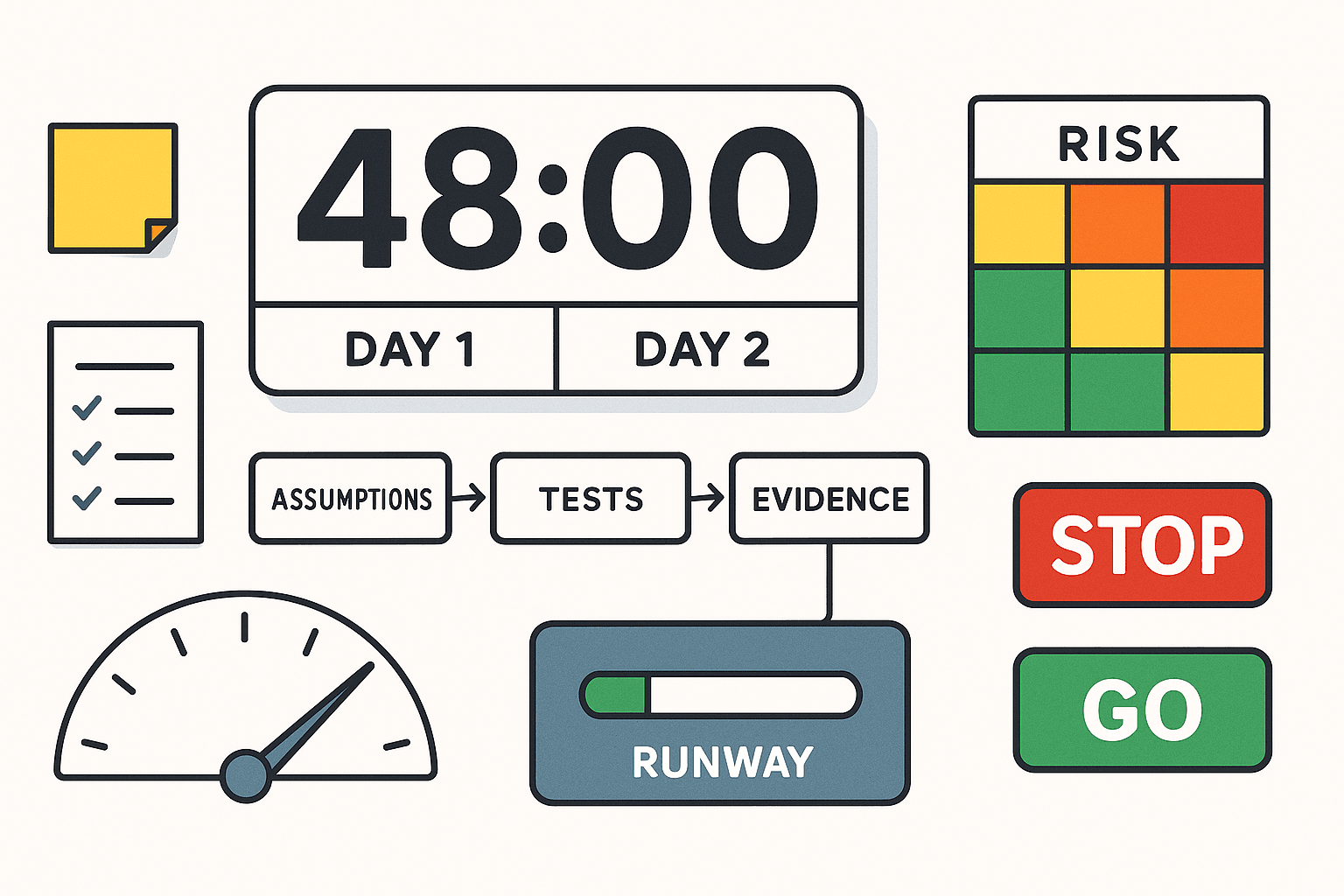
A Pre-Mortem Sprint is a two-day workflow designed to do one thing: surface and attempt to falsify the assumptions that would kill your startup: before you spend weeks shipping, selling, hiring, or raising.
This is not a lean-theater “talk to customers” reminder. It’s a structured, opinionated sprint with:
- Failure mapping (how this idea dies in the real world)
- Evidence checkpoints (what proof you must obtain by specific times)
- Red-flag metrics (signals that should stop you)
- A decision rubric (kill, pivot, or proceed)
If you do this well, you will kill more ideas. That’s the point. Startups die from unpaid optimism. Your job is to price optimism using evidence.
Core principle: treat your idea like a hypothesis you’re trying to disprove
A useful mental model is Karl Popper’s falsifiability: good hypotheses are testable and can be proven wrong.2
In startups, founders frequently do the opposite:
- They collect confirmatory anecdotes (“Someone said they’d use it!”)
- They avoid sharp predictions (“It’s a big market”)
- They build to learn (slow, expensive) instead of testing to learn (fast, cheap)
The Pre-Mortem Sprint forces you to make sharp, falsifiable claims and then tries to break them.
Who this sprint is for (and when it’s not)
Great fit
- You’re pre-seed or early seed and still shaping the product.
- You have a B2B idea where buying dynamics matter: budget owner, security, procurement, switching costs.
- You can access 6–12 relevant people within 48 hours (even if they’re “friendlies”).
Not a great fit
- You’re already scaling a proven motion (this becomes a quarterly risk review instead).
- You’re in deep tech with long validation cycles (still useful, but your evidence will be different: lab results, regulatory milestones, LOIs with credible partners).
Tooling: keep it lightweight by design
You can run the sprint with:
- A shared doc (Notion/Google Docs)
- A spreadsheet for assumptions + scoring
- A calendar link for interviews
- A call recorder + transcript (with consent)
- A simple landing page (Carrd/Webflow) or a one-page PDF
- Optional: an email sequencer (Apollo, HubSpot) if you have lists
The sprint is intentionally hostile to “but we need to set up a full stack.” If you need infrastructure to validate the idea, that’s already a signal.
The 48-hour agenda at a glance
Day 1: Map how you die; design tests
- Define the idea in one sentence (with a buyer)
- Run a pre-mortem workshop: generate failure modes
- Convert failure modes into assumptions
- Prioritize assumptions by fatality × uncertainty
- Design evidence checkpoints and red-flag metrics
- Recruit interviewees; ship a “test artifact”
Day 2: Collect evidence; decide
- Run interviews and reality checks
- Score evidence; watch for red flags
- Use a decision rubric: kill / pivot / proceed
- Write the “next 7 days” plan (not the next 6 months)
Step 1 (60 minutes): Define the idea with painful specificity
If you can’t state the idea precisely, you can’t invalidate it.
Use this template:
For [specific buyer role] at [type of company] who struggles with [pain], we provide [solution category] that delivers [measurable outcome] by [mechanism], unlike [alternative] which fails because [gap].
Example (good):
For RevOps leaders at 200–2,000 person SaaS companies who struggle to keep pipeline forecasts accurate, we provide an automated forecast integrity layer that flags data drift and stage inflation, delivering <10% forecast error by analyzing CRM behavioral patterns, unlike spreadsheets and “manager judgment” which miss systemic bias.
Example (bad):
AI forecasting for sales teams.
Also specify:
- Buyer (economic buyer, not just user)
- Trigger (what event causes them to care now)
- Alternative (what they do today)
- Price anchor (even if wrong)
You are about to test buying reality, not feature elegance.
Step 2 (90 minutes): Run the pre-mortem workshop (failure mapping)
A pre-mortem is a technique popularized in decision science and management: assume the project failed, then explain why.3
How to run it
Invite 2–5 smart people who will disagree with you (cofounder, advisor, senior operator friend). Set the tone:
“It’s 12 months from now. This startup is dead. We’re writing the autopsy. What killed it?”
Generate 30–50 failure modes. Don’t debate yet.
Use failure categories (so you don’t miss the obvious)
Below is a non-exhaustive list; pick what fits.
Market / Pain
- Pain is not urgent; it’s “nice to have.”
- Problem exists only in edge cases.
- Customers don’t agree it’s a problem.
Buyer / Economics
- The user loves it, but the buyer won’t pay.
- Budget comes from a different team than you thought.
- Price point doesn’t clear procurement thresholds.
Distribution / GTM
- CAC is too high for ACV.
- Sales cycle is too long for runway.
- Channel partners don’t care.
Product / Value
- It doesn’t beat the spreadsheet/workaround.
- Onboarding is too hard.
- Integration requirements are non-trivial.
Trust / Risk
- Security reviews block adoption.
- Compliance requirements add months.
- AI output is untrusted without auditability.
Competition / Differentiation
- Incumbents ship it as a feature.
- Switching costs are higher than perceived.
Team / Execution
- Founder-market fit is weak.
- No credible wedge.
Timing
- Not the right cycle (budget, regulation, macro).
Output
A messy list of statements like:
- “RevOps says yes, CFO says no.”
- “Security review kills us.”
- “Forecasting is political; no one wants a truth machine.”
Good. Now you have targets.
Step 3 (60 minutes): Convert failure modes into testable assumptions
Turn each failure mode into an assumption that can be validated or falsified.
Failure mode → assumption examples
-
“Security review kills us” →
- Assumption A: Target customers will accept SOC 2 Type I within 3 months.
- Assumption B: We can avoid PII to reduce compliance scope.
-
“Forecasting is political” →
- Assumption: Leaders will adopt a system that exposes bias if it improves predictability by X%.
-
“CFO says no” →
- Assumption: Buyer is VP Sales (budget owner), not CFO.
- Assumption: CFO approval threshold is above $Y annually.
Your goal is not to list everything. It’s to isolate the fatal assumptions: the ones that, if false, make the company non-viable.
Step 4 (45 minutes): Prioritize assumptions by fatality × uncertainty
Create a table:
| Assumption | Fatal if false? (1–5) | Uncertain? (1–5) | Score | Test method |
|---|
Prioritize the top 5–7 assumptions.
Opinionated guidance
- If an assumption is fatal and untested, it belongs in the top set.
- If an assumption is uncertain but not fatal, it’s a “later learning.”
This is the part founders skip because it forces tradeoffs. Don’t.
Step 5 (90 minutes): Design evidence checkpoints and red-flag metrics
Here’s the discipline: You don’t “talk to customers.” You collect evidence against specific claims.
For each top assumption define:
- Prediction (what must be true)
- Evidence required (what would convince a skeptic)
- Checkpoint (by when)
- Red flag (what kills or forces a pivot)
Evidence types (ranked by strength)
Not all evidence is equal. A rough hierarchy:
- Money (paid pilot, prepayment, contract)
- Time / access (they give you data, intro you internally, add you to Slack)
- Commitment with cost (legal review, security questionnaire, LOI from a credible buyer)
- Behavioral proof (they use a prototype with their workflow)
- Stated preference (“I’d use this”), weakest
This aligns with classic customer development thinking: optimize for behavior, not compliments.4
Example: turn assumptions into checkpoints
Assumption: “RevOps leaders have an urgent need to reduce forecast error.”
- Prediction: 6/10 RevOps leaders say forecast accuracy is a top-3 priority this quarter, and can quantify the cost.
- Evidence: At least 4 describe a recent incident (board miss, hiring plan error) and current workaround.
- Red flag: If fewer than 2 can quantify impact or name a trigger event.
Assumption: “They will pay $12k/year for a forecast integrity layer.”
- Prediction: 3/10 buyers say $10–20k is plausible and ask about procurement steps.
- Evidence: At least 1 agrees to a paid pilot or asks for vendor paperwork.
- Red flag: Repeated “we’d pay… but only if it’s bundled into CRM,” or “budget is $0 unless it replaces something.”
Assumption: “We can access required data without deep integration.”
- Prediction: 5/10 are willing to export CRM data or connect read-only API.
- Evidence: One provides a sample export within a week.
- Red flag: “Requires Salesforce managed package + security review + admin time we can’t spare.”
Step 6 (remainder of Day 1): Recruit interviewees and ship a test artifact
You need a minimum viable set of conversations:
- 6–10 interviews with target users/buyers
- 2–3 interviews with adjacent roles (security, finance, ops)
If you can’t access these people, that itself is a distribution risk.
Recruiting scripts that don’t bias the answers
Avoid pitching. You’re collecting truth.
Cold-ish outreach (LinkedIn/email):
I’m researching how [role] teams handle [problem]. Not selling anything. Can I ask you 20 minutes about your current process? In return I’ll share a summary of patterns I find.
Warm intro ask:
Do you know a RevOps leader who’s recently dealt with forecast accuracy issues (board pressure, missed quarter)? I’m running fast research and need blunt feedback.
The test artifact (choose one)
You need something to react to that’s concrete but cheap.
- A 1-page PRD (problem, who, value, how it works, security stance)
- A 2-screen clickable Figma
- A landing page with a specific promise and an “apply for pilot” form
- A “concierge demo”: a manual workflow you claim is automated
Important: your artifact should expose the risky parts (data needs, workflow changes, required trust). Don’t hide the hard bits.
Day 2 Step 7: Run interviews that uncover buying reality (not feature requests)
Use a structure influenced by the “Mom Test” principle: ask about their life, not your idea.5
Interview structure (25 minutes)
- Context (5 min): “Walk me through how you do X today.”
- Pain & frequency (7 min): “When was the last time this hurt? What happened?”
- Cost of pain (5 min): “What did it cost (time, money, risk, political capital)?”
- Current alternatives (5 min): “What have you tried? Why didn’t it stick?”
- Reaction to artifact (3 min): “What seems wrong or missing? What would block this?”
Questions that produce evidence
- “What happens if this doesn’t get solved this quarter?”
- “Who owns the budget for this? What line item?”
- “What’s the approval path at $10k vs $50k?”
- “What would make this a hell yes? What would make it a no?”
- “If you had this tomorrow, what would you stop using?”
- “Can you introduce me to the person who would veto this?”
Avoid these traps
- “Would you use it?” (invites politeness)
- “Do you like the idea?” (measures taste, not demand)
- Over-explaining (you’re contaminating the data)
Day 2 Step 8: Score evidence live; track red flags
After each interview, immediately log:
- Role, company size, stack
- Pain severity (1–5)
- Urgency (1–5)
- Current spend / workaround
- Budget owner identified? (Y/N)
- Procurement/security blockers
- Strong signals (asked for pilot, asked for pricing, offered data)
- Quotes (verbatim)
Red-flag metrics (use these to kill fast)
The point is not to be “fair.” The point is to protect runway.
Consider these red flags for B2B:
- No identifiable budget owner after 6 interviews.
- Sales cycle reality > runway reality (e.g., everyone says 6–9 months, you have 4 months).
- Pain is universal but not funded (“Yes it’s annoying, but we won’t pay”).
- Value requires major behavior change and no one wants to own the change.
- Integration/security requirements imply enterprise readiness before you have traction.
- Alternative is ‘good enough’ and switching costs dominate.
Also watch for the politeness pattern:
- Lots of “interesting” and “cool.”
- No one asks “what does it cost?”
- No one offers intros.
That’s not a pipeline. It’s a compliment queue.
Step 9: Use the decision rubric (kill / pivot / proceed)
At the end of Day 2, you should not be debating vibes. You should be scoring against pre-defined criteria.
A practical rubric
Score each dimension 0–2.
1) Problem intensity & urgency
- 0: mild / infrequent
- 1: real but not urgent
- 2: urgent with clear trigger and consequence
2) Willingness to pay (credible)
- 0: no budget / expects free
- 1: vague willingness
- 2: budget owner confirms price band or path to paid pilot
3) Reachability (distribution)
- 0: hard to access buyers, no channel
- 1: some access via network
- 2: repeatable access path (ICP list + reply rate or warm intro engine)
4) Feasibility within constraints
- 0: needs major R&D / enterprise compliance upfront
- 1: feasible but heavy
- 2: feasible with a narrow wedge and manual start
5) Differentiation & wedge
- 0: feature parity / easily copied
- 1: moderate advantage
- 2: clear wedge (data advantage, workflow lock-in, distribution edge)
Interpretation (max 10):
- 0–4: Kill (or radically re-scope)
- 5–7: Pivot (change ICP, wedge, pricing, or go-to-market)
- 8–10: Proceed with a 7-day execution plan
The key: “Proceed” does not mean “build the full product”
Proceed means: you earned the right to run the next experiment, usually a paid pilot, concierge MVP, or design partner build.
Step 10: Write the next 7 days plan (the only plan you need)
A good output looks like:
- Goal: Secure 2 design partners and 1 paid pilot
- Build: One integration path (CSV import or read-only API)
- Deliverable: Weekly forecast integrity report + dashboard
- Success metric: At least one buyer agrees to pay $X for 60 days
- Kill metric: If no one shares real data by Day 7
This keeps you honest. It also aligns with evidence strength: the next proof should be commitment, not more opinions.
Worked example (condensed): “AI security questionnaire autopilot”
Idea: Use LLMs to auto-complete vendor security questionnaires.
Failure mapping highlights
- Security teams don’t trust AI output.
- Procurement requires perfect accuracy.
- Data is too sensitive to upload.
- Existing tools (GRC platforms) already do it.
Top assumptions
- Security/compliance teams spend significant time on questionnaires monthly.
- They will accept AI-assisted drafts with audit trails.
- Data can stay in their environment or be handled securely.
- Budget exists outside of “nice-to-have tooling.”
48-hour evidence
- 8 interviews: 5 say questionnaires are painful; 2 say it’s a quarterly annoyance.
- 3 say they already use a trust portal + knowledge base.
- 2 request “in-VPC / on-prem” requirement.
- 1 offers a paid pilot if accuracy is proven and sources are cited.
Decision
Pivot to a wedge: “evidence-linked answer library + change tracking” (less magical, more trustworthy), plus on-prem pathway for later.
This is exactly what the sprint is for: it doesn’t just kill ideas, it kills the wrong version of the idea.
Common founder objections (and the reality)
“Two days isn’t enough to validate anything.”
Correct: it’s enough to invalidate some things quickly. You’re not proving the company; you’re trying to catch the fatal flaw early.
“But customers can’t imagine new products.”
Also correct, so don’t ask them to imagine. Ask them about:
- their current workflow
- their constraints
- their purchasing process
- what they’ve already tried
Those are real and stable.
“We already know the problem is real.”
Then the sprint should be easy: you’ll get strong signals fast (data access, intros, pilot asks). If you don’t, you didn’t know.
Advanced move: stress-test the go-to-market, not just the product
Many teams validate pain and ignore distribution. In B2B, distribution often kills you.
Add two fast tests:
- ICP list test: Build a list of 50 ICP accounts in 30 minutes. If you can’t define them, you’re not ready.
- Message test: Send 20 targeted emails with a specific pain promise. Track reply rate and “problem resonance.” (Not signups, replies.)
A low reply rate is not always a bad product, but it’s always a GTM learning.
Deliverables checklist (what you should have after 48 hours)
- A one-sentence definition of the idea + ICP
- A failure map (30–50 failure modes)
- A prioritized assumptions table (top 5–7)
- Evidence checkpoints + red flags for each
- Notes from 6–10 interviews (with key quotes)
- A scored decision rubric result: kill/pivot/proceed
- A 7-day plan tied to stronger evidence (money/time/data)
If you don’t have these, you didn’t run a sprint, you had startup therapy.
Bottom line
The Pre-Mortem Sprint is a blunt instrument for a blunt reality: runway is a non-renewable resource. The job of an early founder is not to be right; it’s to be less wrong, faster.
If your idea survives 48 hours of adversarial testing, if buyers describe urgent pain, identify budgets, accept constraints, and make concrete commitments, you haven’t guaranteed success.
But you’ve done something rarer: you’ve earned the right to spend more.
References
Footnotes
-
CB Insights, The Top Reasons Startups Fail (analysis based on startup post-mortems). https://www.cbinsights.com/research/startup-failure-reasons-top/ ↩
-
Karl Popper, The Logic of Scientific Discovery (book), falsifiability as a demarcation criterion for scientific hypotheses. ↩
-
Gary Klein, Performing a Project Premortem, Harvard Business Review (2007). https://hbr.org/2007/09/performing-a-project-premortem ↩
-
Steve Blank, The Four Steps to the Epiphany (book) and Customer Development methodology. https://steveblank.com/ ↩
-
Rob Fitzpatrick, The Mom Test (book), on avoiding biased customer conversations. ↩