
Why this sprint exists (and why it’s not “just marketing”)
Most founders over-invest in building and under-invest in proving. They spend weeks polishing onboarding, architecture, and features, then discover the painful truth: nobody will pay.
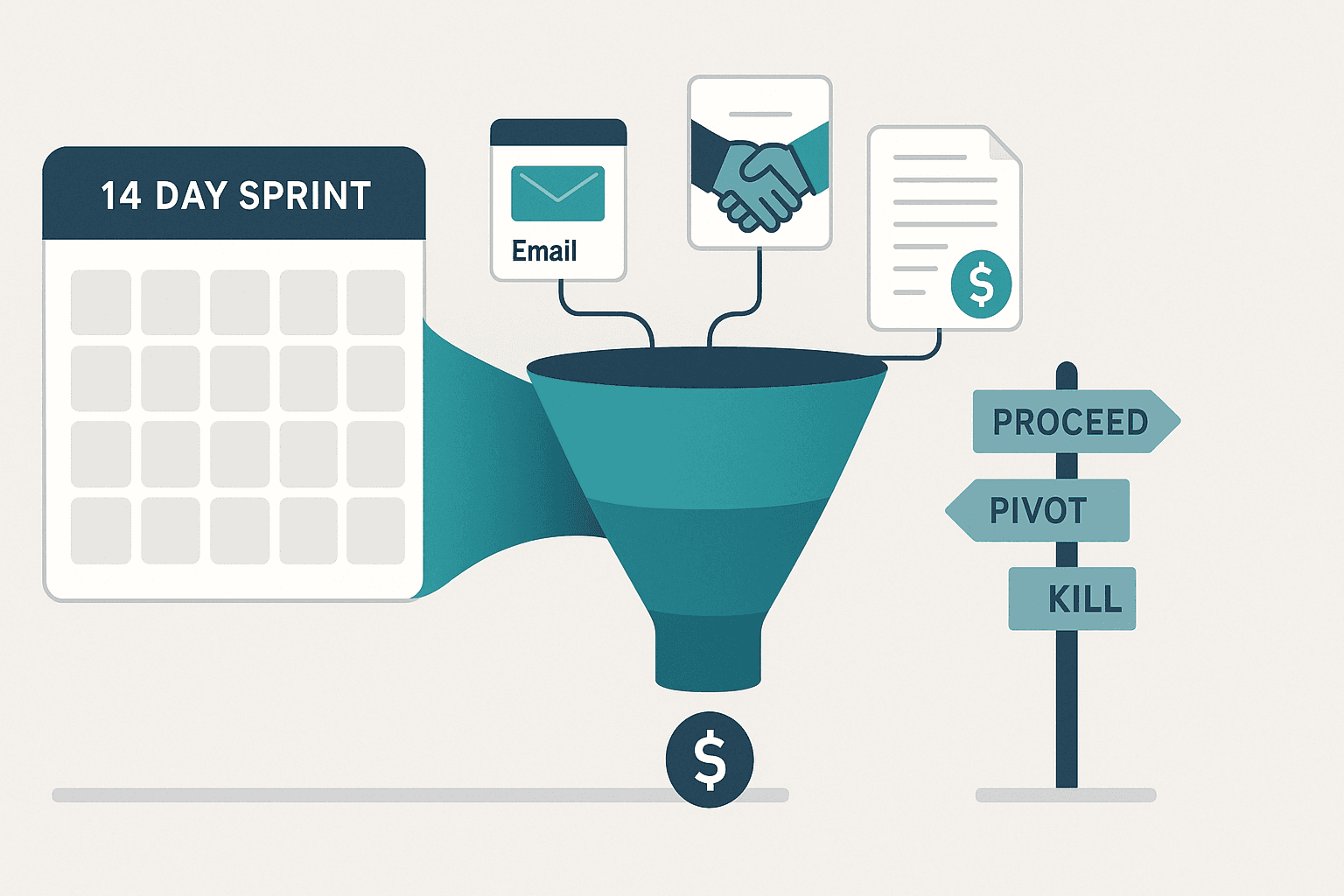
The Pre-PMF Sales Sprint is a two-week experiment designed to answer one question with real evidence:
Will a specific buyer in a specific market commit money or an explicit purchase intent for a specific outcome, before you build the product?
This is not a “smoke test” for vanity metrics. It’s a demand validation protocol centered on:
- Willingness-to-pay (not interest)
- A defined buyer (not “users”)
- A concrete problem and outcome (not feature wishlists)
- Commitment artifacts like LOIs, paid pilots, and calendar time (not likes)
In B2B, pre-PMF learning happens fastest when you try to sell, because selling forces specificity: who, what, why now, and how much.
This approach aligns with lean startup principles, validated learning and rapid experimentation, while being much more tactical about sales execution (Eric Ries’ The Lean Startup; Steve Blank’s customer development framework). It also echoes the “do things that don’t scale” ethos: early sales is supposed to be manual (Paul Graham, Y Combinator).
If you can’t sell it manually in week 1–2, software won’t magically fix the demand problem in month 6.
What “validated” looks like (clear pass/fail criteria)
Before you start, decide what counts as proof. Without predefined thresholds, every sprint becomes rationalization.
Strong validation signals (ranked)
- Paid pilot (best): money hits your account or card captured
- Signed LOI with commercial terms: scope, price range, timeline, success criteria
- Procurement steps initiated: vendor onboarding, security review, legal redlines
- Multiple stakeholder meeting scheduled: buyer brings finance/security/ops
- High-intent referrals: “Talk to our VP of X” or “We should roll this to Y team”
Weak signals (don’t confuse these with demand)
- “This is interesting”
- “Keep me posted”
- “We’d use this” (without timeline, budget, or authority)
- Email opens, clicks, Product Hunt upvotes
Practical sprint success targets
Pick targets based on deal size and audience. For typical early B2B:
- 30–60 cold outreaches/day (founder-led)
- 8–15 discovery calls total in 14 days
- 3–5 proposal/LOI conversations
- 1–2 paid pilots or LOIs
If you can’t reach these volumes because the market is tiny (e.g., 200 total target accounts), then your sprint shifts from volume to depth: fewer targets, more stakeholder mapping.
The sprint in one sentence
In 14 days, you will:
- Define a narrow ICP and pain hypothesis
- Launch a landing page that sells a specific outcome
- Run cold outreach to book calls
- Convert calls into LOIs or paid pilots
- Decide to proceed, pivot, or kill the idea
You will build no product: only sales assets.
Day 0: Set up the guardrails (2 hours)
1) Pick one ICP you can actually reach
The #1 sprint killer is choosing an ICP that’s too broad (“mid-market SaaS”) or too hard to access (buyers behind layers of gatekeepers).
A good sprint ICP:
- Has a clear buyer role (Head of RevOps, Director of Security, Controller)
- Has frequent pain (weekly/daily)
- Has budget authority or can trigger budget
- Is reachable via cold email/LinkedIn
Write it like this:
- Industry: B2B SaaS
- Size: 50–300 employees
- Buyer: Head of RevOps
- Trigger: Recently migrated CRM / scaling outbound / pipeline quality issues
- Pain: Attribution gaps, broken handoffs, noisy data
2) Choose one problem and one promised outcome
Your sprint is not to validate a platform. It’s to validate an outcome a buyer will pay for.
Bad: “AI platform for sales enablement.”
Better: “Reduce time-to-first-qualified-meeting by 30% by auto-personalizing outbound sequences using company-specific signals.”
3) Decide your price hypothesis now
Pricing is part of validation. If you avoid price, you’re validating curiosity, not willingness-to-pay.
Pick one of:
- Paid pilot: $1k–$5k for 2–4 weeks (common early B2B)
- Monthly SaaS: $300–$2k/month depending on ROI and buyer
- Outcome-based: % of savings/revenue (harder to implement pre-product)
Your goal isn’t perfect pricing; it’s to see if any pricing band clears the “this is expensive” reflex.
Days 1–2: Write the offer like a contract, not a tagline
A strong pre-PMF offer reads like something procurement could understand.
The “Offer One-Pager” (write this before your landing page)
Use this template:
For: [ICP]
Who have: [pain]
We deliver: [measurable outcome]
By: [mechanism, high-level]
In: [time]
Without: [common friction]
Pilot includes:
- [Deliverable 1]
- [Deliverable 2]
- [Deliverable 3]
Success criteria:
- [Metric]
- [Metric]
Price: $X for Y weeks (or $X/month)
Guarantee / risk reversal: (optional)
What we need from you:
- [Access or data]
- [Time commitment]
If you can’t fill this in, you’re not ready to outreach.
Opinionated note: sell a “done-for-you” pilot
Pre-PMF, “software-only” pilots often fail because buyers don’t want to babysit your experiment. A done-for-you component (services wrapped around the product you haven’t built yet) accelerates learning:
- You learn the workflow
- You discover integration blockers
- You get paid while iterating
This is consistent with many successful B2B startups that started as services before productizing (a recurring pattern discussed in startup lore; see also the general “services to software” path).
Days 2–3: Launch a landing page that sells one thing
Your landing page is a sales asset, not a brand statement.
Landing page structure (high conversion for cold traffic)
- Hero outcome
- “Cut SOC2 evidence collection time by 50% in 30 days.”
- Who it’s for
- “For security teams at 50–500 person SaaS companies preparing for SOC2/ISO.”
- The pain
- Bullet the ugly reality in their words.
- What you do (mechanism)
- High-level steps; avoid vague “AI-powered” claims.
- Pilot offer
- Scope, timeline, price anchor (or ‘starting at’).
- Proof
- If no logos, use credible proof:
- founder background
- specific case-style examples (clearly labeled as “example scenario”)
- advisors
- If no logos, use credible proof:
- Call to action
- “Book a 15-min fit check” (Calendly)
- FAQ
- Security, integrations, time to value, pricing model
Tools (keep it fast)
- Webflow / Framer / Carrd
- Calendly
- A simple CRM (HubSpot free is fine)
- A tracking doc (Google Sheet)
What not to do
- Don’t add product screenshots unless they represent something real
- Don’t hide pricing if you’re selling to SMB/mid-market
- Don’t collect “join waitlist” unless you also ask qualifying questions and propose a call
Your CTA is a conversation, not an email capture.
Days 3–5: Build a target list like you’re doing account-based sales
This sprint is won or lost in list quality.
Build a list of 150–300 targets
For most B2B offers, 150–300 accounts is enough for two weeks of outreach.
Where to find them:
- LinkedIn Sales Navigator
- Apollo / Clay / Crunchbase (depending on budget)
- Job postings (a gold mine for active pain)
- Tech stack signals (BuiltWith, Wappalyzer)
Add “trigger signals” to increase reply rates
Cold outreach works better when you have a reason now.
Examples:
- Hiring for RevOps / Security / Data roles
- Recently raised funding (but don’t rely on this alone)
- Migrating systems (job post mentions Salesforce, HubSpot, Snowflake)
- Compliance deadline (SOC2, HIPAA, ISO)
- Public incident or downtime postmortem (be tactful)
Decision-maker targeting
Start with the most direct buyer, then expand.
- Economic buyer (budget owner)
- Champion (daily pain owner)
- Technical approver (security, IT)
In early validation, a “no” from the economic buyer is more informative than ten “interesting” comments from end users.
Days 5–10: Run cold outreach as an experiment, not a personality test
Cold outreach is not a referendum on you. It’s a controlled test of:
- ICP relevance
- Problem resonance
- Offer clarity
- Price tolerance
Outreach channels
Use at least two:
- Cold email (scalable, measurable)
- LinkedIn (high context, good for follow-ups)
If your buyers are phone-forward (some industries are), add calling. But for most technical B2B, email + LinkedIn is enough for a sprint.
The most effective cold email pattern for pre-PMF
Keep it short, specific, and oriented around a measurable outcome.
Email #1 (problem + outcome + pilot)
Subject: Quick question about [pain]
Hi [Name], I noticed [trigger].
We’re running a small pilot to help [ICP] achieve [outcome] in [time], typically by [mechanism].
If you’re dealing with [pain], open to a 15-min call to see if this is relevant? If not you, who owns [area]?, [Name]
Why this works:
- Trigger shows it’s not spam
- Outcome is concrete
- Pilot framing reduces perceived risk
- “If not you” invites forwarding
Follow-up sequence (don’t be shy)
Most replies come from follow-ups. A simple 4-touch sequence:
- Day 1: Email #1
- Day 3: Follow-up with one sentence + ask
- Day 6: Add a micro-case or example scenario
- Day 9: Breakup email (“Should I close the loop?”)
Metrics to watch (and what they mean)
- Open rate low: deliverability/list quality/subject lines
- Open high, reply low: message/offering mismatch
- Replies but no meetings: unclear CTA or low urgency
- Meetings but no LOIs: weak pain, wrong buyer, wrong pricing, or low trust
A common founder mistake is optimizing copy before fixing ICP.
Days 6–12: Run discovery calls that end in commitments
Discovery is not “tell me about your problems.” It’s structured qualification to reach a commercial next step.
Call agenda (30 minutes)
- Context (3 min)
- “What prompted you to take this call?”
- Pain and urgency (10 min)
- frequency, severity, who feels it
- Current workflow (7 min)
- tools, handoffs, failure points
- Impact and ROI (5 min)
- dollars, time, risk
- Decision process (3 min)
- budget owner, procurement, timeline
- Pilot proposal (2 min)
- scope, success criteria, price
The questions that actually validate demand
Ask questions that surface willingness-to-pay and urgency:
- “What happens if you don’t fix this in the next 90 days?”
- “Have you tried to solve this before? What did you spend?”
- “Who signs off on a $3k pilot?”
- “If we could deliver [outcome] in 2–4 weeks, would you run this pilot this month?”
- “What would make this a ‘no’?”
The anti-pattern: feature interviews
If you spend the call collecting feature requests, you’ll walk away with a roadmap and zero revenue.
Your goal is to test:
- Is the pain real?
- Is it expensive?
- Is it a priority now?
- Will they commit?
Close each call with a binary next step
At the end, you need one of:
- Pilot proposal sent
- LOI draft sent
- Intro to decision-maker
- Clear rejection reason (and what would change it)
If the next step is “I’ll think about it,” you didn’t qualify hard enough.
LOIs, paid pilots, and what counts as “real”
LOI (Letter of Intent): the best pre-build commitment
A good LOI is not legal theater. It’s a forcing function.
Include:
- Scope of pilot
- Target start date
- Success criteria
- Commercial terms (price or price range)
- Signatures
Even if non-binding, a signed LOI is a meaningful psychological and organizational commitment.
Paid pilot: the gold standard
A paid pilot can be:
- “Done-for-you” plus lightweight tooling
- A manual workflow you run behind the scenes
- A concierge MVP
The key is not automation. The key is whether the buyer pays for the outcome.
If they won’t pay anything, be careful: you may be solving a “nice-to-have.”
Risk reversal to increase conversion
When you have low trust (which you do), reduce risk:
- Money-back guarantee if success criteria not met
- Short pilot duration (2 weeks)
- Clear exit
In B2B, the real risk is often internal: stakeholders don’t want to bet their reputation on an unknown vendor. Your job is to lower that perceived cost.
The 14-day schedule (day-by-day)
Day 1: Narrow the ICP and write the one-page offer
- Define buyer, trigger, pain, outcome, price hypothesis
- Draft pilot scope + success criteria
Day 2: Create landing page v1
- Outcome-first copy
- Calendly CTA
- Simple FAQ
Day 3: Build target list (first 150)
- Add triggers
- Identify buyer titles
Day 4: Write outreach copy + set sequence
- 1 main email + 3 follow-ups
- LinkedIn connection note
Day 5–10: Outreach daily + book calls
- 30–60 contacts/day
- Track results: replies, meetings
- Iterate ICP/message (not just wording)
Day 6–12: Run discovery calls
- Use structured qualification
- Ask for pilot/LOI commitment
Day 10–14: Propose pilots, negotiate, close
- Send 1–2 page pilot proposal
- Send LOI template
- Collect payment or signatures
Day 14: Decision day
- Continue, pivot, or kill
What to do when the sprint “fails” (most do)
A sprint that doesn’t close a pilot is not automatically a bad idea. It’s data.
Diagnose failure mode:
1) Low reply rate
Likely:
- Wrong ICP
- No trigger
- Unclear pain/outcome
Fix:
- Narrow ICP
- Use stronger triggers (job posts, migrations)
- Rewrite the offer in buyer language
2) Good replies, low meeting conversion
Likely:
- CTA too big
- Too vague
Fix:
- Offer a “15-min fit check”
- Add a specific pilot scope and timeline
3) Meetings happen, but no one will sign
Likely:
- Not painful enough
- Not urgent
- Wrong buyer
- Price misfit
Fix:
- Move upmarket (bigger pain, budget)
- Shift to compliance/deadline-driven triggers
- Sell a smaller paid pilot
4) They love it, but procurement/security blocks
Likely:
- You’re selling into a high-friction environment too early
Fix:
- Target startups/SMB first
- Offer low-data pilots
- Provide basic security posture docs
Sometimes the right move is to pivot to an adjacent ICP with the same pain but fewer blockers.
Ethical lines: don’t fake product, do sell the outcome
Pre-PMF validation has a reputation risk because some founders misrepresent what exists.
Principles:
- Be explicit: “We’re running a pilot; some parts are manual.”
- Don’t demo fake dashboards as real.
- Don’t claim customers you don’t have.
You can sell something you haven’t built if:
- You can deliver the outcome manually
- You are transparent about implementation
This is essentially a concierge MVP approach, widely used in lean product validation.
Advanced tactics (if you’re technical and want leverage)
1) Use “artifact selling” to increase trust
Instead of selling software, sell an artifact:
- “We deliver a weekly compliance evidence packet.”
- “We deliver a clean, deduped lead list with scoring rules.”
- “We deliver a churn risk report plus playbooks.”
Artifacts feel concrete and reduce uncertainty.
2) Instrument your sprint like a product funnel
Track:
- Contact → Reply → Meeting → Qualified → Proposal → LOI → Paid
Even in a spreadsheet, treat it like a funnel. This is your pre-PMF growth model.
3) Run two parallel messages, not ten micro-edits
A/B test at the level that matters:
- Message A: Outcome + urgency
- Message B: Cost savings + risk reduction
Don’t waste time testing synonyms.
4) Use pricing as a segmentation tool
Offer two options:
- Pilot: $2,500 / 2 weeks (done-for-you)
- Full engagement: $1,000/mo platform (waitlist)
See who self-selects. Early on, you want buyers with urgency.
Common objections and how to handle them
“We already have a tool for that.”
Response:
- “Makes sense. What’s missing today?”
- “If I could deliver [outcome] without replacing your stack, would that matter?”
You’re probing for gaps, often tools exist but workflows still break.
“We don’t have budget.”
Response:
- “Understood. Is this a priority problem or a ‘someday’ problem?”
- “What budget would exist if this saved X hours/week or reduced risk?”
No budget often means no urgency, not no money.
“Come back when it’s built.”
Response:
- “Fair. We’re specifically looking for 2–3 design partners to shape the workflow and get early value via a pilot. If we could do it manually first, would you be open?”
This reframes: they’re not buying unfinished software; they’re buying early outcomes and influence.
The decision framework: proceed, pivot, or kill
At day 14, decide based on evidence.
Proceed if
- You got 1–2 paid pilots or strong LOIs
- Buyers pulled you into internal conversations
- The pain is urgent and expensive
Pivot if
- You got meetings and clear pain, but:
- wrong buyer
- pricing mismatch
- procurement friction too high
- offer too broad
Pivot usually means changing ICP, wedge, or packaging: not adding features.
Kill if
- You cannot find urgent pain
- Buyers won’t commit even with risk reversal
- Problem is consistently deprioritized
Killing fast is a feature, not a failure. Opportunity cost is real.
Why this works: sales is the highest-bandwidth form of research
Founders often say they’re “doing research,” but they’re really collecting opinions.
Sales conversations produce higher-quality data because:
- Buyers reveal constraints (budget, security, timelines)
- You learn the real competition (status quo, internal tools)
- You’re forced to quantify ROI
- Commitment requires internal alignment
The sprint compresses months of uncertainty into 14 days.
In lean startup terms, you’re testing the riskiest assumption first: customers will pay. In customer development terms, you’re moving quickly from problem discovery to early validation. And in practical startup terms, you’re creating momentum with the only resource that truly matters early on: revenue commitments.
A simple LOI template (starter)
Use this as a lightweight structure (adapt with counsel as needed):
- Parties
- Pilot description
- Timeline
- Success criteria
- Pilot fee and payment terms
- Confidentiality
- Non-binding clause (unless you want binding)
- Signature lines
Even a Google Doc with signatures via DocuSign/HelloSign is enough for validation.
Final takeaway
If you can’t get a buyer to commit, time, social capital, or money, your idea is not yet a business.
The Pre-PMF Sales Sprint is a disciplined way to find out quickly. It forces you to:
- choose a real buyer
- sell a measurable outcome
- price the value
- ask for commitment
Do it for 14 days. If it works, you’ll have the rarest pre-PMF asset: proof. If it doesn’t, you’ll have something almost as valuable: clarity.
References / further reading
- Eric Ries, The Lean Startup (validated learning, build-measure-learn)
- Steve Blank, The Four Steps to the Epiphany (customer development)
- Y Combinator / Paul Graham essays on “Do Things That Don’t Scale”
- Rob Fitzpatrick, The Mom Test (how to talk to customers without getting lied to)
- April Dunford, Obviously Awesome (positioning, clarity on category and value)
- The concept of concierge MVPs and smoke tests in lean product experimentation (commonly discussed in lean startup literature)