
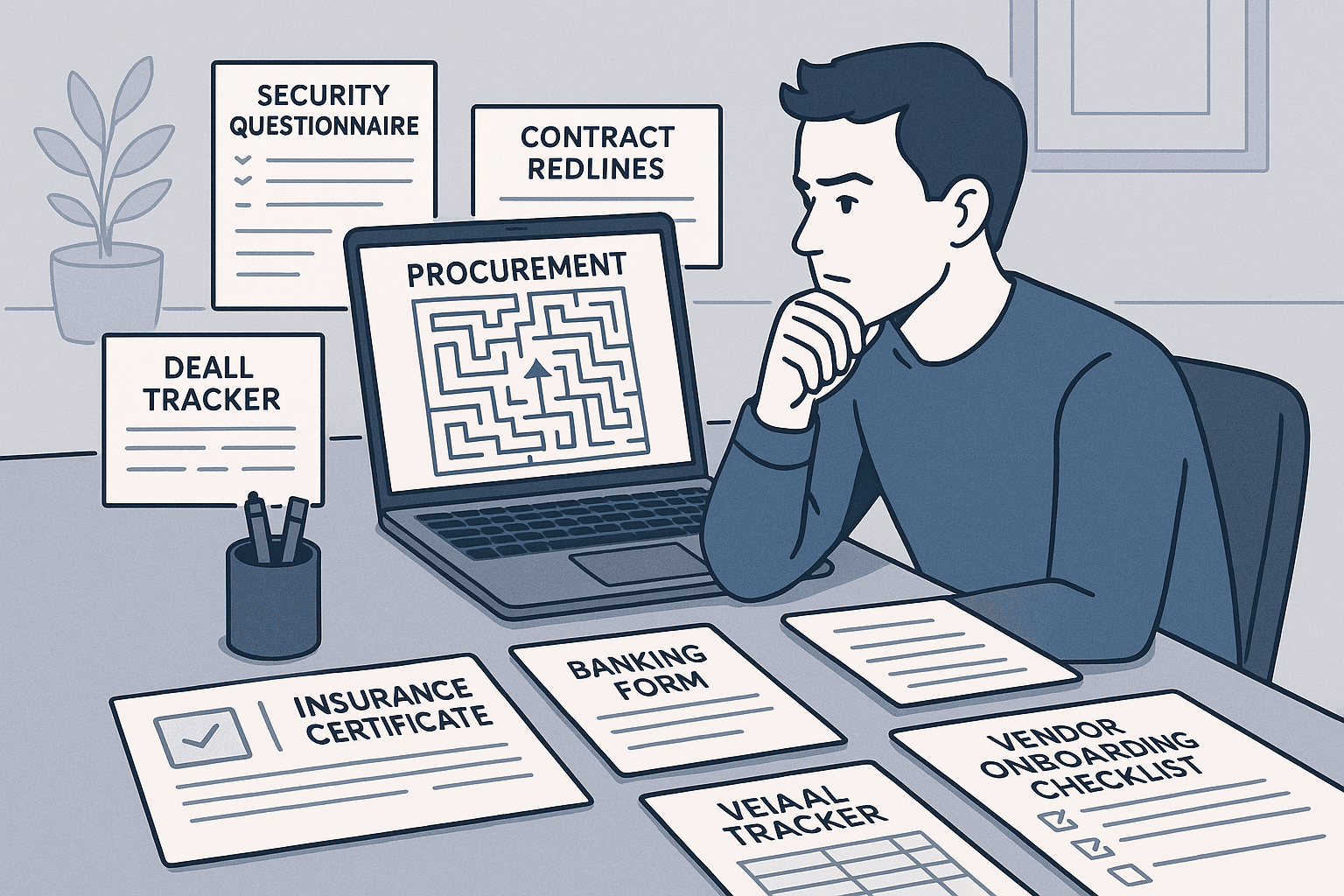
A familiar kind of loss happens in early-stage B2B startups, and it rarely shows up honestly in the CRM.
The deal looks healthy. The champion is engaged. The demo went well. The pilot discussion sounded real. Budget exists. The buyer says some version of, "We want to move forward. Next step is procurement/security/legal."
Then the deal enters a gray zone.
A security questionnaire arrives and sits unanswered for six business days because nobody knows who owns it. Legal sends back a redlined MSA and the founder reviews it at 11:30 p.m. between investor updates. Procurement asks for the company’s W-9, banking details, proof of insurance, data processing addendum, security policy, and primary support terms. Finance asks whether the customer requires vendor registration in a portal the team has never seen. The buyer asks for an implementation plan and target go-live date, but internally nobody wants to commit until the contract is signed. Meanwhile, the champion starts sending shorter emails.
Two weeks later the startup tells itself the prospect "went dark" or "had internal delays."
In reality, the company fell into a procurement readiness gap.
This gap is one of the most expensive hidden operating problems in early-stage B2B. It doesn’t feel like a product problem, and it doesn’t look like a pipeline generation problem. It feels administrative. Founders postpone it because it looks like enterprise theater. But when you start selling into companies with security review, legal review, vendor onboarding, or finance controls, procurement readiness becomes part of the product you are actually selling.
If your company creates demand, survives evaluation, and then slows down when buyers ask for a security packet, MSA redlines, insurance docs, banking forms, or vendor setup details, you do not have a closing problem. You have an operational conversion problem.
This article is a tactical playbook for fixing it without overbuilding. The goal is not to mimic a Fortune 500 vendor management program. The goal is to build a lightweight procurement-readiness system early enough that enterprise friction stops silently killing your close rates.
The failure scenario: a deal you should have won
Let’s make this concrete.
Imagine a seed-stage startup selling workflow software into mid-market operations teams. ACV is $18,000 to $35,000. The company has seven employees. Sales is founder-led plus one account executive. The product is good enough to create real pull. The team has three late-stage deals in the quarter, and one of them feels especially likely.
The buyer loves the product. The department VP joins the final demo and asks smart implementation questions. The internal champion says, "If we can get through security and paperwork quickly, I think we can get this live next month."
Then the requests begin.
The customer asks for:
- Security questionnaire
- SOC 2 status or alternative controls overview
- Data processing addendum
- Standard MSA
- Insurance certificate with specified limits
- W-9
- ACH or banking setup form
- Company legal entity details
- Support and uptime commitments
- Subprocessor list
- Vendor onboarding registration
None of these requests is individually unreasonable. Collectively, they become a systems test the startup is unprepared to pass.
What happens internally:
- The AE forwards the email to the founder.
- The founder asks the CTO to handle security.
- The CTO is in the middle of shipping a release.
- Nobody knows whether there is a current certificate of insurance or whether limits meet the buyer’s requirement.
- The startup has an MSA template, but it was copied from a template generator eighteen months ago and has never been pressure tested.
- The DPA exists, but nobody is sure whether it matches current product architecture.
- Banking setup requires finance approval, but finance is an outsourced bookkeeper with a two-day response time.
- The questionnaire includes 140 questions, 80 of which are repetitive, but no prior answer library exists.
- Legal redlines arrive in a PDF with comments from a procurement counsel who changes payment terms from net 30 to net 60, adds broad indemnity obligations, requires a 24-hour breach notification window, and inserts uncapped liability around confidentiality and data security.
The startup does eventually respond. But the response pattern signals risk:
- Slow first reply
- Incomplete packet
- Inconsistent answers across documents
- Unclear ownership
- Excessive escalation for routine asks
- Long pauses between steps
To the buyer, this does not look like "scrappy startup energy." It looks like execution risk.
Now the champion, who was already spending political capital internally, has to defend a vendor that seems hard to buy from. Procurement starts prioritizing other vendors. Security asks follow-up questions because answers were vague. Legal stalls because redline turnaround is slow and every issue gets kicked back to the founder. Finance cannot finish setup because banking information came through an insecure email chain and then had to be reconfirmed.
Thirty days later, the deal misses the quarter. Sixty days later, budget is reallocated. The CRM disposition says: timing slipped.
That is the procurement readiness gap in practice.
Pattern identification: what this problem actually is
Most founders initially misclassify this issue.
They think:
- We need a better salesperson.
- Enterprise deals just take longer.
- Big companies move slowly.
- We need SOC 2 before we can sell upmarket.
- Legal is always a mess.
Those statements contain partial truth, but they miss the core pattern.
The procurement readiness gap is the distance between customer buying intent and your company’s ability to satisfy the non-product requirements required to become an approved vendor.
That distance has five recurring dimensions.
- Document readiness
You do not have a complete, current, easy-to-send set of materials buyers routinely ask for.
Typical missing or stale items:
- Security overview or trust packet
- Standard security questionnaire answers
- SOC 2 report or roadmap summary
- DPA
- MSA
- SLA/support terms
- Certificate of insurance
- W-9 or local tax forms
- Banking/ACH setup details
- Legal entity information
- Subprocessor list
- Privacy policy and data retention summary
- Ownership readiness
You do not know who owns each type of request, who approves deviations, and who is responsible for turnaround.
Typical symptoms:
- Sales forwards everything to founders
- CTO handles every security question ad hoc
- Nobody owns insurance, tax forms, or finance setup
- Contract review bottlenecks with one person
- Customer questions get answered by whoever saw the email first
- Policy readiness
You have no rules for what you will accept, what you will negotiate, and what requires escalation.
Typical symptoms:
- Every redline is treated as bespoke legal work
- Security answers are improvised each time
- Sales promises terms before approval
- Finance exceptions are granted inconsistently
- One customer gets favorable terms that become precedent for the next
- Workflow readiness
The work is not sequenced or tracked.
Typical symptoms:
- Security review starts late
- Legal review waits until after security when it could run in parallel
- Vendor setup begins after signature instead of before
- Follow-ups rely on memory instead of a checklist
- Nobody knows current status across workstreams
- Risk visibility
The company cannot tell which deals are likely to die in procurement and why.
Typical symptoms:
- CRM stages stop at proposal or verbal commit
- No field tracks security/legal/onboarding blockers
- Delays appear as vague slippage
- Leadership cannot distinguish deal quality from process friction
- Repeated failure modes never get fixed systemically
When these five readiness layers are weak, the buyer experiences drag exactly at the point when they expected confidence.
Why standard advice fails
A lot of common startup advice breaks here because it assumes procurement friction is either unavoidable or only relevant much later.
Standard advice #1: "Just focus on product and sales until enterprise pull is obvious."
This is directionally right when you are searching for product-market fit. It is wrong once you are regularly getting into real buying processes. If multiple prospects are asking for the same procurement artifacts, this is no longer edge-case overhead. It is part of your go-to-market system.
The mistake is binary thinking: either we ignore enterprise process entirely, or we build a heavyweight compliance machine. The right move is a lightweight readiness layer that matches current deal size and segment.
Standard advice #2: "Get SOC 2 and the problem goes away."
SOC 2 helps. It does not solve procurement readiness.
You can have SOC 2 and still lose deals because:
- Nobody returns questionnaires quickly
- Your MSA is weak or outdated
- Insurance limits are too low
- Vendor onboarding forms are incomplete
- Security answers are inconsistent with legal terms
- There is no owner for procurement follow-through
SOC 2 is one input into trust. It is not a substitute for process.
Standard advice #3: "Use outside counsel when contracts come in."
Outside counsel is useful for specific issues and templates. It is a terrible day-to-day operating system for routine procurement flow, especially if every customer redline starts a new email thread billed in six-minute increments.
If your default contract workflow is "send to outside counsel and wait," your turnaround time will be too slow and your costs will be disproportionate to deal size.
Standard advice #4: "Have sales handle it."
Sales should coordinate the buyer experience. Sales should not invent legal positions, answer detailed security architecture questions, or email unapproved banking information from personal judgment. When companies say "sales owns the deal," they often create a hidden escalation trap where sales is responsible but not actually empowered.
Standard advice #5: "Big customers just move slowly."
Some do. But founders often use buyer complexity as an excuse for internal unreadiness. The key question is not whether the customer is slow. It is whether your side is compressing time or expanding it.
If you take four days to send a first-pass security packet, seven days to return basic redlines, and another week to finish vendor setup forms, you are actively increasing the odds that the deal dies in someone else’s queue.
The better approach: build a procurement-readiness system before you think you need one
You do not need an enterprise legal department. You need a startup-grade system with enough structure to do three things well:
- Respond fast
- Respond consistently
- Expose risk early
A good lightweight system has six parts:
- A standard document pack
- Named owners and backups
- Redline and exception rules
- Security questionnaire workflow
- Response SLAs
- A deal-risk tracker tied to the CRM or deal review process
That is it.
If you build those six pieces, you will close more of the deals you already earned.
Part 1: Build a standard document pack
The document pack is the core of procurement readiness. This is the material you can send within hours, not days, when a buyer says, "Can you send over your security and vendor docs?"
At minimum, most early-stage B2B startups selling into serious buyers should have:
Commercial/legal
- Standard MSA
- Order form template
- DPA
- SLA or support terms
- Privacy policy
Security/trust
- Security overview or trust packet
- Architecture summary at a level safe to share
- Access control summary
- Encryption summary
- Incident response summary
- Business continuity or backup summary
- Subprocessor list
- SOC 2 report if available, or readiness roadmap if not
Finance/vendor setup
- W-9 or equivalent tax form
- Certificate of insurance
- Banking/ACH setup form or standard remittance instructions
- Legal entity name, incorporation state, address, and contact details
Operational
- Primary support contact details
- Implementation overview
- Data retention/deletion summary
- Standard onboarding timeline assumptions
A few practical rules matter here.
First, create a single source of truth.
Do not keep these across random Google Drive folders, old email attachments, a founder laptop, and your broker’s portal. Put them in one controlled location with current versions and clear file names.
Example folder structure:
- /Procurement Readiness
- /01 Legal
- /02 Security
- /03 Finance Vendor Setup
- /04 Templates
- /05 Archived
Second, version and date key documents.
Nothing undermines trust faster than sending an outdated insurance certificate or contradictory policy docs. Put visible dates on the security overview, subprocessor list, and any summary document that might change.
Third, separate what is standard from what is customer-specific.
For example:
- Standard MSA template: reusable
- DPA template: reusable
- Security overview: reusable
- Order form: customer-specific
- Insurance certificate with named insured or endorsements: may be customer-specific
- Vendor portal registration: customer-specific
Fourth, write for speed, not legal elegance.
Your trust packet should not read like a consulting artifact. It should answer common questions clearly enough to reduce follow-ups.
Typical trust packet sections:
- Company overview
- Product overview
- Data types processed
- Hosting/provider overview
- Authentication and access controls
- Encryption in transit and at rest
- Backup/recovery basics
- Logging/monitoring basics
- Vulnerability management approach
- Incident response summary
- Security contact
- Compliance status and roadmap
Tool options for managing the pack
Option A: Shared drive + internal checklist
Best for: pre-seed to seed teams with low document volume Cost: near zero Pros:
- Simple
- Fast to set up
- No new tooling overhead
Cons:
- Weak auditability
- Easy for versions to drift
- Poor external buyer experience if they expect a trust portal
Option B: Notion or Confluence as internal source + drive for files
Best for: teams that need documented workflows and answer libraries Cost: low Pros:
- Good for ownership and playbooks
- Easy to update collaboratively
- Useful for questionnaire response libraries
Cons:
- Still not ideal as an external trust center
- Permissions can get messy
Option C: Trust center/security portal tools
Best for: startups increasingly selling into security-conscious buyers Cost: moderate Pros:
- Cleaner buyer-facing experience
- Centralizes common artifacts
- Can reduce repetitive back-and-forth
Cons:
- Another system to maintain
- Not necessary for very early volume
- Can create polish without fixing internal response workflows
Founder recommendation: start with shared drive + internal wiki + basic external trust page. Upgrade to a dedicated trust platform when request volume justifies it.
Part 2: Assign owners and backups
Most procurement chaos is ownership chaos wearing a paperwork costume.
Every request category needs:
- A primary owner
- A backup owner
- An approver for non-standard exceptions
A simple owner matrix might look like this:
- Security questionnaires: primary CTO or security lead; backup senior engineer; approver CTO/founder
- MSA/DPA redlines: primary COO/founder or legal ops owner; backup CEO; approver designated legal counsel for specific issues
- Insurance requests: primary finance/ops; backup founder; approver CEO/CFO equivalent
- W-9 and tax docs: primary finance/ops; backup bookkeeper
- Banking setup forms: primary finance/ops; backup founder; approval and secure transmission rules documented
- Vendor portal registration: primary sales ops or account owner; backup ops manager
- Implementation timelines/support terms: primary customer success or product lead; backup founder
The key is not title sophistication. The key is explicitness.
If you are a 10-person company, the matrix may still involve founders. That is fine. What kills deals is not founder involvement. It is unstructured founder involvement.
Two rules help a lot:
Rule 1: Sales coordinates, owners answer.
The AE or founder-seller should remain the buyer-facing coordinator so the customer experiences a single thread. But internal content should come from the designated owner.
Rule 2: Every owner has a response expectation.
Ownership without timing is fake ownership. If security owns questionnaires but has no expected turnaround, the work still sits.
Part 3: Define redline rules before the first redline arrives
If every contract negotiation starts from zero, your close cycle will bloat and legal costs will climb.
You need a simple negotiation policy that tells the team:
- What we usually accept
- What we usually reject
- What needs escalation
- Who can approve tradeoffs
This is not a full legal playbook. It is a founder-operating tool.
Common contract terms to pre-decide:
- Payment terms: net 30 vs net 45 vs net 60
- Auto-renewal position
- Termination for convenience
- Limitation of liability cap
- Indemnity scope
- Security commitments
- Breach notification timing
- Audit rights
- Governing law/venue
- Warranty language
- Service levels and remedies
- Data deletion timing
- Assignment and subcontracting language
Example startup-grade redline policy:
Usually accept:
- Net 30
- Reasonable confidentiality edits
- DPA changes aligned to actual practices
- Customer paper for larger deals if core economics justify it
Escalate:
- Net 60 or longer on sub-$25k ACV deals
- Unlimited indemnity
- Uncapped liability for security/privacy on small contracts
- Aggressive audit rights
- Breach notices shorter than your actual detection/validation ability
- Uptime credits disproportionate to contract value
- Broad IP ownership changes
Usually reject:
- Work-for-hire language on core product
- Customer ownership of generalized product improvements
- Security obligations you cannot operationally meet
- Insurance requirements far beyond current coverage unless deal size supports upgrade
This policy does two things.
First, it compresses routine decision-making.
Second, it exposes when a seemingly attractive deal actually has bad economics once procurement terms are included.
This matters because founders often accept expensive legal and insurance obligations to win logos that are too small to support them.
A $15,000 ACV deal that requires $5 million cyber coverage, deep customer paper negotiation, net 90 terms, and weeks of security review may not be a good deal. Your system should help you see that early.
Tool comparison for contract workflows
Option A: Google Docs/Word + manual redlines + email
Best for: very early volume Cost: low Pros:
- Flexible
- Familiar
Cons:
- Version control pain
- Hard to track clause patterns
- Slow with multiple approvers
Option B: CLM-lite or contract workflow tools
Best for: startups doing repeated contract cycles monthly Cost: low to moderate Pros:
- Better visibility
- Template control
- Approval routing
Cons:
- Setup overhead
- Overkill if volume is still tiny
Option C: Outside counsel + internal issue matrix
Best for: keeping legal spend bounded while founders retain speed Cost: moderate variable Pros:
- Good for edge cases
- Prevents full dependency on counsel
Cons:
- Requires internal discipline
- Still too slow if every issue is escalated
Founder recommendation: keep templates in standard docs, maintain an internal redline policy, and use counsel only for threshold issues and template upgrades.
Part 4: Create a security questionnaire workflow, not just answers
Questionnaires are where startup teams lose an absurd amount of time.
The instinctive approach is to answer each new sheet from scratch. That is slow, inconsistent, and exhausting.
Instead, create a lightweight workflow:
Step 1: Build an answer library
Capture reusable answers to common questions:
- Hosting environment
- Data encryption
- SSO/MFA support
- Access review practices
- Logging and monitoring
- Vulnerability scanning
- Incident response
- Employee security training
- Backups and recovery
- Data retention and deletion
- Subprocessor management
- Customer data segregation
Store answers in a searchable format with:
- Standard answer text
- Last reviewed date
- Owner
- Notes on where customization may be needed
Step 2: Triage incoming questionnaires
Not all questionnaires deserve equal effort.
Classify by:
- Deal size
- Strategic value
- Prospect stage
- Procurement requirement vs optional request
- Degree of overlap with existing answers
For example:
- Tier 1: strategic/large deal, complete within 2 business days initial pass
- Tier 2: solid mid-market deal, complete within 4 business days
- Tier 3: low ACV or low-likelihood deal, require stronger buying signal before deep custom work
Step 3: Split factual vs policy questions
Many questions are factual and answerable from your library. Others imply commitments.
Examples:
- Factual: Is data encrypted at rest?
- Policy/commitment: Do you guarantee annual third-party penetration testing and provide reports to customers upon request?
Factual questions can move quickly. Commitment questions may require escalation.
Step 4: Track unresolved items
Never send a questionnaire with silent guesswork. Maintain an internal unresolved list for:
- Questions requiring engineering confirmation
- Questions requiring legal review
- Questions where the truthful answer may create risk
- Questions that need customer clarification
Step 5: Save the final answer set
Every completed questionnaire should enrich the answer library. Otherwise you pay the same time tax repeatedly.
Tool options for questionnaires
Option A: Spreadsheet answer library
Best for: early teams Cost: minimal Pros:
- Easy to start
- Good enough at low volume
Cons:
- Hard to search at scale
- Easy for answers to drift
Option B: Notion/Airtable answer database
Best for: teams wanting lightweight structure Cost: low Pros:
- Searchable
- Versionable
- Easy owner fields
Cons:
- Requires maintenance discipline
Option C: Dedicated questionnaire automation tools
Best for: higher volume enterprise sales motions Cost: moderate to high Pros:
- Faster completion
- Better reuse
- Integrations possible
Cons:
- Expensive early
- Can encourage low-quality auto-filled answers if unmanaged
Founder recommendation: start with Airtable or Notion plus document templates. Upgrade only when volume consistently hurts win capacity.
Part 5: Set response SLAs internally
Most startups have customer support SLAs before they have procurement response SLAs. That is backward if enterprise deals matter.
Internal response SLAs should define the maximum time to first response and turnaround for common request types.
Example internal procurement SLAs:
- Initial send of standard document pack: same business day, or within 24 hours max
- Acknowledge security questionnaire and confirm ETA: same business day
- First-pass questionnaire completion: 2 to 4 business days depending on tier
- First review of standard redlines: 2 business days
- W-9 and insurance certificate send: same business day
- Banking/vendor setup form completion: 1 business day if no special approvals required
- Escalation decision on non-standard terms: within 48 hours
These are internal SLAs, not buyer promises. Their purpose is to prevent invisible stalling.
One nuance: do not confuse speed with recklessness. Same-day acknowledgement matters even when full completion takes longer. Buyers tolerate complexity better than silence.
A good buyer-facing message sounds like:
"We’ve started internal review. Attached are our standard vendor docs and trust materials. We’ll return the questionnaire by Thursday EOD and flag any items that need clarification. We can run legal review in parallel if helpful."
That message alone creates confidence because it signals control.
Part 6: Build a deal-risk tracker for procurement friction
If procurement friction is not visible in your pipeline, you will underinvest in fixing it.
You need a lightweight tracker at the deal level.
At minimum, capture:
- Security review required? yes/no
- Legal review required? yes/no
- Vendor onboarding required? yes/no
- Procurement complexity score: low/medium/high
- Missing required docs? yes/no
- Key blocker type: security/legal/insurance/finance/champion/internal resourcing
- Days in procurement stage
- Next owner on your side
- Next customer action due
- Risk level: green/yellow/red
You can do this in your CRM, a deal review sheet, or both.
A simple procurement risk score can work like this:
Add 1 point each for:
- Security questionnaire >100 questions
- Customer paper required instead of your paper
- Insurance requirement exceeds current coverage
- Vendor portal onboarding required
- Banking setup with external approvals needed
- No security owner assigned
- No redline policy for deal segment
- Response SLA already breached once
Interpretation:
- 0 to 1: low friction
- 2 to 3: moderate friction, track actively
- 4+: high risk of silent slip, escalate in forecast calls
This is not about making forecasting look scientific. It is about forcing operational truth into the sales conversation.
If a deal is "commit" but redlines are untouched, the questionnaire is unanswered, and insurance is below required thresholds, that deal is not a clean commit.
Workflow example: what good looks like in practice
Here is a practical sequence for a startup handling an enterprise-ish procurement motion well.
Day 0: Buyer says they want to move forward pending procurement/security/legal.
Account owner triggers internal procurement checklist.
Checklist auto-assigns:
- Security owner
- Contract owner
- Finance/vendor setup owner
- Executive approver if required
Day 0 or 1:
Buyer receives:
- Short acknowledgement email
- Standard trust/security packet
- W-9
- insurance certificate
- standard MSA/DPA if appropriate
- confirmation of questionnaire turnaround ETA
Internal tracker updated with:
- procurement stage start date
- required workstreams
- risk score
- target customer deadline
Day 1 to 3:
Security owner completes first-pass questionnaire using answer library. Legal owner reviews customer paper or prepares startup paper. Finance/ops begins vendor portal registration if available. Sales coordinates buyer communication and schedules a short procurement unblock call if useful.
Day 3:
Startup returns questionnaire with highlighted exceptions or pending clarifications. Contract redlines returned or legal call proposed. Any insurance gaps or unsupported terms escalated internally with clear commercial tradeoff.
Day 4 to 7:
Follow-ups handled within SLA. Champion gets concise status updates they can forward internally. Forecast category adjusted if risk increases.
What changed here is not brilliance. It is orchestration.
Cost and time analysis: the economics of readiness
Founders often delay this work because it feels like non-core overhead. That is understandable. But the cost math usually favors readiness much earlier than teams assume.
Let’s compare two scenarios.
Scenario A: Ad hoc procurement handling
Assume per enterprise-ish deal:
- Founder time: 5 to 8 hours
- CTO/security time: 4 to 6 hours
- AE coordination time: 3 to 5 hours
- Outside counsel: $750 to $3,000 depending on redlines
- Delay introduced by response gaps: 1 to 3 weeks
Now assume 10 such deals per quarter reach this stage.
Rough quarterly cost:
- 50 to 80 founder hours
- 40 to 60 technical hours
- 30 to 50 sales hours
- $7,500 to $30,000 external legal spend
- At least a few deals slip or die from preventable drag
Scenario B: Lightweight readiness system
One-time setup:
- Build document pack: 10 to 20 hours
- Build answer library: 8 to 15 hours
- Create redline rules with counsel input: 3 to 6 hours internal + some legal fees
- Set owner matrix and tracker: 2 to 4 hours
Ongoing per deal:
- Founder time: 1 to 3 hours
- CTO/security time: 1 to 2 hours
- AE coordination time: 1 to 2 hours
- Outside counsel only for edge cases
This is one of those operational investments where even a single saved deal can justify the setup cost.
Example:
If your ACV is $25,000 and procurement readiness improves close rate on late-stage enterprise deals by even 10 to 15 percentage points, the revenue impact can be material fast. Two additional wins a year can pay for legal templates, insurance upgrades, tooling, and internal process time many times over.
The bigger gain, though, is cycle time compression. Faster procurement response means:
- Better quarter-end conversion
- Less champion fatigue
- More accurate forecasting
- Lower founder distraction
- Better signal on real product objections vs process friction
What not to overbuild
This is important because startups love swinging from chaos to bureaucracy.
Do not overbuild in these ways:
Do not hire for a full procurement/compliance function too early.
A lightweight owner matrix across current team members is usually enough until volume is clearly high.
Do not create policies you cannot operationally support.
If your security summary claims mature controls that do not actually exist, you are buying future pain.
Do not let counsel design the whole workflow.
Lawyers are good at legal risk management. They are not always good at startup throughput design.
Do not force every customer through maximum rigor.
A $12,000 low-complexity deal should not get the same internal effort as a strategic six-figure expansion path account.
Do not hide friction in optimism.
If procurement is red, mark it red. Hope is not a process.
A 30-day implementation plan for the next 30 days
If you want to fix this fast, here is a practical first month.
Week 1: Inventory and gather
- List every document recent customers have requested
- Collect current versions
- Identify missing items
- Create one shared folder as source of truth
- Assign temporary owners
Output: baseline document pack skeleton
Week 2: Standardize and decide
- Update or create standard MSA, DPA, and order form
- Get current insurance certificate and confirm coverage limits
- Prepare W-9/tax and banking setup materials
- Draft a security overview/trust packet
- Create a simple redline policy with legal input on escalation thresholds
Output: first usable pack + redline rules
Week 3: Build workflows
- Create questionnaire answer library
- Define internal procurement SLAs
- Build owner matrix with backups
- Add procurement fields to CRM or deal review sheet
- Create a checklist for new deals entering procurement
Output: operational workflow
Week 4: Run and refine
- Pilot the system on active deals
- Measure turnaround time for each request type
- Note repeat buyer questions not covered by current pack
- Tighten messaging templates
- Identify which requests still depend too heavily on founders
Output: working version 1 with real usage data
Messaging templates that help immediately
Internal handoff message from sales:
"Deal entered procurement. Target signature date: June 30. Required workstreams: security questionnaire, customer paper redlines, W-9, insurance cert, vendor portal registration. Risk factors: customer paper, 120-question security sheet, net 60 request. Owners assigned per matrix. Initial buyer response due today."
Buyer acknowledgement message:
"Thanks. We’ve kicked off review internally. Attached are our standard vendor materials, including tax and insurance docs plus our security overview. We’ll return the questionnaire by Thursday EOD and can review legal in parallel to keep things moving. If helpful, we can also set up a 20-minute call to unblock security or procurement questions."
Champion update message:
"Quick status update: security packet sent, questionnaire in progress for Thursday return, legal reviewing customer paper now, vendor setup docs ready once portal access is provided. Current risk is low; only open issue on our side is confirmation of insurance wording if your procurement team requires a specific endorsement."
These messages are simple, but they reduce buyer anxiety and make your company feel easier to work with.
The deeper lesson: procurement readiness is a revenue system
Founders tend to treat procurement as back-office work that starts after selling is done. In practice, selling is not done until the buyer can get you approved, contracted, and set up.
That means procurement readiness belongs in revenue operations, not in a mental drawer labeled "admin."
It affects:
- Late-stage conversion
- Sales cycle length
- Forecast accuracy
- Founder time allocation
- Segment expansion ability
- Brand perception with enterprise buyers
It also creates a subtle strategic advantage.
Most early-stage competitors are underprepared here. They are good in demos and weak in diligence. If you become the startup that is easy to buy from, you punch above your maturity level.
Enterprise buyers do not expect a 15-person startup to look like Oracle. They do expect responsiveness, consistency, and honesty. A clean document pack, clear owners, pragmatic redline rules, fast questionnaire handling, and visible deal-risk tracking go a long way.
The takeaway
If your startup is getting real buyer interest but deals are slowing down once security, legal, finance, and vendor onboarding appear, stop calling it bad luck or enterprise slowness.
You likely have a procurement readiness gap.
The fix is not glamorous:
- Build a standard document pack
- Assign owners and backups
- Define redline rules
- Create a questionnaire workflow
- Set response SLAs
- Track procurement risk explicitly
Done well, this system is lightweight. It does not require a giant budget or a big-company compliance org. But it does require treating procurement as part of the conversion path, not post-sale paperwork.
The practical test is simple.
If a good-fit prospect asked for your full procurement packet today, could your team send a credible first response by end of day, answer who owns each next step, and predict where the deal might get stuck?
If the answer is no, you are leaving revenue on the table after the hardest part of the sale is already done.
That is a fixable problem. And for many early-stage B2B startups, it is one of the highest-leverage operational fixes available.