
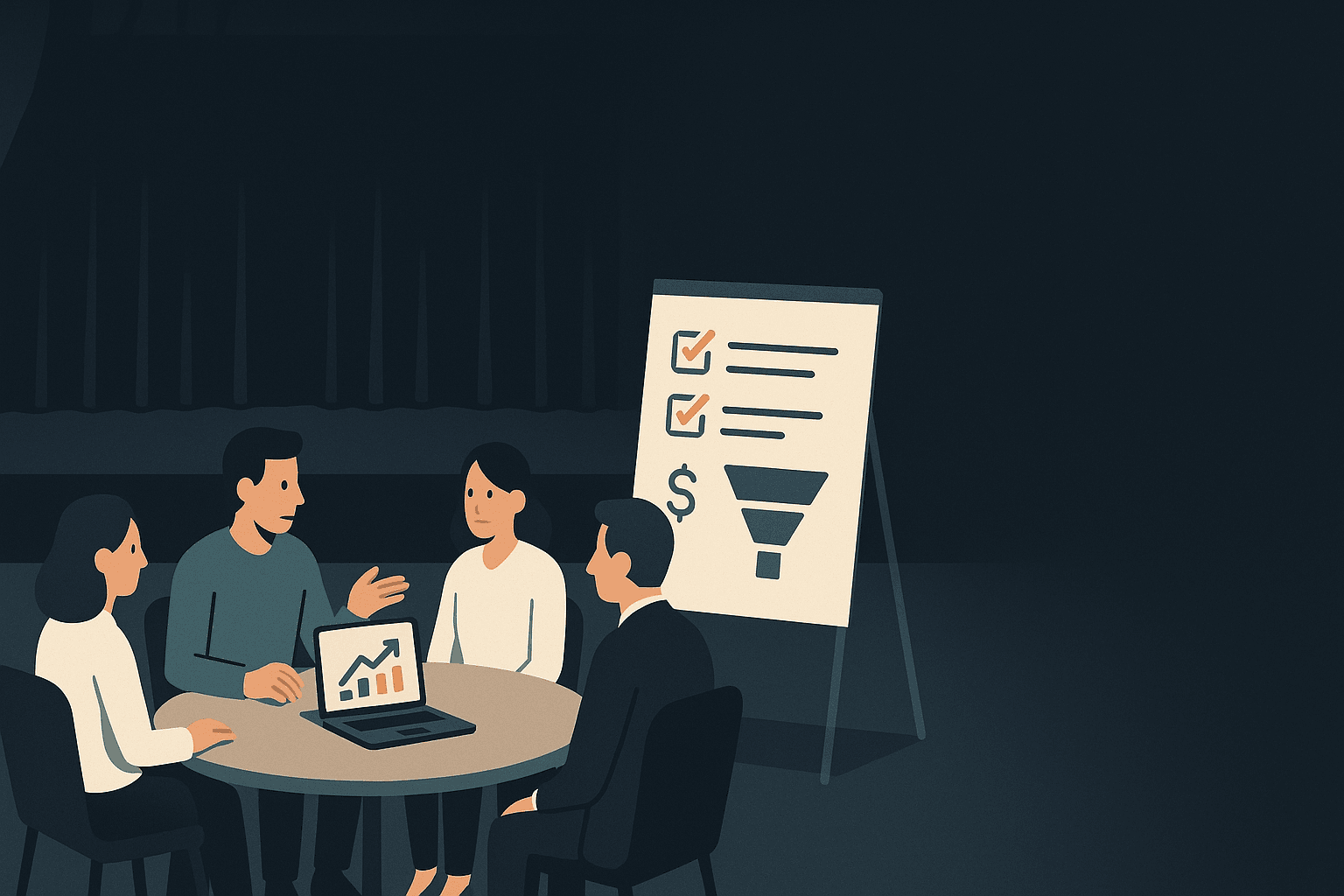
The premise: a startup can be “live” without being public
Most startup advice assumes a single moment of truth: the launch. A splashy Product Hunt post, a press push, a waitlist landing page, a viral thread, an “open beta” announcement.
That narrative is convenient, but it’s often strategically backwards, especially in B2B, devtools, infra, or any product where:
- the buyer is not the end-user,
- distribution is relationship-driven,
- switching costs and procurement are real,
- and the early product is (necessarily) rough.
A quiet launch flips the sequence:
- Sell privately before you announce publicly.
- Ship only what you must to deliver value to a narrow set of real buyers.
- Use revenue, usage, and retention, not signups, as the proof of demand.
A quiet launch is not “stealth mode” as an excuse to avoid customers. It’s the opposite: it’s high-contact selling and high-fidelity learning, without the distraction of hype.
Why quiet launches often beat waitlists
Waitlists are popular because they are easy to ship and emotionally reassuring. They also frequently create the wrong feedback loop.
Waitlists optimize for attention, not commitment
A waitlist signup is cheap. You’re measuring curiosity, not purchase intent.
In B2B, “I’d use this” often means:
- “This sounds interesting.”
- “If it worked perfectly and integrated with my stack, maybe.”
- “I’m not the buyer.”
- “Our budget is locked until next quarter.”
A quiet launch forces a different question: Will you pay (or allocate real resources) now?
Waitlists create false precision
Teams track conversion rates on landing pages, A/B test headlines, and celebrate “10,000 people on the list.” But the signal-to-noise is low.
It’s common to see:
- high signup rates,
- low activation rates,
- near-zero willingness to do onboarding work,
- and confusion about what to build next.
Waitlists delay the hardest part: distribution
A public waitlist can become a procrastination tool: “We’ll build the product, then we’ll figure out marketing.”
Quiet launches do the opposite: distribution is built from day one via direct outreach, partnerships, services-like delivery, and early channel tests.
Waitlists can burn your best launch moment
If you hype too early, you often spend your limited attention budget on an experience that isn’t ready. In markets where trust is everything (security, infra, finance), that matters.
A quiet launch preserves your eventual public launch as a credibility event, not a plea for patience.
Reference lens: This aligns with long-standing customer development thinking from Steve Blank and the Lean Startup school: validate via customer behavior, not opinions. But a quiet launch is more operational, focused on deal mechanics and learning loops rather than just interviews.
The quiet launch mindset: “Revenue and retention are the only real votes”
Quiet launching means you treat commitment as the currency of validation. Commitment can look like:
- money (paid pilot, annual contract),
- time (engineering integration, security review),
- risk (putting your tool in a production workflow),
- reputation (internal championing),
- or data access (granting you real datasets and environments).
The core belief is simple:
If someone won’t commit anything meaningful, you haven’t found a must-have problem yet.
This is not cynicism. It’s a filter.
The playbook (overview)
A practical quiet launch usually uses 4 moves, in sequence:
- Private demos to qualify problem and buyer.
- Concierge MVP to deliver outcome manually where needed.
- Paid pilots to prove value and learn procurement realities.
- Stealth distribution to build repeatable acquisition before going public.
The rest of this guide goes deep on each, plus the metrics that matter.
1) Private demos: sell the problem before you sell the product
Private demos are not “pitch meetings.” They are structured discovery sessions that end with a clear next step.
What a private demo is (in quiet-launch terms)
A private demo is:
- 1:1 or small-group,
- tailored to a specific account,
- positioned around the buyer’s workflow,
- and designed to test willingness to take the next commitment step.
Often, your first “demo” is a clickable prototype, a deck, or even a spreadsheet, if it correctly conveys the promised outcome.
How to source demo candidates without a public launch
You don’t need brand awareness; you need a list.
Common sources:
- Your network (ex-colleagues, customers from prior roles)
- Targeted LinkedIn outbound to specific roles
- Communities (Slack groups, OSS communities, niche forums)
- Conferences (not booths, meetings)
- Integration partner ecosystems (e.g., “If you’re building for Snowflake users, find Snowflake consultants.”)
The demo script that produces signal (not compliments)
Aim for:
- Context: “How do you do X today?”
- Pain: “What breaks? What’s expensive? What’s risky?”
- Trigger: “When does it become urgent?”
- Buyer map: “Who signs off? Who blocks?”
- Value hypothesis: “If we could deliver Y in Z days, what would that be worth?”
- Commitment ask: “Can we run a pilot with success criteria and a price?”
The key is step 6. Most founders stop at “Would you use it?”, which is nearly meaningless.
Qualification: deciding who not to build for
A quiet launch requires focus. You should disqualify quickly when:
- the prospect can’t describe a real workflow,
- they can’t quantify impact at all,
- they want a generic platform,
- they want you to be a feature of a competitor,
- or there is no plausible path to a paid pilot.
In B2B, early focus often means one persona + one workflow + one integration path.
2) Concierge MVPs: deliver the outcome first, automate later
A concierge MVP is the most underrated quiet-launch tool because it feels “unscalable.” That’s exactly why it works.
What a concierge MVP actually validates
It validates:
- the problem is real,
- the outcome is valuable,
- the workflow can exist inside a company,
- and the buyer will commit resources to get it.
It does not validate your long-term unit economics yet, and that’s okay. Early on, you’re buying truth.
Reference lens: This mirrors the “concierge MVP” and “wizard-of-oz” MVP concepts often cited in Lean Startup circles, but the quiet-launch framing pushes you to pair it with selling motion and paid commitments.
Examples of concierge MVPs (B2B)
- Security tooling: You manually run weekly scans + write executive summaries while building automation.
- Data quality: You implement checks in the customer’s dbt project by hand, then build a product around recurring patterns.
- Sales ops: You manually enrich and route leads, then automate the routing and enrichment.
- Devtools: You personally help integrate the SDK, fix edge cases, and ship patches rapidly.
How to price concierge work without becoming an agency
Two rules:
- Price the outcome, not the hours.
- Structure the engagement to convert into software.
A simple structure:
- 2–4 week “implementation + pilot” fee (e.g., $5k–$25k depending on ACV expectations)
- then a conversion to a subscription or annual contract contingent on success criteria
If you only sell time-and-materials, you can end up trapped in services. But if you explicitly sell “a pilot that becomes a product,” you stay on track.
The quiet-launch deliverable: a “learning contract”
For each concierge customer, write down:
- the exact workflow you’re enabling,
- the success criteria (quantitative if possible),
- what data/access you need,
- what the customer must do,
- and what you’ll automate by the end.
This turns a fuzzy early engagement into a repeatable play.
3) Paid pilots: the fastest path to real validation
If you do only one thing from this article, do this: charge for pilots.
Free pilots are sometimes necessary (especially with very large enterprises), but they create two common problems:
- the customer doesn’t prioritize onboarding,
- and you can’t tell if the value is real or just curiosity.
What a paid pilot proves
A paid pilot proves:
- budget exists,
- the problem ranks high enough to pay for,
- procurement is at least partially navigable,
- and there’s a plausible path to expansion.
It also forces clarity on scope and timeline.
How to structure a paid pilot
A strong paid pilot has:
- Fixed length: usually 2–8 weeks
- Narrow scope: one team, one workflow, one environment
- Success criteria: agreed up front
- Mutual commitments: they provide data, access, internal champion; you provide support, turnaround, training
- Conversion clause: “If success criteria are met, we convert to $X/yr with Y terms” (even if non-binding, write it down)
Pricing pilots: avoid the two traps
Trap 1: pricing too low to matter.
- If it’s $500, it’s not a signal.
- You want “this is annoying to expense without value” levels of friction.
Trap 2: pricing so high it forces enterprise procurement too early.
A workable heuristic:
- If your intended ACV is $12k–$60k, pilot fees often land in the $2k–$15k range.
- If your intended ACV is $100k+, pilots can be $15k–$50k+, but you should expect more process.
What to do when they ask: “Can we do a free trial first?”
Your response should be calm and structured:
- “We can, but free trials tend to fail because nobody allocates time. For pilots, we define success criteria and we do the integration work with you. That’s how we ensure you get value.”
If they refuse to pay anything, you’ve learned something: either the pain is not urgent, the buyer isn’t the buyer, or you’re too early for that segment.
4) Stealth distribution: build acquisition while you build product
Quiet launching is not synonymous with “no marketing.” It’s targeted marketing with tight feedback loops, not broad awareness.
Stealth distribution channels that work early
A) Founder-led outbound (but engineered)
Outbound works best when it’s not spam. Use:
- tight ICP definition,
- relevant triggers (recent funding, job openings, tech stack signals),
- and a specific promise tied to one workflow.
Measure replies and meetings, but optimize for pilot conversions, not just calls booked.
B) Integration-led distribution
In B2B software, integrations are distribution.
Examples:
- “We integrate with Datadog, so we can co-sell to teams already paying for observability.”
- “We sit on top of Salesforce and improve X workflow.”
Even before a formal partnership, you can:
- build a minimal integration,
- publish a small guide,
- and use it as a reason to reach out (“We built a working connector for your stack.”)
C) Consultants and agencies as channel partners
Consultants already have trust and access.
Offer them:
- a referral fee,
- a packaged implementation,
- co-branded deliverables,
- or a way to reduce their delivery time.
This is often the fastest path to early revenue, especially in data, security, and ERP-adjacent products.
D) “Private content”: one-person webinars and account-specific teardown docs
Instead of public content marketing, produce:
- a 3-page teardown of their current process,
- a Loom video explaining gaps,
- a risk assessment,
- or a benchmark report.
It’s marketing, but with a single recipient, and it tends to convert.
E) Narrow communities and OSS
If you’re in devtools or infra:
- ship a small OSS component,
- or contribute to the ecosystem,
- and use maintainers and users as your early customer funnel.
Just remember: OSS adoption is not revenue. Treat it as top-of-funnel unless you have a clear conversion path.
The metrics that prove real demand (without hype)
Quiet launches live or die on measurement. But not vanity measurement.
Below are metrics that actually predict a business.
1) “Time-to-commitment”
How long from first conversation to one of the following?
- paid pilot
- security review kickoff
- integration work started
- budget owner introduced
If this drags endlessly, your value proposition isn’t sharp or your ICP is wrong.
2) Pilot conversion rate (meeting → paid pilot)
This is one of the cleanest signals in early B2B.
- If you can’t convert interest into a paid pilot, you don’t have willingness to pay.
Track:
-
of qualified demos
-
of pilot offers
-
of paid pilots closed
3) Activation tied to value (not logins)
Define activation as the first moment the customer receives the promised outcome.
Examples:
- “First monitored service reporting an incident correctly”
- “First dashboard showing anomalies with acknowledged accuracy”
- “First successful PR merged using our tool in the workflow”
Avoid “created an account” metrics.
4) Retention and recurrence in the workflow
In early B2B, retention can look like:
- weekly report consumption,
- number of runs of a pipeline,
- number of alerts acknowledged,
- number of deployments with your agent,
- number of internal users invited.
The question: Does the workflow repeat without you pushing it?
5) Expansion intent (the strongest qualitative metric)
Look for:
- “Can we roll this out to another team?”
- “Can you support prod?”
- “Can we add these data sources?”
- “Procurement wants a longer-term agreement.”
Track it like a metric: how many pilots generate expansion conversations before the pilot ends?
6) Churn reasons categorized by type
Early churn is fine if it’s informative.
Tag churn into:
- Missing feature (clear)
- Wrong ICP (mis-target)
- No urgency (timing)
- Trust/compliance gap
- Integration complexity
- Pricing mismatch
Over time, you want churn to move from “wrong ICP” to “product gaps,” because that means your targeting is getting sharper.
7) The “ask-to-value” ratio
How much does the customer have to do to get value?
- If value requires 4 weeks of integration and internal alignment, your early ICP must tolerate that.
- If buyers want plug-and-play, your product must deliver value faster.
This ratio drives everything: pricing, onboarding, and who you can sell to.
How to run a quiet launch as an execution system (not a vibe)
Quiet launches work when you operate them like a weekly cadence.
Weekly operating loop
- 10–20 targeted outreaches (or fewer, if very high quality)
- 5–10 discovery calls
- 2–5 tailored demos
- 1–2 pilot proposals
- Ship product changes tied to blocked deals
This is founder-led sales plus product iteration. If you separate them too much early, you lose the learning.
The “deal-backlog” product roadmap
Early roadmaps should be grounded in deals.
Maintain a simple table:
- Account
- Stage
- Blocker
- Value hypothesis
- If shipped, expected impact (close pilot? convert to annual?)
Prioritize work that:
- unlocks paid pilots,
- unlocks conversion from pilot to annual,
- or reduces onboarding time materially.
Private demos vs. public launch: when each is correct
Quiet launching is not always superior. There are times public launches win.
Quiet launch is best when:
- B2B sales cycle exists (even if short)
- Trust, security, or compliance matter
- Product needs tight integration
- Market is noisy and you need differentiation by outcomes
- You can access buyers directly
Public launch is best when:
- Low switching costs
- Self-serve adoption is plausible
- Viral or community distribution exists
- Product is understandable in 5 seconds
- You can onboard users without high-touch support
Even then, many “public launch” products still benefit from a quiet launch phase to nail onboarding and pricing before scaling attention.
Tactical assets to prepare (the quiet-launch toolkit)
You don’t need a brand campaign. You need a small set of sharp assets.
1) One-page pilot plan
Include:
- scope
- timeline
- success metrics
- responsibilities
- price
- conversion path
This reduces friction and makes you look operational.
2) Security/compliance fast path (even if lightweight)
In B2B, security questions appear early.
Have:
- a basic security overview doc
- data handling explanation
- encryption and access controls summary
- roadmap for SOC 2 (if relevant)
You don’t need to overpromise; you do need to be credible.
3) ROI narrative with ranges, not fantasies
Use conservative math.
- “If we reduce incident triage time by 20–40%, that’s X engineer-hours/month.”
Anchor to what the buyer cares about: cost, risk, speed, or revenue.
4) Case-study style internal notes (even before you can publish)
Even if you can’t name the customer publicly, write internally:
- Problem
- What you did
- Result
- Quote
These become public case studies later when you have permission.
Common failure modes (and how to avoid them)
Failure mode 1: confusing quiet launch with secrecy
If you avoid customer conversations because you want to “build first,” you’re not quiet launching, you’re hiding.
Fix: measure weekly customer touchpoints like you measure commits.
Failure mode 2: doing bespoke work with no product extraction
Concierge MVP can become consulting if you don’t systematize.
Fix: after every engagement, write “What did we do repeatedly?” and build that.
Failure mode 3: selling to friendly logos with no urgency
“Design partners” who never deploy are a trap.
Fix: require a timeline and success criteria; require some form of commitment.
Failure mode 4: pilots with ambiguous success criteria
Ambiguity kills conversions.
Fix: define measurable outcomes and decision dates.
Failure mode 5: optimizing for meetings, not conversions
Busy calendars feel like progress.
Fix: make “paid pilot started” the north star in early GTM.
A concrete quiet-launch timeline (example: first 8 weeks)
Weeks 1–2: ICP, problem framing, and outreach
- Write ICP: industry, role, stack, trigger
- 30–50 targeted outreaches
- 10 discovery calls
- Draft pilot plan template
Weeks 3–4: first concierge delivery
- Close 1 pilot (ideally paid)
- Deliver manually where needed
- Instrument activation metric
- Identify top 3 blockers to repeatability
Weeks 5–6: second and third pilots
- Close 1–2 more pilots
- Start documenting repeatable onboarding
- Begin integration-led distribution (one integration, one guide)
Weeks 7–8: convert and tighten
- Convert first pilot to subscription/annual
- Write internal case study
- Decide: narrow ICP further or expand one dimension
By week 8, you should have a strong answer to:
- Who buys?
- Why now?
- What’s the onboarding path?
- What do we charge?
- What proves value?
Not guesses, evidence.
Why this works: the compounding advantages of quiet launches
Quiet launches compound in ways public launches usually don’t.
- You get real product constraints early (security, integration, data quality).
- You learn buyer language from objections, not from comments.
- You build credibility through outcomes instead of brand impressions.
- You preserve your public launch for when it can amplify traction, not compensate for its absence.
In other words: you’re building a business, not a moment.
References and further reading
These sources won’t give you a “quiet launch” checklist directly, but they strongly inform the underlying approach:
- Steve Blank, The Four Steps to the Epiphany (customer development, learning from behavior)
- Eric Ries, The Lean Startup (MVP thinking, validated learning)
- Ash Maurya, Running Lean (problem/solution fit and traction testing)
- Geoffrey Moore, Crossing the Chasm (focus and segmentation, especially for B2B tech adoption)
- Jason Lemkin (SaaStr), extensive writing on early-stage B2B sales execution and pilot-to-annual motion
If you want one practical north star from all of this:
Don’t ask the market to believe in you publicly. Get a few customers to bet on you privately, and let that evidence dictate what you build and how you grow.