
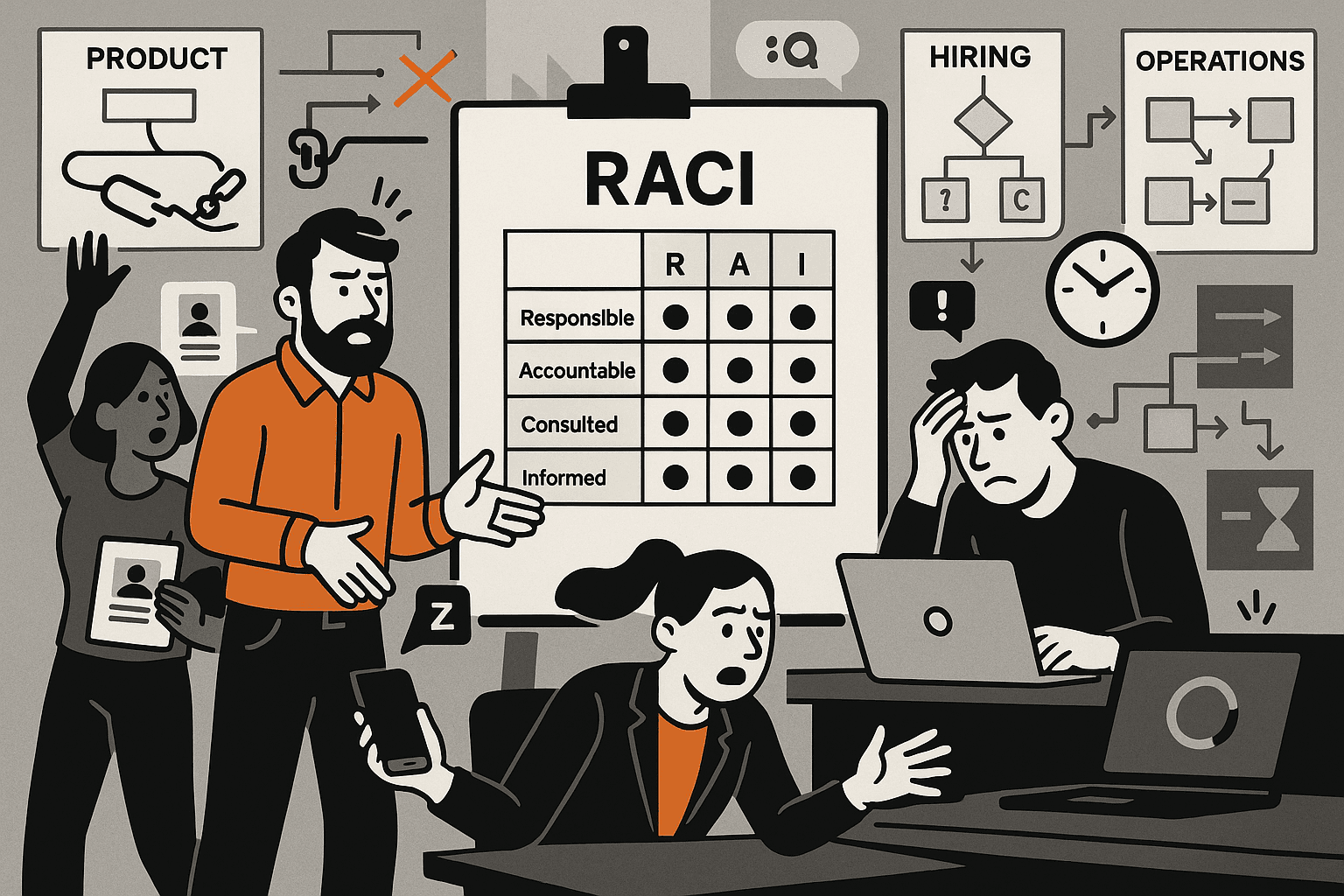
A startup can have a perfectly clean RACI matrix and still miss every important deadline.
Founders usually discover this the hard way. The board deck says every initiative has a clear owner. The team offsite produced a tidy spreadsheet with Responsible, Accountable, Consulted, and Informed for every major function. Everyone nodded. The meeting felt organized. Two weeks later, product is waiting on marketing, marketing is waiting on compliance review, sales is promising dates no one approved, recruiting is “owned” by hiring managers who still expect talent to drive the whole process, and finance is somehow the surprise blocker on a vendor implementation that was supposed to launch last month.
On paper, ownership exists. In reality, no one can answer four basic questions quickly:
- Who makes the decision?
- Who does the work?
- Who must approve before the work moves?
- What happens if that person does not respond?
That gap is the RACI illusion. It is accountability theater: the appearance of clarity without the operating mechanisms that make clarity real.
This problem shows up most in startups that are graduating from founder-driven execution to team-based execution. In the earliest stage, ambiguity is masked by force of will. The founder jumps into every thread, resolves every dispute, approves every exception, and manually pushes stalled work forward. Once the company adds layers, functions, and managers, that informal glue breaks. But instead of redesigning the workflow, teams often reach for a framework. RACI is one of the most common.
RACI itself is not the enemy. The failure is using RACI as a static documentation exercise instead of an execution system.
If you want cross-functional work to move, you need to separate decision ownership from task ownership, make approval paths explicit, define service levels for handoffs, and attach all of that to the tools where work actually happens. Otherwise, you are not creating accountability. You are creating a diagram people reference after the deadline has already slipped.
The failure scenario: the launch that everyone owned and no one could move
Take a common startup example: a product launch tied to revenue targets.
A B2B SaaS company wants to release a new pricing package in six weeks. The work spans product, engineering, sales, marketing, customer success, finance, RevOps, and legal. Leadership does the “right” thing and creates a launch plan. Every workstream has names attached:
- Product owns packaging definition
- Engineering owns billing changes
- Marketing owns launch assets
- Sales owns enablement
- Finance owns margin review
- Legal owns terms review
- RevOps owns CRM updates
- Customer Success owns migration communication
There is even a RACI grid in Notion.
Then execution starts.
Week 1: Product drafts the package. Sales gives feedback. Finance says pricing needs a margin threshold review. Product assumed that was advisory feedback. Finance assumed it was a required checkpoint.
Week 2: Engineering asks whether the billing change requires grandfathering current customers. Customer Success says yes for enterprise accounts. Sales says no because the reps already positioned migration differently. Who decides? The meeting ends with “let’s align offline.”
Week 3: Marketing starts building the launch page. Legal later says the claims language needs review before publishing. Marketing assumed legal would review final copy only. Legal assumed they needed to review messaging strategy earlier.
Week 4: RevOps cannot update the CRM because no one finalized SKU naming conventions. Product thought finance owned naming because it affects reporting. Finance thought RevOps owned naming because it affects systems. RevOps thought product owned naming because it comes from packaging.
Week 5: Sales asks for enablement. Product says positioning is changing. Marketing says they need final pricing. Finance says discounts need policy approval. The CRO escalates to the CEO.
Week 6: The launch slips.
Afterward, the retro sounds familiar:
- “We had unclear ownership.”
- “Too many stakeholders.”
- “People were working in silos.”
- “We need better communication.”
Those diagnoses are not wrong. They are just shallow.
The real issue is that the company defined deliverable ownership but failed to define execution-critical decisions, approval triggers, response time expectations, and escalation rules. Everyone “owned” their box. No one owned the seams.
That is where startups actually break.
The pattern: accountability theater happens at the seams, not inside functions
Most leaders look for ownership problems inside teams. Usually the bigger problem is between teams.
Within a function, people often know how work gets done. Engineering knows how to move a ticket through development. Marketing knows how to publish a campaign. Recruiting knows how to run a candidate pipeline. Problems emerge when one team depends on another team’s answer, approval, input, or system change.
The most common failure patterns look like this:
1. Deliverables have owners, but decisions do not
A launch plan says marketing owns the webpage. Fine. But who decides the final positioning? Who decides whether the feature is launch-worthy? Who decides if the launch date moves? Those are different from webpage ownership.
When decisions are not explicitly assigned, teams default to one of three bad modes:
- consensus theater: everyone must agree
- shadow hierarchy: whoever has the strongest personality wins
- founder override: everyone waits for the CEO
None scale.
2. “Accountable” means different things to different people
In theory, one person is accountable. In practice, teams use “accountable” to mean any of the following:
- final approver
- ultimate decision-maker
- person doing status reporting
- functional manager
- person who gets blamed if it fails
If your team cannot define accountable in one sentence, your RACI is decorative.
A better rule: for any workflow step, specify whether the named owner is a decision owner, work owner, or approval owner. Do not collapse them into one ambiguous label.
3. Approvals are implied rather than embedded
A huge amount of startup work gets blocked by hidden approvals.
Examples:
- Sales compensation changes need finance signoff
- Customer-facing claims need legal review
- New tools need security review
- Headcount requests need budget approval
- Pricing changes need CEO approval over a threshold
If those approvals exist socially but not operationally, teams discover them late. That is why projects look green until the week they miss.
4. No response-time expectation exists for dependencies
A lot of “ownership problems” are actually SLA problems.
A team might know exactly who must review something, but if there is no expected response window, the work still stalls.
Examples:
- Legal review target: 2 business days for standard changes, 5 for non-standard
- Finance approval target: 48 hours under budget threshold, 1 week above threshold
- Hiring feedback target: interview feedback due same day, no later than 24 hours
- Product dependency review target: engineering architecture review within 3 business days
Without service levels, ownership degrades into polite waiting.
5. Escalation paths are undefined or politically expensive
If a reviewer does not respond, what happens? Most startups rely on ad hoc escalation. That means the person blocked has to choose between annoying a peer, dragging in a manager, or silently slipping the deadline.
Predictably, they usually choose delay.
A real workflow defines escalation mechanically:
- At 24 hours overdue, remind in tool + Slack
- At 48 hours overdue, tag manager
- At 72 hours overdue, escalate to decision owner and move date or force decision
The goal is not bureaucracy. It is reducing the social friction of pushing work forward.
6. Handoffs are undocumented
This is the silent killer.
A handoff is not “marketing takes over after product.” A handoff is a rule set:
- what input must be complete
- what format it arrives in
- what constitutes acceptance
- how long the receiving team has to accept or reject
- what happens if required fields are missing
If you do not define handoff criteria, you do not have process. You have hope.
Why standard advice fails
Most startup advice on accountability is too abstract to fix this.
“Just assign a DRI”
The directly responsible individual concept is useful, but incomplete. One DRI does not solve a workflow involving multiple decisions, multiple approvals, and multiple tool transitions.
A launch manager can drive the timeline, but cannot unilaterally decide pricing policy, legal language, sales exceptions, and engineering scope. If those rights are not separately defined, the DRI becomes a project manager with no authority.
“Improve communication”
Communication is not a root cause. It is a symptom channel.
When roles, approvals, and response times are unclear, teams communicate more and still get less done. More meetings are often evidence of poor operating design, not a fix for it.
You do not need a better meeting. You need fewer ambiguous steps.
“Use RACI consistently”
Even a well-maintained RACI usually lives in a document, not in the workflow. That means people consult it episodically, often after confusion starts.
If your CRM, ATS, ticketing system, project tracker, contract flow, and budgeting workflow do not reflect the actual ownership model, the document loses to the tools.
Work follows the path of least resistance. If the software lets people skip a required approver, they will. If the launch tracker does not show blocked dependencies, no one will see them until too late.
“Empower people to make decisions”
This sounds great and often backfires.
The issue is not lack of encouragement. The issue is unclear decision boundaries and fear of stepping on another function’s territory.
In startups, cross-functional mistakes are costly because they create rework, customer confusion, and political conflict. So people hedge. They ask for more input. They wait for alignment. That is rational behavior in a system with undefined decision rights.
Empowerment without explicit guardrails creates more shadow negotiation, not more speed.
The better approach: build an accountability operating system, not a spreadsheet
The practical fix is to treat accountability as part of workflow design.
Here is the model I recommend.
For every cross-functional workflow, map six layers:
- Deliverables: what outputs must be produced
- Decisions: what choices can block or redirect work
- Approvals: what formal signoffs are required
- Handoffs: when work changes teams or systems
- SLAs: expected response or completion windows
- Escalations: what happens when someone misses a response window
Most startups stop at layer one. Better operators build all six.
The key design principle is simple:
Map execution-critical decisions separately from deliverables.
That one move exposes most fake accountability.
Step 1: Audit for fake accountability across product, GTM, hiring, and ops
Start by identifying workflows that repeatedly slip, produce last-minute fire drills, or require founder intervention.
Good audit candidates:
- product launches
- pricing and packaging changes
- enterprise deal support
- hiring and headcount approvals
- vendor procurement and security review
- quarterly planning
- customer escalations
- policy changes affecting multiple teams
For each workflow, run a 45-minute audit with the actual operators, not just managers.
Use these questions:
Workflow audit questions
- What are the major deliverables?
- What decisions can stall or reverse the workflow?
- Which approvals are mandatory versus advisory?
- Where do handoffs occur between functions?
- What systems/tools are used at each step?
- How long is each step supposed to take?
- What actually causes delays today?
- When a step stalls, who is allowed to escalate, and how?
- What exceptions occur often enough that they need a standard path?
- Where does founder or exec intervention usually happen?
That last question is especially useful. Founder intervention is often a bright red marker for an unowned decision seam.
What to look for during the audit
Fake accountability usually reveals itself through language patterns:
- “It depends.”
- “Usually X reviews it.”
- “We try to get alignment.”
- “It’s kind of owned by…”
- “We loop in Y if needed.”
- “There isn’t a strict SLA.”
- “We escalate if it’s urgent.”
Those phrases mean the workflow is relying on relationships, heroics, or memory.
Example audit findings by function
Product
Common fake-accountability points:
- Who decides whether feedback is incorporated before launch?
- Who approves scope cuts when engineering capacity changes?
- Who signs off on release readiness?
- Who owns SKU naming and system implications?
- Who can commit dates externally?
GTM
Common fake-accountability points:
- Who decides packaging exceptions for strategic deals?
- Who approves discounting outside policy?
- Who owns final positioning when product and sales disagree?
- Who must review customer-facing claims?
- Who owns launch-go/no-go?
Hiring
Common fake-accountability points:
- Who owns moving a candidate between stages?
- Who decides must-have versus nice-to-have criteria?
- Who must submit feedback by when?
- Who approves opening a req, pausing it, or changing comp band?
- Who closes the loop if interviewers do not respond?
Operations
Common fake-accountability points:
- Who approves new vendors?
- Who owns security review versus budget review versus legal review?
- Who can accept process exceptions?
- Who updates source-of-truth systems?
- Who decides priority when multiple teams are blocked?
The point of the audit is not to produce a prettier process map. It is to reveal where “ownership” exists only as a narrative.
Step 2: Separate decision rights from task ownership
This is the highest-leverage change.
For each workflow, create two parallel maps:
A. Deliverable map
Example for a launch:
- Packaging brief, Product work owner
- Billing implementation, Engineering work owner
- Sales enablement deck, Marketing work owner
- CRM configuration, RevOps work owner
- Pricing policy memo, Finance work owner
- Terms update, Legal work owner
B. Decision map
Now separately identify the decisions that control progress:
- Final package definition, Product decision owner
- Discount policy thresholds, Finance decision owner
- External launch date, GM/CRO/Product trio, with one explicit tie-break owner
- Migration policy for existing accounts, CS or GM decision owner
- Customer claims language, Legal approval owner, Marketing draft owner
- Whether enterprise exceptions are allowed pre-launch, CRO decision owner
Notice how this differs from a normal project plan. The deliverables tell you who creates outputs. The decision map tells you who gets to unblock work.
That distinction matters because many startup delays come from decision latency, not work latency.
A practical role model that works better than pure RACI
For each critical step, assign four explicit roles:
- Work Owner: does the task and keeps status current
- Decision Owner: makes the call when judgment is required
- Approval Owner: provides mandatory signoff if policy/risk demands it
- Escalation Owner: receives escalation if SLA is missed or conflict persists
Sometimes one person holds multiple roles. That is fine. The key is naming the roles separately.
This resolves a common failure mode where a project owner is expected to “own” progress but lacks authority to force choices.
Step 3: Embed ownership in the tools where work happens
If accountability only exists in Notion, it does not exist.
You need to connect ownership to operational systems.
Product and engineering tools
In Jira, Linear, or Asana, add fields or labels for:
- work owner
- decision owner
- blocked by
- approval required?
- approval owner
- due date / response SLA
- escalation after
For release workflows, make blocked status meaningful. “Blocked” should require selecting a blocker type:
- waiting on decision
- waiting on approval
- waiting on external input
- waiting on system dependency
This creates visibility into why work is stuck instead of making every delay look the same.
GTM systems
In your CRM and launch tracker:
- define who can approve pricing exceptions
- route non-standard discounts automatically
- require claim review for certain asset types
- store launch readiness criteria in one visible place
- log final decision owners for external commitments
If sales can quote something the product or finance team has not approved, the software is undermining your operating model.
Hiring systems
In your ATS:
- assign stage owner for every step
- set automated reminders for feedback deadlines
- define who can move candidates forward
- require scorecard completion before debrief
- route comp exceptions to the right approver
- trigger escalation when interview feedback is late
A hiring manager saying “recruiting owns this” is often shorthand for a broken ATS workflow that never made responsibilities explicit.
Operations and procurement tools
In vendor and procurement workflows:
- separate security review, legal review, budget approval, and system setup
- define thresholds that trigger extra review
- set standard SLA by request type
- create an exception path with named approver
- expose status to requesters so they do not have to chase manually
This matters because ops bottlenecks become political quickly when no one can see whether delay is due to risk review, budget approval, or queue prioritization.
Step 4: Define SLAs and handoff rules for cross-functional steps
Ownership without timing is weak. Timing without handoff rules is chaos.
For every handoff, define:
- required inputs
- accepting team
- expected response window
- accepted/rejected criteria
- next step if rejected
- escalation path if no response
Example: marketing handoff from product
Bad version:
- Product sends messaging to marketing
Useful version:
- Product submits launch brief in template
- Required fields: target user, problem, feature summary, launch tier, approved screenshots, pricing status, known limitations
- Marketing accepts or rejects within 2 business days
- If rejected, marketing must specify missing fields in the tracker
- If no response in 2 business days, escalation goes to PMM lead
- Customer-facing claims require legal review only for launch tier 1 and regulated segments
Now the handoff is operational, not conceptual.
Example: hiring debrief handoff
Bad version:
- Interviewers provide feedback and team decides
Useful version:
- Each interviewer submits scorecard within 24 hours
- Hiring manager cannot schedule debrief until all scorecards are complete or SLA exception approved
- Recruiter triggers reminder at 12 hours, escalates to functional leader at 24 hours
- Comp changes beyond approved band route to finance + people approval within 48 hours
- Final hire/no-hire decision owner is hiring manager, not consensus panel
That last line prevents one of the classic startup hiring failures: confusing collaborative input with collective decision ownership.
Step 5: Build escalation mechanics that do not require courage every time
A lot of startup execution depends too much on interpersonal bravery.
Someone is waiting for feedback from a peer or executive, but escalating feels awkward. So they wait. The deadline slips quietly. Then the issue becomes urgent, political, and more expensive.
Good escalation design removes heroics.
A simple escalation ladder
For any cross-functional dependency:
- T = due date: owner notified in tool
- T + 1 business day: automated reminder in tool + Slack
- T + 2 business days: manager notified
- T + 3 business days: escalation owner notified; either decision forced, priority changed, or deadline moved explicitly
This should not be punitive. It should be routine. The goal is fast conflict resolution, not catching people out.
When founder escalation is still needed
Some decisions should still escalate to founders or executives:
- tradeoff between short-term revenue and long-term product integrity
- major customer exception with downstream precedent risk
- headcount tradeoffs across functions
- security or legal exceptions with material risk
But founder escalation should happen at clearly defined decision points, not as a generic substitute for process.
If the founder is still the de facto escalation path for routine launch details, discount approvals, candidate movement, or vendor review, the organization has not actually delegated.
Tool comparisons: documents versus workflow systems
Founders often ask whether this should live in Notion, Asana, Jira, Airtable, Monday, ClickUp, or some mix. The short answer: documents are useful for policy and context; systems are better for enforcement and visibility.
Here is the practical tradeoff.
Notion / Confluence
Best for:
- documenting decision rights
- storing templates and playbooks
- process overviews
- training new managers
Weak for:
- enforcing approvals
- SLA reminders
- status visibility across active work
- escalation automation
Use these as the reference layer, not the execution layer.
Jira / Linear
Best for:
- product and engineering workflows
- dependency tracking
- blocked-state visibility
- release readiness checklists
Weak for:
- broad non-technical cross-functional workflows unless customized heavily
- finance/legal approval routing
Good if your main bottlenecks revolve around product and engineering dependencies.
Asana / Monday / ClickUp
Best for:
- cross-functional project orchestration
- launch planning
- assigning owners across teams
- reminders and basic automations
Weak for:
- deeply structured approval rules unless configured carefully
- becoming the source of truth for specialized systems like ATS/CRM/procurement
Good for startup operating cadence if you are disciplined about fields and automations.
Airtable
Best for:
- customizable cross-functional workflows
- lightweight operational apps
- intake, approvals, and exception tracking
- combining structured data with views for different teams
Weak for:
- becoming a parallel system if you do not integrate with core tools
- requiring ops ownership to maintain quality
Excellent for startups that need flexibility and have one strong operator to manage the system.
ATS / CRM / procurement systems
Best for:
- embedding accountability into domain-specific workflows
- reducing side-channel confusion
- preserving audit trail
Weak for:
- cross-functional visibility unless integrated well
Whenever possible, decision and approval logic should live inside the system where the work transaction already occurs.
Recommended stack by stage
Seed to Series A
Keep it light:
- Notion for policy/process docs
- Asana or ClickUp for cross-functional workflows
- Jira/Linear if engineering already needs it
- native ATS/CRM automation for hiring and sales exceptions
Do not over-engineer. But do define owners, SLAs, and escalations on your top 3 most painful workflows.
Series A to B
You need stronger operational spine:
- structured fields in project system
- intake forms and approval routing
- regular blocked-work review
- tighter integration between project tracker and domain tools
At this stage, the biggest risk is adding headcount without adding decision clarity.
Series B+
Standardize the recurring cross-functional workflows:
- launch governance
- pricing approval matrix
- hiring process SLAs
- vendor/security/legal review paths
- planning and dependency management rituals
The cost of ambiguity compounds quickly once functions have their own sub-goals and managers.
Cost and time analysis: what this actually takes
A lot of teams avoid fixing accountability because they assume it requires a full operations overhaul. It usually does not.
Lightweight implementation for one workflow
For a single high-friction workflow, like product launches:
- 45 minutes: audit session with operators
- 60 minutes: draft deliverable + decision map
- 60 minutes: define approvals, SLAs, escalations
- 90 minutes: configure tool fields/templates/automations
- 30 minutes: train team on new rules
Total: about 4 to 5 hours of concentrated ops work, plus system setup.
If this saves even one launch slip, one executive fire drill, or one lost week of cross-functional delay, the ROI is obvious.
Broader rollout across core workflows
For 4 key workflows across product, GTM, hiring, and ops:
- 1 to 2 weeks of part-time ops/design work
- likely 1 owner from BizOps, COO office, PMO, or an operator founder
- 2 to 4 hours per function leader for review and alignment
- modest admin/config work in existing tools
The real cost is not software. It is forcing explicit decisions people have been avoiding socially.
That is why many companies postpone it.
Hidden cost of not doing it
This is where founders undercount.
Fake accountability causes:
- slower launches
- more executive escalations
- rework from late approvals
- sales/customer confusion from inconsistent decisions
- hiring delays due to stale candidate loops
- operator burnout from constant chasing
- reduced trust between functions
A startup can easily burn tens of thousands of dollars in labor and opportunity cost per quarter from avoidable cross-functional stalls. In growth stages, the number is often much higher.
Workflow example: turning a fake-accountability launch process into a real one
Here is a simplified before-and-after.
Before
- Product owns launch
- Marketing owns assets
- Sales owns enablement
- Legal reviews if needed
- Finance approves pricing
- RevOps updates systems
This looks fine until conflict hits.
After
Deliverables
- Packaging brief, Product work owner
- Pricing approval memo, Finance work owner
- Launch assets, PMM work owner
- Sales enablement, Sales enablement work owner
- CRM/SKU updates, RevOps work owner
- Terms update, Legal work owner
Decisions
- Final package scope, Product decision owner
- External launch date, GM decision owner
- Discount exception policy, Finance decision owner
- Migration approach for current customers, CS decision owner
- Claims language approval, Legal approval owner
Handoffs and SLAs
- Product brief to PMM: accept/reject within 2 business days
- Pricing policy to RevOps: SKU template complete before CRM work starts
- Legal review for launch claims: 3 business days standard, 5 days non-standard
- Sales enablement draft review: 48-hour feedback SLA from product and PMM
Escalations
- Overdue review by 1 day: reminder
- Overdue by 2 days: function lead notified
- Overdue by 3 days: GM decides whether to force scope reduction or move date
Tool embedding
- Asana launch template includes decision owner field per milestone
- CRM exception request form routes discounts above threshold to finance
- Notion playbook documents launch tier criteria and legal-review triggers
- Slack bot posts blocked launch items every morning during final two weeks
Now the system can surface where things are stuck before the deadline is gone.
Common objections and the real tradeoffs
“This sounds bureaucratic”
It can be, if you map every tiny decision. Do not do that.
Only formalize decisions and handoffs that are frequent, costly, or cross-functional. Leave local team execution flexible.
The goal is not maximum process. It is minimum viable clarity.
“We move too fast for rigid workflows”
Fast-moving teams actually need clearer decision rights because they have less time for negotiation.
Ambiguity feels lightweight until it creates rework. Then it is the slowest thing in the company.
“We trust our people”
Good. This is not about distrust. It is about reducing avoidable coordination load.
Strong operators often get punished by vague systems because they become the unofficial glue. Clear workflows protect your best people from becoming permanent escalation routers.
“Our culture is collaborative”
Collaboration and decision clarity are not opposites.
In fact, collaboration gets better when people know whether they are being consulted, asked to approve, or expected to decide. A lot of fake collaboration is really uncertainty about authority.
Implementation checklist for founders and operators
If you want to fix this in the next 30 days, do this:
Week 1: Identify the worst workflow
Pick one recurring cross-functional process that consistently hurts:
- launches
- deal desk / pricing exceptions
- hiring
- vendor procurement
- customer escalations
Do not start with a generic company-wide RACI refresh.
Week 2: Map work and decisions separately
For that workflow, list:
- deliverables
- decisions
- mandatory approvals
- handoffs
- current tools
- common failure points
Name four roles where needed:
- work owner
- decision owner
- approval owner
- escalation owner
Week 3: Add SLAs and escalation rules
Set realistic defaults for response times. Distinguish standard versus non-standard requests. Define exactly how escalation works.
If everything is urgent, nothing is.
Week 4: Embed in the tools
Add fields, templates, forms, automations, and blocked-state visibility in your active systems.
Do not rely on memory or meeting notes.
Week 5: Review blocked work weekly
For the first month, run a 20-minute review of blocked items:
- what is blocked
- by whom or what
- how long it has been blocked
- whether the SLA or handoff rule needs adjustment
This is where the process becomes real.
The takeaway
The RACI illusion is not that ownership frameworks are useless. It is that startups mistake naming people for designing execution.
A company does not become accountable because it filled in a matrix. It becomes accountable when the critical decisions, approvals, handoffs, response times, and escalation paths are explicit and wired into the way work moves.
If your team keeps missing deadlines across functions, do not ask first whether people are communicating enough or collaborating hard enough. Ask:
- Which decisions are blocking progress?
- Who actually owns those decisions?
- Which approvals are mandatory?
- What is the SLA for each handoff?
- Where does work stall in the tools?
- What happens when someone does not respond?
That is the operating layer beneath the org chart.
Founders who get this right stop building accountability theater. They build workflows that can survive without constant heroics.
And that is when execution starts to scale.