
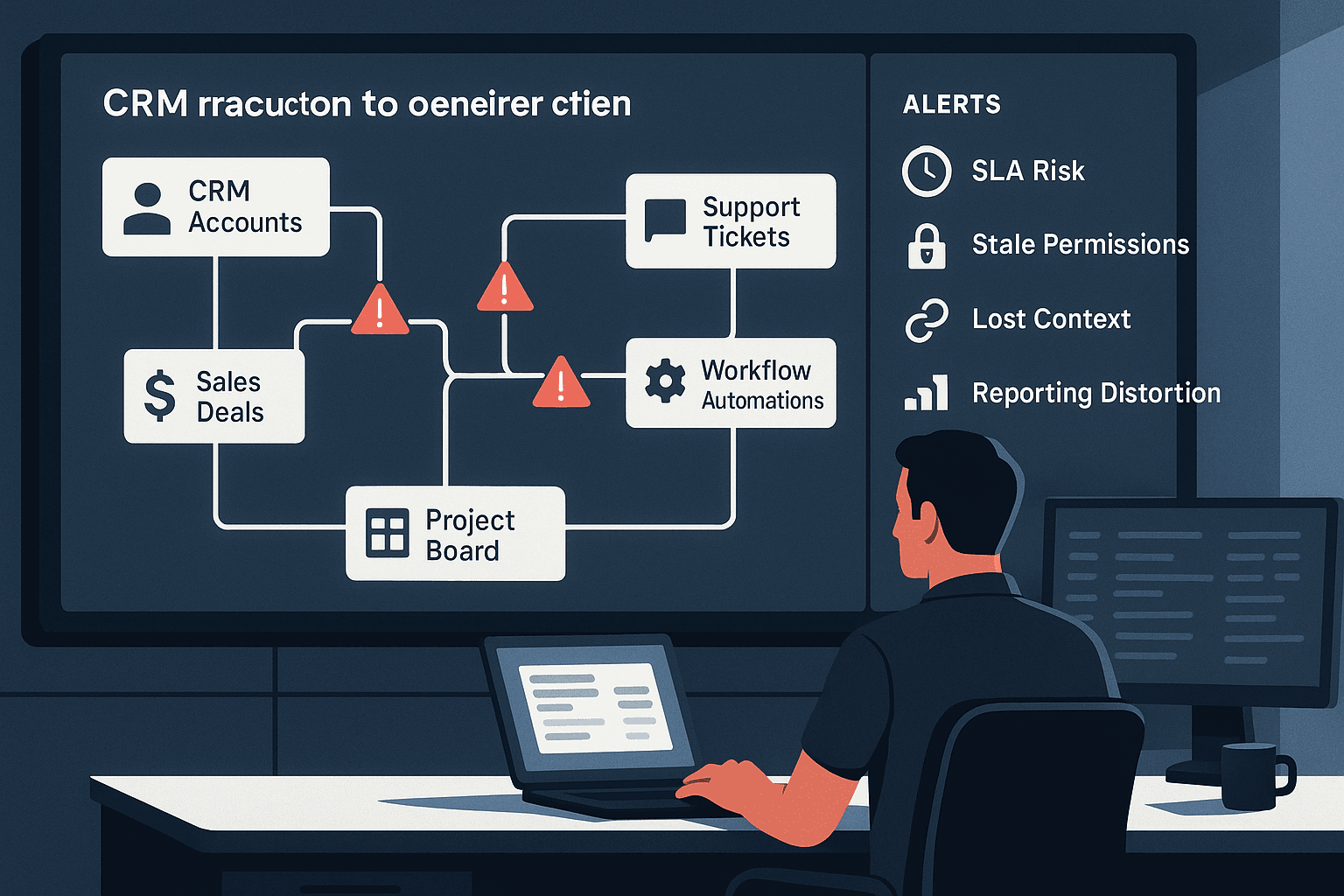
Most startups do not have an ownership problem. They have an ownership-change problem.
Everything works fine when the original account executive still owns the deal, the same CSM still owns the customer, the same recruiter still owns the candidate pipeline, the same support lead still owns the escalation queue, and the same PM still owns the implementation project. Dashboards look clean. Handoffs seem rare. The org chart still roughly matches the system of record.
Then reality starts doing what reality always does.
A salesperson leaves. A founder stops directly managing enterprise prospects. A CSM inherits a portfolio after a territory redesign. A recruiter moves to a new team. A support manager rotates on-call ownership. An operations person clones an automation for a new workflow but forgets three dependencies tied to the old owner. Suddenly the company is not managing work. It is managing the chain reaction created by changing who owns the work.
That chain reaction is the reassignment cascade.
It is what happens when one owner change in one system silently breaks continuity in five other places: customer coverage, deal progression, permissions, automations, reporting, SLAs, approvals, internal projects, and executive visibility. It looks small at the moment of change. It becomes expensive three weeks later.
If you have ever found any of the following, you have seen the cascade in action:
- A high-value account shows as "owned" but no one has contacted it in 45 days.
- A deal was reassigned in the CRM, but associated tasks, mutual action plans, quotes, and legal approvals stayed with the old rep.
- A support queue still routes escalations to a departed employee.
- A recruiter changed, but candidate notes and follow-up expectations did not transfer cleanly, creating a terrible candidate experience.
- An implementation project changed owners in the PM tool, but the customer-facing kickoff doc and Slack channel still reference the old lead.
- A manager inherits a team and immediately gets blamed for broken SLA performance caused by tickets assigned before the reorg.
- Board reporting suddenly shows artificial productivity improvements or dips because the underlying owner fields changed mid-period.
The painful part is that none of these failures are usually caused by a single catastrophic operational mistake. They are caused by a very ordinary event, changing ownership, combined with fragmented systems and naive assumptions.
The assumption is usually this: if we update the owner field, the work is transferred.
It is not.
Updating the owner field usually changes only one thing: the owner field.
Everything else, open loops, embedded permissions, automation triggers, pending approvals, meeting cadences, documentation references, revenue attribution, service-level clocks, customer expectations, and internal accountability, often remains partially attached to the old state. The startup keeps moving, but continuity has already been broken.
This is why owner changes become a hidden source of revenue leakage and execution drag. Not because startups reassign too often, but because they treat reassignment as a record update instead of an operational transition.
A failure scenario that will feel uncomfortably familiar
Let’s start with a realistic scenario.
A 60-person B2B SaaS company sells mid-market contracts with a 45- to 90-day sales cycle. Customer success owns renewals for accounts under $50k ARR and partners with account executives on expansion for larger accounts. Support uses a separate ticketing system. Recruiting runs in its own ATS. Internal implementation projects are tracked in Asana. The company has a RevOps manager, a support ops generalist, and one founder who still gets involved in strategic accounts.
In Q2, three things happen at once:
- One account executive quits with two weeks’ notice.
- The company redraws territories because enterprise pipeline is weak.
- The founder decides to stop personally owning late-stage deals.
The team responds quickly, at least on the surface.
- All open deals from the departing AE are reassigned in the CRM.
- Strategic accounts are moved from the founder to two senior reps.
- CSM books are adjusted to align with the new account segmentation.
- Leadership announces the changes in Slack.
Everyone feels productive because there was action.
Then the second-order failures arrive.
Week 1: coverage gaps
Several accounts were reassigned in Salesforce or HubSpot, but recurring check-in tasks were still linked to the old owner. The new CSMs assume those meetings were already planned. Customers hear nothing.
Two enterprise prospects have active security review workstreams. The deal owner changed, but the legal and security work lives in separate shared docs and email threads. Nobody actively drives next steps for a week.
A support escalation rule still pings the former AE for specific strategic customers. Since the AE has already lost access, nobody sees the escalation until the customer complains.
Week 2: stale permissions and broken workflows
The departed rep is removed from the CRM, but still has access to a pricing calculator and shared proposal folder because identity offboarding is not tied to operational ownership transfer.
One workflow automation triggers only when “owner = founder” for custom executive approval routing. Reassigned strategic deals stop entering the special review path entirely.
In Asana, implementation projects tied to new customers still show the old sales owner in a handoff template. Delivery teams are unsure who to pull into kickoff calls.
Week 3: reporting distortion
Pipeline coverage by segment suddenly looks healthier because high-value deals moved to top-performing reps, even though no new selling happened.
CSM portfolio health appears worse because inherited at-risk accounts are now counted under new managers without inherited context.
Support SLA reporting degrades because queue ownership changed during active ticket life cycles, and no one adjusted attribution logic.
The leadership team starts asking the wrong questions:
- Why are the new owners underperforming?
- Why did follow-up slow down?
- Why are implementation handoffs messy?
- Why did support misses spike?
These are reasonable questions based on the dashboard.
They are also incomplete. The real problem is not individual underperformance. It is that the company changed names in systems without migrating operational state.
That is the pattern.
The pattern: one owner field, many dependent systems
The reassignment cascade happens because “owner” is not one concept.
In practice, owner means several different things at once:
- Commercial owner: who is responsible for revenue progression
- Relationship owner: who the customer or candidate expects to hear from
- Workflow owner: who receives tasks, reminders, and approvals
- System owner: who has permissions and visibility
- Escalation owner: who gets paged when something goes wrong
- Reporting owner: who gets credit or blame in metrics
- Context owner: who holds the decision history and nuance
Startups often compress all of these into one CRM field or one task assignment. That works until people move.
When ownership changes, each of those layers needs to be examined separately. If not, the company gets false continuity:
- Records look reassigned.
- Work is not actually transferred.
- Risk is not explicitly accepted.
- Customers are not clearly informed.
- Metrics become less trustworthy.
Most teams first notice the problem in one function, sales, support, success, recruiting, or project delivery. But the underlying operating pattern is cross-functional.
Here are the most common cascade paths.
1. CRM owner changes without activity transfer
The account or deal owner changes, but these do not:
- open tasks n- next meeting owner
- quote/proposal responsibility
- mutual action plans
- renewal reminders
- champion maps
- implementation handoff checklists
- call recording review expectations
The visible record moves. The operational queue does not.
2. Ticket or queue ownership changes without SLA logic updates
A support manager rebalances ownership, but:
- escalations still route to old individuals
- business hours or priority rules were built around the prior team design
- customer tiers are linked to outdated account owners
- reporting attributes misses to whoever currently owns the ticket, not who owned it when breach risk began
Now the team both misses service expectations and misdiagnoses why.
3. Recruiting ownership changes without candidate continuity
A recruiter or hiring manager changes, but:
- candidate stage notes stay buried in old threads
- scheduling templates still reference the former owner
- scorecard accountability is unclear
- candidate communication goes quiet during the switch
- interview panel permissions are outdated
This is how startups create avoidable candidate drop-off while thinking they merely “reshuffled req coverage.”
4. Project ownership changes without dependency mapping
A PM or implementation lead changes, but:
- project plans still assign subtasks to the prior owner
- customer docs and Slack channels still point to old contacts
- dependency deadlines linked to prior approvals break silently
- status reporting remains tied to outdated responsible parties
The result is classic startup confusion: everyone thinks someone else has it.
5. Territory or org redesign changes reporting more than reality
A team reorg moves books of business, but:
- historical performance becomes non-comparable
- inherited pipeline inflates or depresses manager scorecards
- compensation exceptions pile up
- account health trends become impossible to interpret cleanly
This creates executive noise and political friction because dashboards stop reflecting operational truth.
Why standard advice fails
The standard advice for ownership transitions usually sounds fine and still fails:
- “Document your handoffs.”
- “Keep your CRM clean.”
- “Run a reassignment workflow.”
- “Use automation.”
- “Have better onboarding and offboarding.”
None of this is wrong. It is just not specific enough to stop the cascade.
Here is why.
Standard advice assumes systems are integrated at the right level
They usually are not.
Even if your CRM, help desk, ATS, project management tool, and identity provider are technically integrated, that does not mean ownership semantics are aligned. A synced owner field does not transfer tasks, notes, permissions, SLA clocks, or exception logic by default.
Standard advice treats reassignment as an event, not a transition window
In most startups, ownership change is processed as a point-in-time update:
- change owner
- notify team
- move on
But continuity risk persists for days or weeks after the update. During that window, old responsibilities may still exist, customer expectations may still point to the previous owner, and automations may still reference the previous state.
Standard advice ignores inherited risk
n The new owner often inherits backlog, stale follow-ups, unhappy stakeholders, and undocumented exceptions. If you do not explicitly distinguish “newly inherited risk” from “newly created underperformance,” you create bad management behavior and bad reporting.
Standard advice forgets permission residue
A company can be diligent about reassigning records and still leave behind dangerous access.
This is common when ownership is spread across:
- CRM roles
- shared drives
- proposal tools
- support admin privileges
- Slack channels
- calendaring and scheduling systems
- BI dashboards
- contract repositories
The reassignment cascade is partly an execution problem and partly a security problem.
Standard advice over-automates the wrong thing
Founders love the idea of “just automate reassignment.” But bulk automation without dependency checks often makes the problem worse.
Example: auto-reassign every open deal from Rep A to Rep B.
What happens to:
- opportunities with active pricing exceptions?
- accounts where the customer was told the founder remains involved?
- deals with legal escalations tied to named approvers?
- renewal motions managed in a separate CS platform?
- active sequences still sending from the old rep’s email identity?
A blind automation can move the record faster than the operating model can absorb the change.
The better approach: treat owner changes as operational migrations
The solution is to stop thinking about reassignment as editing a field and start thinking about it as migrating a live workload.
That means every owner change needs four layers handled explicitly:
- Record transfer: the official system-of-record owner changes
- Work transfer: open tasks, workflows, queues, approvals, and dependencies move
- Context transfer: decision history, stakeholder nuance, and next steps are made usable
- Control transfer: permissions, reporting logic, and escalation paths update correctly
If you only do layer 1, you have cosmetics.
If you do layers 1 and 2, you reduce immediate operational breakage.
If you do all four, you preserve continuity.
This is the operational standard startups should aim for.
The reassignment control plane: what to standardize
You do not need enterprise software to solve this. You need a repeatable control plane.
At minimum, standardize these components.
1. An ownership object model
Define, in plain English, which ownership fields matter in each system.
For example:
Accounts / customers
- Account owner
- Executive sponsor
- CSM owner
- Renewal owner
- Escalation owner
- Implementation owner
Deals / opportunities
- AE owner
- Solutions/supporting owner
- Approver owner
- Legal owner
- Pricing exception approver
Support tickets
- Queue owner
- Assignee
- Escalation manager
- SLA attribution owner
Recruiting
- Recruiter owner
- Hiring manager
- Coordinator
- Offer approver
Internal projects
- Project owner
- Functional workstream owner
- Executive reviewer
Without this model, teams accidentally use one owner field as a stand-in for five different responsibilities.
2. A reassignment impact checklist
Every ownership change should trigger a short dependency review.
At minimum, review:
- Open tasks and reminders
- Scheduled meetings and recurring cadences
- Pending approvals
- Workflow automations and routing rules
- External customer/candidate-facing references
- Slack/email aliases and channels
- Dashboards and reporting attribution
- Permissions and group membership
- Linked records in adjacent systems
- SLA, escalation, or compliance obligations
This checklist should exist as an operational artifact, not tribal memory.
3. Transition states, not just final states
Add explicit temporary statuses where useful:
- Reassignment pending
- Context handoff required
- Dual coverage active
- Awaiting customer notification
- Access removal pending
These states matter because handoffs are not always atomic. They help teams distinguish “new owner assigned” from “continuity secured.”
4. Inherited-risk tagging
When a new owner takes over, mark what was inherited.
Examples:
- inherited overdue tasks
- inherited late-stage renewal risk
- inherited escalated support account
- inherited stalled candidate process
- inherited implementation delay
This protects reporting integrity and improves coaching. A new manager should be able to ask: what performance issue began after reassignment versus before it?
Implementation details: a practical playbook
Here is how to operationalize this without turning your startup into a bureaucracy museum.
Step 1: Map the top 10 owner-change scenarios
Do not start abstractly. Start from the actual situations you repeatedly face.
Common scenarios:
- Employee departure
- Territory redesign
- Promotion to manager
- Founder stepping back from direct ownership
- Coverage during leave
- Temporary overflow balancing
- Team merger or split
- Support queue redesign
- Recruiter or coordinator replacement
- Implementation/project lead change midstream
For each scenario, answer:
- Which records move?
- Which systems are touched?
- What work must transfer?
- What external communication is required?
- What permissions must be added/removed?
- Which metrics will be distorted if we do nothing?
This exercise usually surfaces more hidden dependencies than any tool audit.
Step 2: Build a dependency matrix by system
A simple spreadsheet is enough to start.
Columns:
- System
- Object type
- Owner field(s)
- Dependent tasks/workflows
- Notification paths
- Permissions impacted
- Reporting impacted
- External-facing references
- Validation method
- System admin
Example rows:
- Salesforce | Opportunity | Opportunity Owner | Open tasks, approval chain, quote owner | Deal Slack alert | CPQ access | Pipeline attribution | Proposal contact block | Report + spot audit | RevOps
- Zendesk | Ticket | Assignee / Group | SLA timers, escalation macros | PagerDuty/Slack escalation | queue access | SLA reporting | Support signature | dashboard audit | Support Ops
- Asana | Project | Project Owner | subtasks, milestones, dependencies | project update posts | project visibility | on-time delivery reporting | customer kickoff doc | template audit | PMO/Ops
This matrix becomes the source of truth for what “reassignment complete” really means.
Step 3: Separate bulk reassignment from high-risk reassignment
Not every owner change deserves the same process.
Use a risk tiering model.
Low-risk
- low-value inactive leads
- closed candidates in archive states
- internal tasks with no external dependencies
Can often be bulk reassigned automatically.
Medium-risk
- active SMB deals
- standard support queues
- routine internal projects
Bulk reassignment is fine if paired with validation checks.
High-risk
- strategic accounts
- late-stage deals
- customers with active escalations
- enterprise renewals
- executive sponsor relationships
- implementation projects with external deadlines
- candidates in final stages
These require named handoff owners, explicit context transfer, and confirmation of downstream dependencies.
This one distinction prevents a lot of damage. The mistake is not automation. The mistake is automating all records as if they carry equal continuity risk.
Step 4: Create a reassignment runbook with a 24/72/168-hour cadence
Think of ownership changes like incident response or onboarding. Time windows matter.
Within 24 hours
- change system-of-record owner fields
- assign interim backup coverage if handoff is incomplete
- freeze or review high-risk automations
- update routing rules and escalation paths
- secure access changes for departing or changing personnel
- notify internal stakeholders
Within 72 hours
- transfer open tasks and meetings
- complete context handoff notes
- notify customers/candidates where needed
- validate linked tools and templates
- tag inherited risk/backlog
- review open approvals and exceptions
Within 168 hours
- audit SLA and response continuity
- verify reporting treatment
- confirm customer-facing artifacts are updated
- review no-contact/no-owner exceptions
- clean up stale permissions residue
- capture handoff defects for process improvement
This cadence is useful because it makes reassignment measurable instead of aspirational.
Step 5: Standardize the context handoff format
Most handoffs fail because the context transfer is unstructured.
Require a concise format. For each account, deal, candidate, ticket portfolio, or project, include:
- current status
- last meaningful activity date
- next committed action
- primary stakeholders and influence map
- active risks/blockers
- promises already made
- exceptions or nonstandard process paths
- documents/threads that matter
- what would surprise a new owner?
If you want continuity, the handoff cannot be “see notes in the CRM.” That is not a handoff. That is a scavenger hunt.
Step 6: Fix reporting before leadership uses the numbers
This is a big one.
Any major reassignment event should trigger a reporting note and, where needed, temporary segmented views:
- performance excluding inherited backlog
- pre- and post-reassignment trend lines
- by-created-owner vs current-owner views
- tickets breached before vs after reassignment
- pipeline moved vs pipeline generated
- inherited at-risk renewals vs newly at-risk renewals
If you do not do this, leaders start managing artifacts instead of reality.
A good startup operator treats org changes as data events, not just people events.
Step 7: Close the loop with exception reporting
After every significant ownership change, generate an exception list:
- records with no next activity
- records with old owner still referenced in tasks
- tickets routed to inactive users
- projects with mismatched owner fields across systems
- sequences or automations still sending from prior owner
- shared folders or tools with stale access
- records missing handoff notes
This is where a lot of continuity is won. Not by pretending the process is perfect, but by aggressively surfacing what fell through.
Tooling: what to use and where each category helps
There is no single perfect stack, but there are patterns.
CRM: Salesforce vs HubSpot
Salesforce
- Strengths: highly configurable ownership models, workflow depth, reporting flexibility, enterprise-grade permissions
- Weaknesses: complexity, admin overhead, easy to create brittle owner-dependent automation
- Best for: teams with multiple owner types and complex approval/routing logic
HubSpot
- Strengths: easier admin, simpler workflows, faster operational adoption, decent cross-object automation
- Weaknesses: can become messy when ownership models outgrow the default assumptions
- Best for: earlier-stage teams that still need discipline but want lower admin burden
Practical advice: if you are on either platform, inventory every automation referencing owner values or owner-based routing. That is usually the highest-yield audit.
Support: Zendesk vs Intercom vs Front
Zendesk
- Strong for formal queue ownership, SLA management, macros, and enterprise support workflows
- Risk: group and trigger logic becomes opaque over time
Intercom
- Strong for conversational support and customer messaging continuity
- Risk: ownership can be more relationship-oriented than process-controlled unless designed carefully
Front
- Strong for shared inbox visibility and collaborative ownership transitions
- Risk: not always enough process rigor for scaled SLA-heavy environments without additional discipline
Practical advice: if your business has hard support obligations, explicitly separate “conversation owner” from “SLA accountability owner.”
Project management: Asana vs ClickUp vs Jira
Asana
- Strong for cross-functional project ownership and clear task transitions
- Risk: templates often preserve outdated assignees and references
ClickUp
- Strong flexibility and affordability
- Risk: flexibility can create inconsistent ownership semantics across teams
Jira
- Strong for engineering and structured workflow ownership
- Risk: less intuitive for customer-facing continuity unless paired with disciplined process design
Practical advice: template governance matters more than tool selection here. Most reassignment issues in PM tools come from template drift.
Identity and access: Okta / Google Workspace / Microsoft Entra
Whatever you use, tie people changes to an access review checklist that specifically includes operational tools outside the core IT stack.
Founders underestimate how often pricing tools, BI dashboards, contract repositories, support admin settings, and shared drives stay accessible long after record ownership changes.
Workflow examples
Example 1: Sales rep departure
Bad workflow
- bulk reassign all open opportunities
- send Slack note
- remove CRM seat
Better workflow
- segment opportunities by stage and ARR
- assign temporary coverage within 24 hours
- transfer tasks, meetings, and active sequences
- require handoff notes for stage 3+ deals
- review approvals, pricing exceptions, and legal workstreams
- notify customers/prospects for active late-stage deals
- tag inherited pipeline by receiving rep
- create exception report after 72 hours
Time cost:
- Bad workflow: 1–2 hours now, 20–40 hours cleanup later
- Better workflow: 6–10 hours now, 3–8 hours cleanup later
Example 2: CSM book redistribution
Bad workflow
- update account owner and CSM owner fields
- tell team to “reach out to your new accounts”
Better workflow
- classify accounts by health, ARR, renewal date, and open escalation status
- prioritize top 20% for live handoffs or recorded walkthroughs
- transfer recurring meeting ownership and success plans
- update support escalation routing and customer-facing documentation
- send proactive intro email where relationship continuity matters
- segment reporting into inherited book vs newly originated outcomes for one quarter
Cost tradeoff:
- More communication overhead upfront
- Meaningfully lower churn and fewer silent coverage gaps
Example 3: Recruiter replacement mid-search
Bad workflow
- change recruiter field in ATS
- expect hiring manager to pick up context from notes
Better workflow
- review all active candidates by stage
- identify candidates waiting on communication >48 hours
- standardize transfer notes including compensation expectations and risk signals
- update scheduling templates, scorecard ownership, and panel instructions
- send continuity messages to late-stage candidates
- audit access for the departing recruiter across interview docs and candidate communications
Cost tradeoff:
- 2–4 hours of focused ops work per active search
- Avoids candidate ghosting, duplicated outreach, and damaged employer brand
Cost and time analysis: why this matters earlier than founders think
Founders usually postpone fixing this because owner changes feel occasional.
They are not occasional for long.
Once you hit even moderate scale, owner changes compound through:
- attrition
- promotions
- reorganizations
- specialization
- parental leave and temporary coverage
- segment changes
- founder delegation
- account balancing
Here is the rough economics.
The hidden costs of poor reassignment
For a 50–100 person startup, a single badly managed ownership transition can create:
- 5–15 hours of RevOps/admin cleanup
- 5–20 hours of manager investigation and escalation handling
- delayed deal progression worth tens of thousands in pipeline timing
- increased churn/renewal risk from silent coverage gaps
- support SLA misses with reputational damage
- reporting noise that drives bad decisions for an entire quarter
In practical founder terms: a lightweight operational migration process is cheaper than one lost expansion, one preventable churned mid-market account, or one quarter of misleading performance management.
What good enough looks like by stage
Seed (under 30 people)
- shared reassignment checklist
- manual handoff notes
- weekly exception review
- access review tied to offboarding
Series A/B (30–150 people)
- dependency matrix by system
- risk-tiered reassignment workflows
- inherited-risk reporting views
- owner-based automation audit every quarter
Later stage
- orchestration across systems
- event-driven reassignment workflows
- formal attribution logic for inherited performance
- stronger identity/process integration
The key is not to overbuild early. It is to stop doing nothing.
The minimum viable reassignment operating system
If your team wants a pragmatic starting point, implement this in the next 30 days:
- Define owner types across CRM, support, recruiting, and projects.
- Create one universal reassignment checklist.
- Tag high-risk records before bulk reassignments.
- Require structured handoff notes for high-risk transitions.
- Run a 7-day exception report after every major owner change.
- Separate inherited from newly created performance in dashboards where possible.
- Add stale-access review to the reassignment process, not just HR offboarding.
That is enough to eliminate a large percentage of the cascade.
Red flags that tell you the problem is already real
If you are wondering whether this is worth prioritizing, look for these signs:
- leadership keeps finding “orphaned” accounts, deals, or projects
- ticket escalations still reference former employees
- managers dispute dashboards after every reorg
- customer introductions happen late or not at all after ownership changes
- reps inherit pipeline but not context
- permissions are removed inconsistently across operational tools
- no one can explain how reassignment affects SLA or attribution reporting
- there is no distinction between current owner and inherited workload
If several of these are true, you do not have isolated process sloppiness. You have a continuity design problem.
Takeaways
Owner changes are normal. The reassignment cascade is optional.
The mistake startups make is treating reassignment as administrative hygiene when it is actually continuity infrastructure. Every change in ownership affects not just one record, but a web of tasks, expectations, permissions, escalations, and metrics.
The practical fix is straightforward:
- define ownership precisely
- map dependencies by system
- tier reassignment by risk
- treat handoffs as migrations, not field edits
- separate inherited risk from new performance
- audit exceptions after the change, not just during it
If you do this well, you get more than cleaner operations.
You get fewer silent coverage gaps, better customer continuity, more trustworthy reporting, tighter security, and less managerial thrash every time your org evolves.
That matters because startups are always evolving.
People leave. Teams split. Founders delegate. Territories shift. Accounts grow. Responsibilities move.
If every owner change breaks continuity, growth itself becomes a source of operational debt.
If owner changes are handled like controlled migrations, growth becomes a lot less fragile.
That is the real goal: not perfect systems, but a company that can keep context, accountability, and customer trust intact even when the names on the records change.