
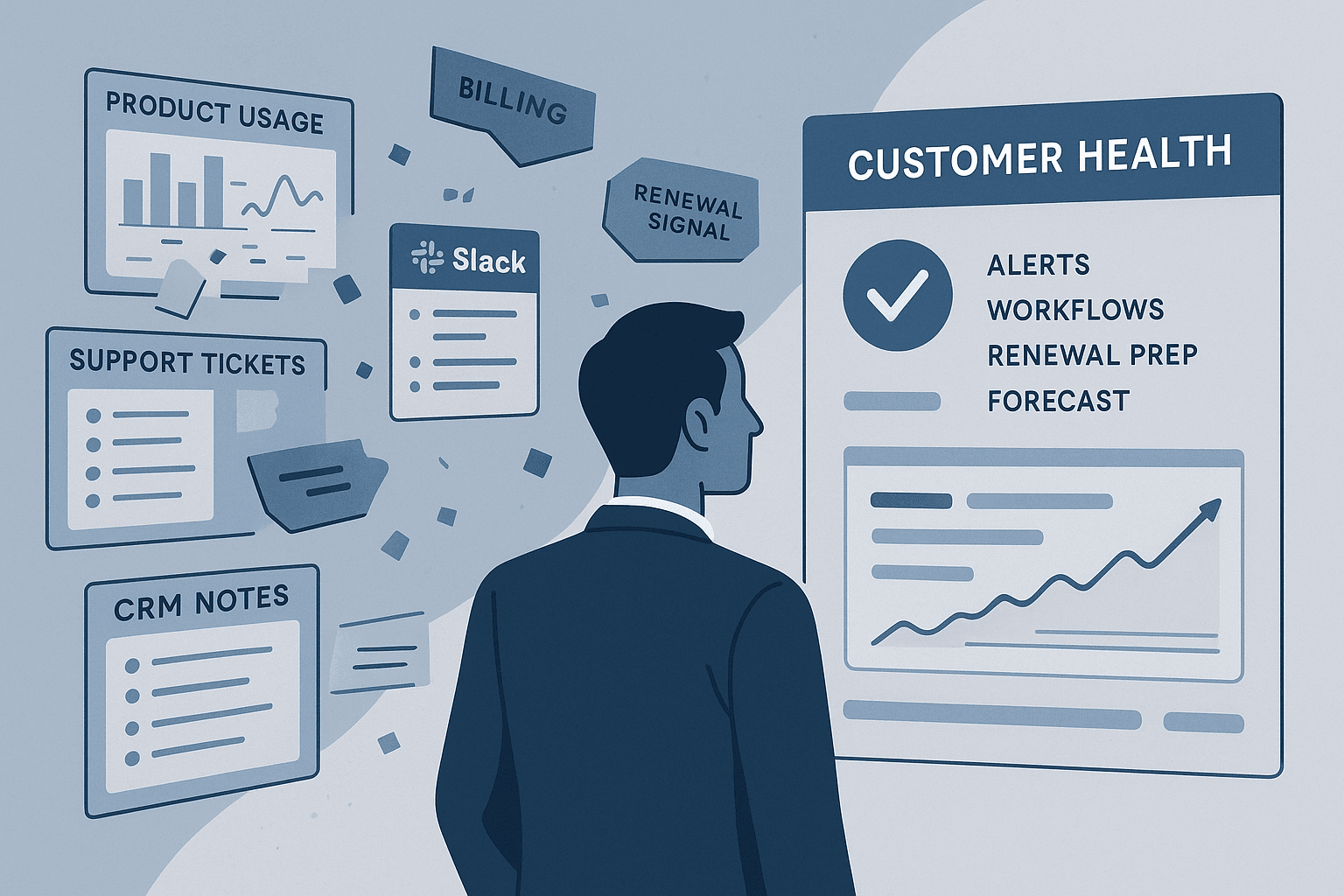
Most early-stage B2B startups do not have a churn problem first. They have a visibility problem that becomes a churn problem six months later.
It usually starts innocently. Product usage is in Mixpanel, Amplitude, PostHog, or your app database. Support issues live in Intercom, Zendesk, Linear, or Jira. Billing status sits in Stripe or Chargebee. Sales context is trapped in HubSpot or Salesforce notes. Customer sentiment is buried in Slack threads, email, and call recordings. Renewal dates may live in a spreadsheet because no one trusted the CRM enough to use it as the source of truth.
Then the company wakes up one quarter later and realizes three things at once:
- A “surprise” churn was not actually a surprise.
- An expansion that should have been obvious was never worked.
- The forecast was fiction because the team had no operating view of account health.
This is the renewal data blind spot: the core signals that determine retention and expansion exist, but they live in the wrong systems, under different owners, with no shared logic for how to turn them into action.
If you are under $10M ARR, this problem is especially dangerous because it hides under growth. A handful of new logos can mask weak retention for a while. Founders tell themselves they will “clean up CS ops later.” But later usually means after a painful quarter, a missed board forecast, or a few preventable churns that expose the fact that post-sale operations are being run off intuition.
The good news: you do not need an enterprise customer success platform, a giant RevOps team, or a machine learning model to fix this. You need a minimum viable health system that makes renewals and expansions operational before the company is large enough for data chaos to become institutional.
A real failure scenario
A seed-to-Series A SaaS company selling workflow software to mid-market operations teams had around $2.8M ARR, 75 customers, and no formal customer success operations function.
On paper, the business looked healthy:
- New logo growth was strong.
- Gross churn looked manageable.
- Leadership had a quarterly renewal forecast in the CRM.
- Founders believed the biggest retention risk was concentrated in a few visibly unhappy accounts.
What was actually happening was more dangerous.
One of their top 15 customers had all the classic pre-churn signals, but each signal was isolated:
- Product usage had dropped 40% over 60 days in one key team, but nobody had a usage threshold tied to the renewal owner.
- Two admins had filed repeated support complaints about data sync reliability in Zendesk.
- Billing showed an invoice paid late twice, which often correlated with procurement scrutiny.
- The account executive had a CRM note from a QBR saying the champion was leaving.
- In Slack, an implementation manager mentioned hearing that a department might standardize on a competitor.
- No one had updated the renewal confidence field because the CSM was busy and assumed someone would escalate if it became serious.
Sixty days later, the customer did not fully churn, which would have at least been visible. Instead they downshifted: fewer seats, lower module usage, and a delayed add-on expansion that had been in the pipeline. The result was more painful than a clean churn event because it hit net revenue retention quietly.
Leadership called it an “unexpected contraction.” It was not unexpected. It was merely unassembled.
That same quarter, another account expanded by 30%, but only after the founder got pulled into a call and learned by accident that a second business unit had already adopted the product informally. The usage signal existed. Support ticket themes showed successful adoption. Billing showed overages. But because there was no structured expansion detection workflow, the company nearly missed a straightforward upsell.
This is how early-stage startups lose both sides of post-sale economics at the same time:
- They discover risk late.
- They discover opportunity late.
- They manage renewals reactively.
- They forecast from anecdotes instead of operating signals.
The pattern behind the problem
The failure pattern is not “we need better analytics.” It is more specific than that.
The real pattern looks like this:
1. Health signals are distributed by function, not by customer outcome
Every team captures a slice of truth:
- Product tracks engagement.
- Support tracks friction.
- Finance tracks payment behavior.
- Sales tracks relationship and org change.
- CS tracks goals and sentiment.
That division is normal organizationally, but disastrous operationally if no one reassembles those signals into an account-level view.
2. The system of record is not the system of action
The CRM may hold renewal date, contract value, and owner. But the real risk indicators live elsewhere. Or the product analytics tool has the deepest truth about customer value, but no one works renewals there.
So teams end up with two bad options:
- Keep the “official” view in the CRM, where it is stale and incomplete.
- Work from ad hoc dashboards and tribal knowledge, which cannot support forecasting discipline.
3. Health definitions are vague
Ask five people what makes an account “green” and you will get five different answers:
- “They are using the product.”
- “Their champion loves us.”
- “No serious support issues.”
- “Renewal is likely.”
- “They attended the QBR.”
All of these may be directionally true, but they are not operational definitions. Without explicit thresholds, ownership, and update rules, health scores become decorative.
4. Risk changes do not trigger workflows
Even companies that have a health score often fail here. They might technically classify a customer as red, yellow, or green, but no operational action occurs when the status changes.
A useful health model is not a dashboard color. It is a workflow engine.
If health drops, who is alerted? What gets reviewed? Is a save plan required? Is product leadership notified if the driver is technical? Does the renewal forecast automatically need revalidation?
If none of that happens, the health score is just a prettier spreadsheet.
5. Renewal prep starts too late
In many startups, “renewal management” begins 30 to 45 days before contract end. That is often too late to solve root causes.
By then:
- Adoption gaps are already entrenched.
- Champion loss has gone unaddressed.
- Procurement is already squeezing budget.
- Open product issues have accumulated too much emotional weight.
- Internal narratives inside the customer account are already set.
Late renewal prep turns account management into negotiation theater rather than retention management.
Why the standard advice fails
Most advice on customer health falls into one of three buckets, and all three are often wrong for early-stage companies.
1. “Buy a customer success platform”
Tools like Gainsight, Totango, ChurnZero, Planhat, Vitally, Catalyst, and others can absolutely help. But early-stage teams often buy them before they have done the hard work of defining health logic and ownership.
What happens next:
- The implementation takes longer than expected.
- Teams debate fields and scores endlessly.
- Data quality issues become obvious but unresolved.
- The platform becomes an expensive shell around unclear process.
A platform does not create operating discipline. It amplifies whatever discipline already exists.
For a company under roughly 50–100 customers, you can often get 70% of the value with a simpler stack if the logic and workflows are tight.
2. “Use NPS or sentiment as your health model”
NPS can be useful. Executive sentiment can be useful. CSM confidence can be useful.
None are sufficient.
Why? Because sentiment is lagging, sparse, and politically distorted.
- Happy champions can still churn if procurement or leadership shifts.
- Unhappy users can still renew if the product is embedded deeply enough.
- CSM confidence is often inflated until it suddenly collapses.
- NPS surveys frequently overrepresent strong opinions rather than broad account reality.
Sentiment should be one input, not the model.
3. “Wait until you have enough data for predictive scoring”
This is a classic early-stage stall tactic dressed up as sophistication.
You do not need a predictive model trained on hundreds of churn events to know that these things matter:
- Sharp usage declines in key roles
- Unresolved support escalations
- Champion departure
- No measurable adoption of purchased modules
- Chronic late payment
- Missing executive alignment close to renewal
Minimum viable health is not a data science project. It is a structured way to combine obvious risk and opportunity signals into repeatable action.
The better approach: build a minimum viable health operating system
The right move for most early-stage B2B startups is to build a minimum viable health operating system with five components:
- A small set of health dimensions tied to retention and expansion
- Clear field ownership and source-of-truth rules
- Risk and opportunity change detection
- A renewal prep workflow that begins early enough to matter
- A regular operating cadence that links customer health to forecast updates
This is not glamorous. It is operational plumbing. But done well, it changes post-sale from reactive account management into a controllable system.
Step 1: Define a minimum viable health model
Do not start with a 25-factor score. Start with 5 to 7 dimensions that reflect whether the customer is getting value, whether the relationship is stable, and whether there are credible signs of risk or growth.
A practical early-stage health model usually includes these categories:
1. Product adoption and usage
Questions to answer:
- Are the right users active, not just any users?
- Is usage stable, growing, or declining?
- Are core workflows being used, or only shallow features?
- Are purchased seats, modules, or volume commitments being realized?
Useful fields:
- Weekly or monthly active users by role
- % of provisioned seats activated
- Usage of key features tied to value realization
- 30/60/90-day usage trend
- Time since last meaningful activity
Important nuance: raw logins are weak. Tie usage to value moments. A customer logging in but not completing core workflows is not healthy.
2. Support and product friction
Questions to answer:
- Are issues isolated or recurring?
- Are they cosmetic annoyances or blockers to value?
- Are the same teams repeatedly complaining?
Useful fields:
- Number of open tickets over severity threshold
- Time to resolution for critical issues
- Repeat issue count by account
- Escalation status
- Presence of known product blocker affecting renewal scope
A customer with moderate usage but repeated unresolved issues can be a hidden red account because the account may be surviving on heroics.
3. Stakeholder and relationship stability
Questions to answer:
- Do we still have an active champion?
- Is there executive sponsor coverage?
- Has the buying center changed?
- Are there signs of org or budget change?
Useful fields:
- Champion status: active / weak / lost
- Executive sponsor identified: yes / no
- Last executive meeting date
- Org change risk flag
- Multi-threading score: number of engaged stakeholders by function/seniority
Many early churns happen not because the product failed, but because the relationship became single-threaded.
4. Commercial and billing behavior
Questions to answer:
- Are invoices being paid predictably?
- Is there usage overage indicating expansion potential?
- Is procurement behavior signaling scrutiny?
- Is contract utilization mismatched with spend?
Useful fields:
- Days sales outstanding or invoice lateness category
- Outstanding billing disputes
- Overages / seat utilization above threshold
- Upcoming renewal date
- Current contract vs realized usage gap
Billing data is underused in startups. It is often one of the earliest indicators that an account is entering internal review.
5. Outcome realization and value narrative
Questions to answer:
- Did the customer achieve the goal they bought for?
- Can the team articulate ROI in the customer’s language?
- Is there evidence the product matters to a business outcome?
Useful fields:
- Primary success metric defined: yes / no
- Last value review date
- Outcome achieved status: on track / partial / off track
- Referenceable win or internal advocacy signal
- Quantified ROI documented: yes / no
Without an outcome narrative, renewal defense becomes weak and expansion cases become harder to sell.
6. Expansion readiness
This is often missed because health models focus only on churn risk.
Questions to answer:
- Are there adjacent teams already showing usage or interest?
- Are there modules/features with partial adoption that indicate upsell fit?
- Are utilization limits creating organic need?
Useful fields:
- Cross-team adoption signal
- Add-on fit identified: yes / no
- Utilization above 80% threshold
- Inbound feature/request pattern tied to higher-tier plan
- Expansion hypothesis owner and next step
Good post-sale systems detect upside as aggressively as downside.
How to score it without overengineering
You have two options that work early.
Option A: Rules-based red/yellow/green by dimension
Example:
- Usage red if key user activity drops >30% over 60 days
- Support red if 2+ unresolved severity-1/2 issues are open >14 days
- Relationship yellow if no executive contact in 90 days
- Billing yellow if invoice paid >15 days late twice in six months
- Outcome red if no agreed success metric exists by day 60 post-launch
Then derive an overall status using simple logic:
- Red if any two dimensions are red
- Yellow if one red or two yellow
- Green otherwise
This is easy to understand and easier to trust.
Option B: Weighted point model
Example:
- Usage trend: 0–30 points
- Support friction: 0–20 points
- Relationship strength: 0–20 points
- Commercial health: 0–15 points
- Outcome realization: 0–15 points
This gives more nuance, but it also creates false precision if your inputs are weak.
For most startups, option A is the better starting point. Clarity beats sophistication.
Step 2: Map field ownership and source-of-truth rules
This is where many teams fail. They define health metrics but never decide who owns each field, where it originates, and how it is updated.
You need a field ownership map.
Here is a practical example:
| Field | Source System | Owner | Update Method | Review Cadence |
|---|---|---|---|---|
| Renewal date | CRM / billing | RevOps | Synced from contract | Weekly |
| ARR / contract value | Billing / CRM | Finance or RevOps | Synced | Weekly |
| Usage trend | Product analytics | Data / product ops | Automated | Weekly |
| Seat utilization | Product + billing | Data / RevOps | Automated | Weekly |
| Open critical issues | Support system | Support ops | Automated | Daily/weekly |
| Champion status | CRM | CSM or AE | Manual required field | Weekly |
| Executive sponsor status | CRM | CSM | Manual | Monthly |
| Outcome achieved status | CRM/CS platform | CSM | Manual | Monthly |
| Health status | CRM/CS platform | CSM with system inputs | Semi-automated | Weekly |
| Save plan in place | CRM/project tracker | CSM + manager | Manual | As needed |
| Expansion hypothesis | CRM | AE/CSM | Manual | Monthly |
A few rules matter a lot:
Rule 1: Every critical field has one accountable owner
Not “shared.” Shared means neglected.
Rule 2: Manual fields must be few and explicit
If your model depends on 20 manually maintained fields, it will decay fast. Reserve manual updates for context machines cannot infer well: champion strength, outcome narrative, political risk, expansion hypothesis.
Rule 3: The account record must show a usable summary
Even if data originates elsewhere, the person running the renewal should not need to inspect six tools to understand account risk. Pull the minimum viable summary into your CRM, CS tool, or account review sheet.
Rule 4: Timestamp important human judgment
A health assessment with no “last updated” date is operationally useless. Require timestamps for fields like renewal confidence, champion status, and outcome status.
Step 3: Instrument risk and opportunity changes, not just snapshots
Static account reviews are too slow. You need event-driven visibility.
The key question is not “what is the account’s health today?”
It is “what changed that requires action?”
Build alerts and triggers around changes such as:
Risk change triggers
- Key usage metric drops by threshold over 14/30/60 days
- Critical support ticket opened or unresolved beyond SLA
- Champion marked as departed or inactive
- Invoice becomes overdue
- Health moves from green to yellow, or yellow to red
- Success metric marked off-track
- Renewal is within 120 days and no exec contact exists
Opportunity change triggers
- Seat utilization exceeds 80–90%
- Usage appears in second team or region
- Overage pattern persists for 2 billing cycles
- Feature usage indicates fit for higher tier/add-on
- Customer requests workflow only available in premium package
- Positive support/implementation completion milestone reached before renewal
The trigger itself is not enough. Each trigger must have an associated action.
Example trigger-to-action design:
| Trigger | Action | Owner | SLA |
|---|---|---|---|
| Usage drops >30% over 30 days | Review account within 3 business days; log root cause; update health | CSM | 3 days |
| Champion leaves | Build re-multithreading plan; secure replacement contact | CSM + AE | 5 days |
| 2 critical unresolved tickets >14 days | Escalation review with support/product; attach recovery plan to account | Support lead + CSM | 2 days |
| Overdue invoice >15 days | Confirm if admin issue or budget scrutiny; update commercial risk | Finance + CSM | 5 days |
| Seat utilization >90% | Open expansion task; validate timeline and buyer | AE/CSM | 7 days |
This is where operational value starts to appear. Risk stops being a subjective impression and becomes a managed queue.
Step 4: Build a renewal prep workflow that starts early enough
For most B2B startups, renewal prep should begin around 120 days before renewal for mid-market and enterprise accounts, and 60–90 days before for smaller contracts depending on sales cycle and procurement complexity.
A practical renewal prep workflow has four phases.
Phase 1: 120 days out, account diagnostic
Goal: determine whether this renewal is healthy, recoverable, or at risk.
Checklist:
- Confirm renewal date, amount, products, and terms
- Review 90-day usage trend
- Review support history and unresolved blockers
- Confirm champion and executive sponsor status
- Review value realization against original purchase reason
- Identify org, budget, or vendor consolidation risk
- Assess expansion potential separately from renewal risk
- Update renewal confidence with evidence
Output:
- Renewal classification: on track / watch / at risk
- Top 3 risks
- Top 2 expansion hypotheses
- Required actions and owners
Phase 2: 90 days out, intervention design
Goal: close gaps before commercial conversations harden.
Examples of interventions:
- Adoption recovery plan for underused teams
- Executive re-alignment call
- Product issue escalation with named owner and timeline
- ROI recap built around customer goals
- Champion replacement plan after personnel changes
- Training plan for shallow feature adoption
This is where many startups underinvest. They jump to discounting or negotiation before solving the real reasons a customer may hesitate.
Phase 3: 60 days out, commercial preparation
Goal: prepare a credible renewal and expansion position.
Tasks:
- Validate procurement process and timing
- Confirm decision makers and approval path
- Package value proof and adoption progress
- Decide on expansion sequencing: with renewal or after
- Determine concession strategy only after operational risk is understood
- Re-forecast based on current evidence
Phase 4: 30 days out, close management
Goal: manage execution and remove surprises.
Tasks:
- Confirm paper process
- Track open approval steps
- Ensure all save-plan commitments are visible internally
- Escalate stalled approvals quickly
- Lock forecast confidence with explicit rationale
A renewal workflow should reduce uncertainty over time. If your team becomes less certain as the date approaches, your prep started too late.
Step 5: Create a weekly operating cadence
A health system only matters if it is used consistently.
The simplest effective cadence for an early-stage startup is:
Weekly: risk and renewal review
Participants:
- Head of CS or founder
- CSMs / account owners
- AE for strategic accounts
- Support or product representative when needed
- RevOps if available
Agenda:
- Accounts with health deterioration this week
- Renewals inside 120 days
- Save-plan progress on red accounts
- Expansion triggers generated this week
- Forecast changes and rationale
This meeting should be action-oriented, not storytelling-oriented.
Bad update: “Customer seems a bit quiet.”
Good update: “Weekly active admins down 35% over 45 days, champion left, one unresolved integration blocker. Moved yellow to red. Exec realignment call booked. Product committed patch by next Friday.”
Monthly: health model calibration
Questions:
- Which triggers created too much noise?
- Which churns or contractions were not predicted by current rules?
- Which expansions happened without being detected early?
- Are manual fields being updated reliably?
- Do owners trust the model enough to use it?
Treat health logic as an operating process that gets tuned, not a one-time design artifact.
Tool comparisons: what to use at different stages
Founders often ask what stack they need. The answer depends on customer count, contract size, and process maturity.
Option 1: Lightweight stack for very early-stage teams
Typical stack:
- CRM: HubSpot or Salesforce
- Billing: Stripe / Chargebee
- Support: Intercom / Zendesk
- Product analytics: PostHog / Mixpanel / Amplitude
- Coordination: Slack + Notion / Airtable / Google Sheets
Best for:
- <$3M–$5M ARR
- <100 customers
- Founder-led or small CS team
- Still designing health logic
Pros:
- Cheap
- Fast to implement
- Flexible
- Good enough if discipline is high
Cons:
- More manual stitching
- Workflow automation limited
- Data consistency can drift
- Harder to scale forecasting rigor
Approximate cost:
- Existing tools + light ops work
- Incremental software cost often near $0 to low hundreds/month if tools already exist
- Main cost is operator time
Best move here: build a customer health sheet or CRM view that consolidates the minimum fields, then automate only the highest-value signals first.
Option 2: Warehouse-centered operational layer
Typical stack:
- CRM n- Billing
- Support
- Product data into warehouse via Fivetran, Airbyte, Segment, RudderStack, native syncs, or direct ETL
- BI layer: Looker Studio, Metabase, Mode, Sigma, Hex, Omni, dbt-powered dashboards
- Reverse ETL or workflow tools: Hightouch, Census, Zapier, Make, Workato
Best for:
- Data-aware teams
- 100+ customers or more complex product usage models
- Companies wanting one account-level model across systems
Pros:
- Flexible and powerful
- Better historical analysis
- Easier to tune health logic centrally
- Can feed CRM and alerts automatically
Cons:
- Requires technical ownership
- Setup can sprawl
- Too much abstraction if process is unclear
Approximate cost:
- A few hundred to a few thousand per month depending on stack and volume
- Nontrivial implementation time
Best move here: create an account_health mart with one row per account and a small set of trusted metrics, then push outputs into CRM and Slack.
Option 3: Dedicated customer success platform
Typical tools:
- Gainsight
- Planhat
- ChurnZero
- Vitally
- Catalyst
- Totango
Best for:
- Teams with established post-sale process
- Multiple CSMs managing significant book of business
- Need playbooks, health scoring, journey orchestration, and account planning in one place
Pros:
- Purpose-built workflows
- Better customer timeline and tasking
- Easier playbook execution
- Stronger scaling for CS orgs
Cons:
- Costly relative to early-stage budgets
- Implementation burden
- Still depends on clean source data and good process
Approximate cost:
- Usually meaningful for a startup budget; often thousands to tens of thousands annually and up
- Hidden cost is implementation and ongoing admin
Best move here: do not buy until you can clearly state your health dimensions, trigger logic, ownership model, and renewal process on one page.
Recommended default for most early-stage startups
Use your CRM as the action system, your analytics/support/billing tools as signal sources, and a lightweight reporting layer to consolidate health. Add a CS platform only when the manual coordination cost becomes the bottleneck.
In plain English: process first, tooling second.
A practical workflow example
Here is what a workable end-to-end workflow can look like without overbuilding.
Data flow
- Product analytics calculates 30/60/90-day usage trends by account.
- Support system tags critical unresolved issues by account.
- Billing system flags overdue invoices and overage patterns.
- CRM holds renewal date, owner, champion status, exec sponsor, and renewal confidence.
- A simple script, warehouse model, or no-code automation writes a summary to the account record and posts trigger alerts to Slack.
Weekly actions
- Slack alert: Account X moved yellow to red due to usage decline + open blocker.
- CSM reviews account within 3 days.
- CSM updates root cause field and proposed recovery plan.
- If product blocker exists, support/product owner is tagged with timeline.
- If renewal within 120 days, account is added to renewal watchlist automatically.
- Forecast owner reviews whether renewal confidence changed.
Renewal prep packet
For each account inside 120 days, generate a renewal prep page with:
- Contract details
- Usage trend snapshots
- Open issues summary
- Stakeholder map
- Value achieved summary
- Risks and mitigation actions
- Expansion opportunities
- Current forecast category
This can be a CRM record, Notion template, or slide if needed. The format matters less than consistency.
Cost and time analysis: what this really takes
Founders often avoid this project because they imagine a giant systems initiative. It does not have to be.
Here is a realistic version.
Phase 1: Define model and ownership
Time:
- 1 to 2 working sessions
- 4 to 8 hours total for founder/CS/RevOps/data stakeholders
Output:
- 5 to 7 health dimensions
- 10 to 15 core fields
- Trigger list
- Ownership map
- Renewal workflow stages
Cost:
- Mostly internal time
Phase 2: Build minimum reporting and alerts
Time:
- 1 to 3 weeks depending on data accessibility
Output:
- Account summary view
- Basic red/yellow/green or rules engine
- Slack or email alerts for key changes
- Renewal watchlist
Cost:
- If using existing tools: low cash cost, moderate operator time
- If using contractor/ops support: maybe a few thousand dollars
Phase 3: Operationalize cadence
Time:
- 2 to 4 weeks of usage before it feels normal
Output:
- Weekly risk review running consistently
- Renewal packets created on schedule
- Forecast changes tied to health evidence
Cost:
- Managerial discipline more than software
ROI logic
You do not need a perfect business case. The economics are usually obvious.
Example:
- Startup at $3M ARR
- Average customer ACV: $40K
- Preventing one avoidable churn = $40K retained ARR
- Saving one contraction and finding one missed expansion can easily produce another $20K–$80K+
If your minimum health system costs a few weeks of operator effort and maybe low thousands in tooling or implementation, the payback can be one account.
The real gain is larger: more reliable renewal forecasting, fewer surprise board conversations, and better use of scarce founder attention.
Common implementation mistakes
1. Making the score too complicated
If no one can explain why an account is red in one sentence, the model is too complex.
2. Confusing activity with value
Logins are not retention. Feature clicks are not outcomes. Measure use of workflows tied to why the customer bought.
3. Leaving relationship risk unstructured
Champion strength, exec sponsor coverage, and org change risk feel qualitative, so teams avoid formalizing them. That is a mistake. Qualitative does not mean unmanageable.
4. Failing to separate risk from upside
An account can be low churn risk but high expansion potential. Another can be at renewal risk but still have strong product usage trapped behind one stakeholder issue. Track both.
5. Treating health updates as optional hygiene
If the weekly review does not require evidence-based updates, the model will rot.
6. Starting renewal conversations before solving customer problems
Commercial pressure cannot compensate for missing value realization.
7. Trying to centralize everything before acting
You do not need a perfect customer 360 to start. Pull the handful of signals that matter most, then iterate.
The founder’s role in fixing this
In early-stage companies, founders often think this is a CS problem. It is not. It is a company operating model problem.
Founders need to do three things:
Set the expectation that retention data is operational data
Renewal confidence should not be a vibes field. It should be evidence-backed.
Force cross-functional ownership
Product, support, finance, sales, and CS each own inputs. If one function fails to maintain signal quality, the account view degrades for everyone.
Review retention with the same rigor as pipeline
Most startups inspect new business pipeline every week and retention risk far less systematically. That imbalance creates predictable surprises.
If you want net revenue retention to improve, post-sale health has to become a first-class management system, not a collection of heroic account saves.
What “good” looks like six months from now
You know you are out of the renewal data blind spot when these statements become true:
- No renewal inside 120 days lacks a current health assessment.
- A health deterioration automatically triggers review and ownership.
- CSM judgment is supported by system signals, not replaced by them.
- Expansion opportunities appear from usage and billing patterns, not just customer asks.
- Forecast changes are traceable to account evidence.
- Churns and contractions are rarely called “surprises.”
That does not mean you will eliminate churn. Some customers should leave. Some budgets will get cut. Some products will still miss fit in parts of the market.
But you will stop losing accounts because the warning signs were scattered across five systems and never translated into action.
That is the real goal.
Not perfect health scoring.
Operational visibility early enough to intervene, prepare renewals intelligently, and capture the expansions your product has already earned.
Takeaways
If your startup’s post-sale data lives in product analytics, support tools, billing, CRM notes, and Slack, you probably do not have a customer health problem. You have an assembly problem.
The fix is not to wait for scale, buy the biggest platform, or build predictive AI before you have process. The fix is to create a minimum viable health operating system:
- Define 5 to 7 health dimensions
- Choose a small set of trusted fields
- Assign explicit ownership
- Detect changes that matter
- Tie triggers to actions
- Start renewal prep 90 to 120 days early
- Review risk weekly and calibrate monthly
Do this before churn surprises compound. Because once a company develops a habit of managing renewals from fragmented signals and stale confidence fields, the damage shows up everywhere: lower NRR, missed expansions, bad forecasts, and founders spending too much time in preventable save motions.
The startups that outperform on retention early are not always the ones with the best dashboards. They are the ones that turn scattered post-sale data into a system people actually use.