
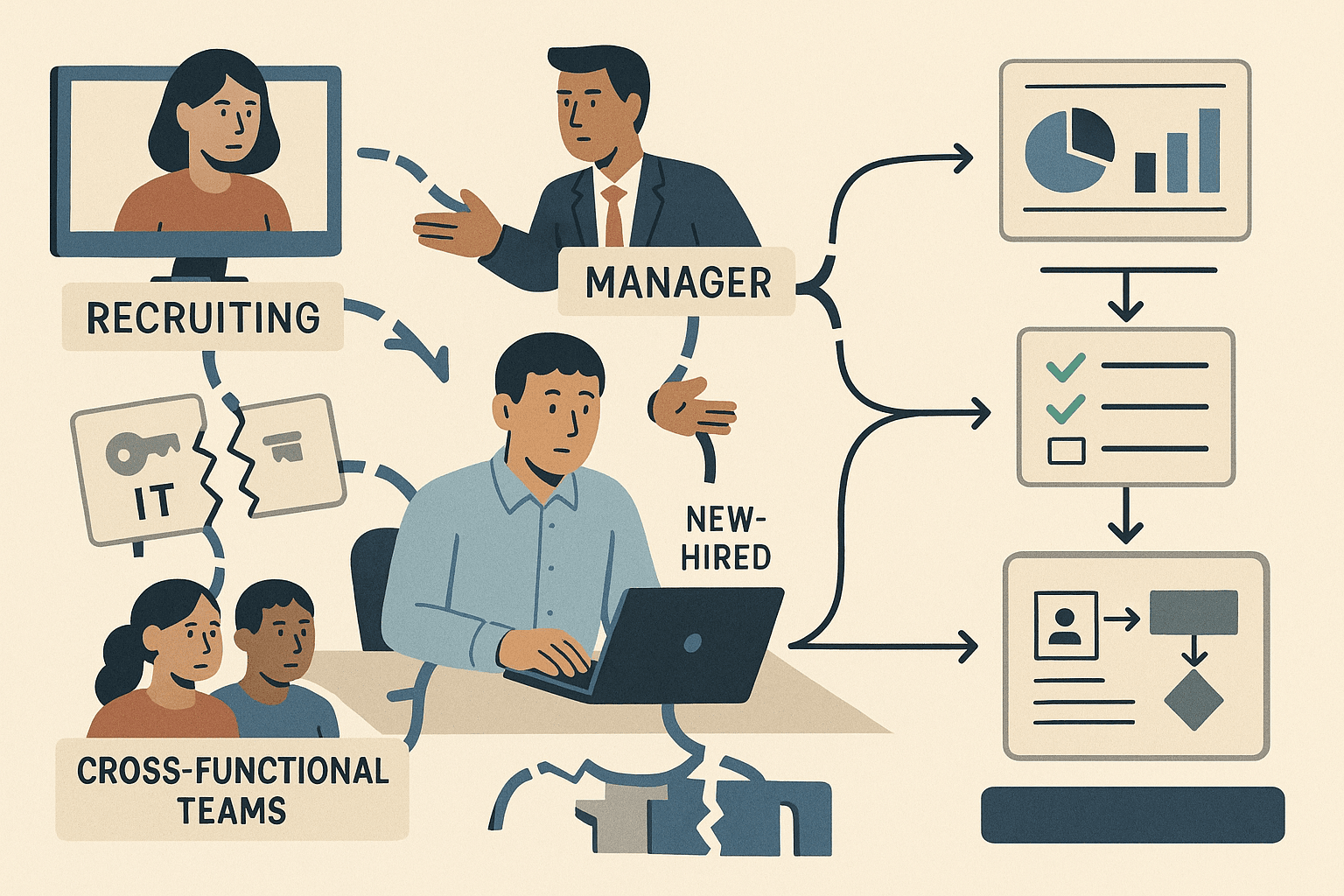
Most startups think they have a hiring problem when they actually have a role-integration problem.
The sequence usually looks good on paper. You source hard, close a strong candidate, celebrate the signed offer in Slack, ship a laptop, add them to a few tools, and schedule a welcome meeting. Two weeks later everyone says the same things:
- “They seem smart.”
- “They’re still ramping.”
- “We probably need to give them more context.”
- “Ownership is still settling.”
- “They haven’t really plugged in yet.”
By day 30, the founder is slightly uneasy, the manager is doing extra translation work, peers are quietly compensating for unclear responsibilities, and the new hire has learned the most dangerous lesson possible: how to stay busy without creating leverage.
That is the role handshake failure.
It happens in the gap between the offer letter and operational effectiveness. Not in recruiting. Not in compensation. Not in culture decks. In the handoff layer where scope, systems, training artifacts, success metrics, and cross-functional expectations are supposed to connect and usually do not.
When that handshake fails, startups misdiagnose the problem as:
- a talent miss
- a manager miss
- a motivation issue
- poor culture fit
- “startup pace” adjustment
Sometimes it is one of those things. But very often the company simply never converted a person into an operating node.
This is a solvable problem. It requires treating the first 30 days after hiring as an execution system, not an HR ceremony.
A real failure scenario
Consider a common early-stage example.
A 35-person B2B SaaS company hires its first RevOps manager. The founder has been duct-taping pipeline reporting. Sales wants cleaner forecasts. Marketing wants attribution clarity. Finance wants better revenue definitions. Customer Success wants cleaner handoffs from closed-won to onboarding.
Everyone agrees this hire is critical.
The candidate is excellent. Strong background. Good references. Clear communication. Excited about the mission.
Offer signed.
Then the cracks start.
Week 0: the invisible preboarding mess
The manager thinks People Ops is handling onboarding. People Ops thinks the hiring manager will define role outcomes. IT is outsourced and only knows to ship hardware and provision email. The founder assumes “RevOps” is self-explanatory. Sales leadership expects immediate forecasting cleanup. Marketing expects a HubSpot-Salesforce audit. Finance expects board-level metric consistency.
No one creates a single operating brief that says:
- what problem this person owns first
- what they do not own yet
- which systems matter most
- who their core stakeholders are
- what “good in 30 days” looks like
- which decisions they can make unilaterally
- which landmines to avoid
So preboarding becomes administrative instead of operational.
Day 1: access without architecture
The new hire receives:
- laptop
- Slack
- Salesforce
- HubSpot
- Notion
- Gong
- Looker
- Zoom
- Asana
This looks like onboarding. It is not.
Access is necessary, but access without sequence creates noise. The employee now has ten surfaces, no map, and no answer to the practical question: where does the company actually run?
They attend intro meetings. Everyone is friendly. Everyone says some version of, “You’ll help us fix this mess.”
They leave day 1 with enthusiasm and ambiguity in equal measure.
Week 1: context flood, no control surface
The manager schedules a few onboarding sessions. Sales gives a CRM walkthrough. Marketing shares campaign terminology. Finance explains pipeline categories. CS explains implementation stages.
The new hire gets context, but not prioritization.
This is where startups fail most often. They confuse information transfer with role integration.
The employee learns many facts but not the operating model:
- what should be ignored for now
- which issues are politically sensitive
- which metrics are decision-grade versus decorative
- where source-of-truth actually lives
- which workflows break most often
- what first win matters enough to build trust
So they start doing what capable people do in ambiguous systems: they create local productivity.
They document fields. Audit dashboards. Organize notes. Review lifecycle stages. Build a stakeholder list.
Useful work. But not yet leverage.
Week 2: cross-functional expectation drift
Stakeholders begin pulling the new hire in different directions.
Sales: “Can you clean up close dates and stage definitions?” Marketing: “Can you settle MQL versus SQL definitions?” Finance: “Can you rebuild the board revenue waterfall?” Founder: “Can you tell me if pipeline is real?” CS: “Can you help us define expansion attribution?”
Because no explicit role handshake exists, the new hire becomes a projection surface for every unresolved systems problem in the company.
The manager says, “Prioritize what feels highest impact.”
That sounds empowering. In practice, it is abdication.
The new hire lacks enough local knowledge to adjudicate competing executive requests. They either:
- default to the loudest stakeholder,
- over-index on visible but lower-leverage work,
- try to satisfy everyone and fragment themselves, or
- stall while gathering more context.
All four paths reduce time to real contribution.
Week 3: false signals of progress
Now the company starts generating bad interpretations.
The founder sees lots of meetings and assumes ramp is happening. The manager sees thoughtful questions and assumes the hire is on track. The employee sees complexity and assumes more observation is required. Stakeholders see responsiveness and assume their asks are in motion.
But there is still no committed 30-day deliverable, no decision rights matrix, and no defined integration scorecard.
The employee is present everywhere and anchored nowhere.
Week 4: the quiet productivity stall
At day 30, the manager asks, “How are you feeling?” The employee says, “Good, still connecting the dots.” The manager says, “That’s normal.”
Then in private:
- Sales says forecast quality hasn’t improved.
- Marketing says attribution is still unreliable.
- Finance says definitions remain inconsistent.
- The founder wonders whether the hire is too strategic or not hands-on enough.
The irony: the employee may be entirely capable. The company simply failed to complete the role handshake.
The pattern: what role handshake failure actually is
Role handshake failure is the breakdown between five elements that must connect in the first 30 days:
- Scope: what the person owns now, later, and not at all.
- Systems: the tools, data, docs, permissions, and workflows required to act.
- Training artifacts: the documents and walkthroughs that encode how work actually happens.
- Success metrics: the outcomes that define a good first 30 days.
- Cross-functional expectations: what adjacent teams expect, what they provide, and how conflict gets resolved.
If any one of these is weak, onboarding gets sloppy. If several are weak, execution breaks.
This is especially common in startups because roles are often hired before the company has stabilized the work itself. You are not plugging someone into a mature machine. You are hiring them partly to define the machine. That makes handshake quality even more important, not less.
Symptoms of handshake failure
You likely have this problem if new hires:
- attend many meetings but ship few decisions
- ask smart questions but struggle to prioritize
- create lots of notes but not operating leverage
- get contradictory requests from multiple leaders
- have tool access but no sequence for learning the stack
- own outcomes verbally but not procedurally
- are described as “still ramping” after 30 days with no concrete deficit identified
Manager symptoms are just as telling:
- repeating role context in ad hoc ways
- mediating stakeholder requests manually
- being surprised by what the new hire is working on
- discovering access gaps reactively
- lacking a crisp answer to “what should great look like by day 30?”
Company-level symptoms:
- every new hire has a different ramp experience
- onboarding lives mostly in calendar invites
- process knowledge exists in people, not artifacts
- recruiting closes roles faster than the company can absorb them
Why standard advice fails
The normal startup advice on onboarding is directionally right and operationally incomplete.
You hear things like:
- “Give them lots of context.”
- “Let them talk to everyone.”
- “Don’t overwhelm them with process.”
- “Smart people will figure it out.”
- “Startups need self-starters.”
- “Have them get a quick win.”
Each of these can be useful. None solves the core problem.
1. “Give them lots of context” creates context debt
Context is not inherently useful. Sequenced context is.
A new hire cannot distinguish foundational knowledge from trivia. If you dump ten Looms, twenty docs, and fifteen intro meetings on them, you are not accelerating ramp. You are outsourcing prioritization to someone least equipped to do it.
Good onboarding is a reduction function. It says: start here, ignore this for now, these three workflows matter first, this metric is the one to trust, this stakeholder is your primary counterpart.
2. “Let them talk to everyone” confuses relationship-building with role clarity
Intro meetings are not operating architecture.
Many startups use a meet-everyone tour as a substitute for defining how work flows. The result is social familiarity without execution alignment. The hire learns names, team histories, and pain points, but not obligations, interfaces, and decision boundaries.
3. “Don’t overwhelm them with process” becomes permission for vagueness
Founders often resist structured onboarding because they associate it with big-company bureaucracy.
That is a category error.
There is a huge difference between bureaucratic process and minimum viable operating clarity.
A one-page role brief, day-0 access bundle, 30-day deliverables plan, and manager checklist are not red tape. They are compression algorithms for speed.
4. “Smart people will figure it out” is expensive magical thinking
Yes, strong operators can navigate ambiguity. But every hour spent decoding avoidable ambiguity is an hour not spent improving the business.
If a $140k employee spends their first month reconstructing undocumented workflows, finding source-of-truth systems, and arbitrating conflicting expectations, the company is burning expensive talent on internal archaeology.
5. “Get a quick win” often produces theater
Without a role-specific definition of value, quick wins become performative:
- cleaning a dashboard no one uses
- fixing naming conventions
- producing a summary memo
- joining many conversations helpfully
A real first win should increase trust, reduce friction, or improve decision quality in a measurable way.
The better approach: build a post-offer-to-productivity operating system
The fix is not “better onboarding vibes.” It is an operational system for converting a signed candidate into a functioning owner.
At a minimum, that system should include:
- Preboarding role handshake doc
- Day-0 access bundle
- Manager handoff checklist
- Role-specific operating brief
- First-30-day deliverables plan
- Meeting architecture
- Integration instrumentation
Think of this as the layer between talent acquisition and actual execution.
Below is a practical design for each component.
1. Preboarding role handshake doc
This should be created after offer acceptance and before day 1. It is the canonical agreement between founder, hiring manager, and the business.
It should answer six things:
A. Why this role exists now
Not a generic job description. The current business problem.
Example:
“RevOps role exists to improve forecast reliability, metric consistency, and GTM handoff integrity across Sales, Marketing, Finance, and CS. First value is decision clarity, not stack re-architecture.”
B. What this person owns in the first 30 days
Be concrete.
Example:
- Audit current forecast pipeline logic
- Define source-of-truth metric table for weekly GTM review
- Recommend close date/stage hygiene fix
- Stand up executive reporting draft v1
C. What they do not own yet
This is where a lot of startups fail.
Example:
- No full CRM rebuild in month 1
- No compensation plan redesign
- No lifecycle architecture rewrite
- No procurement of new tooling without approval
D. Primary stakeholders and expected interfaces
For each stakeholder, define:
- what they need from the hire
- what they provide to the hire
- how often they interact
E. Decision rights
Use a simple model:
- Decide
- Recommend
- Consult
- Inform
If a new hire cannot tell whether they can decide, they usually default to over-consulting.
F. 30-day success test
This should be binary enough to reduce ambiguity.
Example:
“By day 30, leadership has a shared weekly pipeline definition, top three forecast failure points are documented with fixes, and the RevOps manager is running the GTM metrics review with minimal support.”
2. Day-0 access bundle
Most startups provision tools. Few provision workflows.
A proper day-0 access bundle should be role-specific and ordered.
What to include
Core systems access
- calendar
- chat
- docs/wiki
- task/project management
- HR/payroll
Role systems access
- product analytics
- CRM
- BI/reporting
- support desk
- code repo
- staging environment
- customer call recordings
- billing system
Distribution lists and channels
- team channels
- incident channels
- weekly review channels
- role-relevant announcement lists
Saved views/dashboards Do not just give tool access. Preload the dashboards, boards, reports, and queries they should start with.
Known source-of-truth index A single doc saying:
- canonical dashboard for weekly metrics
- canonical customer health report
- canonical roadmap source
- canonical product spec template
- canonical GTM definitions
Sequence matters
A Day-0 bundle should also say in what order to use systems.
Example for a product manager:
Day 1–3:
- Notion team wiki
- Linear backlog views
- Slack product + eng channels
- Fullstory/Gong customer evidence playlists
Day 4–10:
- analytics dashboards
- roadmap review workspace
- historical specs archive
Day 10+:
- admin-level reporting views
- experimentation tooling
- release operations workflow
That sequencing reduces cognitive load and directs attention toward real workflows.
Tool comparison: access management options
For small startups, three approaches are common.
Option 1: Manual provisioning via team leads
- Cost: lowest direct cost
- Speed: slow and inconsistent
- Risk: missed access, security gaps, dependence on memory
- Best for: fewer than 10 employees, very low hiring volume
Option 2: IT/HR onboarding checklists in Notion/Asana
- Cost: low
- Speed: medium
- Risk: still manual, but visible
- Best for: 10–75 employees with modest hiring pace
Option 3: Identity + lifecycle automation tools Examples: Rippling, Okta, JumpCloud, BetterCloud
- Cost: medium to high
- Speed: high
- Risk: setup complexity, overkill if team is tiny
- Best for: 25+ employees, multi-tool stack, regular hiring
Battle-tested recommendation: most startups should start with option 2 and graduate to option 3 earlier than they think if hiring is frequent or compliance matters.
3. Manager handoff checklist
Onboarding breaks when managers assume “the company” is onboarding the person.
No. The manager is onboarding the role.
A manager handoff checklist should be completed before day 1 and reviewed in the first week.
Required elements
Role narrative Why this role matters now.
Top 5 workflows What repeated workflows define effectiveness.
For example, for a customer success hire:
- handoff from AE after close
- kickoff preparation
- success plan creation
- renewal risk escalation
- product feedback loop to PM
Expected communication norms
- Slack versus doc versus meeting
- response-time expectations
- escalation rules
- how decisions are recorded
Known landmines This is underrated. Tell the truth.
Examples:
- dashboard numbers differ between finance and sales right now
- roadmap priorities shifted twice last month
- one enterprise account has political sensitivity
- support SLA definition is in flux
First 10 decisions they may need to make This gives the new hire a preview of the operating terrain.
What good looks like at day 7, 14, 30 Not generic “getting up to speed.” Observable signs.
A simple manager checklist template
Before day 1:
- finalized role handshake doc
- created first-30-day plan
- assigned onboarding buddy or core counterpart
- confirmed access bundle
- queued required docs and walkthroughs
- pre-briefed cross-functional stakeholders
Week 1:
- reviewed role narrative live
- aligned on priorities not just activities
- walked source-of-truth systems
- clarified decision rights
- confirmed first deliverable owner/date
Week 2:
- reviewed stakeholder pull versus role priorities
- cut nonessential asks
- confirmed first independent workflow execution
Week 3–4:
- inspect actual work product
- review integration metrics
- resolve any ownership confusion with adjacent teams
4. Role-specific operating brief
Generic onboarding documents are too broad to create effectiveness. Every role needs an operating brief that explains how work gets done in that lane.
Think of this as the practical field manual.
What an operating brief should contain
Mission of the role One paragraph.
Core recurring workflows The 3–7 loops that matter most.
Inputs What information, requests, systems, and stakeholders feed the role.
Outputs What decisions, artifacts, updates, or deliverables the role is expected to produce.
Cadence Weekly, monthly, and event-triggered responsibilities.
Quality bar Examples of good output versus weak output.
Failure modes Where people in this role usually get stuck.
Escalation map What to do when blocked.
Example: operating brief for first product marketer
Core workflows
- turn customer/product insight into messaging updates
- prepare launch briefs for releases
- maintain battlecard feedback loop from sales
- run win/loss synthesis monthly
- support pipeline campaigns with positioning clarity
Failure modes
- becoming a generic content support function
- taking launch requests without prioritization
- producing messaging without customer evidence
- getting trapped between PM and Sales requests
Day-30 quality bar
- can independently run launch brief template
- can explain core segments and messaging hierarchy
- has shipped one enablement or launch asset that sales actually uses
This type of brief dramatically reduces the “what am I really here to do?” drift.
5. First-30-day deliverables plan
The first month needs deliverables, not just exposure.
That does not mean forcing major output before context exists. It means selecting work that proves integration into the operating system.
The right 30-day plan has three layers:
Layer 1: Learn the system
Examples:
- complete stack walkthrough
- shadow two customer calls
- review last three planning docs
- map current workflow and pain points
Layer 2: Produce a diagnostic
Examples:
- funnel integrity audit
- support escalation map
- top-five reliability issues in release process
- renewal-risk taxonomy draft
Layer 3: Ship one leverage-creating improvement
Examples:
- standardize weekly metrics definition sheet
- implement clean handoff template from sales to onboarding
- launch roadmap decision log
- create customer issue triage SOP
The key is that the final output should improve how the company runs, not just prove the employee is active.
A good 30-day deliverable rubric
A first-month deliverable should do at least two of the following:
- remove repeated confusion
- improve decision speed
- improve metric quality
- reduce handoff errors
- clarify ownership
- save recurring team time
If it does none of these, it is probably a learning artifact masquerading as contribution.
6. Meeting architecture
New hires often drown in meetings because startups use meetings to compensate for poor system design.
You need a deliberate meeting architecture for the first 30 days.
Minimum viable meeting set
Manager 1:1 twice weekly for first two weeks, then weekly Purpose: prioritization, context compression, obstacle removal.
Functional onboarding sessions Purpose: tool/workflow walkthroughs, not team history monologues.
Stakeholder alignment meetings Purpose: define interfaces and expectations, not open-ended “intro chats.”
One operating review they will eventually own or materially contribute to Purpose: exposure to the company’s decision rhythm.
Optional shadow sessions Customer calls, incident reviews, planning sessions.
A better intro-meeting format
Instead of “tell me about your team,” ask stakeholders to cover:
- what decisions they make
- where their workflow intersects this role
- what they need from this hire
- common failure points in the handoff
- what great partnership looks like
That turns social onboarding into operational onboarding.
Meeting overload warning signs
- more than 60% of week 1 is intros with no synthesis
- no meeting ends with clarified interface expectations
- recurring invites start before priorities are defined
- the employee attends key reviews but has no role in them
7. Integration instrumentation
This is the layer almost nobody builds.
Startups track recruiting funnel metrics, time-to-fill, and acceptance rate. Then they stop measuring right when execution risk begins.
You need instrumentation to know whether a new hire is integrated or merely present.
Metrics that matter
Time-to-access completeness
- % of required systems provisioned by day 0/day 1/day 3
Time-to-first-independent-workflow
- how long until the hire runs one core workflow with minimal help
Time-to-first-decision-grade-output
- first artifact, recommendation, or deliverable trusted enough to inform a real decision
Stakeholder clarity score Ask core stakeholders at day 14 and day 30:
- Do you know what this person owns?
- Do they know what you need from them?
- Is the handoff/interface clear?
New hire clarity score Ask the hire weekly in first month to rate:
- clarity of priorities
- clarity of success metrics
- clarity of decision rights
- access sufficiency
- confidence in where source-of-truth lives
Manager confidence delta Manager rates weekly:
- Is this person working on the right things?
- Can they prioritize without heavy translation?
- Are stakeholder requests becoming manageable or chaotic?
Simple integration scorecard
Use red/yellow/green across five dimensions:
- access
- role clarity
- workflow competence
- stakeholder alignment
- first-output quality
If two or more are yellow by day 14, intervene. If one remains red by day 21, do not wait for day 30.
A practical workflow example
Let’s make this concrete for a startup hiring its first implementation manager.
Before start date
People Ops
- triggers onboarding project from template
- confirms hardware, payroll, legal docs
Hiring manager
- writes role handshake doc
- creates 30-day deliverables plan
- records 15-minute Loom on why role exists now
IT/ops
- provisions role-based access bundle
- tests login completion
Cross-functional leads
- receive stakeholder interface template to complete
Day 1
- manager reviews role narrative and 30-day goals live
- employee receives source-of-truth index
- employee joins only critical channels, not every channel in the company
- stakeholder meetings are scheduled with defined agenda
Week 1
- shadow handoff from AE to implementation
- review last five implementation plans
- inspect top three causes of delayed go-lives
- meet Product, Support, and CS counterparts using interface format
- draft workflow map of current implementation process
Week 2
- run one kickoff planning workflow with support
- identify friction points in sales-to-implementation handoff
- present diagnostic to manager
- narrow first shipped improvement to one operational fix
Week 3
- ship standardized pre-kickoff intake template
- update handoff checklist with AEs
- join weekly operating review and report early impact
Week 4
- independently run implementation kickoff process
- report baseline metrics: handoff completeness, kickoff readiness, top blockers
- finalize next 60-day recommendations
That is what integration looks like. Not just attendance. Functional insertion into the company’s workflow.
Cost and time analysis
A lot of founders resist building this because they think it sounds heavy.
It is much lighter than recovering from failed ramp.
What poor role handshakes cost
Suppose you hire a mid-level operator at $130k fully loaded closer to $160k after taxes, benefits, equipment, and management overhead.
Monthly cost is roughly $13k.
If the first month produces only 30–40% effective output due to preventable ambiguity, you are easily losing:
- $7k–$9k in direct productivity
- additional manager time translating role scope
- stakeholder time in avoidable meetings
- delay on critical systems fixes or execution goals
Now multiply by five hires per year. The hidden cost can exceed $50k–$100k annually in small teams, before considering morale, missed targets, or false attribution of underperformance.
What a solid handshake system costs
For a 20–60 person startup:
Initial setup
- 10–20 hours to create templates
- 3–6 hours per functional leader to document role briefs for key roles
- 1–2 hours per hire to customize handshake + 30-day plan
Tooling cost
- Notion/Confluence + Asana/Jira/Trello: usually already owned
- Loom: low cost
- Rippling/Okta/JumpCloud if automating access: moderate monthly cost
- Survey or form tooling for scorecards: low cost
This is not a major systems build. It is operating discipline.
Time-to-value comparison
Unstructured onboarding
- Day 1–10: context flood
- Day 11–20: expectation drift
- Day 21–30: activity without anchored leverage
- Time to independent contribution: 30–60+ days
Structured role handshake system
- Day 1–5: clear terrain + access completeness
- Day 6–15: workflow understanding + stakeholder alignment
- Day 16–30: first leverage-generating output
- Time to independent contribution: often 14–30 days depending on role complexity
Tooling stack recommendations by stage
Stage 1: fewer than 20 employees
Keep it simple.
- Notion or Google Docs for role briefs and source-of-truth index
- Asana/Trello for onboarding checklist templates
- Google Forms or Typeform for weekly clarity checks
- Loom for role walkthroughs
Main risk at this stage is not under-tooling. It is founder memory masquerading as a system.
Stage 2: 20–75 employees
Add structure and accountability.
- Notion/Confluence for document system
- Asana/Jira/ClickUp for onboarding workflow tracking
- Rippling or JumpCloud for provisioning if hiring is regular
- Slack workflows or simple automations for preboarding triggers
- BI dashboard or spreadsheet scorecard for onboarding metrics
At this stage, role-specific operating briefs matter a lot because tribal knowledge starts fragmenting.
Stage 3: 75+ employees or compliance-heavy startup
Systematize aggressively.
- HRIS-driven onboarding workflows
- SSO and lifecycle management
- documented competency/ramp models by role family
- standardized stakeholder feedback collection
- integration metrics tied to manager performance expectations
The trap here is creating too much generalized process and losing role specificity. Keep the operational brief close to the team.
Common objections and the blunt response
“We hire too few people for this to matter.”
If you hire few people, each hire matters more. A broken first month is proportionally more damaging.
“Our startup changes too fast to define scope tightly.”
Then define current scope, likely changes, and decision rules for reprioritization. Fast-changing environments need better handshakes, not looser ones.
“We don’t want to over-process onboarding.”
A one-page brief, checklist, and 30-day plan is not over-processing. It is basic managerial competence.
“Great hires should be proactive.”
Yes. Proactivity should be directed toward business problems, not wasted on discovering where the roadmap doc lives or which metric is real.
Implementation plan: deploy this in two weeks
If you want to fix this without launching an HR transformation project, do the following.
Week 1: build the minimum system
Create five templates:
- role handshake doc
- day-0 access bundle checklist
- manager handoff checklist
- role-specific operating brief
- 30-day integration scorecard
Then choose your next two hires or your last two shaky hires and backfill the framework.
Week 2: test on one real role
For a current or upcoming hire:
- define day-30 success criteria
- write the operating brief
- create the system access sequence
- pre-brief stakeholders
- set weekly clarity pulse checks
At day 14, review where confusion still exists. Do not just ask whether onboarding “feels good.” Ask:
- what decisions remain unclear?
- what workflow can they not yet run?
- what tool or artifact is still missing?
- what stakeholder expectation is in conflict?
That review becomes the basis for improving your template.
The practical takeaways
The first 30 days after hiring are not a soft period. They are a systems integration window.
If you do not deliberately connect role scope, access, workflows, success metrics, and stakeholder expectations, you will create employees who are busy but not embedded.
That leads to the worst kind of startup failure: not dramatic underperformance, but slow, polite, expensive non-execution.
Here is the founder-level rule:
Signing a candidate does not complete hiring. Completing the role handshake does.
If you want new hires to become effective faster, implement these five non-negotiables:
- a written role handshake before day 1
- role-specific day-0 access bundles with source-of-truth guidance
- a manager handoff checklist that defines workflows and landmines
- a first-30-day deliverables plan tied to leverage, not activity
- instrumentation that measures integration, not mere attendance
Most startups ignore this layer because it sits in the seam between recruiting, management, ops, and team execution. Which is exactly why it breaks.
Fix the seam.
Your hires will ramp faster. Managers will spend less time translating. Cross-functional teams will stop projecting unresolved problems onto every new employee. And you will get a much cleaner answer to the question that actually matters:
Is this person truly integrated into how the company works, or are they just present inside it?
That is the difference between hiring headcount and building execution capacity.