
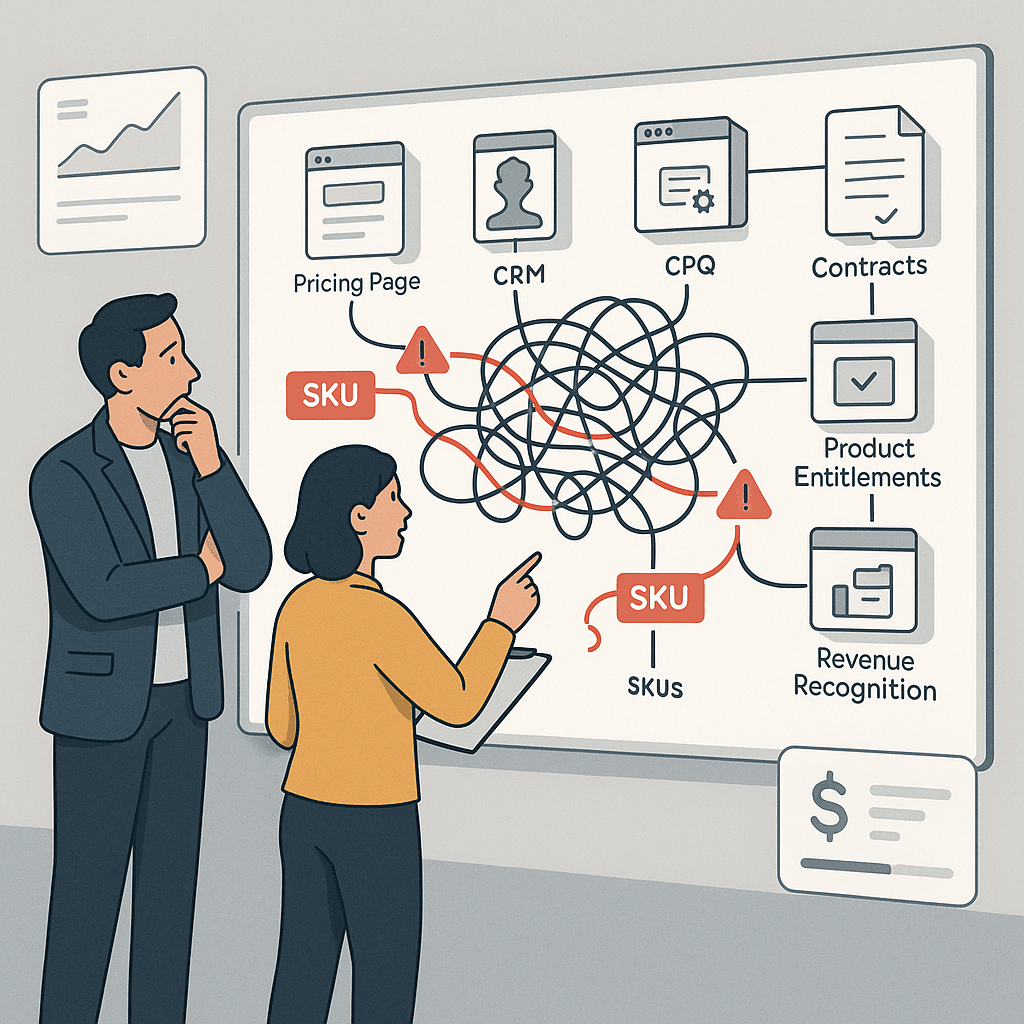
A familiar startup failure mode looks like a finance problem at first, but it usually starts much earlier.
Sales closes a deal for a “Platform Pro + Advanced Security + 3 sandbox environments + premium support” package. The customer signs an order form that references a few quote line items and some custom language. Billing sets up the subscription using the objects available in the billing system, which don’t quite match the quote. Product ops provisions access based on a spreadsheet mapping maintained by one PM and one solutions engineer. Customer success discovers the customer expected sandbox environments to be isolated tenants, while product interpreted them as test workspaces inside the main account. Finance then tries to recognize revenue, but the support package, onboarding fee, and prepaid usage credits were modeled inconsistently across CRM, billing, and revrec.
Thirty days later, every team thinks another team created the mess.
Sales says product packaging was unclear. Product says the order form sold things that do not exist in the product model. Finance says the invoice objects do not line up with standalone selling price allocation or performance obligations. Customer success says renewal is going to be a disaster because nobody can explain what the customer actually bought. Engineering says they were never told “Advanced Security” was sold separately in enterprise deals but bundled on the pricing page for mid-market.
This is the SKU logic drift problem.
It happens when different systems and teams each maintain their own version of “what was sold,” and those versions slowly diverge:
- Pricing page describes market-facing packages.
- CRM and CPQ describe sellable quote line items.
- Order forms describe contractual promises.
- Billing defines invoiceable objects.
- Product defines entitlements and provisioning rules.
- Revenue recognition defines accounting treatment.
- Data warehouse defines reporting categories.
- Customer success defines what gets renewed.
At the beginning, the drift is small and survivable. At $500k ARR, people patch over it manually. At $2M ARR, every weird deal creates cleanup work. At $10M ARR, leadership starts hearing about “billing issues,” “reporting integrity,” “provisioning bugs,” and “renewal confusion” as if they are separate problems. They are usually one problem: your commercial catalog is not canonical, and your execution systems are not operating from the same source of truth.
This article is a tactical playbook for fixing that before it becomes a permanent tax on growth.
The real failure scenario
Let’s make this concrete.
Assume you are a B2B SaaS startup selling workflow automation software. Over three years, you evolved from one all-inclusive annual plan to a more sophisticated packaging model:
- Core platform sold by seat.
- API access included in enterprise, add-on for lower tiers.
- Premium security sold as an add-on.
- Onboarding sold as a one-time fee on larger deals.
- Overage usage sold above included thresholds.
- Sandbox environments sold to larger accounts.
- Support sold as standard, premium, or strategic.
- Multi-year discounts handled in custom order forms.
- A “launch bundle” created for one segment and later copied into multiple deal templates.
Nothing here is unusual. This is normal startup monetization evolution.
The problem is how each team implemented the changes.
Product’s version
Product thinks the sellable items are:
- Workspace seats
- API rate limit tiers
- Security controls
- Number of environments
- Support tier flags
They maintain entitlement logic in code and a config file. Bundle definitions are implicit. “Enterprise” means a set of flags, not a formal commercial object.
Sales and CRM’s version
Sales ops created quote line items like:
- Pro Annual
- Business Annual
- Enterprise Platform
- Advanced Security Add-on
- Sandbox Pack
- Premium Support
- Launch Bundle
- Strategic Onboarding
Some bundles are net-new SKUs. Some are aliases. Some are just labels used in quote templates.
Legal’s version
The order form contains line items plus freeform descriptions like:
- Enterprise Platform includes SSO, audit logs, API access, and 2 sandbox environments
- Premium support includes shared Slack channel
- Additional environments may be purchased during the term at current list price
That language may or may not match actual product entitlements or billing behavior.
Billing’s version
Because the billing platform is constrained, finance ops modeled the catalog as:
- Annual platform subscription
- Security add-on subscription
- Sandbox recurring charge
- Support recurring charge
- One-time onboarding fee
- Usage overage charge
But “included quantities” and “bundled components” aren’t represented cleanly. Discounts sit at the invoice or subscription level rather than SKU level.
RevRec’s version
Finance has to determine:
- Which items are subscriptions vs services
- Which have distinct performance obligations
- Whether onboarding is material or immaterial
- How SSP allocation should work in bundles
- Whether prepaid usage credits are recognized on consumption or ratably
Because source systems are inconsistent, finance creates manual memo rules in spreadsheets.
Data’s version
The BI team classifies revenue into categories like:
- Platform ARR
- Services revenue
- Usage revenue
- Support revenue
- Security upsell
But mappings are maintained downstream and often lag packaging changes by months.
What actually breaks
When these models disagree, failures show up everywhere:
-
Provisioning mistakes
- Customer bought 3 sandboxes, receives 1.
- Customer bought premium support, CS has no trigger to assign it.
- Customer did not buy API access, but entitlement defaults grant it anyway.
-
Billing errors
- Included usage thresholds are not represented correctly.
- Bundled components are double-billed or never billed.
- Mid-term co-terms create line item mismatches.
-
Revenue recognition clean-up
- Contract line items don’t map cleanly to revrec treatment.
- Manual allocation is required every month.
- Auditors ask how SKU definitions are controlled and versioned.
-
Reporting distortion
- Product attach rates are wrong because the add-on is sometimes bundled and sometimes standalone.
- ARR by package is meaningless because package names are aliases.
- Gross retention analysis is distorted by contract restructures.
-
Renewal confusion
- The renewal quote reflects billing objects, not what the customer thinks they bought.
- Account managers cannot explain the current package.
- Customers see line items they never saw before because the original bundle was decomposed internally.
-
Strategic slowdown
- You avoid improving packaging because every change triggers downstream breakage.
- Sales invents workarounds for product gaps.
- Finance becomes the final quality control layer for GTM design.
This is not just an ops nuisance. It becomes a growth constraint.
The pattern: startups confuse pricing, packaging, and system representation
The core pattern is simple.
Most startups never define a canonical commercial catalog. Instead, they let each system become “correct enough” for its local job.
That works when:
- You have one plan.
- You mostly sell annual subscriptions.
- Entitlements are simple.
- Revenue treatment is homogeneous.
- Sales exceptions are rare.
It stops working when packaging becomes multidimensional.
The root confusion is that founders and operators collapse several different concepts into the word “SKU”:
- A market-facing package name
- A quote line item
- A contractual promise
- A billable object
- A product entitlement bundle
- An accounting treatment unit
- A reporting category
These are related, but they are not identical.
A SKU in CRM is not necessarily the same thing as an entitlement object in product or a performance obligation in revrec. The mistake is forcing one system’s representation onto all the others without explicit mapping.
Then drift sets in through perfectly rational local decisions:
- Sales ops adds a temporary quote item to move faster.
- Product ships a flag-based entitlement without formalizing sellable units.
- Finance adapts billing objects to platform constraints.
- Legal adds custom language for a large deal.
- Data creates downstream derived mappings to support board reporting.
Nobody is malicious. Everyone is solving immediate problems. The company still ends up with incompatible monetization logic.
Why standard advice fails
A lot of common advice sounds right but fails in practice.
“Just clean up your SKUs” is too shallow
If you tell a team to rationalize SKUs, they often rename quote line items or reduce catalog sprawl in the CRM. Helpful, but insufficient.
You can have a tidy CRM catalog and still have broken provisioning, revrec, and renewals because the deeper issue is semantic mismatch across systems.
“Use one system as the source of truth” is usually wrong
Founders often ask whether Salesforce, HubSpot, Stripe, Chargebee, NetSuite, or the product database should be the source of truth.
Usually, none of those systems should fully own the meaning of what was sold.
Why?
- CRM is optimized for pipeline and quoting, not entitlements or revrec.
- Billing is optimized for invoicing and collections, not contractual nuance.
- Product is optimized for feature control, not commercial history.
- ERP/revrec is optimized for accounting treatment, not sales usability.
You need a canonical commercial catalog model that maps across these systems. The source of truth is not one operational app by default. It is the controlled definition layer that those apps consume.
“Standardize deals” won’t survive reality
Some operators respond by trying to ban exceptions.
That helps at the margin, but mature B2B selling always produces real-world complexity:
- Bundle pricing by segment
- Legacy plans carried forward
- Regional packaging differences
- Multi-year terms
- Ramp deals
- Included services
- Contractual overrides
- Product access dependencies
You should reduce avoidable exceptions, yes. But the answer is not pretending exceptions won’t exist.
“Finance will catch it” is expensive and dangerous
Finance often becomes the last line of defense because revrec and audits force clarity eventually.
But by the time finance catches SKU drift, the damage already exists in:
- Customer expectations n- Provisioning state
- Renewal history
- Product analytics
- Pipeline reporting
Finance can detect inconsistency. It should not be the primary mechanism for preventing it.
The better approach: build a canonical commercial catalog
The fix is to define a canonical commercial catalog and make every downstream system map to it deliberately.
This does not mean building a giant internal platform on day one. It means getting precise about your commercial objects and their relationships.
At minimum, your canonical model should distinguish six layers.
1. Commercial offer
This is the market-facing package or offer customers can buy.
Examples:
- Pro Annual
- Enterprise Platform
- Security Bundle
- Launch Package
This is useful for pricing pages, segmentation, and sales positioning.
2. Sellable line item
This is the thing sales can quote and legal can reference.
Examples:
- Enterprise Platform Annual Subscription
- Premium Support Annual Add-on
- Strategic Onboarding One-Time Fee
- Additional Sandbox Environment Annual Add-on
A commercial offer may contain one or more sellable line items.
3. Contractual component
This is the explicit promise made in the order form or agreement.
Examples:
- 100 named seats
- API access enabled
- 2 sandbox environments included
- Shared Slack support channel
- Up to 500k workflow runs per month included
These need to be represented in a structured way whenever possible, not buried in prose.
4. Billing object
This is how the item is invoiced and charged.
Examples:
- Annual recurring subscription
- Monthly usage charge
- One-time onboarding invoice item
- Credit balance / drawdown object
Billing objects may split or combine contractual elements depending on system constraints, but the mapping must be explicit.
5. Product entitlement
This is what gets provisioned.
Examples:
- Feature flags
- Environment count
- Usage limits
- Role permissions
- Support routing tags
Product entitlements should not be inferred ad hoc from package names.
6. Revenue treatment unit
This is how finance determines revrec logic.
Examples:
- Ratable subscription revenue
- Distinct one-time service
- Consumption-based revenue
- Bundled arrangement requiring SSP allocation
One sellable line item can map to one or more revenue treatment rules.
Once you define these layers, you stop asking the wrong question, which is “what is the SKU?” and start asking better questions:
- What customer-facing offer exists?
- What line items can be sold?
- What rights/obligations does each line item create?
- How is each line item billed?
- What entitlements should provisioning grant?
- What revrec treatment applies?
- What reporting categories should roll up from this item?
That is how you eliminate drift.
The minimum data model you actually need
You do not need a perfect enterprise architecture diagram. You need a practical catalog table with controlled relationships.
A workable canonical catalog usually includes these entities.
Catalog item master
For each sellable item, store:
- Canonical item ID
- Item name
- Item type: subscription, usage, service, support, credit, discount, bundle, etc.
- Active dates / version dates
- Segment availability
- Region/currency applicability
- Default term options
- Is standalone or bundle-only
- Parent/child relationships
- Legacy status
Offer-to-item mapping
Defines which items are included in which commercial offers.
Fields:
- Offer ID
- Item ID
- Included or optional
- Default quantity
- Pricing behavior
- Effective dates
Item-to-entitlement mapping
Defines what provisioning should do.
Fields:
- Item ID
- Entitlement type
- Entitlement value
- Provisioning dependency rules
- Environment/tenant behavior
- Limits and thresholds
Item-to-billing mapping
Defines how the item appears in billing.
Fields:
- Item ID
- Billing system product/rate plan ID
- Charge model: flat, per-seat, usage, one-time
- Billing frequency
- Included quantity behavior
- Overage handling
- Discount compatibility
Item-to-revrec mapping
Defines accounting treatment.
Fields:
- Item ID
- Revrec category
- Performance obligation type
- SSP family
- Recognition method
- Start/end recognition trigger
- Bundle allocation rules if relevant
Item-to-reporting mapping
Defines analytics rollups.
Fields:
- Item ID
- ARR category
- Revenue category
- Product family
- Attach family
- Renewal family
Version and exception handling
You need to support:
- Effective start/end dates
- Replacement item relationships
- Legacy grandfathered plans
- Deal-specific override flags
- Approval requirements for non-standard items
This is enough for most startups up to meaningful scale if maintained with discipline.
Ownership: if everyone owns packaging, nobody owns it
Most SKU drift persists because responsibility is fragmented.
You need clear ownership at two levels.
1. Executive owner for commercial architecture
This is often one of:
- Head of revenue operations
- CFO / VP Finance
- COO
- Rarely, a strong product ops leader in product-led businesses
This person is not doing all the work. They are accountable for cross-functional coherence.
Their job is to ensure packaging changes cannot launch without system compatibility review.
2. Functional owners by mapping layer
A simple ownership model:
- Commercial offer definition: Product marketing + pricing owner
- Sellable line item governance: RevOps / Sales Ops
- Contract language templates: Legal + RevOps
- Billing object mapping: Finance Ops / Billing Ops
- Entitlement mapping: Product Ops / Engineering
- Revrec mapping: Accounting / Finance
- Reporting taxonomy: Data / BizOps
Critical point: these are not independent owners creating parallel truth. They are stewards of mappings into the canonical catalog.
Use a packaging change review board
Sounds bureaucratic, but it can be lightweight.
For any net-new package, SKU, add-on, bundle, pricing metric, or contract structure, require review from:
- RevOps
- Product/engineering owner for entitlements
- Finance/Accounting
- Legal if contract language changes
- Data if reporting category changes materially
For early-stage teams, this can be a 30-minute weekly working session plus a launch checklist.
Without this, pricing changes will continue to ship as local decisions.
How to version packaging changes without breaking renewals
A common startup mistake is updating a package “in place.”
Example:
Your 2024 Enterprise plan includes 2 sandboxes and premium support. In 2025, you decide Enterprise includes 1 sandbox and standard support, while premium support becomes a paid add-on.
If you simply edit the existing plan object in CRM, billing, and product configs, you create chaos:
- Existing customers may lose entitlements incorrectly.
- Renewal teams won’t know what legacy customers are owed.
- Reporting history becomes incomparable.
- Revrec may not be able to reconcile old vs new contracts.
Better rule: commercial changes create versions, not silent edits
Treat meaningful packaging changes as versioned commercial definitions.
Examples:
- Enterprise Platform v2024
- Enterprise Platform v2025
- Security Add-on v2
- Support Package legacy vs current
You do not have to expose version labels to customers in this exact format, but internally you need version control.
Each version should preserve:
- Effective sell dates
- Included components
- Entitlement logic
- Billing mappings
- Revrec mappings
- Renewal treatment guidance
Decision rule for when to create a new version
Create a new version when any of these change:
- Included features or quantities
- Pricing metric
- Billing behavior
- Revrec treatment
- Contractual obligations
- Renewal rights or conversion logic
Do not create new versions for trivial cosmetic edits.
Mapping SKUs to entitlements: where product and GTM usually disconnect
The most painful operational failures come from weak SKU-to-entitlement mapping.
A lot of startups rely on human interpretation:
- “Enterprise gets all security stuff.”
- “Premium support customers go in the Slack list.”
- “Sandbox pack means give them more environments.”
That is not a provisioning model. That is folklore.
What good entitlement mapping looks like
For each sellable item, define:
- Exact feature flags enabled
- Quantity limits granted
- Environment/tenant behavior
- User role restrictions
- Dependency logic
- Upgrade/downgrade rules
- Effective timing: immediate, contract start, implementation complete, etc.
Example:
Item: Advanced Security Add-on v3
Entitlements:
- sso_enabled = true
- audit_logs_enabled = true
- scim_enabled = true
- session_timeout_policy = advanced
- max_sandboxes change = 0
- requires_enterprise_base_plan = true
- provisioning_trigger = contract_activation
Now compare that to a fuzzy package label like “Security Bundle.” One is operationally executable. The other is a sales story.
Bundle decomposition matters
If a bundle includes multiple entitlements with different provisioning or revrec characteristics, model that explicitly.
For example:
- Platform Enterprise bundle includes core seats, API access, 2 sandboxes, standard support.
- Premium support sold separately includes Slack support and faster SLA.
- Onboarding sold separately creates a service obligation but no product entitlement.
Do not force product provisioning to reverse-engineer bundles from invoice descriptions.
Mapping SKUs to revrec: where finance gets dragged in late
Founders often underestimate how much damage catalog ambiguity creates for accounting.
Finance does not just need total contract value. They need to understand what each sold item represents.
Questions finance must be able to answer per item
- Is this recurring, one-time, or usage-based?
- Is it a distinct performance obligation?
- Does it require SSP allocation inside a bundle?
- Is revenue recognized ratably, on delivery, or on consumption?
- What events start and stop recognition?
- How are credits, minimum commits, and ramps treated?
If your sellable catalog does not map to those answers, finance creates manual workarounds.
That manual layer becomes dangerous because it hides upstream inconsistency. The company keeps selling broken packages while finance reconciles them in spreadsheets.
Common problem cases
-
Implementation/onboarding fees
- Sold as a line item, but no agreement on whether distinct service or setup activity.
-
Bundled support
- Included in package but also sold as standalone for some segments.
-
Prepaid usage credits
- Billed upfront, consumed later, often mapped inconsistently between billing and revenue recognition.
-
Ramp deals
- Commercially one package, operationally multiple billing phases, accounting treatment may require specific treatment.
-
Free months / discount structures
- Represented in billing as 100% discounts, but not reflected cleanly in contract item semantics.
A canonical catalog does not solve accounting policy by itself. It gives finance a durable structure to apply policy consistently.
Tool comparisons: where systems help and where they don’t
No tool will save you if your underlying catalog logic is sloppy. But some tools make different parts easier.
CRM / CPQ
Examples: Salesforce + CPQ, HubSpot, DealHub, PandaDoc with pricing tables
Good for:
- Quote line item control
- Approval workflows
- Guided selling
- Template consistency
Weak for:
- Product entitlement source of truth
- Complex revrec semantics
- Long-term catalog version control unless carefully administered
Practical view: If you are under $5M ARR, a disciplined CRM product catalog plus lightweight quoting controls can work. Above that, uncontrolled custom quote behavior becomes expensive fast.
Billing systems
Examples: Stripe Billing, Chargebee, Recurly, Zuora
Good for:
- Recurring charges
- Usage rating
- Invoicing
- Collections
- Subscription amendments
Weak for:
- Rich contract semantics
- Product provisioning logic
- Market-facing package design
Practical view: Stripe is fast and developer-friendly but often stretched as packaging complexity grows. Chargebee/Recurly are solid for SaaS billing ops. Zuora handles complexity better but adds overhead and implementation burden. None should define commercial meaning by themselves.
RevRec tools
Examples: NetSuite ARM, Stripe Revenue Recognition, Zuora RevPro, Leapfin
Good for:
- Revenue schedules
- Accounting treatment automation
- Audit support
- SSP logic in more mature setups
Weak for:
- Frontline commercial design
- Product entitlement awareness
- Preventing bad packaging changes upstream
Practical view: Revrec tools reduce month-end pain only if upstream item definitions are stable enough to map reliably.
Entitlement systems / internal product config
Examples: LaunchDarkly for flags, homegrown entitlement service, config database, admin tools
Good for:
- Feature access control
- Environment provisioning rules
- Operational product state
Weak for:
- Commercial governance unless deliberately integrated
- Contractual traceability out of the box
Practical view: Most startups outgrow entitlement-by-hardcoded-plan-name. You eventually need a formal mapping layer or entitlement service.
Data warehouse and BI
Examples: Snowflake, BigQuery, dbt, Looker
Good for:
- Reconciliation
- Drift detection
- Reporting rollups
- Historical analysis
Weak for:
- Preventing source inconsistency
- Real-time provisioning correctness
Practical view: BI should detect and surface SKU drift, not quietly paper it over with endless downstream transformations.
A practical workflow for shipping packaging changes safely
Here is a workable cross-functional workflow.
Step 1: Define the commercial change request
Use a standard intake doc with:
- Business goal
- Target customer segment
- Offer description
- Sellable line items
- Pricing metric and term
- Contract language changes
- Entitlement impact
- Billing impact
- Revrec impact
- Reporting impact
- Renewal impact
- Legacy migration impact
If a proposed change cannot answer those fields, it is not ready.
Step 2: Create or version canonical catalog items
Decide:
- New item or revised version?
- Standalone or bundle-only?
- Effective dates?
- Segment restrictions?
- Dependencies?
Step 3: Map the item across systems
For each canonical item:
- CRM/CPQ product mapping
- Contract template token mapping
- Billing product/rate plan mapping
- Entitlement mapping
- Revrec rule mapping
- Reporting category mapping
Step 4: Simulate deal scenarios
Before launch, test at least these workflows:
- New sale
- Expansion
- Downgrade
- Co-term amendment
- Renewal
- Cancellation
- Legacy customer renewal into new package
This is where most hidden incompatibilities surface.
Step 5: Approve launch with explicit signoff
Required signoff owners:
- RevOps
- Product/engineering
- Finance/accounting
- Legal if needed
Step 6: Monitor post-launch exceptions
For 30–60 days, track:
- Manual provisioning tickets
- Invoice adjustments
- Revrec exceptions
- Reporting unmapped items
- Renewal confusion incidents
Any packaging launch with repeated exceptions should trigger a retro.
Cost and time analysis: why fixing this early is worth it
Founders often delay this work because it sounds like internal plumbing. It is internal plumbing. It is also high-leverage.
The hidden cost of not fixing it
At a small but growing startup, SKU drift often creates:
- 5–15 hours/week of RevOps cleanup
- 5–10 hours/week of finance reconciliation
- repeated engineering interruptions for entitlement fixes
- delayed invoicing on complex deals
- customer trust damage from provisioning mistakes
- renewal risk from unclear legacy package definitions
At fully loaded labor rates, it is easy to burn $8k–$25k per month in direct and indirect operating cost long before leaders label it as a systemic issue.
That excludes strategic cost:
- slower packaging experimentation
- degraded pricing confidence
- inaccurate board metrics
- longer deal cycles for custom contracts
A realistic implementation effort
For a startup around $2M–$15M ARR, a first serious cleanup often looks like:
Phase 1: Catalog audit and canonical model design
Time: 2–4 weeks
Core people: RevOps, Finance, Product Ops, Data, Legal part-time
Phase 2: Mapping cleanup and versioning rules
Time: 2–6 weeks
Core people: RevOps, Billing Ops, Engineering/Product
Phase 3: Workflow and approval implementation
Time: 2–4 weeks
Core people: RevOps, Finance, Product leadership
Phase 4: Drift monitoring and exception reduction
Time: ongoing
You do not need six months and a committee empire. Most teams need one strong operator driving an 8–12 week cleanup plus ongoing governance.
A lightweight operating model that works
If you want a practical setup without overengineering, use this.
The artifacts
Maintain:
-
Canonical catalog sheet or database
- One row per sellable item version
- Unique ID
- Mappings to billing, entitlements, revrec, reporting
-
Offer matrix
- Which items belong in which packages by segment
-
Packaging change checklist
- Required reviews before launch
-
Exception log
- Every manual workaround tied back to root cause
-
Renewal guidance table
- Legacy-to-current conversion logic
Early on, this can live in Airtable, Notion plus Sheets, or a simple internal database. The tooling matters less than discipline and explicitness.
The controls
Adopt these rules:
- No new quote item without canonical item ID.
- No contract template addition without structured item mapping.
- No billing product created without finance and RevOps mapping review.
- No entitlement change for commercial packages without version check.
- No packaging launch without tested expansion and renewal scenarios.
- No manual month-end revrec rule without upstream catalog root-cause review.
These controls sound strict because they should be. Monetization logic is production infrastructure.
Warning signs you already have SKU logic drift
If you hear any of these, the problem is already active:
- “That package name means different things for legacy customers.”
- “Billing has to translate the order form.”
- “Provisioning uses a separate spreadsheet.”
- “Finance has a manual revrec tab for special SKUs.”
- “Renewals recreate the deal from scratch because old line items are unusable.”
- “The pricing page bundle doesn’t exist in Salesforce exactly.”
- “We can report total ARR, but not confidently by package or add-on attach.”
- “Engineering hardcoded enterprise behavior because packaging wasn’t settled.”
None of these are isolated annoyances. They are evidence that commercial architecture has drifted.
The founder-level takeaway
This problem sneaks up on startups because it hides inside ordinary growth:
- more pricing sophistication
- more enterprise deals
- more product modularity
- more billing edge cases
- more finance rigor
By the time it becomes visible, teams experience it as separate departmental pain. But the unifying issue is simple: the company never created a canonical, versioned definition of what it sells and how that sale should execute across systems.
The fix is not “better documentation” in the abstract. It is a concrete operating model:
- Define a canonical commercial catalog.
- Separate offers, sellable items, contracts, billing objects, entitlements, and revrec treatment.
- Map every item explicitly across systems.
- Assign clear owners.
- Version meaningful packaging changes.
- Test deal lifecycle scenarios before launch.
- Treat manual cleanup as a catalog design failure, not business as usual.
If you do this well, several good things happen at once:
- customers get what they bought
- invoices match expectations
- finance closes faster
- reporting gets more trustworthy
- renewals get cleaner
- product and GTM can evolve pricing without breaking operations
That is the real prize. Not cleaner SKUs for their own sake, but the ability to change monetization confidently without creating silent operational debt.
Founder to founder: if your team is debating pricing strategy while every packaging change creates downstream confusion, pause and fix the catalog layer first. Otherwise you are not really shipping pricing. You are shipping interpretation risk.