
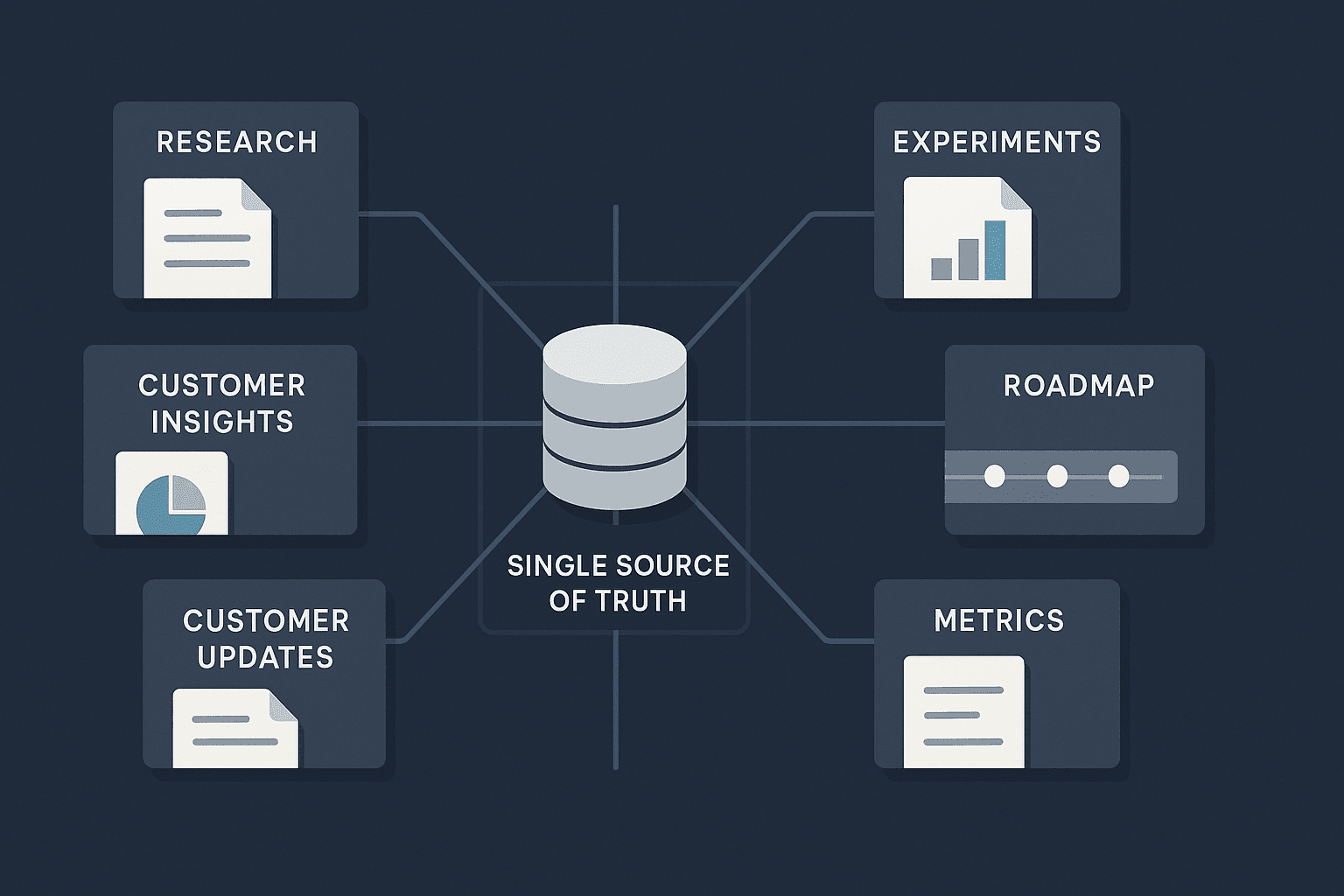
The problem: your company has data, but not truth
Most startups don’t suffer from a lack of information. They suffer from information fragmentation:
- User interviews live in someone’s notes.
- Decisions are in Slack, or in a meeting that wasn’t written down.
- The roadmap is a spreadsheet, a Jira board, and a Figma page, none agree.
- Investor updates are rebuilt from scratch each month.
- Metrics are in dashboards, but the “why” is in someone’s head.
This fragmentation creates a predictable failure mode:
- Teams move slower because they re-ask questions and re-litigate old decisions.
- Product planning degrades into opinions because evidence isn’t accessible.
- Diligence becomes painful because you can’t produce a coherent narrative with sources.
What you need is not “better documentation.” You need a Startup OS: a lightweight, connected system that turns your company’s learning into an operational advantage.
This article lays out a practical framework to build a single source of truth across research, roadmaps, and investor updates, without creating bureaucracy.
What “Startup OS” actually means (and what it does not)
A Startup OS is a set of conventions, artifacts, and links that ensure:
- Every meaningful decision has a recorded rationale.
- Every roadmap item traces back to evidence (research, data, customer request, strategy).
- Every experiment traces to a hypothesis and rolls up into metrics.
- Every investor update is assembled from the same canonical objects.
It is not:
- A single tool that magically solves alignment.
- A 100-page PRD process copied from big tech.
- A rigid knowledge management system that nobody uses.
It is:
- A graph of connected objects (decisions, opportunities, bets, experiments, metrics, narrative) stored in tools you can adopt incrementally.
- A set of rules of the road: naming, tagging, ownership, review cadence.
- A way to make your company’s “why” queryable.
If you like analogies: startups run on a mix of code, cash, and conviction. A Startup OS is how you make conviction legible.
Why a single source of truth matters (in technical terms)
From a systems perspective, most startups have:
- High write volume (new learnings daily)
- High read pressure (planning cycles, onboarding, sales enablement, fundraising)
- Low schema discipline (every doc is different)
The result is classic data inconsistency. In distributed systems, you’d fix this with a canonical store and clear contracts. In startups, you fix it with:
- Canonical objects (records)
- Controlled vocabulary (taxonomy)
- Traceability (links)
- Automated compilation (templates + rollups)
The payoff is compounding:
- Faster planning because decisions and evidence are easy to retrieve.
- Fewer redundant experiments.
- Cleaner strategy communication.
- Diligence-ready artifacts because narrative is assembled from source records.
This is not just vibes. Knowledge management research consistently finds that retrieval and reuse (not capture) is where most value is lost. See work by Thomas Davenport on knowledge work and the “attention economy” constraints in organizations (e.g., Working Knowledge, 1998; later KM research and practitioner syntheses continue to echo this).
The core model: 7 canonical objects (your company’s minimum viable schema)
If you try to centralize everything, you will fail. The trick is to standardize only what must be standardized.
A good Startup OS uses 7 canonical objects. Keep them small, linkable, and opinionated.
1) Customer/Market Insight
A structured record of something you learned (qualitative or quantitative).
Fields:
- Source (interview, sales call, support ticket, analytics)
- Who/segment
- Observation
- Evidence link (call recording, transcript, chart)
- Confidence (low/med/high)
- Tags (problem area, persona, industry)
Why it matters: raw research notes don’t scale; insights do.
References: Teresa Torres’ continuous discovery practices emphasize frequent touchpoints and structured insight synthesis (Continuous Discovery Habits, 2021).
2) Opportunity / Problem Statement
A normalized articulation of a problem worth solving.
Fields:
- Problem statement
- Persona/segment
- Current workaround
- Impact (time, cost, risk)
- Strategic fit
- Linked insights
This is where you avoid the “feature request trap” by translating requests into underlying needs.
3) Decision Record (ADR-style, but for product/business)
A short, durable decision log.
Fields:
- Decision
- Context
- Options considered
- Why this option
- Expected impact
- Revisit trigger/date
- Links (insights, metrics, roadmap)
In engineering, Architecture Decision Records (ADRs) are standard practice for preserving rationale. The same logic applies to product and go-to-market decisions.
References: Michael Nygard popularized ADRs in software architecture practice (widely adopted in engineering orgs; see the ADR pattern writeups).
4) Bet / Initiative
A medium-sized body of work framed as a bet with an explicit success definition.
Fields:
- Goal
- Target metric movement
- Scope boundaries
- Owner
- Time horizon
- Risks
- Linked decisions/opportunities
This is how you prevent roadmaps from becoming lists.
5) Experiment
A test designed to reduce uncertainty.
Fields:
- Hypothesis
- Method
- Primary metric
- Guardrails
- Result
- Decision outcome (scale/iterate/kill)
- Links to bet/initiative
References: Lean Startup methodology emphasizes validated learning and explicit hypotheses (Eric Ries, The Lean Startup, 2011). Even if you dislike the buzzword, the core idea is operationally sound.
6) Metric Definition (North Star + input metrics)
A metric isn’t real unless it is defined.
Fields:
- Metric name
- SQL/query or dashboard link
- Definition (exact)
- Owner
- Update cadence
- Known caveats
This prevents dashboard drift (“Active user” meaning 3 different things).
References: Goodhart’s Law (when a measure becomes a target, it ceases to be a good measure) is a useful caution here. Also see North Star metric frameworks popularized in growth/product practice.
7) Narrative Update (internal + investor)
A narrative is not a KPI dump. It’s a structured story linked to source objects.
Fields:
- What changed
- Why it changed
- What we learned
- What we’re doing next
- Asks (hiring, intros, capital)
- Links to bets, experiments, metrics
This is your “push-button diligence” foundation.
The spine: traceability (research → decision → roadmap → metric → update)
The Startup OS becomes powerful when everything is connected:
- Insights support Opportunities
- Opportunities inform Decisions
- Decisions justify Bets/Initiatives
- Bets contain Experiments
- Experiments aim at Metric Definitions
- Updates summarize changes and link to the above
This gives you a durable chain of reasoning.
The test of a real system
Pick any roadmap item and ask:
- Why are we doing this? → decision record
- What evidence supports it? → insights
- How will we know it worked? → metric definition
- What did we try already? → experiments
- How does it connect to strategy? → bet/initiative goal
If you can’t answer in under 60 seconds with links, you don’t have a Startup OS, you have documents.
Tooling: you don’t need a monolith, you need a contract
A common mistake is to pick a tool first (Notion/Airtable/Linear/Jira/Confluence) and assume it will create alignment.
Instead, define the information contract (the 7 objects + required fields + linking rules), then implement it in tools.
Common tool stacks (pick one and commit)
Option A: Notion-centric (fastest for many early-stage teams)
- Notion databases for objects + templates
- Linear/Jira for execution
- Looker/Metabase/Mode for metrics
- Slack for alerts (but not canonical truth)
Option B: Airtable-centric (better for structured ops)
- Airtable as canonical object store
- Notion for narrative pages
- Linear/Jira for tasks
- BI tool for metrics
Option C: Productboard/Amplitude/Jira ecosystem (product-heavy orgs)
- Productboard for opportunities/insights
- Jira for delivery
- Amplitude/Mixpanel for metrics
- Notion/Confluence for decisions + narrative
Opinionated take: the “best” stack is the one your team will actually keep current. Early on, prioritize low friction writes and fast retrieval over perfect structure.
How to implement Startup OS in 30 days (without a docs migration death spiral)
Do not try to migrate everything. Build forward, and backfill only what matters.
Week 1: Define schema + ownership
- Create the 7 canonical object templates.
- Decide the minimum required fields (keep it lean).
- Assign owners:
- Research/insights: PM, UX, or Founder
- Decisions: whoever calls the shot
- Metrics definitions: data/eng owner
- Narrative updates: CEO/founder or ops
Rule: Every object has one accountable owner. Collaborative editing is fine; accountability is not optional.
Week 2: Start capturing decisions and insights (from now on)
- Add a “Decision” link in your meeting agenda template.
- Create a simple intake: every customer-facing call produces either an Insight or nothing.
- Adopt a naming convention:
DEC-2026-02: Defer SSO to Enterprise planINS-2026-02-14: Mid-market admins struggle with provisioning
Week 3: Rebuild your roadmap as bets, not features
For the next 6–12 weeks, define 3–7 bets max.
Each bet must include:
- a metric target (even if fuzzy)
- key risks
- linked opportunity
- linked decision
Then link delivery tickets to bets (not the other way around).
References: Modern product thinking emphasizes outcome-based roadmaps (see Marty Cagan’s work on empowered product teams; also the broader shift to outcome-oriented planning in product management practice).
Week 4: Investor update becomes a template, not a project
Create an investor update template that pulls from the system:
- Metrics section links to metric definitions and dashboards
- Product section links to bets + experiments shipped
- Learnings section links to insights + decision records
- Asks section is explicit
Then send two versions:
- Internal weekly (short, tactical)
- Investor monthly (narrative + metrics)
Over time, diligence becomes “export access + curated links” rather than “assemble a story under pressure.”
What goes wrong (and how to avoid it)
Failure mode 1: The system becomes a graveyard
Why it happens: writing is hard; people don’t see immediate ROI.
Fix: attach the OS to existing rituals.
- Roadmap reviews must reference bets.
- Postmortems must link to decisions and experiments.
- Investor updates must be generated from OS objects.
If it isn’t used in rituals, it will die.
Failure mode 2: You over-structure too early
Why it happens: founders want certainty; ops wants neatness.
Fix: keep required fields minimal; allow optional depth.
A good heuristic: if a field isn’t used for retrieval or decision-making, it’s probably noise.
Failure mode 3: Metrics become performative
Why it happens: dashboards proliferate; definitions drift; Goodhart’s Law kicks in.
Fix: create metric definitions and guardrails.
- Define “active,” “retained,” “qualified” explicitly.
- Track input metrics that predict outcomes.
- Add “known caveats” to prevent misreads.
Failure mode 4: Research isn’t synthesized
Why it happens: teams collect interviews but don’t convert them into insights.
Fix: require a synthesis step.
A raw transcript is not a reusable asset. A tagged insight with evidence is.
References: Continuous discovery and qualitative synthesis techniques are widely covered in product research practice (e.g., Torres; also methods like affinity mapping from design research toolkits).
Push-button diligence: what investors actually want (and how the OS helps)
During diligence (seed-extension, Series A/B, strategic), investors typically probe:
- Market clarity: who, why now, wedge
- Product evidence: retention, engagement, differentiation
- Execution: roadmap realism, shipping cadence
- GTM: pipeline, cycle length, ICP clarity
- Risks: churn drivers, technical constraints, regulatory
A Startup OS helps because you can answer with linked artifacts:
- Narrative: investor update history shows trajectory and decision quality.
- Metrics: definitions prevent “metric theater.”
- Product: bets show outcome intent; experiments show learning velocity.
- Research: insights show customer pull and ICP specificity.
Instead of generating bespoke decks, you curate a path:
- Company narrative page (living)
- Last 6 investor updates
- Metric dictionary + dashboards
- Top 5 bets with linked outcomes
- Research repository filtered to ICP
That’s “push-button diligence”: not literally one click, but one system.
How this changes day-to-day execution
Product planning becomes evidence-first
Instead of:
- “We should build X because competitor has it”
You get:
- Opportunity: admins can’t provision at scale
- Insights: 9/12 mid-market calls cite provisioning pain
- Decision: build SCIM first, defer SSO
- Bet: reduce time-to-first-value by 30%
- Experiment: concierge provisioning vs self-serve
- Metric: activation rate (defined)
This is not slower. It is faster after the first few reps.
Onboarding becomes coherent
New hires can trace:
- What we believe
- Why we believe it
- What we tried
- What worked
You reduce tribal knowledge and founder dependency.
Cross-functional alignment improves
Sales can link feature requests to opportunities. Marketing can pull customer language from insights. Engineering can see decision rationale and avoid thrash.
A concrete information architecture (example)
Here’s a simple structure that works in Notion/Airtable:
- Database: Insights
- Tags: persona, industry, job-to-be-done
- Database: Opportunities
- Linked insights (relation)
- Database: Decisions
- Linked opportunities + linked bets
- Database: Bets/Initiatives
- Linked decisions + linked metrics
- Database: Experiments
- Linked bets + linked metrics
- Database: Metric Definitions
- Dashboard links, query links
- Database: Updates
- Linked bets + metrics + decisions
Add views:
- “Top opportunities by evidence count”
- “Bets by status (now/next/later)”
- “Experiments shipped this month”
- “Decisions to revisit”
This is enough to run most early-to-mid stage startups.
Multiple perspectives: when not to centralize everything
There are legitimate reasons to avoid over-centralization:
- Speed: early ideation might be faster in scrappy notes.
- Creativity: too much structure can reduce exploration.
- Security: some information (legal, HR) needs different access controls.
- Tool reality: engineering execution belongs in engineering tools.
The compromise is healthy:
- Centralize canonical records, not every working document.
- Let teams draft anywhere, but require that durable learnings end up as objects.
- Use links, not migrations.
A Startup OS is not about controlling where people think. It’s about preserving what the company learns.
Operational rules (the “constitution”)
To keep the system alive, adopt a few rules:
- If it changes priorities, it needs a Decision record.
- If it goes on the roadmap, it must link to an Opportunity.
- If it’s a Bet, it needs a success metric (and a definition).
- If you ran an Experiment, you must record the result.
- If you report a metric externally, it must have a definition page.
- Investor updates are assembled from OS objects, not from memory.
Enforce these lightly but consistently.
Advanced: making it “push-button” with automation
Once the basics work, you can automate:
- Slack workflow: “New insight” form → creates Insight record
- Calendar integration: meeting notes template → prompts for Decisions
- Linear/Jira sync: link tickets to Bets
- Update generator: monthly update template pulls:
- shipped experiments (last 30 days)
- bet status changes
- metric deltas
You don’t need full automation, just enough to reduce friction.
The real advantage: learning velocity becomes measurable
Most startups talk about moving fast. A Startup OS lets you measure why you’re fast:
- How many high-quality insights per month?
- Time from insight → decision → shipped experiment
- Experiment throughput
- Decision revisit rate (were you right?)
You’re not just tracking output. You’re tracking organizational learning.
This is one of the few durable moats available to early companies: not the current feature set, but the rate at which you turn reality into strategy.
A minimal template set (copy/paste concepts)
Decision record (product/business)
- Decision:
- Date / Owner:
- Context:
- Options considered:
- Decision drivers: (e.g., time, revenue, retention, risk)
- Chosen option + rationale:
- Expected impact:
- Links: insights, opportunities, bets, metrics
- Revisit trigger:
Experiment record
- Hypothesis:
- Method:
- Primary metric:
- Guardrails:
- Sample / segment:
- Result:
- Decision: scale / iterate / stop
- Links: bet, metric definition, evidence
Investor update (monthly)
- Headline: (what changed)
- Metrics: (with links + deltas)
- Progress on bets: (status + learnings)
- Key learnings/decisions: (links)
- Risks:
- Asks:
Conclusion: build the system that makes your story true
A Startup OS is not a vanity project. It is a pragmatic response to a predictable scaling problem: as headcount grows, the cost of scattered truth explodes.
If you implement just the essentials, canonical objects, traceability, and rituals, you get:
- Faster planning cycles
- Fewer repeated debates
- Better product bets
- Cleaner investor communication
- Diligence that looks like browsing, not archaeology
The goal is simple: one connected system for decisions, experiments, metrics, and narrative.
Do that, and you’ll find a compounding advantage that most teams never build: the ability to remember, reason, and move, together.
References & further reading
- Eric Ries, The Lean Startup (2011), hypothesis-driven experimentation and validated learning.
- Teresa Torres, Continuous Discovery Habits (2021), ongoing customer discovery and insight habits.
- Marty Cagan, Inspired / SVPG essays, empowered teams, outcome orientation (practitioner perspective).
- Michael Nygard and ADR practice writeups, decision records as an engineering knowledge pattern.
- Thomas H. Davenport & Laurence Prusak, Working Knowledge (1998), foundational concepts in knowledge management and organizational learning.
- Goodhart’s Law (Charles Goodhart, 1975), caution on metrics-as-targets.