
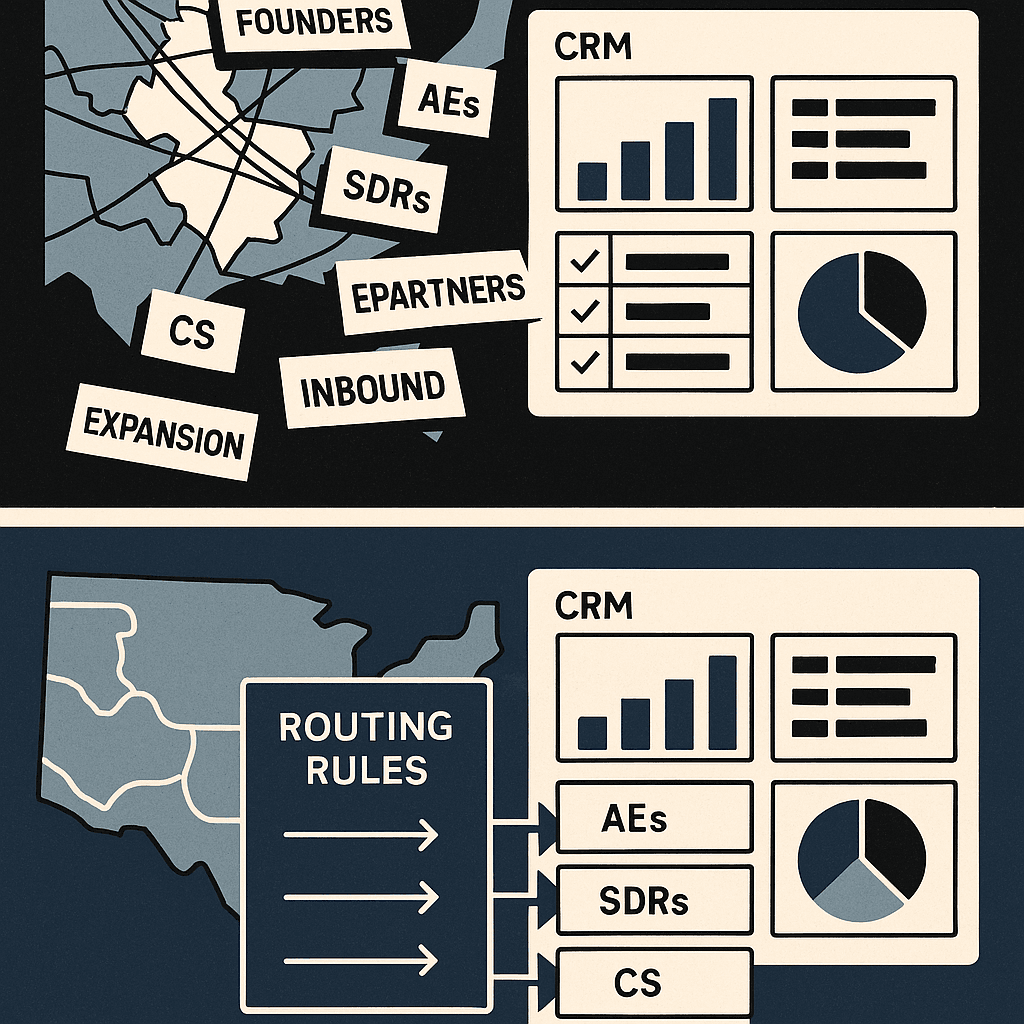
A founder gets a warm intro to a VP at a dream account. At the same time, an AE has been working a different division of the same company for three weeks. Two days earlier, a partner manager sent a reseller lead tied to a procurement contact at the parent entity. Meanwhile, a customer success manager is talking to an existing champion inside a recently acquired subsidiary about expansion.
Nobody thinks this is a crisis.
The founder sends a note and books a meeting. The AE sees activity in the CRM and assumes the founder is helping. The partner manager expects referral credit. CS thinks this is a normal expansion path. Marketing routes a demo request from someone else at the same company to an SDR because the form says "new prospect" and the domain doesn’t exactly match the existing account record.
Now the account has four quasi-owners, no single operating plan, and six different versions of reality.
This is how territory debt starts.
Not with a dramatic reorg. Not with obvious incompetence. It starts because the company is small, everyone is hustling, and ad hoc collaboration feels efficient. In the beginning, it often is. A founder should absolutely jump into strategic accounts. AEs should chase good signals. CS should surface expansion. Partners should create leverage. SDRs should route speed-to-lead inbound.
The problem is not overlap itself. The problem is unmanaged overlap.
If ownership, routing, and handoffs are allowed to emerge by accident, the company quietly trains the go-to-market team to compete inside the same accounts, create duplicate work, hide pipeline risk, and confuse customers. At 5 people in GTM, this feels annoying. At 20, it becomes political. At 50, it turns into revenue drag disguised as "complexity."
I’ve seen this show up in startups that looked healthy on the surface: strong demo volume, a few marquee logos, energetic reps, active founders, decent pipeline. But underneath, basic questions had no reliable answer:
- Who owns this account right now?
- Who is allowed to contact it?
- What happens if inbound comes in from an account with an open opportunity?
- Who owns expansion if the original seller is gone?
- Does a partner-sourced lead outrank a founder relationship?
- What if a strategic account is in one AE’s named list but another AE created the opportunity first?
- When does an account move from sales-led to CS-led to renewal-led?
- Who gets forecast credit when multiple teams are involved?
When those answers live in Slack history, tribal memory, or the CRO’s head, you don’t have a territory model. You have territory debt.
And like most startup debt, it compounds quietly until it suddenly becomes expensive.
What territory debt actually is
Territory debt is the accumulation of ambiguity around who owns accounts, opportunities, relationships, routing, and handoffs across the revenue org.
It usually appears in five layers:
- Account ambiguity: No durable rule for who owns a company or group of related entities.
- Lead ambiguity: New inbound, outbound responses, event leads, partner referrals, and founder intros route differently depending on who sees them first.
- Opportunity ambiguity: Multiple opportunities can be opened against the same account without a clear hierarchy or operating plan.
- Lifecycle ambiguity: Nobody knows exactly when responsibility shifts from SDR to AE, AE to implementation, implementation to CS, CS to expansion, or expansion back to sales.
- Credit ambiguity: Compensation, attribution, and forecasting are based on inconsistent ownership logic.
Early-stage teams often assume these are “later-stage process problems.” They’re not. They’re early-stage design problems with later-stage consequences.
The reason they feel small at first is that founders can personally resolve edge cases. When there are 20 meaningful accounts in play, the founder can adjudicate conflict in real time. When there are 200, every exception becomes a tax on management attention. By then, behavior has already hardened.
People protect "their" accounts. Response times slow because everyone waits for permission. Forecasts inflate because overlapping teams each assume their version of progress is real. Customers get multiple outreach threads from the same company and start asking, politely, whether your team talks internally.
That’s not a tooling issue. It’s an operating model issue.
The pattern: accidental account ownership emerges from hustle
There’s a predictable sequence here.
Phase 1: Everyone does everything
The founder is selling. Early reps are opportunistic. CS is part support, part onboarding, part expansion. Partnerships means whatever introductions are available. CRM hygiene is loose, but volume is manageable.
This is normal.
Phase 2: Signals increase faster than structure
Inbound grows. Outbound gets more targeted. Customers ask for additional teams, regions, or subsidiaries. Partners start sourcing opportunities. Marketing creates campaigns that hit existing accounts. Hiring creates role specialization before process catches up.
This is where problems begin.
Phase 3: Local workarounds become company policy
AEs make informal claims on accounts because they prospected them first. Founders reserve the right to jump in anywhere strategic. SDRs assign based on round-robin unless told otherwise. CS handles expansions because they have the relationship. Partner leads are treated as sacred by partner managers. RevOps starts creating custom fields to reflect exceptions.
Every workaround sounds reasonable in isolation.
Together, they create contradiction.
Phase 4: Conflict gets interpreted as a people problem
Now you hear things like:
- "That AE is territorial."
- "CS is sandbagging expansion."
- "Founders keep breaking process."
- "SDRs don’t know how to route."
- "Partners are causing channel conflict."
- "Marketing keeps sending junk to the wrong owner."
Sometimes these are true. Usually they are downstream symptoms of undefined ownership rules.
Bad systems manufacture bad behavior.
Phase 5: Revenue quality degrades before revenue volume does
This is the dangerous part. Startups can still grow while territory debt is piling up.
You may still close business. In fact, brute-force overlap can temporarily increase top-line activity. More people touching more accounts can create the illusion of hustle and coverage.
But the cracks show up in quality metrics first:
- Slower speed-to-lead because reps hesitate on ownership
- More stale opps because nobody is clearly accountable
- Duplicate outreach and customer confusion
- Expansion underperformance because accounts are politically contested
- Forecast uncertainty because opportunity status depends on whose version you trust
- Lower rep morale because effort and rewards feel arbitrary
- Longer sales cycles caused by internal coordination failures
Eventually, volume suffers too.
Why the standard advice fails
The most common advice is also the least useful.
"Just define territories"
Founders hear this and imagine a clean enterprise sales map: geography, company size, named accounts, maybe industry. That sounds reasonable until it collides with startup reality.
Your buyers may not map cleanly to geography. Parent-child account structures may be messy. Your product may land in one team and expand through another. Founders may still be required to open strategic doors. Channel may overlap with direct. CS may be best positioned to identify growth.
So the team delays the work because a perfect territory design seems impossible.
But your problem is not lack of a sophisticated territory architecture. It’s lack of minimum viable ownership rules.
"Use the CRM as the source of truth"
The CRM is only a source of truth if the underlying logic is explicit, enforced, and trusted.
If account records are duplicated, domains are inconsistent, parent-child relationships aren’t maintained, and account owner fields are frequently overridden by Slack decisions, the CRM is not the truth. It is a partial diary of disputes.
"Let the best rep win"
This is poison once you have a team.
Rewarding whoever got there first, shouted loudest, or has the strongest executive relationship creates a shadow incentive system. People stop collaborating and start staking claims. Strategic accounts become political assets, not company resources.
It can work for a quarter. It breaks trust for a year.
"Handle exceptions manually"
Every startup says exceptions are rare. They aren’t.
Founder relationships, partner influence, inbound from existing accounts, subsidiaries, expansion opportunities, renewals, strategic named accounts, regional nuances, and account reassignments are not fringe events. They are the real operating environment.
If your model only works when there are no exceptions, you don’t have a model.
"We’ll fix it when we hire RevOps"
RevOps can improve enforcement and visibility. It cannot invent management discipline on its own.
If leadership hasn’t decided how account ownership should work, RevOps becomes the janitor of unresolved incentives.
That’s not fair to RevOps, and it doesn’t solve the issue.
A better approach: design a minimum viable territory system
You do not need a big-company territory regime.
You need a lightweight system that answers five questions clearly:
- Who owns the account?
- Who can create or advance an opportunity?
- How are new signals routed?
- What are the exception paths?
- When does ownership or operating responsibility change?
That’s it.
If you can answer those five questions consistently, most GTM conflict drops fast.
The best early-stage territory systems share a few traits:
- Simple enough to explain in one page
- Durable enough to survive routine edge cases
- Explicit about exceptions
- Enforceable in your stack
- Tied to compensation and forecast logic
- Reviewable quarterly, not renegotiated daily
Think of this as product design for GTM coordination.
Start with the account, not the lead
One of the biggest mistakes startups make is building routing logic around leads rather than accounts.
Leads are events. Accounts are the durable unit of coordination.
A demo request, founder intro, partner referral, webinar signup, outbound reply, support ticket, and upsell conversation can all point to the same company. If each event gets independently assigned without checking account ownership and relationship context, overlap becomes inevitable.
So your first design principle should be:
Every route starts with account resolution.
That means before assigning a person, your system should ask:
- Does this company already exist as an account?
- Is it part of a parent account or subsidiary structure?
- Is there an existing customer relationship?
- Is there an open opportunity?
- Is there a current account owner?
- Is there an assigned customer success owner?
- Is there an active partner tied to the account?
- Is this in a named strategic list?
If your team cannot reliably resolve this in the CRM, fix that before tweaking lead routing.
Practical account resolution rules
At minimum, define these:
- Primary account matching key: Usually email domain plus manual review for major accounts.
- Parent-child logic: Decide whether ownership sits at the parent company, business unit, or legal entity level.
- Duplicate prevention process: Who merges records and how fast.
- Existing customer precedence: If any business unit is already a customer, does inbound route to CS, AM, or the original AE?
- Open opportunity precedence: If an opportunity is active, all new signals attach there unless explicitly exempted.
This sounds boring. It is also where half the hidden GTM friction lives.
Design account ownership logic before lead routing logic
Most early teams should define account ownership with a simple precedence model.
Here is a good starting framework.
Layer 1: Strategic named accounts
These are accounts leadership explicitly assigns because they matter disproportionately.
Examples:
- Top 25 dream accounts
- Existing lighthouse logos with expansion potential
- Accounts with active founder or board relationships
- Channel-sensitive accounts requiring deliberate coordination
Rule: one primary owner, one executive sponsor, one documented coverage plan.
This does not mean only one person can touch the account. It means one person is accountable for orchestration.
Layer 2: Customer accounts
Once an account becomes a customer, define who owns the commercial relationship.
Common models:
- CS-led commercial owner for low ACV / product-led / high-velocity expansion
- AM-led commercial owner for account management-heavy motions
- AE retains expansion rights for a fixed period after close in early-stage teams
Any of these can work. What fails is ambiguity.
If you don’t decide, CS will feel responsible for growth but lack authority, AEs will chase opportunistically, and customers will get split signals.
Layer 3: Prospect accounts
For non-customers, pick a primary assignment basis:
- Geography
- Segment by company size
- Industry/vertical
- Named accounts
- Product line
- Hybrid model
For most early-stage startups, simpler is better. Segment + geography or named accounts + pooled remainder is usually enough.
Layer 4: Pooled inbound or unowned accounts
Define what happens when an account doesn’t clearly fit an active owner.
For example:
- Inbound under 500 employees goes to round-robin AE pool
- SMB inbound goes to AE/SDR pool by time zone
- Unworked accounts after 60 days return to pool
- Inbound from target accounts routes to the named owner immediately
Again, the point is not sophistication. The point is predictability.
Build a routing matrix for real-world exceptions
This is the piece most teams skip, and it’s the reason their standard rules fail.
You need a routing matrix that handles the common exceptions before they become internal arguments.
A simple matrix should cover at least these scenarios:
| Scenario | Default owner | Supporting roles | SLA | Notes |
|---|---|---|---|---|
| New inbound from net-new account | Territory AE | SDR | 5 min-4 hrs | Based on segment/time zone |
| Inbound from account with open opp | Existing opp owner | SDR/marketing notify only | Immediate | No new opp without manager approval |
| Inbound from existing customer | CS/AM commercial owner | AE if expansion threshold met | 1 business day | Customer communication coordinated |
| Founder intro to named account | Named account owner | Founder sponsor | Same day | Founder does not supersede owner |
| Partner referral to named account | Named owner | Partner manager | Same day | Referral credit separate from ownership |
| Expansion in customer account | CS/AM or AE per model | Product specialist if needed | 1 business day | Clear threshold for handoff |
| Subsidiary of active target account | Parent owner or designated BU owner | RevOps review if unclear | Same day | Parent-child rules apply |
| Re-engaged closed-lost account | Prior owner for X days, then pool | SDR support | 1 business day | Define aging window |
This kind of matrix is unglamorous. It also eliminates endless Slack debates.
Separate ownership from participation
A major source of conflict is that startups confuse "working on an account" with "owning an account."
Those are not the same.
You can and should allow multiple participants in an account:
- Founder for executive access
- AE for commercial process
- SDR for outbound support
- SE for technical evaluation
- CSM for relationship continuity
- Partner manager for channel coordination
But there still needs to be one accountable owner at the account level and one accountable owner at the opportunity level.
A clean model looks like this:
- Account owner: Orchestrates all activity for that company
- Opportunity owner: Runs a specific deal cycle
- CS owner: Owns post-sale relationship and adoption
- Executive sponsor: Supports access and deal strategy
- Partner manager: Coordinates partner motion and credit
This distinction matters because it prevents the common startup failure mode where founder involvement accidentally voids rep accountability.
Founders should increase win rates, not scramble accountability.
Define handoff triggers, not vague lifecycle stages
Saying "sales owns pre-sale and CS owns post-sale" is too fuzzy.
You need explicit triggers.
SDR to AE
Trigger options:
- Meeting booked and accepted by target persona
- Qualification threshold met in CRM
- Demo completed
- Opportunity created
Pick one. Document it. Tie it to activity expectations.
AE to implementation/onboarding
Trigger options:
- Contract fully executed
- Payment received
- Internal close checklist complete
- Success plan documented and approved
Again, pick the real trigger. Not the aspirational one.
Onboarding to CS
Trigger options:
- Go-live completed
- First value milestone reached
- 30-day activation threshold met
- Implementation project officially signed off
CS to expansion sales
This one causes a lot of pain.
Define thresholds such as:
- Expansion under $X or within existing product line remains CS/AM-led
- Expansion above $X, multi-year, or involving new product family moves to AE/AM-led
- Procurement-led upsell involving security/legal reroute to sales owner
Without this, your best customer relationships become internal turf wars.
Reassignment triggers
Also define when account ownership changes:
- Rep departure
- Territory redesign
- No activity for X days
- Change in customer segment or geography
- Strategic reclassification
If reassignment only happens when someone complains loudly enough, your territory model is not real.
Enforce it in the stack or it won’t stick
If your territory logic lives only in a Notion doc, it will fail under pressure.
You need stack-level enforcement.
That doesn’t require an enterprise RevOps build. It does require a few basics.
Minimum stack requirements
At minimum, enforce these in your CRM and routing tools:
- Required account owner field
- Clear opportunity owner field
- Customer lifecycle status field
- Parent-child account relationship field
- Open opp conflict alert
- Lead-to-account matching before assignment
- Routing rules based on account status and ownership
- Reassignment workflow with manager approval
- SLA reporting for follow-up speed
Practical stack examples
If you run Salesforce, you have more flexibility but more room to create complexity. Use assignment rules, account hierarchies, validation rules, duplicate management, and simple flows before adding custom sprawl.
If you run HubSpot, keep the model lighter. HubSpot can handle ownership, lifecycle stages, workflows, and routing well enough for many early teams, but parent-child nuance and complex exception logic may need process discipline or lightweight ops workarounds.
If you use routing tools like LeanData, Chili Piper, or Default, they can dramatically improve lead-to-account matching and routing enforcement. But they are amplifiers, not substitutes.
Here’s the practical comparison:
Tool comparison: CRM and routing setup
| Option | Best for | Strengths | Weaknesses | Typical cost/time |
|---|---|---|---|---|
| HubSpot only | Seed to early Series A | Fast setup, intuitive workflows, low admin overhead | Weaker complex account hierarchies, can get messy with exceptions | Low to medium cost; 1-3 weeks setup |
| Salesforce only | Series A+ with complex motions | Powerful data model, flexible ownership logic | Easy to overbuild, higher admin burden | Medium to high cost; 2-6+ weeks setup |
| HubSpot + routing layer | Teams needing speed-to-lead and L2A matching | Better assignment control without full SFDC complexity | Two-system coordination, costs add up | Medium cost; 2-4 weeks |
| Salesforce + LeanData | Multi-motion GTM, complex routing | Strong enterprise-grade matching and routing | Expensive, requires ops maturity | High cost; 3-8+ weeks |
| CRM + manual exception review | Very early teams | Cheapest, flexible | Breaks quickly, manager-dependent, low trust | Low software cost; high hidden labor |
The hidden cost is important. Teams often avoid tooling cost while absorbing much larger coordination cost in meetings, disputes, missed SLAs, and bad forecasts.
A practical workflow that actually works
Here’s a lightweight workflow for a startup with founders, 3 AEs, 2 SDRs, 2 CSMs, one partner manager, and no full-time RevOps.
Step 1: Resolve the account
Every new lead, referral, or inbound request gets matched to an account first.
If account exists:
- Check account owner
- Check lifecycle stage
- Check open opportunities
- Check customer status
- Check named account flag
If no account exists:
- Create account using standardized naming
- Assign based on territory rules
Step 2: Apply precedence rules
Example precedence:
- Named strategic account owner
- Existing customer commercial owner
- Open opportunity owner
- Parent account owner
- Territory owner by segment/geography
- Pooled round-robin fallback
This hierarchy alone clears up most disputes.
Step 3: Route the signal, not the whole relationship
If inbound comes from an account with an existing owner, route the signal to that owner rather than creating a new ownership event.
This is a subtle but critical distinction.
A webinar signup from an existing customer should not generate a new rep claim. A founder intro into a named account should not overwrite the AE. A partner referral into an open deal should not create a parallel opportunity.
Signals inform the account plan. They do not automatically redefine control.
Step 4: Trigger collaboration rules
If a founder, partner, or CS team member is involved, the system should prompt coordination steps:
- Notify account owner automatically
- Log influencer/source field
- Schedule joint account review if opportunity size exceeds threshold
- Preserve source credit separately from owner field
This is how you let multiple people contribute without breaking accountability.
Step 5: Enforce handoffs with checklist gates
Before lifecycle changes, require basic fields or tasks:
- Opportunity creation requires confirmed account owner and next step
- Closed-won requires implementation notes, buyer contacts, and use case summary
- Expansion opportunity requires customer owner acknowledgement
- Reassignment requires manager approval and reason code
These are simple controls, but they prevent chaos from becoming official data.
Compensation and forecast design matter more than people admit
A lot of territory debt persists because compensation quietly rewards overlap.
If partner managers need influence credit, founders want strategic visibility, AEs need quota credit, CSMs are measured on expansion, and SDRs are paid on meetings created, everyone has a reason to create ownership claims.
The solution is not to remove all shared incentives. It’s to separate:
- Ownership
- Contribution
- Credit
These can coexist if they are designed deliberately.
Example compensation logic
- AE gets primary quota credit for owned opportunity
- Partner manager gets sourced influence credit, not account ownership
- SDR gets meeting or pipeline creation credit based on accepted rules
- CSM gets expansion participation credit or retention/NRR metric credit
- Founder gets no formal ownership, only strategic sponsor role
Once you mix ownership and credit into one field, politics becomes inevitable.
Forecasting works the same way.
Your forecast should roll up by opportunity owner and manager-defined accountability, not by everyone who touched the account. Supporting participants can be tracked, but forecast responsibility needs one throat to choke.
That phrase sounds harsh. It’s also operationally necessary.
Cost of ignoring territory debt
Founders often underestimate the cost because it doesn’t show up as a line item.
Here’s a rough example for a startup doing $3M ARR with a 7-person GTM team.
Hidden weekly cost example
- 4 hours/week across team in routing disputes and clarification Slack threads
- 3 hours/week manager time resolving ownership issues
- 5 duplicated follow-up incidents/week causing customer confusion or wasted effort
- 10 inbound or expansion leads/month delayed by >24 hours due to ownership uncertainty
- 2 forecast commits/month materially inaccurate due to contested account reality
Conservatively:
- 7 GTM team members x 4 hours = 28 hours/week
- 2 managers x 3 hours = 6 hours/week
- Total: 34 hours/week lost
At blended fully loaded labor of $90/hour, that’s over $3,000/week, or roughly $150,000/year in coordination waste alone.
That excludes missed pipeline, slower sales cycles, lower conversion, or churn caused by customer confusion.
Now add one lost expansion worth $20K-$50K ARR because no one clearly owned it, and the economics of fixing this become obvious.
What lightweight implementation looks like in 30 days
You can fix most of this in a month without a reorg.
Week 1: Decide the rules
Leadership defines:
- Primary account ownership model
- Precedence hierarchy
- Named account list
- Customer expansion ownership model
- Top 10 routing exceptions
- Handoff triggers
- Reassignment rules
Deliverable: a 1-2 page territory operating spec.
Week 2: Clean core data
- Merge top account duplicates
- Standardize naming conventions
- Define parent-child records for top 50-100 accounts
- Fill missing owner fields
- Close or clean stale open opportunities
- Mark customer lifecycle stages accurately
Deliverable: CRM baseline clean enough for enforcement.
Week 3: Configure workflows
- Build routing logic around account resolution
- Add alerts for open opp conflicts
- Require key fields for handoffs and reassignment
- Set notification rules for founder/partner/customer exceptions
- Stand up SLA reporting for follow-up and handoff speed
Deliverable: workflows aligned to rules.
Week 4: Train and enforce
- Walk team through real examples
- Publish routing matrix
- Review disputed accounts live
- Freeze exception approvals to managers only
- Audit first two weeks of routing decisions
Deliverable: operational adoption, not just documentation.
Common tradeoffs and how to handle them
There is no perfect territory design. There are only explicit tradeoffs.
Tradeoff 1: Speed vs fairness
Round-robin can feel fair and fast. Named ownership can feel slower but more coherent.
For high-value accounts, coherence usually matters more than equal distribution. For lower-value inbound, speed often matters more than elegant account strategy.
Use different rules for different segments.
Tradeoff 2: Founder flexibility vs rep accountability
Founders need freedom to help close strategic accounts. Reps need confidence that this doesn’t randomly strip their ownership.
Solution: founders can sponsor any account, but cannot unilaterally change account ownership outside the documented exception process.
Tradeoff 3: CS intimacy vs sales discipline
CS often has the best relationship for expansion. Sales often has stronger commercial rigor.
Solution: use deal thresholds and product complexity triggers instead of debating role superiority in the abstract.
Tradeoff 4: Channel leverage vs direct clarity
Partner-sourced opportunities create leverage but also conflict.
Solution: separate referral credit and partner participation from direct ownership unless your route-to-market is explicitly channel-first.
Tradeoff 5: Simple rules vs edge-case accuracy
If you try to perfectly model every edge case, the system becomes unusable. If you oversimplify too much, people work around it.
Aim for rules that handle 80-90% of cases cleanly, with manager-reviewed exceptions for the rest.
That is enough.
Warning signs you already have territory debt
If any of these are happening, you are already paying interest:
- Reps ask in Slack who owns an account more than once a day
- Founders routinely route intros manually because they don’t trust the system
- CS discovers expansion opportunities but doesn’t know whether to open an opp
- Partner referrals generate internal tension
- Multiple people from your company contact the same prospect without coordination
- The same account appears under multiple owners in different reports
- Forecast calls spend time debating ownership instead of deal reality
- Reassigned accounts have no clear handoff notes
- SDRs hesitate to route inbound tied to existing accounts
- Strategic account plans exist outside the CRM entirely
These are not minor annoyances. They are evidence that your GTM system is scaling through improvisation.
The operating principle to remember
Territories are not just about slicing markets. They are about reducing internal conflict so the customer experiences one company.
That’s the real goal.
A startup with ambiguous ownership doesn’t just create rep frustration. It creates a broken external experience:
- slower response
- repeated questions
- contradictory messaging
- dropped context across handoffs
- awkward executive outreach
- expansion friction
Customers experience your internal ambiguity as lack of professionalism.
And because startups win on focus, speed, and trust, this kind of sloppiness is more expensive for you than it is for a larger incumbent.
Final takeaways
Territory debt accumulates when account ownership, lead routing, partner influence, founder relationships, and customer expansion are allowed to emerge through hustle instead of design.
The fix is not a giant enterprise territory project. It’s a minimum viable operating system:
- Start with account resolution, not lead assignment
- Define explicit account ownership precedence
- Build a routing matrix for common exceptions
- Separate ownership from participation and from credit
- Use handoff triggers, not vague lifecycle language
- Enforce core logic in the CRM and routing stack
- Review exceptions centrally instead of renegotiating them ad hoc
If you do this early, you prevent a huge amount of future friction.
If you wait, the issue won’t just get operationally harder. It will become cultural. People will build identity, compensation expectations, and political memory around accidental ownership patterns.
That is much harder to unwind than a routing workflow.
The founder-level move is simple: decide the rules while the stakes are still small.
Because once your GTM team is spending real energy fighting over who owns the account, the market is no longer your hardest problem. You are.