
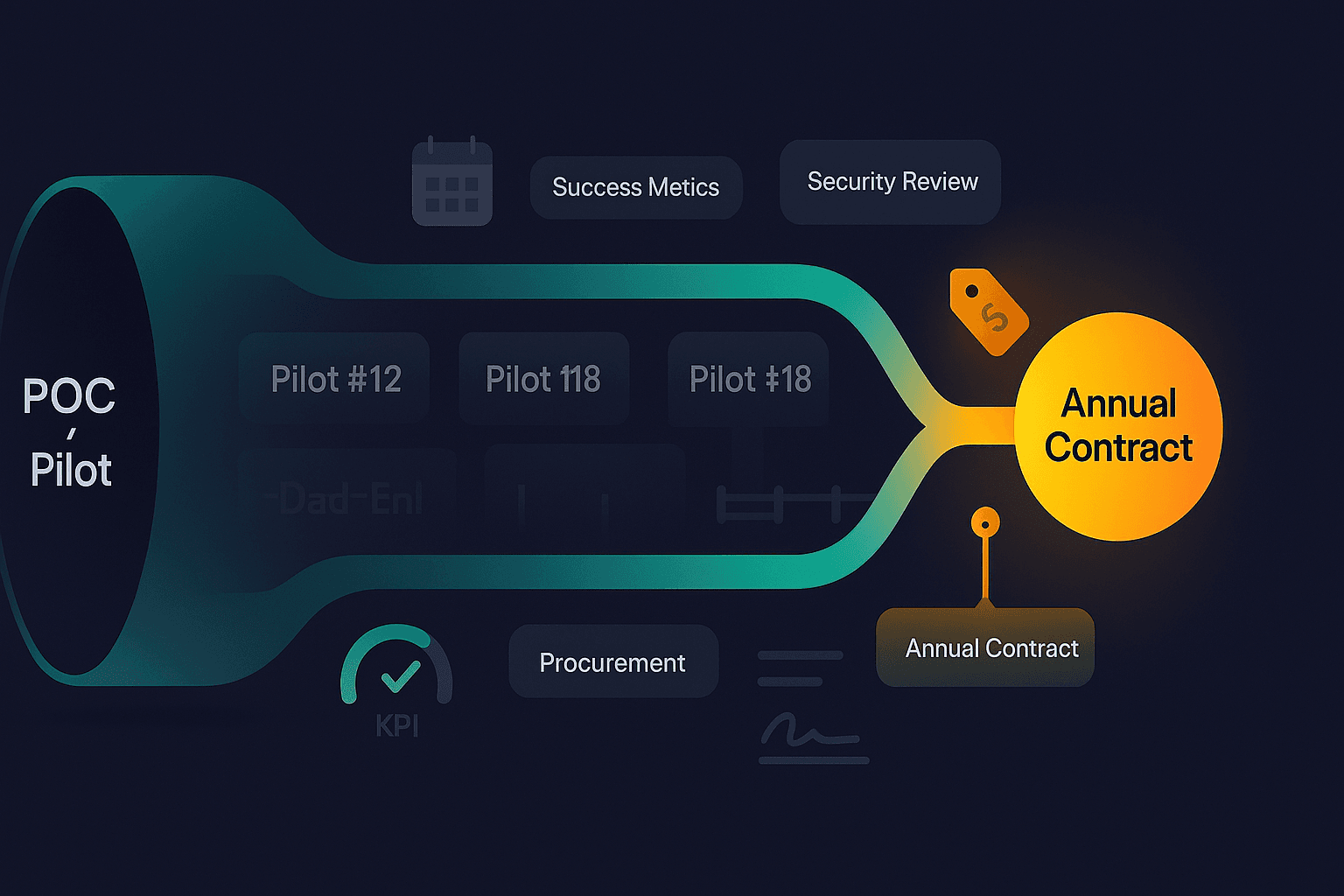
The POC paradox: why “yes” doesn’t become revenue
In B2B startups, pilots and POCs (proofs of concept) are often sold as the responsible way to reduce risk: validate integration, confirm ROI, earn stakeholder trust, then roll out.
In practice, pilots frequently become a structural failure mode, what many teams quietly experience as a “graveyard”:
- The pilot technically works, but nothing happens.
- Internal champions go quiet after the demo.
- Procurement appears late and resets the conversation.
- Security reviews arrive after you’ve already built custom work.
- You deliver value, but the buyer can’t quantify it.
- The pilot gets renewed for “one more month” (for free or cheap).
This is the Pilot Trap: a pilot that feels like progress but is actually a deferral mechanism.
The good news: pilots can convert consistently. But only if you treat them as a productized commercial motion with explicit gates, not as a vaguely-scoped engineering favor.
This article is a practical playbook for diagnosing why pilots stall, rewriting scope and success metrics, pricing rollout, and building a conversion path from POC to contract, without setting your roadmap on fire.
What a pilot is really for (and what it isn’t)
A pilot should do exactly one thing:
Reduce a specific buyer risk enough that they can sign a contract for a defined rollout.
Most failed pilots try to do everything:
- Prove the product works
- Prove the company is credible
- Prove ROI
- Build missing features
- Replace onboarding
- Substitute for security due diligence
- Satisfy every stakeholder
That’s how pilots turn into unbounded delivery projects.
The three legitimate buyer risks
Most pilots exist to reduce one (or more) of these risks:
- Technical risk: “Will this integrate with our stack and meet performance/security needs?”
- Adoption/operational risk: “Will our team actually use it, and can we run it without pain?”
- Economic risk: “Will this measurably save money or grow revenue enough to justify budget?”
If you can’t name which risk the pilot is reducing, you’re likely running a pilot because the buyer asked for one, not because it is necessary.
A pilot is not:
- A discounted subscription with vague terms
- A “free trial” for enterprise procurement
- A custom build to win a logo
- A substitute for a rollout plan
- A way to keep a deal alive with no next step
The rule of thumb: if a pilot doesn’t have an explicit conversion gate, it’s not a pilot, it’s unpriced consulting.
Why pilots stall: the 9 most common root causes
Most stalled pilots are predictable. Here are the failure patterns you can actively diagnose.
1) You’re proving the wrong thing
Teams often measure pilot success by activity (integrated, launched, ran tests) rather than decision readiness (budget approved, stakeholders aligned, contract path clear).
If the buyer needed security and procurement alignment, but you measured “events ingested,” you may “win” the pilot and still lose the deal.
2) No economic buyer is committed
A pilot champion can be enthusiastic and still powerless.
A reliable conversion requires at least one of these:
- A budget owner who agrees to a purchase path
- A senior sponsor who can unblock procurement and resourcing
Without it, you can deliver value indefinitely and still get stuck in “interesting experiment” territory.
(For frameworks on identifying economic buyers and deal qualification, see common enterprise sales guidance such as MEDDICC/MEDDIC; while not a single canonical source exists, the framework is widely used in B2B sales practice.)
3) Success criteria are vague or non-quantitative
“Improve efficiency” and “help visibility” aren’t success criteria, they’re intentions.
If your success criteria can’t be measured or audited, procurement and finance can’t justify rollout.
4) The pilot lives outside production reality
Many startups run pilots in a sandbox environment with hand-held workflows. The buyer nods, the demo shines, then production requirements appear:
- data retention policies
- SSO/SAML
- SOC 2 expectations
- audit logs
- region/data residency
- availability/SLA
This is why the pilot “worked” but rollout becomes a new project.
References worth knowing:
- NIST guidance on security controls and risk management is a common baseline in regulated enterprises (e.g., NIST SP 800-series).
- SOC 2 is an AICPA framework widely requested for vendor assurance.
5) Stakeholders were not mapped, so consensus fails late
If the pilot only involved an end-user team, you may have ignored:
- security
- compliance
- IT/architecture
- finance
- legal
- procurement
- operations
Enterprise buying is often consensus-driven. Late stakeholders can veto or slow-roll.
6) The pilot scope quietly becomes “feature discovery”
A buyer requests “just one more tweak” and you comply because you want conversion.
Then the pilot becomes a backlog grooming exercise:
- “Can it support our edge case?”
- “Can you integrate with this system?”
- “We need custom dashboards.”
You’re no longer proving fit, you’re building fit.
7) Pricing is deferred, so rollout triggers sticker shock
If you avoid pricing until “after we prove value,” you invite a painful reset:
- Pilot is judged against a mental model of “cheap experiment.”
- Rollout looks like a new purchase decision.
- Budget cycles and procurement start from scratch.
8) The buyer uses pilots as a negotiation tool
Some organizations have a pattern:
- run parallel pilots with 2–4 vendors
- extract learnings and free work
- use that to negotiate price down
This is not always malicious; it can be institutional procurement behavior.
9) Your team can’t support conversions operationally
Startups sometimes could convert, but can’t deliver:
- no customer success capacity
- no implementation playbook
- no SLA story
- no security collateral
So the buyer senses delivery risk and drags the decision.
A simple diagnostic: “Decision Readiness” vs “Product Readiness”
Most teams track the wrong readiness.
Product readiness questions
- Does it work?
- Can we ingest data?
- Did the model perform?
- Did the integration succeed?
Decision readiness questions
- Who signs, and have they agreed to a purchase timeline?
- What budget line pays for this?
- What is the procurement process and typical cycle time?
- What security/compliance gates exist, and who owns them?
- What is the rollout scope (users/sites/workloads) and timeline?
- What is the documented ROI case?
If you can’t answer the decision readiness questions by week 1–2 of a pilot, you are likely headed into the graveyard.
The conversion-first pilot: redesigning scope, metrics, and gates
Here’s the core shift:
Design pilots backward from the rollout contract, not forward from the demo.
Step 1: Write the “rollout press release” first
Before you agree to a pilot, write a one-page internal spec as if the rollout already happened:
- Customer segment and use case
- Production environment assumptions
- Rollout scope (teams, sites, volume)
- What success looks like in 90 days
- Dependencies (SSO, security review, data access)
- Commercials (pricing model, expected ACV)
If you can’t write this credibly, you don’t yet know what you’re trying to sell.
Step 2: Pilot scope should be a thin slice of the rollout
A good pilot is not a toy. It is a minimum viable rollout slice:
- same environment class (or close): prod-like constraints
- same stakeholders: security/IT included early
- same operational workflow: real users, real data, real consequences
Thin slice examples:
- Rollout target is 5,000 seats → pilot with 100 seats across 2 departments.
- Rollout target is 50 warehouses → pilot in 2 warehouses with the same SOP.
- Rollout target is full data pipeline → pilot with one critical dataset end-to-end with retention and access controls.
Step 3: Define success metrics that force a decision
Success metrics must be:
- measurable (quantitative or binary)
- attributable (you can link change to product)
- time-bound (measured over a window)
- decision-linked (maps to purchase justification)
Avoid vanity metrics like “users liked it.”
A strong metric template
- Baseline: current time/cost/error rate
- Target: the improvement threshold
- Method: how measured, by whom
- Window: over what period
- Decision: what happens if hit (contract terms)
Example:
- Baseline: 14 hours/week of analyst time spent on manual reconciliation
- Target: reduce to ≤ 6 hours/week within 30 days
- Method: time tracking + workflow logs validated by ops lead
- Decision: if achieved, sign 12-month contract for X sites at $Y ACV
Step 4: Add explicit gates and owners
A pilot plan should include gates that are not product work:
- Security review kickoff by week 1
- Procurement process mapped by week 1
- Legal redlines started by week 3
- Budget owner signoff checkpoint by week 4
If your pilot plan doesn’t mention procurement until the end, you’re not running a pilot, you’re running a science project.
The pilot contract: commercial structure that prevents “forever pilots”
A pilot needs a contract. Not because you’re legalistic, because ambiguity kills conversion.
Principle: the pilot is a paid evaluation with a pre-negotiated path to rollout
The most effective structure is:
- Pilot fee (paid)
- Rollout price and terms pre-agreed (subject to success criteria)
- Pilot fee credited toward rollout (optional, but powerful)
This removes the two biggest traps:
- endless extension (“we’re still evaluating”)
- price reset (“now tell us pricing”) after you already delivered
Pilot pricing: what to charge and why
There are three common approaches:
-
Fixed pilot fee (recommended)
- Pros: sets seriousness, funds delivery, easy to approve
- Cons: some buyers resist paying for pilots
-
Short-term subscription
- Pros: looks like standard SaaS purchase
- Cons: encourages “month-to-month” drift, harder to tie to conversion
-
Free pilot (rarely worth it)
- Pros: removes friction
- Cons: attracts non-buyers, commoditizes you, increases churn of attention
A practical heuristic:
- If the pilot requires engineering time, integration, or ongoing support, it should be paid.
- If the buyer won’t pay anything, that’s a qualification signal, unless you are deliberately pursuing a strategic lighthouse and have explicit executive sponsorship.
The “conversion clause” that changes behavior
Include language like:
- Pilot duration: 30–60 days
- Success criteria: explicit list
- Customer responsibilities: data access, stakeholder time, environment readiness
- Decision date: a date when both parties meet to decide
- Rollout terms: pre-negotiated order form attached (or pricing schedule)
- Extension terms: if extended, it converts into paid subscription at rollout rates
This prevents the common maneuver: “Can we extend the pilot another quarter?”
Scope control without burning the relationship
Startups fear saying no because they believe the pilot is fragile.
But scope creep is not generosity; it’s an unpriced liability that delays conversion and burns your team.
Use a “Pilot Backlog” with a hard boundary
Create two lists:
- In-scope pilot deliverables (what will be delivered during pilot)
- Post-pilot backlog (what’s valuable, but not required to decide)
When new requests appear, respond with:
- “Is this required to meet the agreed success metrics?”
- If no: “We’ll add it to the post-pilot backlog for rollout planning.”
This is not combative; it’s aligning to decision-making.
The one exception: unblockers
If a request is a true unblocker to the agreed metric (e.g., a missing API, SSO requirement, data mapping), treat it as in-scope, but require a tradeoff:
- drop another deliverable
- extend timeline with paid terms
- or increase pilot fee
Building the conversion path: a week-by-week pilot playbook
A pilot should have a cadence that forces momentum.
Week 0 (before kickoff): qualification and mutual plan
Deliverables:
- Signed pilot agreement with decision date
- Rollout pricing proposal shared (even if not signed yet)
- Stakeholder map with names and roles
- Success metric doc signed off
If you can’t get these, you likely don’t have a buyer, only a user.
Week 1: production reality and procurement discovery
Deliverables:
- Access and integration complete (or clearly blocked)
- Security questionnaire initiated
- Procurement process mapped: steps, owners, typical timelines
- Baseline metric captured
The goal isn’t “value” yet. It’s removing unknown unknowns.
Week 2–3: deliver the first measurable win
Deliverables:
- First KPI movement (even small)
- Usage/adoption evidence from real users
- Mid-pilot readout with sponsor
If you wait until week 6 to show value, you’re inviting drift.
Week 4: rollout design (while pilot is still running)
Deliverables:
- Rollout architecture and implementation plan
- Draft order form / MSA redlines started
- ROI narrative draft (1–2 pages)
This is the week many teams forget. They focus on the pilot results and postpone rollout planning, then wonder why rollout takes months.
Week 5–6: decision meeting and close plan
Deliverables:
- Final pilot report tied to success criteria
- Executive summary: ROI, risk reduction, rollout plan
- Contracting path: legal/procurement timeline and next steps
Important: don’t treat the final readout as a “presentation.” Treat it as a decision meeting.
The pilot report that closes deals (not vanity decks)
Your pilot report should be a sales artifact that procurement and executives can reuse.
Structure it like this:
- Objective: what risk was being reduced
- Scope: what was tested, environment, users
- Success criteria: the agreed list
- Results: metric-by-metric outcomes
- Operational learnings: what changed in workflow
- Security/compliance status: what’s done, what remains
- Rollout plan: timeline, resourcing, dependencies
- Commercials: pricing, term, options
- Decision request: sign by X date to achieve Y rollout milestone
If your report can’t be forwarded to a CFO without explanation, it’s not a closing artifact.
Pricing the rollout: avoid the post-pilot “now what?” moment
The post-pilot lull often happens because rollout pricing is undefined, surprising, or politically difficult.
Price the rollout during the pilot
Your pricing should be in the buyer’s hands early, even if you caveat details.
Why?
- It forces budget conversations while excitement is high.
- It gives your champion a number to socialize.
- It reduces the chance that the pilot is treated as “free value” with no purchase intent.
Use rollout tiers aligned to buyer maturity
A common mistake is offering one giant rollout.
Instead, present options:
- Phase 1 (department/site): smaller scope, fast time-to-value
- Phase 2 (multi-department/region): standard
- Phase 3 (enterprise-wide): largest scope, best unit economics
This gives the buyer a politically viable step-up path.
Be explicit about what costs money
If your product requires services to succeed (integration, change management, data mapping), price it transparently.
Buyers don’t hate paying for services, they hate discovering them late.
Don’t let pilots destroy your roadmap: the “two-track” delivery model
The fastest way to kill a startup is to turn pilots into bespoke engineering.
Track A: productized pilot capability
Build reusable capabilities that make pilots cheaper and faster:
- integration templates
- self-serve setup
- logging and observability
- permissioning and audit trails
- standardized dashboards
This is investment in your go-to-market engine.
Track B: bounded customer-specific work
Allow limited customer-specific work, but constrain it:
- only to unblock agreed success metrics
- must be reusable or clearly paid
- must have an owner and end date
This keeps your team from becoming an agency.
Governance: a “pilot review” before committing engineering
Before signing any pilot that requires engineering:
- expected ACV and conversion probability
- scope and success criteria clarity
- stakeholder map completeness
- security/procurement path known
- opportunity cost: what roadmap work is delayed
If you can’t justify the tradeoff, don’t do it.
When a pilot should be free (rare, but real)
Free pilots can make sense if all of these are true:
- It’s truly self-serve (no meaningful engineering/support)
- The segment has low willingness to pay until value is proven
- You are testing a new ICP and need learning more than revenue
- You have explicit timeboxing and an automated conversion motion
Even then, avoid calling it a “pilot.” Call it a trial, and keep it standardized.
For enterprise buyers, “free pilot” often signals you’re not enterprise-ready.
The uncomfortable truth: some pilots are designed never to convert
Not every stalled pilot is your fault.
Some organizations run pilots to:
- check a box (“we evaluated vendors”)
- validate internal strategy, not buy software
- collect requirements to build in-house
- pressure an incumbent vendor
Your job is to detect this early.
Red flags that indicate “non-buyer pilot”
- No willingness to define success metrics
- No access to budget owner
- “We’re just exploring” with no timeline
- Refusal to discuss rollout pricing
- Heavy feature demands unrelated to success criteria
- Multiple vendors in parallel with identical vague scope
If you see these, either:
- walk away, or
- reframe as a paid discovery/assessment, not a pilot
Walking away is often the highest-leverage sales move a startup can make.
Templates you can copy: success metrics and mutual action plan
A. Success metrics worksheet (copy/paste)
- Risk being reduced: (technical / adoption / economic)
- Baseline metric:
- Target metric:
- Measurement method + owner:
- Data sources:
- Pilot duration:
- In-scope deliverables:
- Out-of-scope items:
- Decision date and meeting owner:
- Rollout scope if successful:
- Rollout contract target date:
B. Mutual action plan (MAP) skeleton
| Week | Customer owner | Vendor owner | Deliverable | Exit criteria |
|---|---|---|---|---|
| 0 | Exec sponsor | AE | Stakeholder map | Names + roles confirmed |
| 0 | Procurement | AE | Process overview | Steps + timeline documented |
| 1 | Security | Security lead | Security kickoff | Questionnaire started |
| 1 | IT | Solutions eng | Integration | Data flowing end-to-end |
| 2 | Ops lead | CSM | Baseline captured | Baseline agreed |
| 3 | Sponsor | AE | Midpoint review | KPI trending + blockers logged |
| 4 | Legal | AE | Paperwork started | MSA in redline |
| 6 | Sponsor | AE | Decision meeting | Go/No-go + next steps |
MAPs are a staple in enterprise sales motions because they make invisible work visible and enforce shared accountability.
Converting pilots reliably: the operating system mindset
If you want pilots to convert, treat them like a mini product with a defined funnel:
- Qualified entry (right buyer, right risk)
- Contracted pilot (paid, timeboxed, decision date)
- Decision readiness (procurement/security/legal in parallel)
- Measurable value (baseline → delta)
- Rollout plan (resourcing, timeline)
- Pre-negotiated commercials (no surprise pricing)
- Close (order form signed)
This is less about sales “tactics” and more about designing a system where the default outcome is conversion.
References and further reading
These references are useful for grounding pilots in enterprise realities (security, risk, and buying process):
- NIST Cybersecurity Framework (CSF) and NIST SP 800-series publications (widely used for security posture and controls): https://www.nist.gov/cyberframework
- AICPA SOC 2 (common vendor assurance reporting framework): https://www.aicpa-cima.com/resources/landing/system-and-organization-controls-soc-suite-of-services
- Consensus enterprise buying dynamics are frequently discussed in modern B2B research; one widely cited concept is the expansion of stakeholder groups in B2B purchases (see Gartner’s work on B2B buying groups; access may require subscription): https://www.gartner.com/en/sales/insights/b2b-buying-journey
The bottom line
Pilots fail when they’re treated as a technical experiment and a relationship gesture. They convert when they’re treated as a commercially-structured decision process.
The playbook is straightforward but demands discipline:
- Start with the rollout contract in mind.
- Define measurable success criteria tied to budget.
- Pull procurement/security/legal into the pilot timeline.
- Price the rollout early and pre-negotiate terms.
- Protect your roadmap with bounded scope and reusable work.
Do that, and the pilot graveyard becomes what it was supposed to be all along: a predictable conversion engine.