
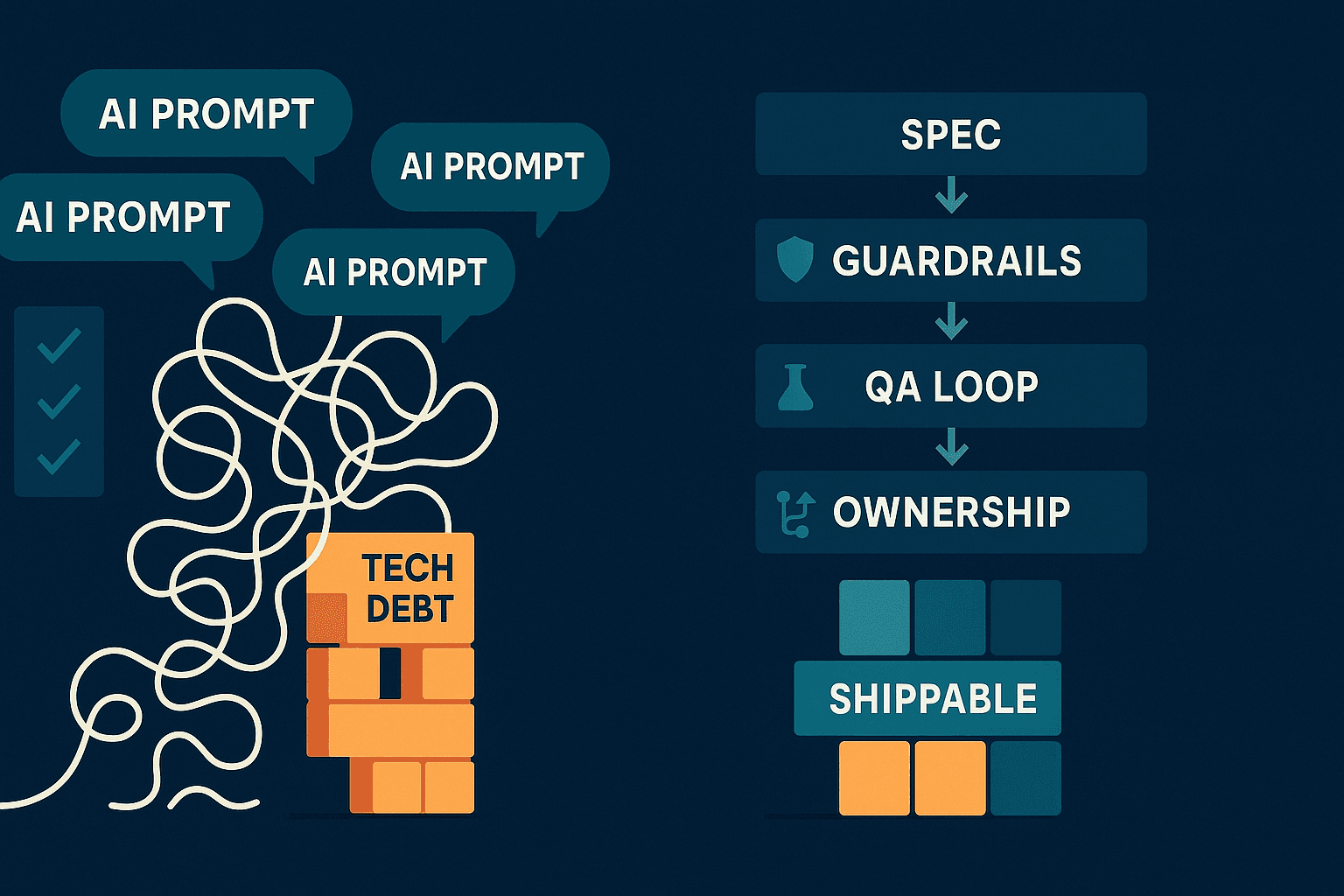
Startups are the perfect habitat for vibe coding: you have urgency, incomplete requirements, small teams, and strong incentives to ship something, anything, before runway runs out. Add modern LLMs and codegen tools and you get a seductive loop:
- Write a prompt.
- Get working-looking code.
- Demo it.
- Move on.
Until week three. Then the “working” feature breaks in production, nobody understands the code, the edge cases pile up, and the only person who can fix it is the same person who wrote the original prompt, except they’ve already moved to the next fire.
This isn’t a rant against AI. Used well, AI is a lever for throughput and iteration speed. Used as a replacement for product thinking, software design, and ownership, it’s a tech debt generator with unusually good marketing.
This article is a founder-grade playbook for turning AI-assisted output into shippable product: reliable features, predictable delivery, and maintainable systems, without dragging your startup into heavyweight process.
We’ll cover:
- What “vibe coding” actually is and why it fails under startup constraints
- The hidden failure modes: security, correctness, coupling, observability, and maintenance
- A practical operating system: lightweight specs, guardrails, QA loops, and ownership
- A repeatable workflow for AI-assisted development that produces durable value
Key idea: AI can accelerate the implementation step, but your team must still provide the intent, constraints, verification, and accountability.
What “vibe coding” really means (and why it feels so productive)
“Vibe coding” isn’t just coding quickly. It’s a specific behavior pattern:
- Requirements are implicit (“make it like X”, “it should just work”).
- Code is produced primarily via prompts with minimal design.
- Success is measured by a short demo or green-path usage.
- The code is accepted because it looks plausible and compiles.
- Ownership is unclear: the author is essentially the model + a human prompter.
Why it feels productive:
- The UI is immediate: you can get a UI screen, an endpoint, and database schema in minutes.
- The model is confident: LLMs speak in complete solutions, not caveats.
- The cost of being wrong is delayed: most correctness constraints only appear at scale, in production, with real users.
If you’re pre-PMF (product-market fit), you might even get away with it, for a while.
But startups don’t die because they couldn’t generate code. They die because they can’t reliably deliver value over time.
Why vibe coding fails in startups (the structural reasons)
Vibe coding fails not because the code is always bad, but because it externalizes the hardest parts of software: and startups can’t afford that.
1) Startups are uncertainty machines, and vibe coding adds more uncertainty
In early-stage product development, uncertainty already exists in:
- user needs
- pricing/packaging
- workflow fit
- performance requirements
- regulatory/security constraints
Vibe coding adds uncertainty in:
- what the code actually does
- which assumptions are encoded
- what edge cases are ignored
- what dependencies are introduced
You end up stacking unknowns on unknowns.
2) The startup bottleneck isn’t writing code; it’s aligning code with outcomes
A feature isn’t “done” when it compiles.
It’s done when:
- users can complete the job-to-be-done end-to-end
- it works across realistic data shapes
- it’s observable and debuggable
- it doesn’t introduce security or reliability regressions
- it can be maintained by someone else
Vibe coding tends to stop at “it runs.”
3) AI makes it easy to generate surface area faster than you can test
LLMs can quickly generate:
- multiple endpoints
- complex UI flows
- ORM models
- background jobs
- third-party integrations
Every line is a liability unless it is constrained and verified.
This aligns with a known truth in software engineering: increasing complexity increases defect probability and maintenance cost (see classic texts like Code Complete by Steve McConnell and The Pragmatic Programmer by Hunt & Thomas).
4) You can’t outsource accountability
In a startup, reliability is social as much as technical:
- Who owns the feature?
- Who gets paged?
- Who decides tradeoffs?
- Who maintains it after the sprint?
Vibe coding tends to blur authorship, which blurs responsibility.
The hidden costs: how vibe coding becomes tech debt (in specific ways)
Tech debt is not “bad code.” It’s future work you have implicitly committed to.
Vibe coding commonly creates these debt categories:
A) Correctness debt (edge cases, invariants, and data shapes)
AI-generated code often assumes:
- happy path inputs
- consistent schemas
- well-formed dates/IDs
- simple concurrency
Startups encounter:
- partial migrations
- malformed CSV imports
- weird timezone behavior
- duplicate records
- retries and idempotency issues
Without explicit invariants and tests, you’ll ship surprises.
B) Security debt (auth, injection, secrets, tenant isolation)
LLMs will often implement auth and security plausibly but not safely unless constrained.
Common failure modes:
- missing authorization checks (authn vs authz confusion)
- insecure direct object references (IDOR)
- SQL injection in string-built queries
- over-permissive CORS
- secrets logged or checked into configs
- broken multi-tenant isolation
If you’re B2B SaaS, tenant isolation is existential.
References you should treat as “non-negotiable reading”:
- OWASP Top 10 (web application security risks): https://owasp.org/www-project-top-ten/
- NIST Secure Software Development Framework (SSDF): https://csrc.nist.gov/Projects/ssdf
C) Maintainability debt (coupling, naming, architecture drift)
LLMs optimize for “complete the task,” not “fit into your architecture.” You get:
- duplicated helper functions
- inconsistent naming
- magic numbers and hidden assumptions
- business logic in controllers/views
- leaky abstractions
The codebase becomes harder to reason about, especially for new hires.
D) Observability debt (no logs, no metrics, no tracing)
The feature ships. Then something breaks. Now what?
If the code doesn’t include:
- structured logs
- meaningful error messages
- metrics around latency and failure rates
- tracing around external calls
…you pay the “debug tax” every week.
References:
- OpenTelemetry: https://opentelemetry.io/
- Google SRE concepts around observability and toil: https://sre.google/books/
E) Product debt (wrong feature boundaries, no success metrics)
Vibe coding often ships UI and endpoints without answering:
- what is the user success metric?
- what is the adoption funnel?
- what is the rollback plan?
So you ship more output, but learn less.
The founder’s playbook: turn AI prompts into shippable product
Here’s the core operating model:
- Lightweight specs (intent + constraints)
- Guardrails (architecture + security + style constraints)
- QA loops (tests + review + staging + observability)
- Ownership (DRIs, on-call, maintenance budgets)
You can implement this with minimal bureaucracy. The goal is to create a thin layer of discipline that converts AI speed into durable output.
1) Lightweight specs: the minimum viable “design” that prevents rework
A spec is not a 20-page document. In startups, the best specs are short and testable.
A good lightweight spec answers:
- What problem are we solving?
- What does success look like?
- What constraints must hold?
- What is explicitly out of scope?
- What can break and how will we know?
Use a one-page “feature contract”
Here’s a template you can copy into a doc or PR description:
markdown## Feature Contract: <Feature Name>

### User story
As a <role>, I want <capability>, so that <outcome>.

### Success metrics
- Activation: <metric>
- Time-to-value: <metric>
- Reliability: <SLO / acceptable error rate>

### Functional requirements
- R1: ...
- R2: ...

### Non-functional requirements
- Performance: p95 < X ms for <endpoint>
- Security: tenant isolation required; audit log required
- Compliance: <SOC2 / HIPAA / GDPR relevant?>

### Data model & invariants
- Invariant 1: ... (e.g., invoice.total = sum(line_items))
- Invariant 2: ...

### Edge cases
- EC1: empty input
- EC2: retries / idempotency
- EC3: partial failures from 3rd-party API

### Out of scope
- ...

### Rollout plan
- Feature flag? yes/no
- Backfill/migration steps
- Rollback steps

### Observability
- Logs:
- Metrics:
- Alerts:
If you provide this to an LLM, your output quality improves dramatically because you’ve reduced ambiguity.
Write “tests first” requirements (even if you don’t write tests first)
One trick: define acceptance criteria as pseudo-tests.
Example:
- Given a user from tenant A, when they request invoice #123 from tenant B, the system returns 404.
- Given a payment provider timeout, the job retries with exponential backoff and does not double-charge.
This forces you (and the model) to encode security and reliability upfront.
2) Guardrails: make the model operate inside your system constraints
Guardrails are the difference between AI as a teammate and AI as a random code faucet.
Guardrail A: Constrain the architecture explicitly
Your prompt should include:
- the stack (frameworks, versions)
- how you organize code (folders/modules)
- patterns you use (repository pattern, service layer)
- patterns you forbid (business logic in controllers)
Example prompt excerpt:
“Use the existing service layer in
src/services/. Controllers must be thin. No direct DB calls in controllers; useInvoiceRepositoryonly. Follow existing error handling and return typed errors.”
Guardrail B: Constrain dependencies
LLMs love adding new libraries. In startups, every dependency is:
- a security surface
- a maintenance cost
- a future upgrade problem
Add a hard rule:
- “Do not introduce new dependencies without explicit approval.”
If you do allow new dependencies, require:
- why it’s necessary
- license compatibility
- maintenance health (stars don’t count; update frequency and vulnerability history matters)
Reference:
- Supply chain risk and dependency hygiene is a real attack vector (see SLSA framework): https://slsa.dev/
Guardrail C: Enforce security invariants in the prompt
If you’re multi-tenant, put this in every relevant prompt:
- “All queries must be scoped by
tenant_idfrom the authenticated context.” - “Never accept tenant_id from client input.”
And require the model to show where authorization happens.
Guardrail D: Style and correctness constraints
Tell the model:
- “Write TypeScript with strict types; no
any.” - “No silent catch blocks.”
- “Return errors with actionable messages.”
If you don’t specify this, you’ll get the model’s default style, which may not match your codebase.
Guardrail E: Use linters, formatters, and CI as enforcement
Guardrails should not live only in human memory.
Minimum set:
- formatter (Prettier/Black/gofmt)
- linter (ESLint/Ruff/Golangci-lint)
- type checking (tsc/mypy)
- unit tests
- basic security scanning (e.g., Dependabot + CodeQL)
References:
- GitHub CodeQL: https://codeql.github.com/
- Dependabot: https://docs.github.com/en/code-security/dependabot
3) QA loops: turn “it works on my machine” into “it survives reality”
AI increases speed of producing code. QA loops increase confidence in shipping code.
You don’t need enterprise QA. You do need feedback loops that catch the common failure modes.
Loop 1: “LLM-generated code must come with tests”
A practical policy:
- Any AI-generated change above a small threshold (say >50 LOC or touching auth/data) must include at least:
- unit tests for invariants
- one integration test for the main workflow
If you use an LLM to write tests, still review them like production code. Bad tests are worse than none because they create false confidence.
Loop 2: Code review with an explicit checklist
Replace vague review with a short checklist (keep it in the PR template):
- Authorization checks verified (authz, not just authn)
- Tenant scoping present on all data access
- Input validation added
- Idempotency considered (retries, double writes)
- Observability added (logs/metrics)
- Tests added for edge cases
- No new dependencies (or justified)
This reduces cognitive load and catches repeat issues.
Loop 3: Staging that resembles production
Vibe coding dies in staging if staging is realistic.
At minimum:
- same auth provider mode
- same environment variable patterns
- representative data sizes (or synthetic load)
- background jobs enabled
If you can’t afford full staging, do “production-like” smoke tests on a canary environment.
Loop 4: Feature flags and progressive delivery
A feature flag isn’t just for A/B tests; it’s an insurance policy.
Roll out like:
- internal users
- 1–5 design partners
- 10% of customers
- 100%
If something goes wrong, you turn it off.
Reference:
- LaunchDarkly’s body of work on feature flags (conceptual reference): https://launchdarkly.com/
Loop 5: Observability-first shipping
For each feature, ship at least:
- one dashboard chart (e.g., success rate)
- one alert (e.g., error rate > threshold)
- one structured log event for failures
This is how you prevent “silent failure” debt.
4) Ownership: the missing ingredient that vibe coding can’t provide
A startup codebase is a living system. Without ownership, it decays fast.
Assign a DRI (Directly Responsible Individual) per feature
For each shipped feature, one person owns:
- correctness
- on-call response
- post-launch fixes
- documentation updates
This doesn’t mean only they can touch it. It means someone is accountable.
Budget maintenance time explicitly
A simple rule:
- allocate 15–25% of engineering time to maintenance and hardening (bugs, refactors, test coverage, performance).
If you don’t budget it, it won’t happen, and vibe-coded debt will compound.
Create “definition of done” that includes operability
A feature is done when:
- it has tests
- it has basic observability
- it has a rollback plan
- it has an owner
This is startup-lightweight and dramatically improves outcomes.
A practical workflow: how to use AI productively without vibe coding yourself into a corner
Here’s a repeatable workflow your team can adopt tomorrow.
Step 0: Decide if the feature is a prototype or production
Not everything should be production-grade.
Label the work:
- Prototype (disposable): optimize for learning; isolate; timebox.
- Production (durable): requires contracts, guardrails, QA loops.
The mistake is building production systems with prototype discipline.
Step 1: Write the feature contract (30–60 minutes)
Use the one-page template above. Keep it short.
Step 2: Ask the model for a design, not code
Prompt:
- propose data model changes
- propose API shape
- identify risks and edge cases
- outline tests
Then you choose.
This mirrors how strong engineers work: design before implementation.
Step 3: Generate code in small slices
Don’t ask for “build the whole feature.” Ask for:
- DB migration only
- API endpoint only
- UI component only
- job worker only
Each slice gets reviewed and tested.
Step 4: Enforce “no merge without tests + checklist”
This is where most teams fail, because it feels slow.
But it’s not slow compared to:
- production incidents
- customer churn
- emergency rewrites
Step 5: Launch behind a flag + monitor
Treat every launch as an experiment with safety rails.
Step 6: Post-ship hardening
Within 48–72 hours of shipping:
- review logs
- patch the top 2–3 failure cases
- improve tests based on real behavior
This is how you convert early uncertainty into stable systems.
Common objections (and the nuanced truth)
“But we’re a startup. We can’t afford process.”
You can’t afford rework either.
The playbook here is intentionally lightweight. It’s designed to be cheaper than the inevitable rewrite.
“AI gets us to market faster.”
Yes, especially for prototypes, internal tools, and scaffolding.
But market success depends on retention, reliability, and trust. In B2B, a few reliability failures can kill expansions and referrals.
“Our engineers are strong; they’ll clean it up later.”
They won’t, unless you schedule it. “Later” competes with sales deadlines and new features.
This is a known dynamic in software projects: debt that isn’t explicitly tracked and paid down grows (see the original metaphor by Ward Cunningham and the broader discussion in engineering management literature).
“We can just prompt the model to refactor.”
Sometimes. But refactoring requires:
- understanding intent
- preserving behavior
- reliable tests
Without tests, refactoring is gambling.
Where vibe coding does work (use it intentionally)
Vibe coding is not evil. It’s powerful when the output is:
- disposable
- isolated
- reversible
- low-risk
Good vibe coding targets:
- prototypes for user discovery
- one-off scripts and data analysis
- internal admin tools (with limited access)
- UI mock flows for sales demos
Even then, be explicit: label it prototype, and don’t let it quietly become production.
A founder’s checklist: “AI-assisted shipping” in one page
If you want a single operational checklist, use this:
Before coding
- Feature contract written (user story, success metrics, constraints)
- Prototype vs production decision made
- Security invariants stated (tenant isolation, authz)
During coding
- AI output generated in small slices
- No new dependencies unless approved
- Code conforms to architecture boundaries
Before merge
- Tests included (unit + one integration)
- PR checklist completed (authz, validation, idempotency, observability)
- CI green (lint/typecheck/tests)
Before launch
- Feature flag in place
- Dashboard/alert created
- Rollback plan documented
After launch
- Owner assigned (DRI)
- 72-hour hardening pass completed
Closing: speed is only real if it compounds
Vibe coding promises speed, but in startups speed that doesn’t compound is fake speed.
Compounding speed comes from:
- clear intent (lightweight specs)
- constraints (guardrails)
- verification (QA loops)
- accountability (ownership)
If you adopt this playbook, AI becomes what it should be in a startup: a force multiplier for a disciplined team, not a substitute for one.
References (selected)
- OWASP Top 10: https://owasp.org/www-project-top-ten/
- NIST Secure Software Development Framework (SSDF): https://csrc.nist.gov/Projects/ssdf
- SLSA Supply Chain Security: https://slsa.dev/
- OpenTelemetry Observability Framework: https://opentelemetry.io/
- Google Site Reliability Engineering books (free online): https://sre.google/books/
- GitHub CodeQL: https://codeql.github.com/
- GitHub Dependabot: https://docs.github.com/en/code-security/dependabot
Book references (conceptual):
- Steve McConnell, Code Complete
- Andrew Hunt & David Thomas, The Pragmatic Programmer
- Gene Kim et al., Accelerate (delivery performance and feedback loops)